
Finding the Right Person
A worldwide guide to hiring well: the questions to answer before you open a job posting, the job boards and channels that actually work in each country, and how to screen and choose the right person once the applications arrive.
Three steps from “we need someone” to the right person
Every guide here belongs to one of three stages. Work through them in order and most of the common hiring failures — the vague brief, the wrong channel, the gut-feel decision — never get the chance to happen.
Everything a company needs to find the right person
Forty practitioner guides, organised into eight pillars. Each pillar opens with the latest guides and links to its full archive.
Answer these questions before the job goes live
Most bad hires are decided before the first CV arrives: an unclear brief, a wish-list of must-haves, a pay band nobody agreed. These question sets fix the brief first — the 50 master questions, the hiring-manager intake, the role scorecard, the pay band and the legal check of the ad.
The six question sets at a glance

Job Ad Legal Check: What You Can and Cannot Write in 20 Countries
Country-by-country rules on age, gender wording, photos, nationality, language and pay in job ads, plus a 14-question legal check to run before you publish.

Set the Pay Band Before You Post: Questions, Benchmarks and 2026 Pay-Transparency Rules
The questions to answer before you put a salary range in a job ad, plus a November 2026 map of pay-transparency rules in the EU, the US, Canada and the UK.
Define the Role Before the Person: Outcomes, Must-Haves and the Role Scorecard
How to build an outcomes-based role scorecard, cut requirements to the few that predict success, and use one document to drive the ad, screening and interviews.

The Hiring Manager Intake Meeting: A Question Set That Prevents a Bad Hire
A 60-minute agenda, 33 questions and a one-page template for the intake meeting that turns a vague hiring request into a brief both sides sign.

Before You Open a Job Posting: The 50 Questions Every Company Should Answer
Fifty questions in six sets that turn a vague hiring request into a role you can advertise, pay, assess and sell, before a single job ad goes live.
The job boards and platforms that work in each market
LinkedIn and Indeed are global, but in Germany candidates look on StepStone, in Türkiye on Kariyer.net, in India on Naukri and in Australia on SEEK. The directory maps 40 markets, then the guides compare the global platforms, niche boards by profession, freelance marketplaces and what posting really costs.
What It Costs to Post a Job: Pricing Models of the Major Job Platforms
How the major job platforms charge, from pay per click to fixed adverts and slots, with 2026 ranges and a way to budget on cost per qualified applicant.
Freelance and Contract Talent Platforms Compared: Upwork, Fiverr, Toptal, Malt and More
How the main freelance and contract platforms work, what they really cost on both sides, how much vetting you get, and how to avoid misclassification risk.
Niche Job Boards by Profession: Tech, Finance, Engineering, Healthcare and Creative Talent
Where specialists actually look for jobs: niche boards, professional bodies and communities for tech, finance, engineering, healthcare, creative and more.

LinkedIn, Indeed and the Global Job Platforms: Which Works Where
Only LinkedIn and Indeed are truly global. This comparison maps where each job platform really reaches, what is free, what you pay for and which roles each suits.
Job Boards by Country: Where to Post in 40 Markets (2026 Directory)
A 40-market directory of where to post jobs: the leading general boards, public employment services and niche channels in each country, grouped by region.
Pick the channel that fits the role, not the habit
A warehouse team lead, a senior controller and a remote React engineer should not be hired through the same channel. Use the decision matrix, then go deeper on agencies and headhunter fees by country, referral programmes, passive sourcing and hiring in a country where you have no entity.

Hiring in a Country Where You Have No Entity: EOR vs Contractor vs Your Own Entity
How to hire in a country where you have no company: contractor, Employer of Record, payroll registration or your own entity, with misclassification and PE risks explained.
Passive Candidate Sourcing: Boolean Search, LinkedIn Recruiter, GitHub and Communities
A practical guide to sourcing people who are not looking: Boolean strings, LinkedIn products, GitHub and communities, outreach that gets replies, and data-protection limits.
Employee Referral Programmes That Actually Find the Right Person
How to design a referral programme that employees use: bonus amount and timing, tax rules by country, avoiding homogeneity, process, communication and tracking.
Recruitment Agencies and Headhunters: Fees, Contracts and How to Choose, Country by Country
Typical agency and headhunter fees in 13 markets, where agencies must be licensed, the contract clauses that cost more than the percentage, and how to brief an agency well.
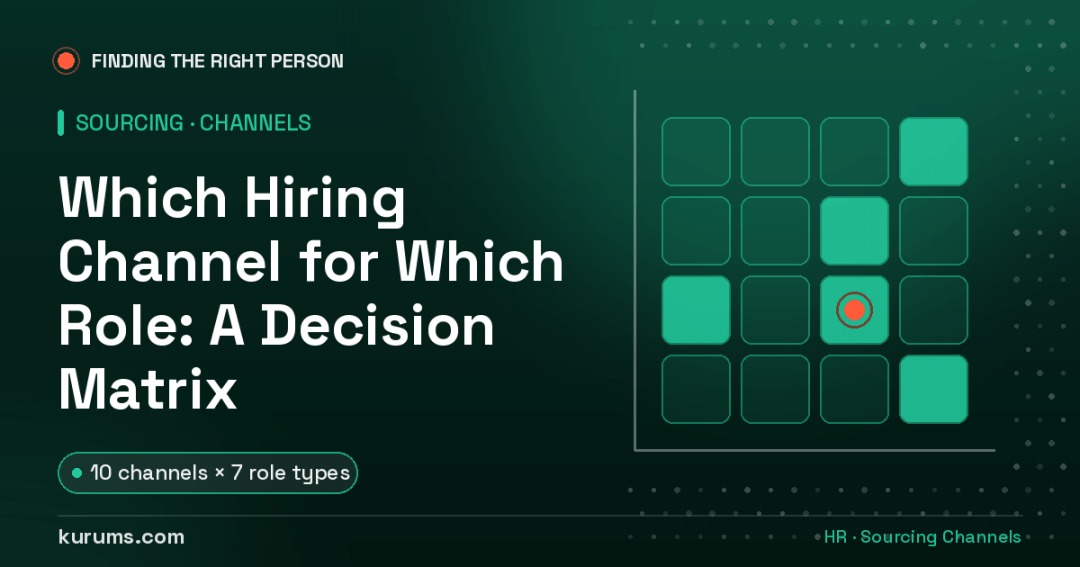
Which Hiring Channel for Which Role: A Decision Matrix
A decision matrix that maps seven role types against ten hiring channels, with cost, speed and quality compared, a channel-selection question set and a source-of-hire scorecard.
Where are you hiring?
Twenty country playbooks, each built the same way: where candidates look, the public employment service, agency norms, what the job ad may say, notice periods and the questions to answer before you post in that market.
Hiring someone from abroad into one of these countries? Visas, payroll and employer compliance for 28 countries are covered in the Expat HR & Global Mobility hub.
Country playbooks: the UK, Germany, France, Poland and Türkiye
Where candidates look, what the public employment service offers, what agencies charge, what you may and may not write in the ad, and the notice periods that decide your start date — one playbook per country, with a question set to answer before you post.
Recruiting in Türkiye: Where to Find the Right People and How to Hire Them (2026 Playbook)
A practical 2026 playbook for hiring in Türkiye: talent clusters, the job boards that work, net-pay and minimum-wage context, lawful advert wording, KVKK, notice and kıdem.
Recruiting in Poland: Where to Find the Right People and How to Hire Them (2026 Playbook)
A practical 2026 playbook for hiring in Poland: talent clusters, the job boards that work, salary rules in force since December 2025, contract types and notice periods.
Recruiting in France: Where to Find the Right People and How to Hire Them (2026 Playbook)
A practical 2026 playbook for hiring in France: the cadre and non-cadre tracks, which job boards work, French advert rules, and how trial and notice periods set your timeline.
Recruiting in Germany: Where to Find the Right People and How to Hire Them (2026 Playbook)
A practical 2026 playbook for hiring in Germany: where talent clusters, which job boards work, how to write an AGG-safe advert, and how quarter-end notice clauses set your start date.
Recruiting in the UK: Where to Find the Right People and How to Hire Them (2026 Playbook)
A practical 2026 playbook for hiring in the UK: where talent clusters, which job boards work, how to write a lawful advert, and how notice periods set your real start date.
Country playbooks: the US, Canada, Mexico, Brazil and Colombia
From US state pay-range laws and Canada’s Job Bank to OCC Mundial in Mexico, Gupy and Catho in Brazil and Computrabajo in Colombia — the channels, rules and hiring rhythm of each market.

Recruiting in Colombia: Where to Find the Right People and How to Hire Them (2026 Playbook)
A practical 2026 playbook for hiring in Colombia: talent hubs, job boards, mandatory vacancy reporting, ad rules, contract types after Law 2466 and nearshore hiring.
Recruiting in Brazil: Where to Find the Right People and How to Hire Them (2026 Playbook)
A practical 2026 playbook for hiring in Brazil: talent hubs, the job boards and ATS platforms candidates use, Portuguese ads, LGPD, quotas and the CLT versus PJ decision.

Recruiting in Mexico: Where to Find the Right People and How to Hire Them (2026 Playbook)
A practical 2026 playbook for hiring in Mexico: talent hubs, OCC Mundial, Computrabajo and WhatsApp channels, non-discriminatory ads, IMSS, REPSE and severance rules.
Recruiting in Mexico: Where to Find the Right People and How to Hire Them (2026 Playbook)
A practical 2026 playbook for hiring in Mexico: talent hubs, OCC Mundial, Computrabajo and WhatsApp channels, non-discriminatory ads, IMSS, REPSE and severance rules.

Recruiting in Canada: Where to Find the Right People and How to Hire Them (2026 Playbook)
A practical 2026 playbook for hiring in Canada: talent hubs, Indeed, LinkedIn and Job Bank, provincial pay-transparency rules, Quebec French ads and contract risks.
Country playbooks: the UAE, Saudi Arabia, Egypt, Nigeria and South Africa
Emiratisation and Saudization quotas, Bayt and Wuzzuf, Jobberman and PNet, employment-equity targets — how to find the right people in markets where nationality rules shape the shortlist.
Recruiting in South Africa: Where to Find the Right People and How to Hire Them (2026 Playbook)
A 2026 playbook for hiring in South Africa: the job boards that work, how employment equity targets shape hiring, lawful ad wording and the process candidates expect.
Recruiting in Nigeria: Where to Find the Right People and How to Hire Them (2026 Playbook)
A 2026 playbook for hiring in Nigeria: where talent clusters, which platforms reach it, how the expatriate quota and data rules work, and what candidates expect.
Recruiting in Egypt: Where to Find the Right People and How to Hire Them (2026 Playbook)
A 2026 playbook for hiring in Egypt: which platforms reach which candidates, the new Labour Law, the 10% foreign-worker ceiling and the process candidates expect.
Recruiting in Saudi Arabia: Where to Find the Right People and How to Hire Them (2026 Playbook)
A 2026 playbook for hiring in Saudi Arabia: how Nitaqat and occupation quotas shape your plan, which channels reach Saudi and expatriate talent, and the Qiwa process.
Recruiting in the UAE: Where to Find the Right People and How to Hire Them (2026 Playbook)
A practical 2026 playbook for hiring in the UAE: which channels reach which candidates, how Emiratisation targets work, and the process candidates expect.
Country playbooks: India, Singapore, Japan, the Philippines and Australia
Naukri and 90-day notice periods, MyCareersFuture and the Fair Consideration Framework, Japan’s graduate hiring cycle and licensed agents, the Philippine BPO talent engine and Australia’s SEEK — each market on its own terms.

Recruiting in Australia: Where to Find the Right People and How to Hire Them (2026 Playbook)
Where Australian candidates look, how labour market testing works for sponsored hires, and what Fair Work, pay-secrecy and discrimination law mean for your ad.
Recruiting in the Philippines: Where to Find the Right People and How to Hire Them (2026 Playbook)
Where Filipino candidates look, how BPO-style volume hiring works, what RA 10911 bans in job ads, and how 30-day notice and 13th-month pay shape the offer.
Recruiting in Japan: Where to Find the Right People and How to Hire Them (2026 Playbook)
Where Japanese candidates look, how tenshoku agents and Hello Work fit together, what a job ad must disclose, and how the graduate hiring calendar works.
Recruiting in Singapore: Where to Find the Right People and How to Hire Them (2026 Playbook)
Where Singapore candidates look, how the 14-day MyCareersFuture rule works before an Employment Pass, and what the Workplace Fairness Act changes for hiring.
Recruiting in India: Where to Find the Right People and How to Hire Them (2026 Playbook)
Where Indian candidates look, what the 2025 Labour Codes and DPDP Act mean for hiring, and how to stop strong hires vanishing during 60–90 day notice periods.
From the shortlist to the right person
Screen CVs against the scorecard, run structured interviews by role family, take references that tell you something, test the real job with a fair work sample, and make the final call in a debrief that resists bias.

Making the Final Hiring Decision: The Debrief Question Set and Offer-Stage Red Flags
A practical framework for the final hiring decision: independent scoring, decision rules, a debrief question set, offer-stage red flags and moving fast to offer.
Work Samples and Trial Tasks: Testing the Real Job Fairly
How to design work samples and trial tasks that predict performance fairly: evidence, formats, time limits and pay, ownership, adjustments, rubrics and AI-use rules.
Reference Checks That Tell You Something: Question Set and Legal Limits by Country
Structured reference check questions for managers, peers and direct reports, why backdoor references are risky, and what the law allows in 13 hiring markets.

Interview Question Sets by Role Family: Sales, Finance, Engineering, Operations and Leadership
Fifty structured interview questions across five role families, each with what a strong answer contains, plus the questions interviewers must never ask in major hiring markets.

Screening CVs Against the Scorecard: A Question Set That Saves Time and Cuts Bias
How to screen CVs against the role scorecard with knockout and weighted criteria, a calibrated scoring table, blind screening and a phone-screen script, plus 2026 rules on AI screening.
The software and the fundamentals behind good hiring
Independent buyer’s guides to the tools recruiters use every day, and the latest from the Kurums Recruitment & Hiring library on employer branding, candidate experience, metrics and offers.
From the Recruitment & Hiring library
Talent Pipelines and Talent Pools: How to Build, Nurture and Use Them
Build and nurture talent pools that shorten time to hire, cut costs and improve quality.
Recruitment Metrics and KPIs: Time to Fill, Cost per Hire, Quality of Hire and More
Formulas and examples for the key recruitment KPIs, plus how to build a dashboard and improve hiring.
Employer Branding: How to Build an EVP and Attract the Right Candidates
Research, define and communicate an employee value proposition that attracts the right candidates.

Candidate Experience: How to Improve Every Stage of the Hiring Journey
Map and improve the candidate journey — applications, communication, interviews, rejections and measurement.
Structured Interviews and Interview Scorecards: How to Design, Run and Debrief
Design structured interviews and scorecards that predict performance and reduce bias.
Finding the right person, in five answers
What should a company decide before opening a job posting?
Agree why the role exists, the three to five outcomes the person must deliver in the first year, the genuine must-haves, the approved pay band, the location and contract model, and who decides on what timeline. The 50-question checklist turns this into six question sets you can work through in one meeting.
Which job boards should I use in another country?
Use one global platform (usually LinkedIn or Indeed) plus the board that leads locally — StepStone in Germany, Kariyer.net in Türkiye, Naukri in India, SEEK in Australia, Bayt in the Gulf, Jobberman in Nigeria. The job boards by country directory lists 40 markets.
How do I hire in a country where my company has no entity?
You can engage an independent contractor, use an Employer of Record that employs the person on your behalf, or set up your own entity. The right answer depends on headcount, permanence and misclassification risk — see EOR vs contractor vs entity.
Do I have to publish the salary in a job ad?
Increasingly, yes. Several US states and cities, Canadian provinces and the EU Pay Transparency Directive (transposition deadline 7 June 2026) require pay ranges or pre-employment pay information. The pay band guide tracks the rules.
How do I avoid choosing the wrong person at the end?
Score every candidate against the same scorecard before the debrief, use structured interviews and a fair work sample, take references with consent, and decide with an explicit rule. The final hiring decision framework shows how.