
Payroll software for growing companies
Payroll platforms that calculate pay, handle filings and move money — from single-country tools to employer-of-record providers covering dozens of jurisdictions. Sponsored listings are paid placements ordered by daily bid; every other company below is listed free by our editors.
Sponsored listings
Claim #1 · $5/dayPick your daily bid and 7, 15 or 30 days, pay once through iyzico, and you are live the moment the payment clears. No account to create first, no subscription, no stored card.
Today's board
Paid today · resets 00:00 UTC · all categoriesAll payroll solutions
Free listings · A to Z · sponsor yours from $5/dayDeel
Global payroll, employer of record and contractor payments across 150+ countries.
Gusto
Payroll, benefits and HR administration for US small and mid-sized employers.
Papaya Global
Global payroll and cross-border workforce payments for multi-country teams.
TriNet
Professional employer organisation bundling payroll, benefits and HR compliance.
Sell in this category? List your product — from $5/day, one payment, no account or stored card. How it works.
What does payroll software actually do?
At its narrowest, payroll software turns hours and salaries into net pay: it calculates gross-to-net, withholds income tax and social contributions, produces payslips, files what the tax authority expects and moves money to employees on a fixed cycle. Everything beyond that — benefits enrolment, time tracking, expense reimbursement, onboarding paperwork — is bundled differently by every vendor, which is why two products with the same label can have very different scopes.
The practical question is not "which payroll system is best" but "which parts of the pay process do we want to stop doing by hand". A ten-person company in one country and a 400-person company across six countries are solving different problems, and the shortlist barely overlaps.
Do you need payroll software, a PEO or an employer of record?
These three sit at different points on the same spectrum, and mixing them up is the most expensive mistake in this category.
| Model | Who is the legal employer | Typical fit |
|---|---|---|
| Payroll software | You are | You have a legal entity in each country where you employ people and want to run pay yourself. |
| PEO (co-employment) | Shared with the provider | Mostly US; you want pooled benefits and HR compliance support without building the function in-house. |
| Employer of record | The provider, in that country | You want to hire in a country where you have no entity, or only a handful of people there. |
Cost follows that order: running your own payroll is cheapest per employee and heaviest in internal work; an employer of record is the reverse. Many companies end up with both — direct payroll where they have entities, an EOR for the two or three countries where opening one is not worth it.
What should you compare before you shortlist?
Feature lists in this category are close to identical. The differences that decide the project are these:
| Criterion | What to ask |
|---|---|
| Country coverage | Which countries are run in-house by the vendor and which are passed to a local partner? Ask for the list, not the map on the website. |
| Filings | Does the vendor file and pay taxes on your behalf, or produce a file you submit yourself? |
| Accounting export | Can it post a journal entry to your ledger in the structure your accountant already uses, per cost centre? |
| Off-cycle work | Terminations, back pay, bonuses and corrections — are these self-service, or a support ticket with a deadline? |
| Data model | One record per employee across HR, payroll and time, or separate systems you reconcile? |
| Support | Named contact and response time, or a shared inbox? Payroll errors are time-critical by nature. |
| Exit | Can you export historical payslips and pay data in a usable format when you leave? |
How is payroll software priced?
Nearly every vendor quotes a base platform fee plus a per-employee-per-month rate, often with different rates for salaried employees and contractors. Employer-of-record services are priced per employee per month at a much higher level, or occasionally as a percentage of salary. Watch for the items that sit outside the headline number: implementation, year-end filings, off-cycle runs, multi-entity setup and integrations are all commonly billed separately.
What usually goes wrong?
Three failure modes account for most unhappy payroll projects. The first is a migration started mid-year, which forces you to carry year-to-date figures across two systems and reconcile them at year end. The second is an accounting export that does not match the chart of accounts, so someone re-keys the journal every month and the saving evaporates. The third is country coverage discovered late: the vendor runs six of your seven countries itself and subcontracts the seventh, which is the one with the complicated union agreement.
Frequently asked questions
Can one platform run payroll in every country we operate in?
In practice, no vendor runs every country with the same depth. Most combine in-house payroll in their core markets with local partners elsewhere. That is not automatically a problem, but it changes who answers when something breaks, so ask which model applies to each of your countries before signing.
Is an employer of record a permanent arrangement?
It can be, and many companies keep a handful of EOR employees indefinitely. The usual trigger for opening your own entity is headcount in one country reaching the point where EOR fees exceed the cost of running an entity plus local payroll — often somewhere between five and fifteen employees, depending on the country.
How long does a payroll migration take?
For a single country and a few dozen employees, four to eight weeks including a parallel run is realistic. Multi-country migrations are normally sequenced country by country rather than switched at once, and are planned around the tax year rather than the calendar.
Should we run a parallel payroll before switching?
Yes for anything beyond a very small team. Running one cycle in both systems and reconciling gross-to-net line by line is the only reliable way to catch a misconfigured contribution or tax code before it reaches employees.
How this directory is compiled
Every company on this page was added by our editors from publicly available information: the product name, what it does in one line, and a link to the vendor's own site. No company paid to be listed in the free section, none was asked for approval, and inclusion here is not a recommendation — it is a starting point for a shortlist you should verify yourself.
The block at the top of the page is different and is labelled as such. Positions there are paid: a company chooses a daily bid and a number of days, pays once, and sits above the free listings for that period, ordered by bid. That is advertising, it is disclosed on every listing, and it has no influence on our editorial comparisons or on the Kurums Trust badges, which are earned against published criteria and are never for sale.
Pricing, feature and availability details change constantly in these categories, so we deliberately keep vendor descriptions here short and factual, and leave verified pricing to the dated editorial comparisons. Check the vendor's own pricing page before you make a decision, and treat anything you read in a directory — including this one — as a list of candidates rather than an answer.
Best Workforce Planning Software in 2026: Pricing & Comparison
Buyer's guide · HR Best Workforce Planning Software in 2026: Pricing & Comparison We compared four workforce planning platforms on public pricing, scenario modelling, headcount tools and fit so you can shortlist two in ten minutes. By Kurums EditorialPricing checked...
Best Employee Experience Software in 2026: Pricing & Comparison
Buyer's guide · HR Best Employee Experience Software in 2026: Pricing & Comparison We compared four employee experience and engagement platforms on public pricing, free or trial options, survey and performance modules, and deployment model so HR and people teams can...
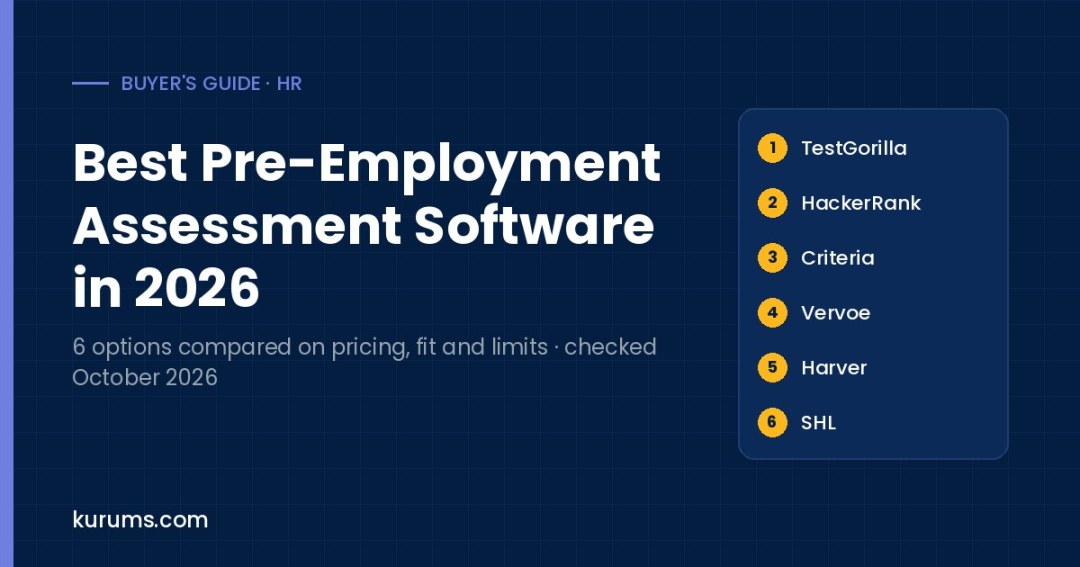
Best Pre-Employment Assessment Software in 2026: Skills Tests Compared
Six pre-employment assessment platforms compared on pricing, free plans and trials, test libraries, AI scoring and the hiring volumes they suit.