
A regional logistics company is hiring an operations manager. The hiring manager, Daniel, interviews four finalists on a Thursday. The first arrives ten minutes early, went to the same university as Daniel and opens with a joke about the car park. By the time they sit down, Daniel is relaxed. The interview feels like a conversation. He writes “strong communicator, great energy” at the top of his notes and very little underneath.
The third candidate is quieter, takes longer to answer and has spent eight years doing almost exactly this job at a competitor. Daniel’s notes say “solid but lacks spark”. On Friday he offers the role to the first candidate. Fourteen months later that person has left, and the team is still clearing up a warehouse migration that was planned with more confidence than detail. Nobody did anything unusual. Daniel made the decision the way most interviews are decided: early, on feeling, with the rest of the hour spent agreeing with himself.
Interviewing feels like a skill people get better at with experience. The uncomfortable finding from decades of selection research is that experience mostly makes interviewers more confident, not more accurate. The conversation that feels most revealing, a free-flowing chat with someone you warm to, is among the weaker ways to predict how a person will perform.
This guide explains what happens in an interviewer’s head during those first minutes, which biases do the most damage, and what changes actually reduce them. It is part of the HR Psychology hub, which covers the human side of hiring, pay, promotion, feedback, discipline and exits.
The decision is usually early.
Impressions form within seconds and harden within minutes; the rest of an unstructured interview mostly confirms them.
Awareness is not a control.
Knowing about bias does not remove it. Changing the process does.
Separate evidence from opinion.
Same questions, scores per answer, independent ratings before discussion.
How fast do interviewers really decide?
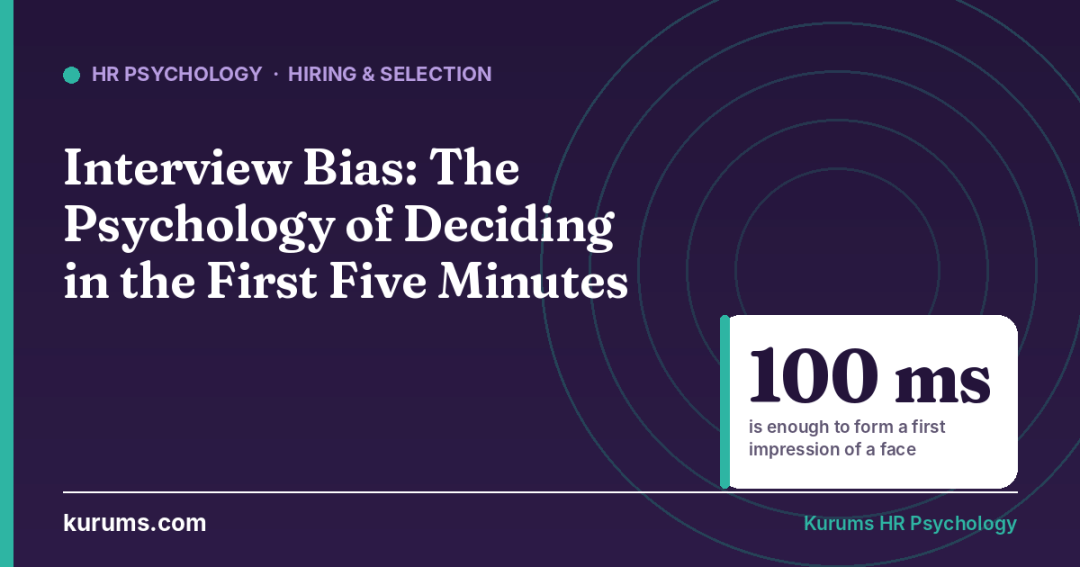
Faster than they think. People form stable impressions of trustworthiness and competence from a face in a fraction of a second, and longer exposure tends to increase confidence in the judgment without changing it much.
Participants shown unfamiliar faces for 100 milliseconds made judgments of traits such as trustworthiness and competence that correlated highly with judgments made with no time limit. More time made people more confident, not more accurate.
Interview studies point the same way. When researchers ask interviewers at what point they reached a decision, a large share report doing so within the first several minutes, and the proportion rises when the interview has no fixed structure. That matters because of what happens next. Once a view exists, the remaining questions are no longer neutral. A candidate you already like gets easier questions and more generous follow-ups. A candidate you doubt gets probing ones. Both then perform in a way that seems to confirm what you thought.
Psychologists call the early stage “thin slicing” and the later stage confirmation bias. Together they turn a sixty-minute interview into a five-minute decision with a fifty-five-minute justification.
Which biases do the most damage in interviews?
Dozens of biases have names, but a handful account for most poor hiring decisions. They are worth learning because each one has a different fix.
| Bias | What it looks like in the room | What it costs |
|---|---|---|
| Halo effect | One strong trait (confident speaker, famous employer) lifts every other rating | Weak areas are never tested |
| Similar-to-me | Warmth toward people with the same background, school, humour or hobbies | A team of people with the same blind spots |
| Confirmation bias | Questions and note-taking bend toward the first impression | The interview adds no new information |
| Contrast effect | An average candidate looks excellent after a poor one | Ranking depends on the order of the diary |
| Primacy and recency | The first and last candidates are remembered best | Mid-day candidates are under-rated |
| Stereotyping | Assumptions from age, accent, gender, name or a career gap | Legal exposure and lost talent |
The halo effect was described more than a century ago by Edward Thorndike, who noticed that army officers’ ratings of their soldiers’ physique, intelligence and leadership were suspiciously correlated. An interviewer who is impressed by a candidate’s presentation will usually also rate their technical depth higher, even when technical depth was barely discussed.
We feel at ease with people who resemble us, and we read that ease as evidence of competence. The feeling is real. The inference is not. “I could see myself working with her” is a statement about the interviewer’s comfort, not about the candidate’s ability.
Is this the same as discrimination?
Not always, but the two overlap. Many biases are not about protected characteristics at all. Preferring the candidate who interviewed just after lunch is a bias and it hurts nobody in particular. Others fall directly on groups, and the evidence that they affect real hiring decisions is strong.
Researchers sent thousands of fictitious résumés to real job advertisements in Boston and Chicago. Identical résumés with names commonly associated with white applicants received about 50% more callbacks than those with names associated with Black applicants.
A different kind of evidence comes from orchestras. When major American orchestras began auditioning musicians behind a screen, so that the panel heard the playing but could not see the player, the share of women advancing rose substantially, according to a well-known analysis by Claudia Goldin and Cecilia Rouse. Nobody on those panels believed they were biased. The screen changed the result anyway.
The practical lesson for HR is that good intentions are not a control. People who are sure they are fair are, if anything, less likely to check their own decisions. Controls have to be built into the process.
Does unconscious bias training fix it?
On its own, not much. Reviews of diversity and bias training generally find that awareness sessions change what people know and say for a short time, with little measurable effect on later hiring behaviour. Knowing that the halo effect exists does not stop you feeling it in the room, in the same way that knowing how an optical illusion works does not stop you seeing it.
Training is useful when it teaches a procedure rather than a state of mind: how to write a scorecard, how to ask the same question the same way, how to take evidence-based notes. If the budget only stretches to one thing, spend it on changing the interview, not on describing the interviewer.
A panel that has done bias training and still runs unstructured interviews is in a weaker position than before. It now has a record of knowing about the problem and no evidence of having changed the process.
What actually reduces interview bias?
The measures with the best evidence are structural. None of them requires software.
Decide what you are looking for first. Write down the four to six things the job genuinely requires before reading any applications. Criteria written after meeting the candidates tend to describe the candidate you liked.
Ask everyone the same questions. Identical core questions make answers comparable and stop interviewers adjusting difficulty to their first impression. The research behind this is covered in why structured interviews beat gut feeling.
Score answers, not people. Rate each answer against a simple anchored scale immediately after it is given. An overall impression formed at the end is where halo does its work.
Score independently, then talk. If panel members hear the most senior person’s view first, the meeting records one opinion several times. Collect written scores before anyone speaks.
Use a work sample. Twenty minutes on a realistic task tells you more than twenty minutes of talk about past tasks. See the work sample and trial task guide for formats that are fair to candidates.
Delay the handshake data. Some teams have a colleague who has not met the candidate review the written scores and notes. It is a cheap way to see how much of a decision survives without the personal chemistry.
Add one line to the bottom of every interview scorecard that reads “Evidence that contradicts my overall view”. Interviewers who must fill it in start looking for disconfirming evidence during the interview, which is the opposite of what confirmation bias does.
How should interviewers take notes?
Notes are where bias becomes visible. Compare “great energy, would fit well” with “described how she cut picking errors from 3% to 1% by re-slotting fast-moving lines; could not explain how the saving was measured”. The first is a feeling. The second is evidence that another person could evaluate.
Evidence-based notes also protect the organisation. If a rejected candidate challenges a decision, “lacks spark” is hard to defend, and in some jurisdictions candidates can request the notes held about them.
What about the candidate’s side of the table?
Candidates manage impressions deliberately. Studies of interview behaviour find that most applicants use some form of self-promotion or ingratiation, and that these tactics raise interviewer ratings more in unstructured interviews than in structured ones. That is not dishonesty so much as the game the format invites. If the interview rewards charm, you will hire for charm.
Nerves cut the other way. Anxious candidates are rated lower on average, although interview anxiety has only a weak relationship with performance in the job. A short explanation of the format at the start, a glass of water and one easy opening question remove a surprising amount of noise. You are trying to measure how someone will work, not how they cope with being judged by strangers.
How do you get hiring managers to accept this?
This is the real obstacle. Most managers believe they are good judges of people, and a structured process can feel like an accusation. Three things help.
First, frame it as protecting their time. A manager who hires the wrong person loses months. Second, let them keep a voice: a structured process still ends with a human decision, and managers should write the criteria themselves. Third, show them their own record. Tracking which interviewers’ ratings predicted later performance, even roughly, is more persuasive than any study.
It also helps to keep one unstructured element where it does no harm. An informal coffee with the team after the scored interviews lets people meet without letting that meeting set the scores. Candidates value it as well, because they are assessing you too; the way the process feels to them is the subject of our guide to candidate experience and rejection.
Frequently asked questions
What is the most common interview bias?
Confirmation bias working on a first impression. The interviewer forms an early view from appearance, small talk or the CV and then, without intending to, asks questions and interprets answers in ways that support it. Halo and similar-to-me effects usually supply the first impression.
Can interview bias ever be eliminated?
No. It can be reduced to the point where it changes fewer decisions. Structured questions, anchored scoring, independent ratings and work samples all narrow the room in which bias operates. The aim is a better process, not a perfect interviewer.
Do panel interviews reduce bias?
Only if panel members score independently before they talk. A panel that discusses first tends to converge on the view of the most senior or most confident member, which gives one opinion the appearance of several.
Is “culture fit” a biased criterion?
It often becomes one, because it is rarely defined. If fit means shared values that you can describe and test, it is a legitimate criterion. If it means “someone I would enjoy a drink with”, it is the similar-to-me effect with a respectable name.
Discover more from Kurums | Business Intelligence
Subscribe to get the latest posts sent to your email.