
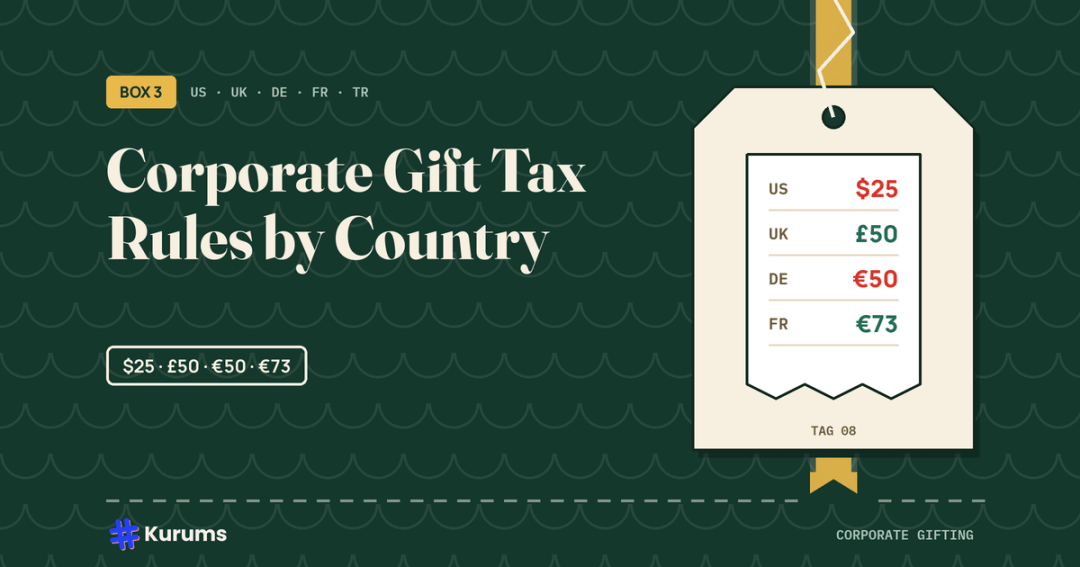
Most tax systems let a business deduct gifts only up to a low limit per recipient per year, and treat gifts to employees as pay unless a specific exemption applies. The headline figures are $25 per recipient for US business gifts, £50 for UK customer gifts and for UK staff under the trivial benefit rules, €50 for gifts to business partners in Germany and €73 including tax for VAT recovery on client gifts in France, with about €200 a year exempt from social charges for French employees in 2026. Several of these limits are cliffs: one unit of currency over and the whole gift loses its treatment. This guide is general information, not tax advice.
Finance teams tend to meet gift tax rules after the gifts have been sent. An invoice for 300 client hampers arrives, the accountant asks who received what, and it turns out that the deduction is capped at a figure nobody had heard of. The rules are not complicated once they are laid out, and they follow a common pattern from country to country. This guide compares five jurisdictions, separating gifts to clients from gifts to employees, and ends with a record-keeping checklist. Figures are those published by the tax authorities or professional bodies named, as of November 2026. Rules change, and your own position depends on facts this page cannot know, so confirm with an adviser before relying on any number here.
What is the US limit?
A business can deduct no more than $25 per recipient per year for business gifts. Incidental costs such as engraving, packaging and mailing are generally not counted.
What is the UK limit?
£50. For staff, a non-cash gift of up to £50 can be a tax-free trivial benefit. For customers, a branded gift of up to £50 a year that is not food, drink, tobacco or a voucher is deductible.
What is the German limit?
€50 per business partner per year, as an all-or-nothing limit. The giver can also pay a 30 percent flat tax on the recipient's behalf.
What is the French limit?
VAT on client gifts is recoverable only up to €73 including tax per recipient per year. Staff gifts are exempt from social charges up to about €200 a year in 2026.
How do tax systems treat corporate gifts in general?
Four questions decide the treatment almost everywhere.
Who receives it? Gifts to clients, suppliers and other outsiders fall under business gift or entertainment rules. Gifts to employees fall under payroll rules, because anything an employer gives to an employee is presumed to be pay.
What is it? Cash and items that work like cash, such as general-purpose gift cards, get the harshest treatment. Low-value items carrying the giver's advertising get the mildest. Food, drink and tobacco are singled out in some countries.
How much, per person, per year? Limits are almost always per recipient and per year, not per gift, so two gifts to the same person are added together.
Which tax? Three taxes can be in play at once: income or corporation tax (is the cost deductible?), VAT or sales tax (can input tax be recovered, and is output tax due?), and payroll taxes or social charges (is the gift taxable pay?).
| Country | Client gifts: deduction limit | Employee gifts: main exemption | Type of limit |
|---|---|---|---|
| United States | $25 per recipient per year | De minimis fringe benefits for low-value, occasional non-cash items; no fixed amount | Cap: excess is not deductible |
| United Kingdom | £50 per recipient per year, with conditions | £50 per gift as a trivial benefit | Cliff |
| Germany | €50 per recipient per year | €60 per personal occasion; €50 a month in non-cash benefits | Cliff |
| France | No fixed deduction cap; €73 including tax for VAT recovery | About €200 per year in 2026 (5 percent of monthly social security ceiling) | Cliff |
| Türkiye | No fixed statutory amount; must be proportionate to the business | Benefits in kind generally taxed as wages | Case by case |
What are the rules in the United States?
Client gifts. Section 274(b) of the Internal Revenue Code limits the deduction for business gifts to $25 per recipient per tax year, a figure that has not changed since 1962. You may spend more, but the excess is not deductible. IRS Publication 463 sets out the details:
- The limit applies to gifts given directly or indirectly to one person. A gift to a client's spouse generally counts as a gift to the client.
- A married couple giving gifts is treated as one taxpayer for the limit.
- Incidental costs such as engraving, packaging, insuring and mailing are generally not included in the $25, provided they do not add substantial value to the gift.
- Items costing $4 or less with the business name permanently imprinted, and distributed widely, do not count toward the limit. Pens, bags and similar promotional products fall here and are treated as advertising.
- A gift to a company intended for general use by the business is not squeezed into one $25 slot, while a gift meant for a particular person there is.
- Records should show the recipient, the business relationship, a description of the gift, its cost, the date and the business purpose.
A gift that could be either a gift or entertainment, such as event tickets, follows entertainment rules in many cases, and entertainment has been largely non-deductible since 2018. Ask an adviser where tickets are involved.
Employee gifts. There is no dollar threshold in the statute. Low-value, occasional, non-cash items, such as a holiday turkey or a branded jacket, are commonly treated as de minimis fringe benefits and excluded from wages. Cash and cash equivalents, including gift cards, are treated as taxable wages regardless of amount. This paragraph summarises general IRS guidance and should be checked against current rules for your case.
What are the rules in the United Kingdom?
Employee gifts. A gift is a tax-free trivial benefit if it costs £50 or less per employee, is not cash or a cash voucher, is not provided under the employment contract and is not a reward for work or performance. A £30 bottle of wine at Christmas qualifies. A £60 gift card for exceptional work does not, on two grounds. There is no annual cap on the number of trivial benefits for ordinary employees, but directors of close companies are limited to £300 a year. Above £50, or where a condition fails, the whole gift is a taxable benefit to be reported on form P11D or settled through a PAYE Settlement Agreement, with Class 1A National Insurance due.
The £50 is a cliff, as accountancy bodies and the press remind employers each December: a gift costing £51 is taxable in full, not on the extra pound. Where the cost per head is hard to establish, for example a shared hamper, HMRC accepts an average.
Customer gifts. HMRC's business income manual allows a deduction for gifts to customers only where the gift carries a conspicuous advertisement for the business, is not food, drink, tobacco or a voucher exchangeable for goods, and costs no more than £50 per recipient per tax year in total. A branded diary passes. A hamper or bottle of wine does not, at any price.
VAT. Input VAT on business gifts is recoverable. No output VAT is due if the total cost of gifts to the same person in any 12 months is £50 or less excluding VAT. Above that, output VAT must be accounted for on the full value. HMRC's VAT Notice 700/7 covers gifts, samples and vouchers.
What are the rules in Germany?
Gifts to business partners. Expenses for gifts to people who are not employees are deductible only if the total per recipient per business year does not exceed €50. The figure was raised from €35 for business years starting after 31 December 2023 by the Growth Opportunities Act. It is a Freigrenze, a cliff: at €50.01 the entire cost is non-deductible. All gifts to one person in the year are added together. For businesses entitled to deduct input VAT the limit is measured net of VAT, and otherwise gross.
Flat tax under section 37b. A gift from a business is taxable income in the hands of a business recipient. To spare the recipient, the giver can pay a flat 30 percent income tax (plus solidarity surcharge and church tax) on the gift's value and must tell the recipient that it has done so. According to guidance published by the Munich chamber of commerce, citing a Federal Fiscal Court ruling, this flat tax is included when testing the €50 limit, which lowers the effective gift value that still qualifies.
Giveaways. Small promotional items worth up to €10, known as Streuwerbeartikel, are treated as advertising, are fully deductible and need no recipient records.
Employees. Two exemptions matter. Gifts for a personal occasion such as a birthday, wedding or birth are tax-free up to €60 including VAT per occasion. Christmas does not count as a personal occasion. Separately, non-cash benefits are tax-free up to €50 a month in total. Cash is always taxable pay.
Records. The recipient's name must be recorded for each gift, and gift expenses must be booked separately from other costs. Missing records alone can cost the deduction.
What are the rules in France?
Client gifts (cadeaux d'affaires). French law sets no maximum value for deductibility. The gift must be made in the interest of the business and must not be excessive in relation to the size and turnover of the company and the customs of the trade. The fixed number is in VAT: input VAT can be recovered only if the gift's value does not exceed €73 including tax per recipient per year. The economy ministry's guidance confirms the figure, and practitioners note that it includes packaging and delivery costs. It is all or nothing: a €90 gift gives no VAT recovery at all, though the cost including VAT remains deductible from profit if the general conditions are met. Items designed specifically as advertising follow separate rules.
Employee gifts. A gift or voucher from an employer is in principle extra pay subject to social contributions. URSSAF applies a tolerance: if the total of gifts and vouchers given to an employee in a calendar year does not exceed 5 percent of the monthly social security ceiling, they are exempt. With the ceiling at €4,005 in 2026 the limit is €200 per employee, up from €196 in 2025. If the annual total is higher, each gift can still be exempt when it is linked to one of the recognised events, such as Christmas, a wedding or a birth, is used for that purpose and stays within the 5 percent limit per event. At Christmas the allowance applies per employee and per child. Above the limit the whole amount is subject to contributions.
What are the rules in Türkiye?
Turkish tax law does not set a single statutory amount for business gifts in the way the four systems above do, and practice rests on general principles and on rulings of the Revenue Administration. In outline, and subject to confirmation by a Turkish adviser:
- Promotional items and giveaways carrying the business name are generally treated as advertising or marketing expenses and are deductible when they are connected with the business and proportionate to its size, the test that rulings on promotional campaigns repeat.
- Promotional goods given with a sale have a specific VAT rule in the VAT General Implementation Communiqué: input VAT on the promotional item is deductible up to the VAT rate of the main product sold, and any excess is recorded as a cost.
- Gifts to employees in kind are generally treated as wages and taxed through payroll, apart from specific statutory exemptions.
- Recipients that are businesses are expected to book promotional goods they receive as income, according to published rulings.
Because the position depends on rulings and facts, companies in Türkiye usually agree the treatment of a gifting programme with their certified accountant before the order is placed.
Which costs count toward the limit?
The answer differs by country, and it changes real budgets.
| Cost | United States | United Kingdom | Germany | France |
|---|---|---|---|---|
| Engraving or logo decoration | Generally excluded if incidental | Part of the cost of the gift | Included | Included |
| Packaging and gift wrap | Generally excluded if incidental | Usually part of the cost of providing the gift | Gift packaging usually counted as part of the gift | Included |
| Postage and delivery | Generally excluded | Confirm with your adviser | Shipping costs generally left out of the value | Included |
| VAT or sales tax | Part of cost | Staff limit is VAT-inclusive; the customer VAT test is net | Net if VAT is recoverable, otherwise gross | Limit is stated including tax |
The table shows the general approach described in official guidance and professional commentary. Where a gift sits close to a limit, ask your adviser how each cost is counted before you fix the price.
How do gift cards and cash equivalents change the picture?
Almost every system is stricter with money-like gifts.
- In the United States, gift cards to employees are taxable wages whatever the amount.
- In the United Kingdom, cash and cash vouchers can never be trivial benefits. Non-cash retail vouchers can, within £50.
- In Germany, cash is always taxable pay. Vouchers can fall within the €50 monthly non-cash allowance only if they meet the legal conditions for non-cash benefits.
- In France, gift vouchers fall within the URSSAF tolerance on the same terms as physical gifts.
For client gifts, vouchers are excluded from the UK deduction altogether, and gift cards for business contacts raise anti-bribery concerns everywhere, since most gift policies prohibit cash equivalents. See gift policies and anti-bribery rules.
What happens when gifts cross a border?
Tax on the gift and tax on the parcel are different things. A gift shipped from one country to a recipient in another may meet customs duty and import VAT at the border regardless of how it is treated in the giver's accounts. The United States suspended duty-free entry for commercial shipments worth $800 or less on 29 August 2025, and the European Union introduced a flat €3 customs duty per item on low-value consignments on 1 July 2026. The exemption for "bona fide gifts" worth $100 or less that still exists in US customs law is for presents from one private person to another, not for a company's gifting programme.
Employees abroad are also taxed under the rules of the country where they are employed, not where the head office sits. A global holiday gift therefore needs a per-country value check. The logistics and international shipping guide covers customs, and the Decoded entry on de minimis explains the term.
What records should we keep?
A single register serves tax, audit and compliance. For each gift, record:
- Date and occasion.
- Recipient's name, employer and relationship to the business.
- Description of the gift.
- Cost, split into item, decoration, packaging, delivery and tax.
- Running total for that recipient in the year.
- Business purpose.
- Who approved it.
- Tax treatment applied, such as "within €50 limit" or "flat tax paid".
Code gifts to separate ledger accounts for clients and for employees. Keep supplier invoices and the recipient list together. Gifting platforms export this register automatically, which is one of their less advertised benefits. For choosing the budget level in the first place, see corporate gift budgets.
Frequently Asked Questions
How much can a US business deduct for a gift?
$25 per recipient per year under section 274(b). Incidental costs such as engraving, packaging and mailing are generally excluded, and widely distributed branded items costing $4 or less do not count.
Are gifts to employees taxable in the UK?
Not if they qualify as trivial benefits: £50 or less, not cash or a cash voucher, not contractual and not a reward for work. Otherwise the whole value is a taxable benefit.
What is the gift limit for business partners in Germany?
€50 per recipient per business year since 2024. Above it the whole expense is non-deductible. Promotional items up to €10 are treated as advertising.
What is the €73 rule in France?
VAT on a client gift can be recovered only if the gift's value is €73 or less including tax, per recipient per year. Above that no VAT is recoverable.
Do gift cards count as gifts for tax?
They are usually treated like cash. For employees that generally means taxable pay, with limited exceptions such as French vouchers within the URSSAF limit and some UK retail vouchers.
Discover more from Kurums | Business Intelligence
Subscribe to get the latest posts sent to your email.