
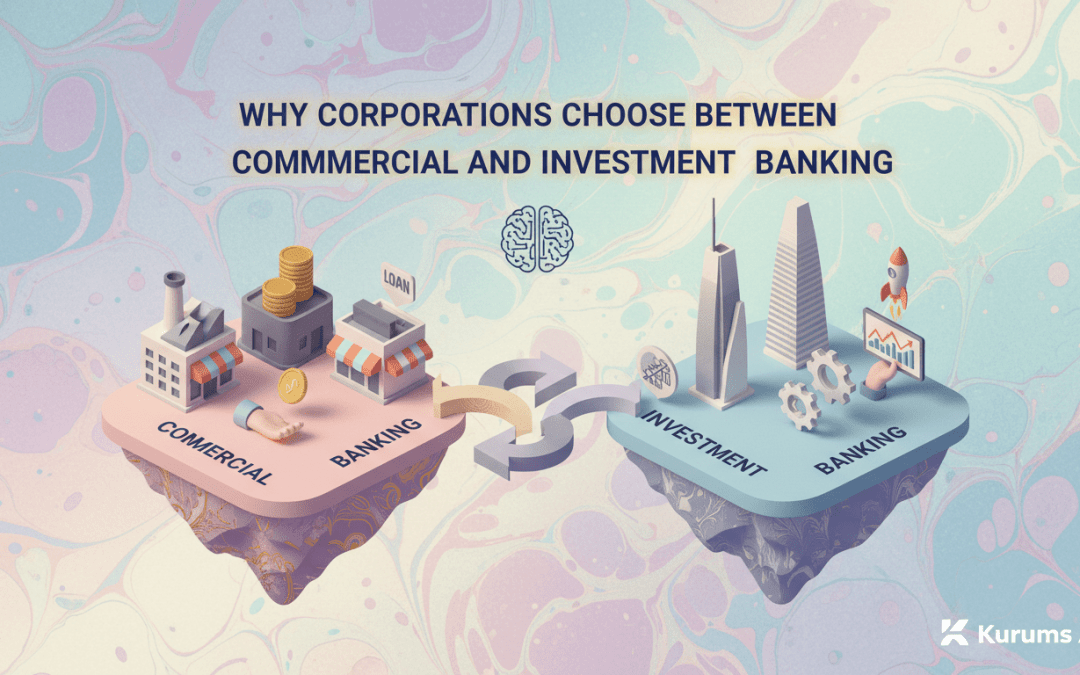
Commercial banking focuses on liquidity management through deposit-taking and credit provision (loans), while investment banking facilitates capital growth through securities underwriting, M&A advisory, and access to public markets.
How does this choice affect corporate strategy?
Choosing between them dictates the company’s Weighted Average Cost of Capital (WACC). Commercial debt is generally cheaper but more restrictive (covenants), whereas investment banking services offer massive scale for expansion but involve higher fees and market volatility risks.
In the high-stakes arena of corporate finance, the choice of a banking partner is not merely a transactional decision; it is a strategic maneuver that defines the trajectory of an entire organization. For the modern Chief Financial Officer (CFO), the landscape is divided into two primary domains: the stable, utility-driven world of commercial banking and the high-octane, market-driven world of investment banking.
But here is the real issue: The boundary between these two worlds is increasingly blurred by the rise of universal banking. To navigate this, you must first understand the fundamental structural differences. Whether you are looking to optimize your day-to-day cash flow or prepare for a multi-billion dollar acquisition, the partner you choose will influence your balance sheet for decades. Why do some corporations stick to the safety of credit lines while others brave the volatility of the equity markets? The answer lies in the delicate balance of risk, cost, and control.
The Core Divergence: Stability vs. Scalability
At its heart, commercial banking is the “engine room” of the economy. It operates on the principle of maturity transformation—taking short-term deposits and turning them into long-term loans. For a corporation, this translates into reliable access to working capital, trade finance, and the plumbing of the global financial system. Think of commercial banks as the providers of the “oxygen” your business needs to breathe daily.
On the other hand, investment banking acts as a “catalyst” for transformation. These institutions do not typically hold deposits. Instead, they act as intermediaries between corporations seeking massive amounts of capital and institutional investors looking for yield. If commercial banking is about maintenance, investment banking is about evolution. It is the vehicle through which a private company becomes public, or a domestic leader becomes a global conglomerate.
Consider this: When a corporation faces a temporary cash flow mismatch due to seasonal inventory build-up, they call their commercial relationship manager. When that same corporation decides to acquire a competitor in a different continent, they call their investment banker. One manages the present; the other builds the future.
Commercial Banking: The Bedrock of Corporate Liquidity
Commercial banks serve as the primary source of debt capital for most middle-market and large-cap firms. The relationship is governed by the “Three C’s of Credit”: Character, Capacity, and Collateral. Unlike the public markets, commercial banking is deeply personal. It is built on years of shared history and “know-your-customer” (KYC) depth.
The primary products provided here include:
- Revolving Credit Facilities (Revolvers): These act as a corporate credit card, allowing firms to draw down, repay, and redraw funds as needed to manage working capital.
- Term Loans: Fixed amounts of debt used for specific capital expenditures (CapEx) like building a new factory or purchasing machinery.
- Treasury Management: The sophisticated software and systems used to manage global cash pools, automate accounts payable, and mitigate currency risk.
- Trade Finance: Letters of credit and documentary collections that ensure international suppliers get paid while protecting the buyer.
The beauty of commercial banking lies in its predictability. Interest rates are often tied to benchmarks like SOFR (Secured Overnight Financing Rate), and while covenants (financial restrictions) can be strict, they provide a framework of discipline that many boards find comforting.
Investment Banking: Accessing the Global Capital Markets
Investment banking is where the “heavy lifting” of capital structure happens. When a corporation outgrows the lending capacity of a single bank—or even a syndicate of banks—it must turn to the Capital Markets. This involves issuing securities (stocks or bonds) to the public or private institutional investors.
Investment bankers perform three primary roles:
- Underwriting: The bank “guarantees” the sale of a new issue of stocks or bonds. They take on the risk of buying the securities from the company and reselling them to the market.
- Mergers and Acquisitions (M&A): Strategic advice on buying, selling, or merging companies. This includes valuation, negotiation, and structuring the deal.
- Sales and Trading: Facilitating the secondary market movement of securities, ensuring that there is always “liquidity” for the company’s stock or debt.
Let’s look at the numbers. An investment bank might charge a 1% to 7% fee on an Initial Public Offering (IPO). This sounds expensive compared to a commercial bank’s 0.5% arrangement fee. However, the scale of capital unlocked—often in the billions—can reduce the company’s overall WACC by diversifying its funding sources and increasing its public profile.
Key Structural Differences: A Comparative Deep Dive
To truly understand which path to take, we must look at the mechanics of how these entities operate. The following table highlights the critical distinctions that every financial executive must internalize.
| Feature | Commercial Banking | Investment Banking |
|---|---|---|
| Primary Source of Funds | Customer Deposits (Retail/Corporate) | Public Markets (Equity/Debt Issuance) |
| Risk Profile | Credit Risk (Default on loans) | Market Risk (Fluctuation in prices) |
| Revenue Model | Net Interest Margin (Spread) & Fees | Advisory Fees & Commissions |
| Regulatory Body | FED, OCC, FDIC (Focus on Safety) | SEC, FINRA (Focus on Disclosure) |
| Client Duration | Long-term, ongoing relationship | Project-based, transactional |
This table illustrates why the choice isn’t just about money—it’s about partnership style. If your firm values a banker who knows your quarterly inventory cycles by heart, the commercial side is your home. If you want a partner who can pitch your story to 500 hedge funds in a week, you need an investment bank.
Underwriting: The High-Stakes Art of Capital Commitment
Underwriting is perhaps the most misunderstood function of investment banking. When a corporation wants to issue $500 million in corporate bonds, they don’t just “put them on a website” and hope for the best. The investment bank acts as the underwriter.
In a “Firm Commitment” underwriting, the bank actually buys the entire bond issue from the corporation at a discount. If the market turns sour and investors only want to buy $400 million, the bank is left holding the remaining $100 million on its own balance sheet. This absorption of risk is why investment banking fees are significantly higher than commercial banking fees.
Think about the “book-building” process. The bankers spend weeks on a “roadshow,” presenting the company’s vision to pension funds and institutional investors. This creates a price discovery mechanism that commercial banking simply cannot offer. It sets the market value of your enterprise.
WACC Optimization: The CFO’s Ultimate Goal
The primary duty of a CFO is to minimize the Weighted Average Cost of Capital (WACC). This is the average rate a company pays to finance its assets, calculated by weighting each capital source (debt and equity).
Commercial banking provides “cheap” debt. Because the loans are often secured by assets (receivables, inventory, real estate), the interest rate is relatively low. However, too much bank debt increases your leverage ratio, making you look risky to future investors.
Investment banking allows for Equity Capital Markets (ECM) activities. Issuing equity doesn’t require monthly interest payments, which preserves cash flow. However, it dilutes existing shareholders and usually has a higher “cost” in the long run because shareholders expect higher returns (dividends + growth) than lenders expect in interest.
The strategic choice involves using commercial banking for operational leverage and investment banking for structural leverage. By balancing these, a corporation can maintain a “clean” balance sheet that allows for aggressive growth without the threat of technical default from restrictive bank covenants.
The “Universal Banking” Paradox
Since the repeal of the Glass-Steagall Act in 1999 (in the US) and similar deregulations globally, the line between these two types of banks has practically vanished for the world’s largest players. Institutions like JPMorgan Chase, Bank of America, and Citigroup operate as “Universal Banks.”
For a corporation, this offers a “One-Stop-Shop” advantage. You can have your payroll accounts with the same institution that is advising you on your merger with a European rival.
However, this convenience comes with risks:
- Concentration Risk: If your lead lender is also your lead M&A advisor, a disagreement in one area can jeopardize the entire relationship.
- Conflict of Interest: An investment bank might push for an acquisition because of the advisory fees, even if the commercial side of the bank knows your debt capacity is reaching its limit.
- Cross-Selling Pressure: Universal banks often “bundle” services, making it difficult for CFOs to unbundle and see the true cost of each individual service.
Fee Structures: Comparing the Price of Capital
Budgeting for banking services requires a deep understanding of how these institutions get paid. It’s not just interest rates; it’s a complex web of commitment fees, success fees, and “spreads.”
| Service Type | Cost Component | Typical Range |
|---|---|---|
| Commercial Revolver | Unused Line Fee / Spread over SOFR | 0.25% – 2.50% (Spread) |
| Investment Grade Bond | Underwriting Discount | 0.40% – 1.00% of Principal |
| Initial Public Offering (IPO) | Gross Spread (Fees to the bank) | 3.00% – 7.00% of Proceeds |
| M&A Advisory (Buy-side) | Retainer + Success Fee | $50k/mo + 0.5% – 2% of Deal Value |
| Cash Management | Per-transaction or Monthly SaaS fee | Varies by volume |
As the table shows, investment banking is highly event-driven and expensive in the short term. Commercial banking is a utility with recurring, smaller costs. A savvy treasurer will model these costs over a 5-year horizon to ensure the “total cost of banking” remains within benchmarks.
The Regulatory Web: Basel III and Beyond
Why should a corporate executive care about banking regulations? Because these regulations dictate what your bank can do for you. Under Basel III, commercial banks are required to hold more capital against “risky” corporate loans. This means that if your company’s credit rating drops, your commercial bank might be legally forced to raise your interest rates or reduce your credit limit.
Investment banks, meanwhile, face intense scrutiny regarding Proprietary Trading (the Volcker Rule). This has pushed them to focus more on pure advisory services rather than using their own money to facilitate deals. For a corporation, this means that your investment banker is now more of a “consultant” and less of a “partner with skin in the game” than they were in the early 2000s.
Asset-Based Lending (ABL) vs. Cash Flow Lending
Within the commercial banking sphere, a critical sub-choice exists: ABL vs. Cash Flow. This distinction often determines how much operational freedom a CEO has.
In Asset-Based Lending, the loan amount is strictly tied to the value of your collateral (e.g., you can borrow 80% of your receivables). This is excellent for retailers or distributors with heavy inventory.
In Cash Flow Lending, the bank lends based on your EBITDA (Earnings Before Interest, Taxes, Depreciation, and Amortization). This is the preferred method for service-based or tech companies that have few physical assets but strong margins. Investment banks often prefer cash flow models because they align better with how public equity markets value a company (multiples of earnings).
When to Make the Switch: A Strategic Roadmap
How do you know when it’s time to move from a purely commercial relationship to an investment banking engagement? Look for these three triggers:
- The “Credit Ceiling”: Your local or regional bank can no longer fulfill your capital needs without hitting their “single-obligor limit.”
- The “Consolidation Wave”: Your industry is consolidating, and you need to act fast to acquire a rival or defend yourself from a hostile takeover.
- The “Liquidity Event”: Founders or private equity backers want to exit, necessitating an IPO or a massive debt recapitalization that requires the “reach” of global institutional investors.
M&A Advisory: The Hidden Value of Investment Banking
While the capital raise gets the headlines, the advisory component of investment banking is where strategic value is often maximized. A good investment banker does more than just run spreadsheets; they provide “intelligence.”
They know who is looking to sell, what the “synergy” value of a merger would be, and how the market will react to the news. For a CFO, having an investment banker on speed dial is like having a specialized intelligence agency. This is a far cry from the commercial banker’s role, which is primarily focused on the safety and soundness of the current loan portfolio.
The Role of Syndicate Desks
When a deal is too large for one bank, they form a “syndicate.” The Lead Left bank (the one with its name on the top left of the prospectus) does the heavy lifting, while other banks provide additional capital and distribution. Managing this syndicate is an art form, requiring the CFO to balance the egos and capabilities of multiple multi-billion dollar institutions.
Digital Transformation: The Rise of “Tech-First” Banking
We cannot discuss modern banking without mentioning the impact of Fintech and AI. Both commercial and investment banks are being disrupted.
Commercial banks are using AI to speed up credit underwriting. What used to take six weeks of manual document review can now be done in six hours via automated data scraping of a company’s ERP (Enterprise Resource Planning) system.
Investment banks are using big data to identify acquisition targets before they even hit the market. For the corporation, this means banking is becoming more “real-time.” The choice is no longer just between “Commercial or Investment,” but between “Legacy or Digital-First.”
The Multi-Bank Strategy: A Best Practice
Most sophisticated corporations do not choose between commercial and investment banking; they build a Bank Group. This group typically consists of:
- A Lead Commercial Bank: Handles day-to-day cash, treasury, and the primary revolver.
- Two or Three “Tier 2” Banks: Provide secondary credit lines and specialized services like foreign exchange (FX) hedging.
- A Rotation of Investment Banks: Engaged for specific M&A projects or capital market issuances based on their sector expertise.
This strategy ensures that the corporation always has competitive pricing and is never at the mercy of a single institution’s credit committee.
Conclusion: Designing Your Financial Future
The choice between commercial and investment banking is ultimately a choice between operations and aspirations.
Commercial banking provides the stability, the safety net, and the operational tools to ensure your business runs like a well-oiled machine. It is the foundation upon which your daily successes are built. Investment banking provides the ladder, the platform, and the global audience to turn a successful business into a market-dominant force.
For the C-suite, the task is clear: Audit your current capital structure. Are you over-reliant on restrictive bank loans that are stifling your growth? Or are you paying massive investment banking fees for capital that could have been secured more cheaply through a traditional credit line?
Take Action: Review your banking stack today. Map your 3-year growth targets against your current banking capabilities. If your ambition outstrips your credit line, it’s time to pick up the phone and talk to the capital markets experts. Your next stage of growth depends on it.
Discover more from Kurums | Business Intelligence
Subscribe to get the latest posts sent to your email.