
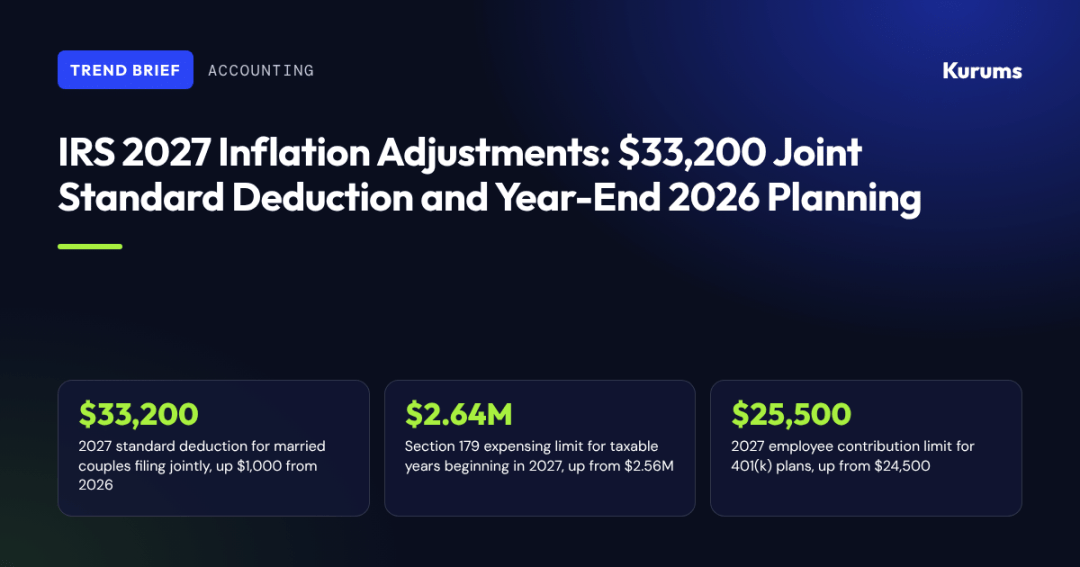
Revenue Procedure 2026-35 raises almost 70 thresholds for tax year 2027, giving accountants and business owners both years' numbers to work with before the Dec. 31, 2026 cutoff for most timing decisions.
The IRS released tax year 2027 inflation adjustments on Nov. 5, 2026, covering almost 70 provisions. Rates are unchanged, but every bracket threshold rises; the joint standard deduction goes to $33,200, the Section 179 limit to $2,640,000 and the estate tax basic exclusion to $15,480,000. A Nov. 12 release lifted the 401(k) limit to $25,500. With both years' thresholds now known, accountants can model income, deduction, equipment and retirement-plan timing before Dec. 31, 2026 and the Jan. 15, 2027 estimated payment.
What the IRS announced on Nov. 5, 2026
The Internal Revenue Service published its annual inflation adjustments for tax year 2027 on Nov. 5, 2026, in news release IR-2026-133. The IRS said the update covers almost 70 federal tax provisions, including the tax rate schedules and standard deduction amounts, with the detail set out in Revenue Procedure 2026-35.
The adjustments apply to taxable years beginning in 2027, generally reported on returns filed in 2028. They do not change the 2026 return filed next spring. Their value in late 2026 is as a planning input: advisers can now compare the 2026 and 2027 thresholds side by side before Dec. 31.
The seven federal income tax rates stay at 10%, 12%, 22%, 24%, 32%, 35% and 37%. Only the income thresholds move, a point a Nov. 25 CPA Practice Advisor analysis also makes.
The 2027 figures that matter most
For married couples filing jointly, the standard deduction rises to $33,200, up $1,000 from 2026. Single filers and married individuals filing separately get $16,600, and heads of household $24,925, according to the IRS.
The 2027 bracket thresholds for single filers and joint filers are:
- 10%: taxable income up to $12,800 (single) or $25,600 (joint)
- 12%: over $12,800 or $25,600
- 22%: over $52,025 or $104,050
- 24%: over $109,125 or $218,250
- 32%: over $208,325 or $416,650
- 35%: over $264,550 or $529,100
- 37%: over $661,375 or $793,650
Long-term capital gains thresholds also move. The zero-rate band ends at $102,100 of taxable income for joint filers and $51,050 for single filers, and the 15% band ends at $633,600 and $563,200 respectively, per Revenue Procedure 2026-35.
The table below sets the 2027 amounts against 2026. The 2027 column comes from the Nov. 5 and Nov. 12, 2026 IRS releases; the 2026 column comes from the same releases and from the IRS release of Oct. 9, 2025.
| Item | Tax year 2026 | Tax year 2027 |
|---|---|---|
| Standard deduction, married filing jointly | $32,200 | $33,200 |
| 37% rate begins, single filers | Over $640,600 | Over $661,375 |
| Section 179 expensing limit | $2,560,000 | $2,640,000 |
| Estate tax basic exclusion amount | $15,000,000 | $15,480,000 |
| Annual gift exclusion, per recipient | $19,000 | $20,000 |
| 401(k) employee contribution limit | $24,500 | $25,500 |
The estate and gift figures work on a calendar-year basis. The $15,480,000 basic exclusion applies to estates of people who die during 2027, and the $20,000 annual exclusion applies to gifts made in calendar year 2027. Both figures are in the IRS release.
The revenue procedure, the IRS release, a KPMG summary and a practitioner index from Current Federal Tax Developments all give the same brackets, standard deduction, Section 179 limit, and estate and gift amounts.
Business provisions: expensing, pass-through deduction and accounting thresholds
Section 179 lets a business deduct the cost of qualifying property in the year it is placed in service instead of depreciating it over several years. For taxable years beginning in 2027 the limit is $2,640,000, and it starts to shrink once the cost of Section 179 property placed in service in the year exceeds $4,230,000, according to Revenue Procedure 2026-35.
The 2026 equivalents are $2.56 million and $4.09 million, as reported by CPA Practice Advisor.
The qualified business income (QBI) deduction allows owners of sole proprietorships, partnerships, S corporations and most limited liability companies to deduct up to 20% of qualifying income, subject to limits that phase in above a taxable income threshold. For 2027 the threshold is $208,300, or $416,600 on a joint return, and the limits are fully phased in at $283,300 or $566,600, per Revenue Procedure 2026-35. For 2026, CPA Practice Advisor gives $201,750 and $276,750, doubled for joint filers.
Three other items are relevant to controllers:
- Cash method of accounting. A corporation or partnership meets the gross receipts test for 2027 if its average annual gross receipts for the prior three taxable years do not exceed $33,000,000.
- Excess business loss. The threshold for noncorporate taxpayers is $264,000, or $528,000 on a joint return.
- Employee benefits. The monthly cap on qualified transportation and parking benefits rises to $350, and the health flexible spending arrangement limit rises to $3,500.
The first two figures are in Revenue Procedure 2026-35; the benefit limits are in the IRS release.
Retirement plan limits for 2027
A separate release on Nov. 12, 2026 covered retirement plans. The IRS said employees in 401(k), 403(b) and governmental 457 plans and the federal Thrift Savings Plan can contribute $25,500 in 2027, up from $24,500. The general catch-up limit for participants aged 50 and over rises to $8,500 from $8,000, which makes $34,000 in total. A higher catch-up limit of $11,750 applies to employees aged 60 to 63.
The individual retirement account limit stays at $7,500 and the IRA catch-up stays at $1,100.
For owners deciding how much to put into a plan, the technical guidance in Notice 2026-66 raises the overall defined contribution limit to $75,000 from $72,000 and the annual compensation limit to $375,000 from $360,000. The highly compensated employee threshold rises to $170,000 from $160,000.
How the 2027 figures feed year-end 2026 planning
A Nov. 27 CPA Practice Advisor article aimed at sole proprietors and pass-through owners expecting a strong 2026 starts with a year-end tax projection. Its inputs include year-to-date results, expected results for the rest of the year, significant asset purchases, and owner compensation and distributions.
The second step is estimated tax. The fourth estimated payment for tax year 2026 is due Jan. 15, 2027. The article points out that a larger final payment does not necessarily remove penalties for earlier underpayments.
The article then describes four timing options:
- Income and deduction timing. The traditional approach is to accelerate deductions into 2026 and defer income into 2027. The article notes the opposite can make sense if the owner expects to be in a higher bracket next year. Each 2027 bracket starts at a higher income level than its 2026 equivalent.
- QBI thresholds. Owners near the 2026 threshold may preserve more of the deduction by keeping taxable income below it, or by increasing W-2 wages before year-end, according to the article.
- First-year depreciation. An asset must be placed in service by Dec. 31, 2026 to produce a 2026 deduction. The article says many assets with recovery periods of 20 years or less may qualify for 100% bonus depreciation and Section 179 expensing.
- Retirement contributions. Some qualified plans can be adopted and funded as late as the return due date, including extensions, for the adoption year.
The article also warns that these moves interact. Large first-year depreciation deductions or retirement contributions reduce taxable income and can therefore reduce the QBI deduction. It adds that strong profits do not automatically mean strong cash flow, so equipment purchases and bonuses have to be weighed against upcoming tax payments.
Caveats and open questions
Revenue Procedure 2026-35 states that it reflects the tax code as in effect on its release date. If Congress amends the code for 2027 after that date, the IRS says taxpayers should consult additional guidance to determine whether the adjustments still apply.
Some amounts are fixed by statute and do not move with inflation. Personal exemptions remain at zero, and the Lifetime Learning Credit still phases out between $80,000 and $90,000 of modified adjusted gross income, or $160,000 and $180,000 on joint returns, a range the IRS says has not been adjusted since 2020.
Search interest spiked on the announcement and faded within a week
Google Trends data for the United States over the 90 days to Nov. 28, 2026 shows a sharp, short spike. Searches for “2027 tax brackets” sat in low single digits on the 0 to 100 index until the IRS release, jumped to 29 on Nov. 5, peaked at 100 on Nov. 6 and fell back to 21 by Nov. 8. The average for the last seven days is 3.3.
On the same scale, “standard deduction” is a steadier term. It peaked at only 16, on Nov. 10 and 11, but its last-seven-day average of 5.9 is now higher than the bracket query. Rising related searches include “2027 irs standard deduction amounts” and “what are the new tax brackets for 2027”. The index measures relative interest, not search volume. It suggests public attention to the announcement faded within about a week, while the planning window it opened runs to Dec. 31.
Search interest: 2027 tax brackets vs standard deduction
Google Trends, United States, Aug 28, 2026 to Nov 28, 2026. Daily index, 100 = peak interest across both terms.
What accountants and business owners should do now
- Update planning templates. Load the 2027 brackets, standard deduction, capital gains thresholds and QBI thresholds from Revenue Procedure 2026-35 into projection workbooks and tax software, and confirm the vendor has done the same.
- Run a two-year projection for each owner. Model 2026 and 2027 together using year-to-date results, expected fourth-quarter activity, planned asset purchases and owner compensation, so timing choices are compared on actual thresholds.
- Check the Jan. 15, 2027 estimated payment. Recalculate the fourth-quarter 2026 payment against projected income and reserve cash for both that payment and the expected balance due at filing.
- Confirm placed-in-service dates. For any equipment intended to produce a 2026 deduction, verify delivery and installation schedules with suppliers, since the asset must be in service by Dec. 31, 2026.
- Reset payroll and benefit limits for January. Update 2027 deferral limits ($25,500 for 401(k) plans, $8,500 general catch-up), the $350 transit and parking cap and the $3,500 health FSA limit in payroll and enrollment systems.
- Flag clients with gifting programs. Tell them the annual exclusion moves to $20,000 per recipient for gifts made in calendar year 2027, while 2026 gifts remain subject to the $19,000 amount.
Frequently asked questions
What are the 2027 federal tax brackets?
The seven rates are unchanged at 10%, 12%, 22%, 24%, 32%, 35% and 37%. For 2027, the IRS says the 37% rate applies to taxable income over $661,375 for single filers and $793,650 for married couples filing jointly. The 10% rate covers income up to $12,800 for single filers and $25,600 for joint filers. Full tables are in Revenue Procedure 2026-35.
What is the standard deduction for 2027?
According to the IRS release of Nov. 5, 2026, the 2027 standard deduction is $33,200 for married couples filing jointly, up $1,000 from 2026. It is $16,600 for single taxpayers and married individuals filing separately, and $24,925 for heads of household. The amounts apply to taxable years beginning in 2027, which most people report on returns filed in 2028.
How much can I contribute to a 401(k) in 2027?
The IRS announced on Nov. 12, 2026 that the employee contribution limit for 401(k), 403(b) and governmental 457 plans rises to $25,500 for 2027, from $24,500. Workers aged 50 and over can add a catch-up contribution of $8,500, for $34,000 in total, and those aged 60 to 63 have a higher catch-up limit of $11,750. The IRA limit stays at $7,500.
What is the Section 179 deduction limit for 2026 and 2027?
For tax year 2026 the Section 179 expensing limit is $2,560,000, and CPA Practice Advisor reports that it begins to phase out when eligible purchases exceed $4.09 million. For taxable years beginning in 2027, Revenue Procedure 2026-35 sets the limit at $2,640,000 with the phase-out starting above $4,230,000. An asset must be placed in service by Dec. 31, 2026 to count for 2026.
- Internal Revenue Service: IRS releases tax inflation adjustments for tax year 2027; taxpayers continue to benefit from the Working Families Tax Cuts (IR-2026-133) (2026-11-05)
- Internal Revenue Service: Revenue Procedure 2026-35 (2026-11-05)
- Internal Revenue Service: 401(k) limit increases to $25,500 for 2027, IRA limit remains $7,500 (IR-2026-136) (2026-11-12)
- Internal Revenue Service: Notice 2026-66 (2026-11-12)
- Internal Revenue Service: IRS releases tax inflation adjustments for tax year 2026, including amendments from the One, Big, Beautiful Bill (IR-2025-103) (2025-10-09)
- CPA Practice Advisor: 2027 Tax Changes: What IRS Inflation Adjustments Mean for Your Tax Strategy (2026-11-25)
- CPA Practice Advisor: Expecting a Big Revenue Year? Consider These Tax Moves Before Year-End (2026-11-27)
- KPMG: Rev. Proc. 2026-35: Inflation adjustments for tax year 2027 (2026-11-05)
- Current Federal Tax Developments: 2027 Inflation-Adjusted Tax Provisions: Technical Analysis and Legal Index for Tax Practitioners (2026-11-05)
Search-interest figures are from Google Trends (United States, 90 days to November 28, 2026). This article is analysis for operators, not legal, tax or investment advice. Last updated November 28, 2026.
Discover more from Kurums | Business Intelligence
Subscribe to get the latest posts sent to your email.