
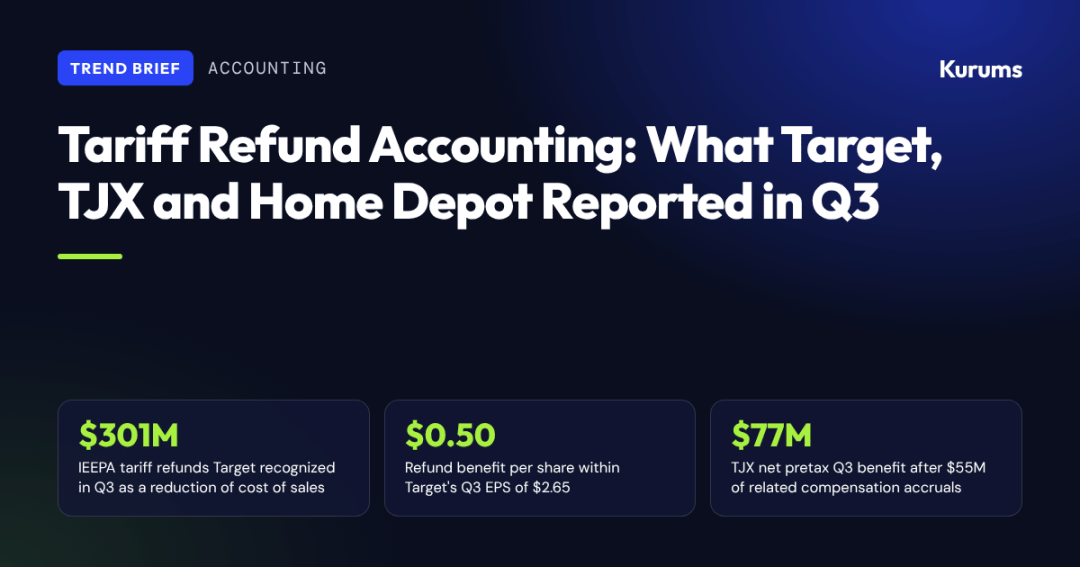
Third-quarter filings show IEEPA tariff refunds landing in cost of sales, but retailers differ on adjusted earnings, related costs and interest.
Third-quarter filings from Target, TJX and Home Depot show IEEPA tariff refunds being recognized as reductions of cost of sales, mostly as cash is received. Target booked $301 million in the quarter and $1.3 billion year to date. The companies differ on whether refunds sit inside adjusted earnings, whether related bonus accruals are netted, and where interest goes. With no GAAP topic directly on point and new Section 301 tariffs proposed, accounting teams should document policy, presentation and disclosure choices before year end.
What the third-quarter filings show
Tariff refund accounting has moved from a contingency note to a line that changes reported margins. In its third-quarter earnings release of November 18, 2026, Target said it recognized $301 million of International Emergency Economic Powers Act (IEEPA) tariff refunds received in the quarter ended October 31 “as a reduction of Cost of Sales.” The company said the refunds added $228 million to net earnings and $0.50 to both GAAP and Adjusted EPS of $2.65, and 1.1 percentage points to a 30.5 percent gross margin rate. For the nine months, the figure is $1.3 billion, or 1.6 points of margin. Fortune calculated that the quarter’s refund was about 18 percent of Target’s $1.67 billion operating profit.
Target is not alone. TJX said in its release of the same day that it received $132 million of refunds in the quarter and $463 million over nine months, and that these “benefited the Company’s cost of sales.” Home Depot’s Form 10-Q for the quarter ended November 1 reports approximately $740 million received to date, of which about $685 million reduced cost of sales in the second quarter and about $55 million in the third.
The background: the Supreme Court ruled 6-3 on February 20, 2026 that IEEPA did not authorize the tariffs, according to Grant Thornton. U.S. Customs and Border Protection opened its refund system, CAPE, in April and had paid out $106.6 billion by August 21, Supply Chain Dive reported. That is the most recent total we could confirm; we did not find a verified November figure.
Same cash, three different presentations
All three retailers put the refund in cost of sales. They differ on almost everything around it, and those differences are where controllers and audit committees should look.
| Item | Target | TJX | Home Depot |
|---|---|---|---|
| Refunds recognized, latest quarter | $301 million | $132 million | About $55 million |
| Year to date | $1.3 billion | $463 million | About $740 million received |
| Income statement line | Reduction of cost of sales | Benefit to cost of sales | Reduction of cost of sales; interest in interest income and other, net |
| Treatment in adjusted measures | Left inside Adjusted EPS; growth also shown excluding refunds | Excluded from adjusted results, net of related compensation accruals | Not covered in the pages we reviewed |
| Related costs disclosed | None quantified in the release | $55 million incentive compensation accrual in the quarter | None quantified |
| Further refunds | Guidance excludes any potential future refunds | Not expecting additional refunds | Received “the vast majority” of expected refunds |
Three points stand out. First, Target kept the refunds inside its non-GAAP measure. Its Adjusted EPS equals GAAP EPS at $2.65, and the release instead states that, excluding refunds, GAAP EPS would have risen 42 percent and Adjusted EPS 21 percent. TJX went the other way and defined adjusted results to exclude the refunds, which moved its pretax margin from a reported 13.0 percent to an adjusted 12.5 percent.
Second, TJX netted the benefit against costs it attributes to the refunds. It accrued $55 million in the quarter for year-end incentive compensation and discretionary bonuses, leaving a net pretax benefit of $77 million, or $0.05 per share. It expects further accruals to reduce fourth-quarter pretax margin by 0.3 points. A refund that feeds a bonus pool is not a clean one-line item.
Third, Home Depot separated the interest. Its 10-Q says interest received with the refunds “was recognized within interest income and other, net,” not in cost of sales.
The accounting policy choice underneath
No Codification topic addresses tariff refunds directly, so companies have reasoned by analogy. Grant Thornton’s guidance, dated July 22, 2026, describes two models. Under a loss recovery model, which applies ASC 410-30 by analogy, a recovery “may only be recognized when receipt of the recovery is probable,” and the asset is limited to previously recognized tariff costs. Under a contingent gain model based on ASC 450-30, recoveries are recognized when received.
The quarter’s disclosures lean toward cash. Target’s wording ties recognition to refunds “received during the third quarter,” and TJX and Home Depot both describe amounts received. That matches the caution advisers were giving at mid-year. In a Thomson Reuters Checkpoint article published June 29, UHY partner Thomas Alongi said, “There is no published U.S. GAAP specifically addressing the current tariff situation,” and SAX Advisors partner Joshua Chananie said there was “no hard and fast guidance.”
Presentation has its own rule set. Grant Thornton says that where tariffs sit in the cost of an asset still on the balance sheet, that cost basis should be reduced by the refund. Where the tariff cost has already gone through earnings, entities may reduce the expense line previously affected or recognize other income. This explains why a refund can be recognized in more than one period: Supply Chain Dive reported in August that Home Depot’s CFO expected about $45 million of its refunds to reach the income statement as inventory turned over.
Search interest has faded while the accounting work has grown
Public attention is moving on. Google Trends data for the United States, a relative index from 0 to 100 and not a measure of search volume, shows “tariff refund” averaging 4.3 over the last seven days against 8.9 across the earlier part of the 90-day window, with the peak of 100 on September 3, 2026. “IEEPA” averaged 3.4 against 6.3. The rising related queries are mostly consumer questions about retailers and refund checks, but one reads like a technical accounting question: “when should a company reassess its accounting for a tariff refund claim?”
Search interest: tariff refund vs IEEPA
Google Trends, United States, Aug 27, 2026 to Nov 27, 2026. Daily index, 0–100, relative to the highest point among the terms compared; it shows relative attention, not search volume.
For finance teams the timing runs the opposite way. Companies that received refunds in 2026 are approaching a year-end close in which the policy behind those entries, chosen by analogy, will be audited.
How to respond, by role
Controllers
Write the policy down before year end. State which model applies, the recognition trigger, and how refunds are split between inventory on hand and cost already expensed. Grant Thornton’s summary of the loss recovery model makes probability a continuing assessment, so document the evidence for each open claim at each reporting date. Keep interest separate from principal in the ledger so that it can be classified on its own, as Home Depot did.
Financial reporting and investor relations
Decide whether refunds belong inside or outside adjusted measures and apply the choice consistently across quarters and in guidance. Target and TJX made opposite choices, and both quantified the effect so that a reader can reconcile either way. If guidance excludes future refunds, say so in the guidance table, as Target does.
Auditors and audit committees
Expect questions on completeness of related costs. Ask whether refunds trigger bonuses, customer rebates or supplier settlements. Grant Thornton notes that a rebate to a customer is variable consideration that reduces the transaction price under ASC 606 and must be re-estimated each period.
Tax teams
Target reported a $301 million pretax benefit and a $228 million contribution to net earnings, a gap of $73 million by our arithmetic. Chananie’s warning in June was that early recognition accelerates “potential taxable income.” Align the book recognition date with the tax position, and model the effect on the annual effective rate and on estimated payments.
Risks and open questions
Comparability is the first risk. Refunds reduce this year’s cost of sales and will not recur at the same scale once claims are paid, so next year’s margins face a tougher comparison. Target’s after-tax return on invested capital for the trailing twelve months was lifted 3.0 percentage points by refunds, by its own disclosure.
New tariffs are also on the way under different legal authority. Bloomberg News, carried by CPA Practice Advisor reported on November 25 that the administration plans tariffs under Section 301 of the Trade Act of 1974 on goods from China, the European Union and a dozen other economies, with proposed rates including 20 percent for China and 15 percent for the EU. The action is proposed, subject to public comment, and a final decision could come as early as January, according to the report. The IEEPA refund experience may not carry over to duties imposed under other statutes; Grant Thornton notes the ruling did not affect tariffs authorized under other legal authorities.
Finally, the refund process is not finished for every importer. Target still excludes potential future refunds from guidance, and Supply Chain Dive reported in August that Lowe’s had received $80 million, a smaller portion of what it paid, and was pursuing more. Companies with open claims will carry the recognition judgment into year-end reporting.
What to do next
- Document the tariff refund accounting policy, including the model applied by analogy and the recognition trigger, before the year-end close.
- Split each refund between inventory still on hand and tariff cost already expensed, and track when the inventory portion reaches cost of sales.
- Record interest received on refunds separately from principal and decide its income statement line.
- Decide whether refunds are included in or excluded from adjusted measures and apply that choice consistently in results and guidance.
- List every cost linked to the refunds, such as incentive compensation, customer rebates and supplier settlements, and accrue those that qualify.
- Quantify the refund effect on gross margin, operating income, EPS and the effective tax rate for the audit committee and for next year's comparisons.
- Track the proposed Section 301 tariffs separately in landed cost models and do not assume they will be refundable.
Frequently asked questions
Where do tariff refunds go on the income statement?
Target, TJX and Home Depot all reported IEEPA tariff refunds as reductions of cost of sales in their third-quarter filings. Grant Thornton's guidance says refunds tied to assets still on the balance sheet should reduce that cost basis, while refunds of tariffs already expensed may reduce the expense line previously affected or be shown as other income.
When can a company recognize a tariff refund under US GAAP?
No Codification topic addresses it directly. Grant Thornton describes two models applied by analogy: a loss recovery model under ASC 410-30, which permits recognition when receipt is probable and caps the asset at tariff costs previously recognized, and a contingent gain model under ASC 450-30, under which recoveries are recognized when received.
Should tariff refunds be excluded from adjusted earnings?
Practice differs. Target left refunds inside Adjusted EPS and separately disclosed growth rates excluding them. TJX defined its adjusted results to exclude the refunds, net of related incremental compensation accruals. Both quantified the effect on margin and EPS, which lets readers reconcile the figures whichever presentation a company chooses.
How should interest on tariff refunds be classified?
Home Depot's Form 10-Q for the quarter ended November 1, 2026 states that interest received in connection with IEEPA tariff refunds was recognized within interest income and other, net, separately from the refunds themselves, which reduced cost of sales. The Target and TJX releases we reviewed do not describe interest separately.
- Target Corporation (SEC): Target Corporation Reports Third Quarter Earnings (Form 8-K, Exhibit 99) (2026-11-18)
- The TJX Companies (SEC): TJX Q3 FY27 earnings press release (Form 8-K exhibit) (2026-11-18)
- The Home Depot (SEC): Form 10-Q for the quarterly period ended November 1, 2026
- Fortune: Target Q3 booked $301 million from Trump tariff refunds (2026-11-19)
- Supply Chain Dive: How big-box retailers are using tariff refunds (2026-08-26)
- Grant Thornton: Accounting implications of SCOTUS tariffs ruling (2026-07-22)
- Thomson Reuters Checkpoint: CFOs warned not to book that tariff refund until the cash is in the bank (2026-06-29)
- CPA Practice Advisor (Bloomberg News): U.S. Targets China, EU with New Tariffs Citing Overcapacity (2026-11-25)
Search-interest figures are from Google Trends (United States, 90 days to November 27, 2026). This article is analysis for operators, not legal, tax or investment advice. Last updated November 27, 2026.
Discover more from Kurums | Business Intelligence
Subscribe to get the latest posts sent to your email.