
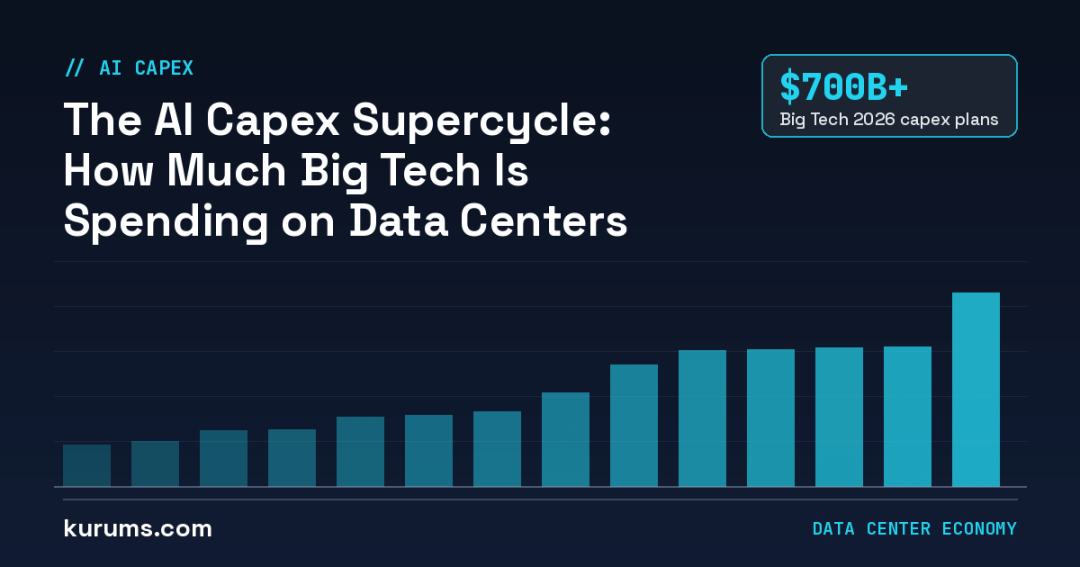
Big Tech’s data center spending has entered a supercycle. Microsoft, Alphabet, Amazon and Meta spent more than $416 billion on capex in 2025, up 66% from $251 billion in 2024, according to Platformonomics. Latest 2026 guidance points to roughly $700 billion-plus: Amazon about $220bn, Alphabet $195–205bn, Microsoft about $175bn (calendar 2026) and Meta $135–145bn, with Oracle spending $28.5bn in a single quarter. Amazon and Alphabet say 2027 will be higher still. The cost is showing up in cash flow: Amazon’s trailing free cash flow was –$42.4bn and Meta posted negative free cash flow in Q3 2026.
AI capex supercycle spending by Big Tech is the single biggest force in the data center economy: the cloud and internet giants are now spending more each quarter than many countries invest in a year. This article, part of the Kurums Data Center Economy hub, compiles 2024–2026 capital expenditure for Microsoft, Alphabet, Amazon, Meta and Oracle from their latest filings, explains how much of the money goes into data centers, and looks at what it is doing to free cash flow and balance sheets. For what that money buys, see how much it costs to build a data center; for how the rest of the market is funding itself, see how data centers are financed.
How much is Big Tech spending on AI data centers in 2026?
Based on guidance issued between July and October 2026, Amazon, Alphabet, Microsoft and Meta together plan roughly $700–735 billion of capex in 2026, nearly double 2025. Apollo estimated hyperscaler capex at about 2% of US GDP.
Which company spends the most?
Amazon, with about $220 billion of planned 2026 cash capex, most of it for AWS. Alphabet is next after raising its range to $195–205 billion in October 2026.
Is the spending hurting free cash flow?
Yes. Amazon’s trailing twelve-month free cash flow was an outflow of $42.4 billion at Q3 2026, Meta’s quarterly capex exceeded operating cash flow, and Oracle has reported negative free cash flow for more than a year.
How much is Big Tech spending on data centers in 2026?
The four largest US hyperscalers are guiding to roughly $700–735 billion of 2026 capital expenditure, almost double the $416 billion-plus they spent in 2025. Most of it goes to AI servers, networking and the data centers and power infrastructure that house them.
The figure has risen with every earnings season. In late April 2026, technology writer Om Malik tallied combined 2026 guidance from Amazon, Alphabet, Microsoft and Meta at about $700 billion, close to double 2025. Apollo’s chief economist put 2026 hyperscaler capex at around $646 billion, roughly 2% of US GDP, and a Bridgewater analysis cited about $650 billion. Since then, Alphabet has raised its range twice and Meta has lifted the floor of its range, while Microsoft trimmed its calendar 2026 figure for accounting reasons rather than lower spending.
Adding the latest guidance midpoints, Amazon at about $220 billion, Alphabet at about $200 billion, Microsoft at about $175 billion and Meta at about $140 billion, gives roughly $735 billion for 2026, by Kurums’ arithmetic. Oracle, which reports on a June fiscal year, adds tens of billions more: it spent $28.5 billion in the single quarter to August 2026.
| Company | 2025 capex | 2026 guidance (latest) | Latest quarter | Cash flow signal |
|---|---|---|---|---|
| Amazon | $134.7bn | ~$220bn cash capex; 2027 “meaningfully more” | Q3 2026: $77.3bn P&E purchases | TTM FCF –$42.4bn |
| Alphabet | $91.5bn | $195–205bn (raised Oct 2026) | Q3 2026: $51.4bn | Cloud revenue +103% to $30.7bn |
| Microsoft | $118bn (calendar, incl. finance leases) | ~$175bn calendar 2026 | FY Q1 2027: $39.4bn P&E ($45.2bn incl. finance leases) | Quarterly FCF $18.6bn |
| Meta | $72.2bn | $135–145bn | Q3 2026: $34.91bn | Q3 FCF –$2.12bn |
| Oracle | n/a (June fiscal year) | No FY27 capex guide; ~$40bn FY27 financing planned | Q1 FY27: $28.5bn | Q1 FCF –$5.4bn |
Source: Company earnings releases and calls (July–October 2026); 2025 capex from Platformonomics’ 2025 capex retrospective; Microsoft quarterly split from secondary coverage of its FY Q1 2027 results.
How fast has hyperscaler capex grown since 2024?
Combined capex at Microsoft, Alphabet, Amazon and Meta rose from about $251 billion in 2024 to more than $416 billion in 2025, a 66% jump, and is on track to rise by roughly 70–80% again in 2026. Futuriom notes capex growth far outpacing revenue growth.
Platformonomics’ 2025 retrospective breaks the growth down by company: Meta up 84% to $72.2 billion, Alphabet up 74% to $91.5 billion, Amazon up 61% to $134.7 billion and Microsoft up 56% to about $118 billion on a calendar basis including finance leases. Amazon’s AWS segment alone accounted for $96.5 billion, up 81%. Futuriom calculated that capex growth at the four companies averaged 60% in 2025 against revenue growth of 16.5%, and that 2026 plans imply about 80% capex growth against roughly 15.5% revenue growth.
Measured against the companies’ own history, the shift is dramatic. Microsoft’s fiscal 2026 capex, reported at about $116 billion in purchases of property and equipment, equalled 63% of operating cash flow, up from 38% in fiscal 2024, according to a TIKR analysis of its filings. Including finance leases, Data Center Dynamics reported Microsoft’s fiscal 2026 capex at $145.3 billion, and said the company brought 88 data centers online in the year.
What are Amazon, Alphabet, Microsoft and Meta guiding for 2026 and 2027?
Amazon expects about $220 billion of 2026 cash capex and meaningfully more in 2027. Alphabet raised its 2026 range to $195–205 billion. Microsoft guides about $175 billion for calendar 2026, and Meta narrowed its range to $135–145 billion while saying 2027 investment will stay aggressive.
Amazon
Amazon reported third-quarter 2026 purchases of property and equipment of $77.3 billion, up from $35.1 billion a year earlier, and cash capex of $75.9 billion on its earnings call. CEO Andy Jassy reiterated about $220 billion of 2026 cash capex, mostly for AWS, and said 2027 spending would rise meaningfully. AWS revenue grew 39% to about $46 billion with a 38.7% operating margin, and the AWS backlog reached $578 billion. Jassy has said AWS capacity is sold out for 2026 and largely sold out for 2027.
Alphabet
Alphabet’s third-quarter 2026 capex was $51.4 billion, and it raised full-year guidance to $195–205 billion from $180–190 billion in April and $175–185 billion at the start of the year. Google Cloud revenue more than doubled to $30.7 billion. A summary of its October filing by AI Weekly reported that Alphabet expects 2027 capex to exceed $300 billion.
Microsoft
Microsoft reported fiscal first-quarter 2027 capex of $39.4 billion in property and equipment, about $45.2 billion including finance leases according to secondary coverage, against revenue of $92.3 billion and Azure growth of 48%. Its commercial remaining performance obligations reached $677 billion, up 73%. In July 2026 it lowered calendar 2026 capex guidance from about $190 billion to about $175 billion, and CFO Amy Hood explained that the change reflected longer useful lives for buildings, extended from 15 to 25 years, and more leases classified as operating leases, not reduced investment.
Meta
Meta’s third-quarter 2026 capex, including principal payments on finance leases, was $34.91 billion, up about 80% year on year, and nine-month capex reached $85.82 billion. It narrowed its 2026 range to $135–145 billion. For 2027, it has not given a figure but said it will keep investing aggressively in its core business and AI.
What is Oracle spending on AI data centers?
Oracle has become the most leveraged hyperscaler bet on AI. It spent $28.5 billion on capex in the quarter to August 2026, had $664 billion of remaining performance obligations, and expects to raise about $40 billion of debt and equity in fiscal 2027.
Oracle’s transformation is tied to its contracts with OpenAI, including a reported $300 billion agreement signed in September 2025 for about 4.5 GW of capacity over five years, and to its role in the Stargate venture with OpenAI, SoftBank and MGX. In its fiscal first quarter of 2027, Oracle reported revenue of $19.3 billion, up 30%, and cloud infrastructure revenue of $7.4 billion, up 121%. Operating cash flow was $23.1 billion, but after $28.5 billion of capex free cash flow was negative $5.4 billion. For the four quarters to May 2026, free cash flow was negative $23.7 billion.
Futuriom noted that Oracle’s capex reached 37% of revenue in fiscal 2025 and 66% of revenue in the first half of fiscal 2026, and that its share price had fallen sharply from its September 2025 peak. Oracle’s model depends on leasing large campuses from developers and financing GPUs with debt, a structure we explain in our financing guide. Its competitive position is compared in our hyperscaler footprint comparison.
How much of Big Tech capex actually goes into data centers?
Nearly all of it goes into data center infrastructure, broadly defined, but the largest share now buys servers, GPUs and networking rather than buildings. Microsoft said roughly two-thirds of a recent quarter’s capex went to IT hardware, and Epoch AI estimates servers dominate the cost of an AI campus.
Hyperscaler capex covers land, buildings, power and cooling equipment, servers, accelerators, networking and, at Amazon, warehouses, trucks and satellites. Data Center Dynamics reported that about two-thirds of Microsoft’s quarterly capex went to IT hardware, with the rest mainly to facilities and finance leases. Epoch AI’s May 2026 model of a 1 GW hyperscaler campus estimates up-front capex of roughly $37–38 billion, with the chip stack accounting for more than half; Bernstein put GPUs alone at about 39% of AI data center capex. Nvidia’s Jensen Huang said in October 2026 that the company’s revenue per gigawatt had risen to more than $40 billion.
This split matters because the two parts age very differently. Buildings and power infrastructure last decades; GPUs have useful lives of perhaps four to six years. Epoch AI’s sensitivity analysis showed that shortening IT equipment life from five to three years would raise the annual cost of a 1 GW AI facility from about $8.5 billion to about $12 billion. Depreciation is already climbing: Meta’s quarterly depreciation and amortisation rose 44% to $7.15 billion in Q3 2026, and Microsoft’s reached $39 billion in fiscal 2026. Our AI bubble analysis looks at the depreciation debate in detail.
How is the capex boom affecting free cash flow?
Free cash flow is shrinking or turning negative. Amazon’s trailing twelve-month free cash flow was an outflow of $42.4 billion at Q3 2026, against a $14.8 billion inflow a year earlier, Meta’s Q3 capex exceeded operating cash flow, and Oracle has been cash-negative for over a year.
Meta’s third quarter illustrates the squeeze: operating cash flow rose 9% to $32.79 billion, but capex of $34.91 billion left free cash flow at negative $2.12 billion, against a positive $10.63 billion a year earlier. Its cash and marketable securities fell to $82.45 billion from $90.26 billion three months earlier, and its board approved a new class of non-voting shares from January 2027. Alphabet’s first-quarter 2026 free cash flow fell 38%, according to Om Malik’s tally, and Microsoft’s fiscal 2026 free cash flow fell to about $67 billion from about $71.6 billion even as operating cash flow rose 34%.
Off-balance-sheet commitments are growing even faster. Moody’s reportedly estimated about $662 billion of signed but not yet commenced data center lease commitments across the hyperscalers as of spring 2026. Meta’s 10-Q showed $454.5 billion of non-cancelable contractual commitments at 30 September 2026, about $121 billion of them due in 2027. Alphabet disclosed $232.7 billion of non-cancelable commitments earlier in the year.
Is the AI capex supercycle sustainable?
It is sustainable as long as cloud and AI revenue keep growing fast enough to justify it. Supporters point to record backlogs and sold-out capacity; sceptics point to capex growing four to five times faster than revenue, falling free cash flow and circular deals among AI companies.
The bull case rests on demand evidence. Google Cloud revenue grew 103% in Q3 2026, Azure 48% and AWS 39%; Amazon, Microsoft and Oracle reported backlogs of $578 billion, $677 billion and $664 billion respectively. Amazon says AWS capacity for 2026 is sold out. JLL expects global data center capacity to roughly double to about 200 GW by 2030, and estimates hyperscalers could spend up to $1 trillion over 2024–2026.
The bear case focuses on the gap between spending and revenue, the concentration of backlogs in a few AI labs, and financing that increasingly involves suppliers investing in their customers. Futuriom described 2026 free cash flow estimates as abysmal and flagged private credit stress and local opposition as project risks. Both sides agree that 2027 will be the test: Amazon and Alphabet are already guiding higher. Balanced perspectives are in our bubble debate and our market forecast to 2030.
Who benefits from Big Tech’s data center spending?
The biggest beneficiaries are chipmakers led by Nvidia, followed by power and cooling equipment makers, data center developers and landlords, construction firms and utilities. Nvidia says its revenue per gigawatt of AI capacity has more than doubled, to over $40 billion.
Money flows down the supply chain in a predictable order. Accelerators and networking capture the largest slice; electrical and mechanical equipment such as switchgear, transformers, generators and cooling units comes next, which is why Cushman & Wakefield reports switchgear prices up 60% since late 2021. Developers and REITs benefit when hyperscalers lease rather than build, and utilities gain from new large-load contracts, though those contracts have raised questions over who pays for grid upgrades, covered in our article on data centers and electricity prices.
Countries and regions compete for a share of the spending too. Hyperscaler commitments now regularly run into tens of billions of dollars per country, from the United States and Europe to the Gulf and India, and the next phase of the supercycle will be shaped as much by where power is available as by where customers are.
Frequently Asked Questions
How much will Big Tech spend on capex in 2026?
Based on the latest guidance as of October 2026, Amazon expects about $220 billion, Alphabet $195–205 billion, Microsoft about $175 billion for calendar 2026 and Meta $135–145 billion. Together that is roughly $700–735 billion, nearly double 2025. Oracle adds more: it spent $28.5 billion in its fiscal first quarter alone.
Why did Microsoft lower its capex guidance in 2026?
Microsoft cut its calendar 2026 capex guidance from about $190 billion to about $175 billion because of accounting changes, not lower spending. It extended the useful lives of data center buildings from 15 to 25 years and began classifying more future data center leases as operating leases, which are excluded from capex. CFO Amy Hood said underlying investment plans were unchanged.
What share of hyperscaler capex goes to GPUs?
There is no single disclosed figure, but estimates are consistent. Microsoft has said roughly two-thirds of a recent quarter’s capex went to IT hardware. Bernstein estimated that GPUs make up about 39% of an AI data center’s capex, and Epoch AI’s model attributes more than half of a 1 GW campus’s up-front cost to the chip stack.
Is Big Tech borrowing to pay for AI data centers?
Increasingly, yes, directly and indirectly. Meta used a joint venture with Blue Owl-managed funds, valued at about $27 billion, to develop its Hyperion campus, Oracle plans about $40 billion of debt and equity in fiscal 2027, and Moody’s reportedly estimated about $662 billion of signed but not yet started data center leases across the hyperscalers. Leases shift the borrowing to developers and their lenders.
Discover more from Kurums | Business Intelligence
Subscribe to get the latest posts sent to your email.