
Influencer Marketing
Who the players are, how creators are priced, how each platform works, what the law requires and which tools and agencies are worth your budget. Six reels of guides, reviews and Decoded terms, plus a free calculator and a directory.
- Creator economy by 2027
- $480bnGoldman Sachs Research estimate
- Expect a bigger budget
- 87%IMH Benchmark Report 2026
- Companies in our directory
- 21listed free, A–Z
- Guides in this hub
- 34and growing
00 Stories
Pick a reel
Goldman Sachs Research expects the creator economy to approach $480 billion by 2027, and brand deals supply about 70% of what creators earn. This hub explains the business behind those deals and gives marketers the numbers, clauses and vocabulary they need to buy well.
REEL 1 Posts 01 to 03
Who makes money in influencer marketing, and how?
Five kinds of company sit between a brand's budget and a creator's bank account: social platforms, creators, software platforms, agencies and talent managers. Start with the map of the industry, then see how each intermediary charges and how creator rates are really set.
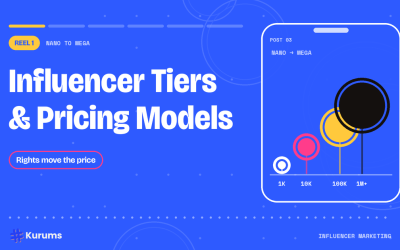
Influencer Tiers and Pricing Models: From Nano to Mega, and How Rates Are Really Set
Follower counts sort creators into nano, micro, macro and mega tiers, but they do not set the price. How rates are built from deliverables, audience, usage rights and exclusivity, and which pricing model suits which goal.
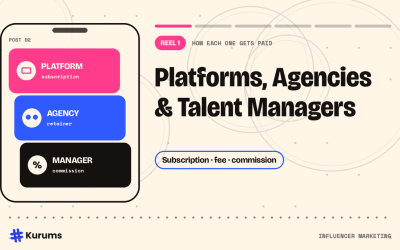
Influencer Platforms, Agencies and Talent Managers: How Each One Makes Money
A platform sells you software, an agency sells you a team, a marketplace takes a cut of each deal and a talent manager takes a cut of the creator’s fee. How each model charges, with published prices from GRIN, Modash and Collabstr.
The Influencer Marketing Industry in 2026: Size, Players and Where the Money Goes
Brand deals supply most creator income in an economy Goldman Sachs expects to approach $480 billion by 2027. Who the players in influencer marketing are, how money moves between them and why ad holding companies are buying agencies and platforms.
Brand Ambassadors Explained: How They Build Real Influence
What brand ambassadors are, how they differ from influencers and affiliates, why authentic advocacy builds trust, and how brands work with ambassadors effectively.
What Is Influencer Marketing and How Does It Work?
A practical guide to influencer marketing — how it works, why micro-influencers often outperform celebrities, how to find the right partners, and how to run campaigns that deliver.
REEL 2 Posts 04 to 07
How does each platform work for brands?
Every network now has its own way to label a paid post and to turn a creator's content into an advertisement. These playbooks cover the mechanics, formats and pricing logic platform by platform.
Creator Affiliate and Social Commerce: TikTok Shop, YouTube Shopping, LTK and Amazon Compared
Paying creators a commission on sales turns influencer marketing from a media cost into a sales channel. How TikTok Shop, YouTube Shopping, LTK, Amazon and brand-run affiliate programmes compare, and where commission-only deals fall short.

Twitch and Live-Streaming Influencer Marketing: Sponsorships, Formats and Pricing
A live stream cannot be approved in advance, edited or skipped. How Twitch sponsorships work, which formats brands buy, how streamers are paid and what to measure when the content is three hours long.
LinkedIn and B2B Influencer Marketing: Thought Leader Ads, BrandLink and Creator Partnerships
B2B buyers follow people, not logos. How to find LinkedIn creators who reach your buying committee, how Thought Leader Ads and BrandLink work, and how to judge a programme on pipeline instead of likes.
Instagram Influencer Marketing: Paid Partnership Labels, Collab Posts and Partnership Ads
An Instagram creator deal now has two halves: the organic post and the right to advertise through it. How the paid partnership label, Collab posts and partnership ad codes work, and what to put in the brief.
Instagram Marketing Strategy: A 2026 Plan for B2B and Consumer Brands
A practical Instagram plan for B2B and consumer businesses: which formats to use, how often to post, how search, DMs, creators and Insights fit, and what Meta changed in 2026, including the Meta One link rules.
YouTube Creator Partnerships: A Brand Guide to Deals and Rules
How brands find, brief, contract and measure YouTube creators in 2026, including the Creator Partnerships tools in Google Ads, disclosure and AI likeness rules.
How to Manage a TikTok Affiliate Program at Scale
Turn a passive TikTok affiliate plan into a managed sales engine — systematic recruitment, tiered commissions, creator enablement, tracking, and retention.
TikTok Shop Affiliate Program: A Seller’s Guide to Creator-Driven Sales
A seller’s guide to the TikTok Shop Affiliate program — how it works, open vs targeted plans, commission strategy, and recruiting creators profitably.
TikTok Creator Marketing: Build a Program That Actually Sells
A guide to TikTok creator and influencer marketing — finding partners, paid vs affiliate models, authentic briefing, ROI measurement, and scaling a program.
Enter a creator's numbers and a fee to get engagement rate three ways, cost per thousand views, cost per engagement, cost per click and return on spend.
REEL 3 Posts 08 to 11
How do you run a campaign that is safe and worth the money?
Most problems in creator campaigns come from things nobody wrote down or checked: usage rights, fake audiences and missing disclosures. These guides cover the brief and contract, vetting, the rules in nine jurisdictions and where the market is heading.
Influencer Marketing Trends for 2027: What the Data Says and What Brands Should Do
Budgets are rising, creators are getting smaller, AI runs the back office and holding companies are buying the specialists. Eight influencer marketing trends for 2027, each with the evidence and a practical response.
Influencer Disclosure Rules by Country: US, UK, EU, France, UAE, India, Türkiye and More
“#ad” works in New York, “Publicité” is the law in Paris and a permit number is required in Dubai. A country-by-country comparison of influencer disclosure rules, accepted labels and who is liable.
Influencer Fraud: Fake Followers, Engagement Pods, View Bots and How to Vet a Creator
Followers, likes, comments and live viewers can all be bought. The types of influencer fraud, the signals that expose them and a vetting routine that takes fifteen minutes per creator.
The Influencer Campaign Brief, Contract and Usage Rights: What to Put in Writing
Most influencer disputes come from things nobody wrote down: how long the brand may use the video, whether it can run as an ad, what counts as a competitor. The brief and contract clauses that prevent them.
Influencer Marketing Measurement in 2026: Lessons From ANA Research and Cal AI’s Growth Formula
Two-thirds of marketers say measuring influencer campaigns is the hardest part. What the ANA data and Cal AI’s playbook mean for your creator budget.

FTC Influencer Marketing Rules in 2026: Disclosure Requirements, Enforcement Risk, and What Brands Must Fix Now
The FTC hasn’t passed sweeping new influencer marketing law in 2026, but enforcement of its Endorsement Guides has intensified sharply, with penalties up to $53,088 per violation. Here’s what brands need to fix in their disclosure workflows now.
REEL 4 Posts 12 to 15
Which influencer platforms have we reviewed?
Kurums Trust reviews look at each platform from the buyer's side: published prices, contract terms, what users say and who it suits. No vendor can pay for a badge; see how we review.
Modash Review: Pricing, Features and What Buyers Should Know
Modash is a discovery, outreach and tracking tool covering Instagram, TikTok and YouTube, with published prices from $199 a month billed yearly and a 14-day free trial. Our review covers plans and limits, strengths, gaps and who it suits.
Upfluence Review: Pricing, Features and What Buyers Should Know
Upfluence combines influencer search, campaign management, affiliate tracking and payments, with deep e-commerce integrations. It charges a fixed fee by quote and requires a twelve-month term. Our review covers costs, contract, features and fit.
GRIN Review: Pricing, Features and What Buyers Should Know
GRIN made its name as the creator-management platform for e-commerce brands and now sells self-serve plans from free to $1,500 a month, each with a fee on payments. Our review explains the real cost, the features and who it suits.
CreatorIQ Review: Pricing, Features and What Buyers Should Know
CreatorIQ is the enterprise standard for creator marketing, used by more than 1,300 brands and agencies. Our buyer-side review covers how it is priced, what the modules do, what users say and when a lighter tool is the better choice.
REEL 5 Posts 16 to 17
Which agencies and tools are best for your budget?
Our Best lists compare influencer agencies, with who owns each, and the free and low-cost tools a small business can use to find creators. Lists cannot be bought.
Best Influencer Discovery Tools for Small Business in 2027: Free and Low-Cost Options
Six ways for a small business to find creators without an enterprise budget: the social platforms’ free marketplaces, Heepsy, Collabstr, GRIN’s free plan, Modash and HypeAuditor — with published prices, limits and who each suits.
Best Influencer Marketing Agencies in 2027: 6 Compared, and Who Owns Them
Six leading influencer marketing agencies compared from the client’s side: Viral Nation, Billion Dollar Boy, The Goat Agency, Obviously, Influential and Whalar — who owns each, what they are known for and how to choose.
Best Influencer Marketing Platforms in 2026: Features, Pricing & Comparison
Compare the best influencer marketing platforms of 2026 — Upfluence, Grin, Aspire, CreatorIQ and Modash — across pricing, use cases and features, with direct links.
REEL 6 Posts 18 to 23
What do creators and agencies actually mean by that?
Whitelisting, UGC, engagement rate, nano-influencer, earned media value, usage rights: the vocabulary of a creator contract, explained by Kurums Decoded in plain English.
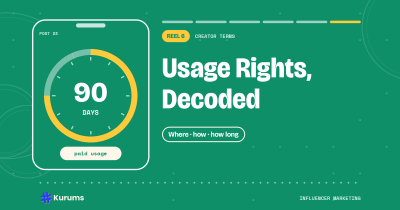
Usage rights, Decoded: What It Actually Means
The permission a brand buys to use a creator’s content beyond the creator’s own post: where, how and for how long. Usage rights are the permissions a creator grants a brand to reuse their content. They define where the content may appear, whether it can run as paid advertising, whether it can be edited, in which countries and for how long.
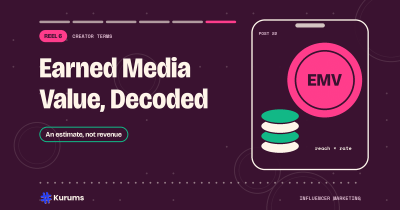
Earned media value, Decoded: What It Actually Means
An estimate of what your creator and social coverage would have cost if you had bought the same exposure as advertising. Earned media value, or EMV, is a figure that puts a money value on unpaid or creator-driven exposure. It multiplies results such as impressions or engagements by an assumed cost for each, so the total suggests what equivalent advertising would have cost.
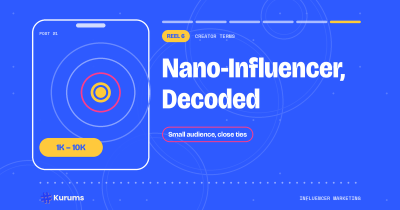
Nano-influencer, Decoded: What It Actually Means
A creator with a small following, roughly a thousand to ten thousand people, who mostly know or trust them personally. A nano-influencer is a creator with a small audience, by the most common convention between about 1,000 and 10,000 followers on a platform. Their reach is limited, but their followers tend to be friends, neighbours or members of a tight niche.
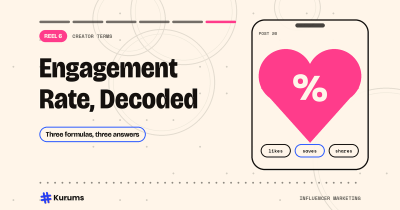
Engagement rate, Decoded: What It Actually Means
The share of people who did something with a post, such as like, comment, share or save, instead of just scrolling past. Engagement rate is the number of interactions a post receives, such as likes, comments, shares and saves, divided by a measure of audience size and shown as a percentage. The audience measure can be followers, reach or views, which is why the same post can have three different rates.
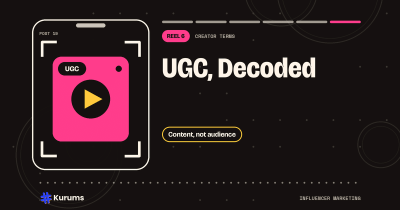
UGC, Decoded: What It Actually Means
Content that looks like a customer made it. Increasingly, a paid creator did, and the brand posts it on its own channels. UGC stands for user-generated content: photos, videos and reviews made by ordinary users instead of by the brand. In marketing today it usually means content a brand pays a creator to produce in that natural style, for use on the brand’s own channels and ads.
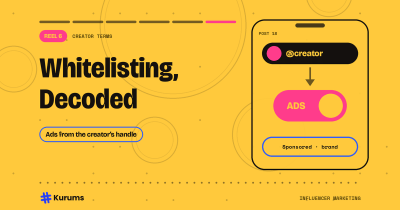
Whitelisting, Decoded: What It Actually Means
When a brand runs paid ads through a creator’s own account, so the ad shows up under the creator’s name instead of the brand’s. Whitelisting is when a creator gives a brand permission to run paid advertising through the creator’s social media handle. The ad appears to come from the creator, but the brand controls the budget, the targeting and how long it runs.
Influencer marketing, Decoded: What It Actually Means
Influencer marketing is when a brand works with creators who have an engaged following on social media, video or podcasts, so they can present the brand’s product to their audience. The creator is usually paid with money, free products or a commission, and the content often feels more personal and trusted than a classic ad.
A–Z Solutions Directory
Where can you find influencer platforms and agencies?
CreatorIQ, GRIN, Upfluence, Modash, HypeAuditor, Collabstr, LTK, Viral Nation, The Goat Agency and more in the Kurums Solutions Directory. No position can be bought; companies request a listing by email.
INFO The industry in numbers
How big is influencer marketing?
| Measure | Figure | Source |
|---|---|---|
| Creator economy | About $250 billion in 2023; approaching $480 billion by 2027 | Goldman Sachs Research |
| Creators worldwide | About 50 million; roughly 4% earn more than $100,000 a year | Goldman Sachs Research |
| Brand deals | About 70% of creator income | Goldman Sachs Research |
| Budgets | 87.49% of respondents expect an increase in 2026 | Influencer Marketing Hub, Benchmark Report 2026 |
| Smaller creators | 52.83% plan more micro-influencers; 51.43% more nano-influencers | Influencer Marketing Hub, Benchmark Report 2026 |
| AI | About 89% use AI in their influencer programmes | Influencer Marketing Hub, Benchmark Report 2026 |
| Disclosure | 20% of 576 influencers systematically disclosed advertising | European Commission sweep, February 2024 |
| Consolidation | Publicis bought Influential (2024) and Captiv8 (2025); Accenture Song acquired Whalar (2026) | Company announcements |
FAQ Influencer marketing
Frequently asked questions
What is influencer marketing?
Influencer marketing is paying or otherwise rewarding people with an audience to recommend a product to it. The reward can be a fee, free product, commission on sales or a long-term ambassador role, and the relationship has to be disclosed.
How much does influencer marketing cost?
It depends on the creators, the deliverables and the rights you buy. Rates reflect audience, production effort, usage rights and exclusivity more than follower count alone. Software ranges from free plans to enterprise contracts, and agencies charge retainers or project fees on top of creator costs.
Do I need an agency or a platform?
Use a platform when your team has time and you work with creators continuously; use an agency when you need strategy, creative ideas or extra hands. Many brands combine software as the system of record with an agency for major campaigns.
Do gifted products have to be disclosed?
Yes. A free product is a material connection under the rules in the United States, the United Kingdom, the European Union and most other markets.
How can a company get listed in the Kurums directory?
Listings in the Solutions Directory are free and editor-compiled. Email [email protected] with the company's name, website and a one-line description.
Last updated 27 November 2026 · Kurums Marketing editorial team. Figures are as published by Goldman Sachs Research, Influencer Marketing Hub, the European Commission and the companies named; prices and platform rules change, so confirm them at the source. Nothing here is legal advice. Part of the Marketing department on Kurums.