
Hedging can make a diesel budget predictable, but most shippers will get more from fixing their fuel surcharge clauses first and hedging only what remains.
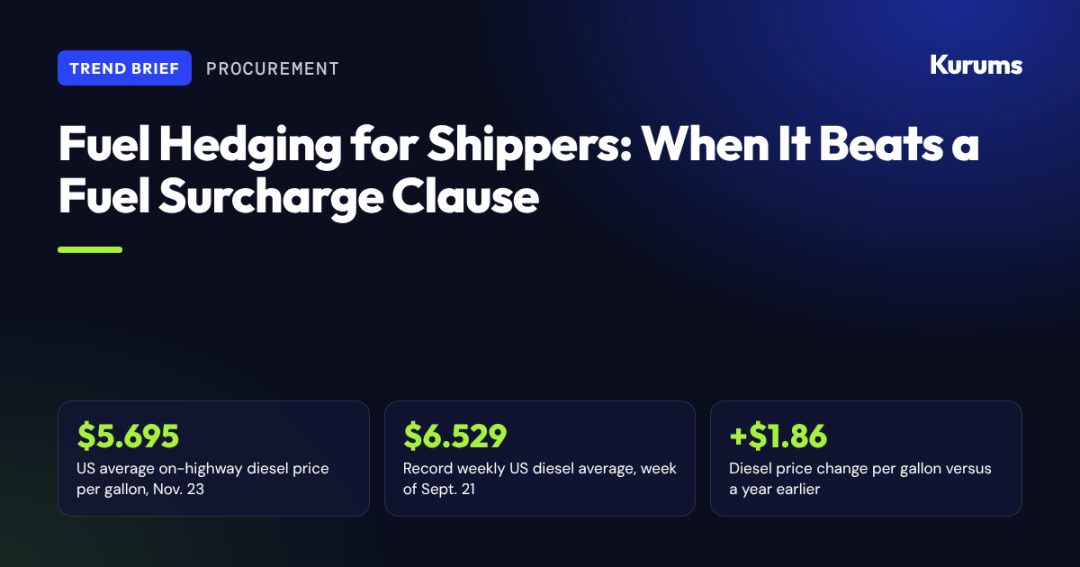
Molson Coors and Primo Brands said on third-quarter earnings calls that they hedge fuel to manage transport costs. US diesel averaged $5.695 a gallon on Nov. 23, down from a record $6.529 in September but $1.86 above a year earlier. Advisers quoted by Supply Chain Dive say hedging is uncommon among shippers because it is costly and needs specialist skills. Procurement should first measure its gallon exposure, tighten surcharge clauses, then take a sized proposal to treasury.
Two beverage shippers put fuel hedges on the record
Fuel hedging is normally an airline and trucking-fleet subject. This week it appeared in consumer goods. Supply Chain Dive reported on Nov. 25 that Molson Coors and Primo Brands both pointed to hedging on their third-quarter earnings calls as a way to manage transport costs pushed up by the Iran war.
Molson Coors CFO Tracey Joubert said cost of goods sold per hectoliter rose 8.1%, driven by aluminum, fuel and a tighter freight market, and that the brewer hedges what it can. She added that tight capacity has forced the company onto the higher-priced spot market despite long-term transport contracts. A $450 million savings program is absorbing part of the pressure.
Primo Brands, owner of Pure Life and Arrowhead, raised its 2027 diesel hedging to roughly its 2026 level. CFO David Hass said the locked prices sit above the company’s 2026 average but below the current spot market. CEO Eric Foss was clear that this does not fully insulate the business.
United Natural Foods is a third example: its CEO told a September investor conference that hedging keeps exposure in a reasonable place, according to an earlier Supply Chain Dive report.
Where diesel stands now
The weekly Energy Information Administration survey put the US on-highway diesel average at $5.695 a gallon on Nov. 23, down 24.2 cents in a week and $1.864 above the same week last year. FreightWaves called it the largest one-week decline since the war began and the fourth straight weekly fall.
| Week (EIA) | US diesel, $/gal | Note |
|---|---|---|
| March 2 | 3.897 | Last reading before the war’s price impact, per FreightWaves |
| Sept. 21 | 6.529 | Record high |
| Oct. 26 | 6.352 | Start of the current decline |
| Nov. 23 | 5.695 | Lowest since Aug. 31 |
Source: EIA weekly retail diesel series.
Relief at the pump has not made the freight market easy. FTR’s Shippers Conditions Index fell to -17.3 in September from -13.8 in August, with record diesel the largest factor, DC Velocity reported. FTR expects firmer rates in the coming quarters.
When a hedge makes sense for a shipper
A hedge works like a price lock. Dean Croke of DAT Freight & Analytics told Supply Chain Dive that if prices climb the hedge covers the difference, and if they fall the company misses the savings; in both cases the cost is known in advance. Will Dusek of AlixPartners made the same point from the other side: a hedging program manages price exposure in both directions.
From those descriptions and the company examples, a hedge is worth studying when most of the following hold:
- The exposure is large and measurable. DAT’s argument applies to companies buying millions of gallons a year. A private fleet or dedicated contract carriage gives a clean gallon count. Fuel paid through carrier surcharges has to be estimated from miles and the surcharge table.
- Volume is steady. A hedge sized for volume that never ships leaves the company holding a financial position with nothing behind it.
- You cannot pass the cost on. Dusek noted that most shippers recover fuel through fees and surcharges to their own customers. Primo keeps that option open through delivery fees.
- Budget certainty has value in itself. A fixed annual plan or investor guidance is a reason to pay for predictability.
Timing matters too. Primo is locking 2027 prices above its 2026 average. A hedge bought after a spike protects against a further rise, and it also commits the buyer to a high price if the market keeps falling.
What hedging costs
Eddison Lee of AlixPartners told Supply Chain Dive the business case is hard to justify day to day: hedging solutions can be costly and need either a sophisticated procurement desk or an outside specialist.
The costs fall into four groups:
- Transaction cost. Bank or broker pricing, plus any upfront premium on instruments that keep the downside open.
- Opportunity cost. Savings forgone when prices fall below the locked level.
- Mismatch. Surcharges follow the EIA retail average, while financial hedges usually settle against futures. FreightWaves notes that retail prices lag futures, and that the gap between diesel and crude narrowed from 90 cents to $1 a gallon through August to roughly 64 cents on Nov. 23. A hedge can pay out less than the surcharge bill grows.
- Overhead. Policy, approvals, accounting treatment and reporting, all of which belong to treasury.
This is analysis, not financial advice; instrument choice needs treasury and its advisers.
The alternatives sit in the contract
Before paying for a hedge, check what the transport contracts already do with fuel.
| Approach | Who carries price risk | Main cost or catch | Best fit |
|---|---|---|---|
| Index-based surcharge schedule | Shipper | Spend moves weekly with the EIA average | Default for most contract freight |
| Regionally indexed surcharge | Shipper, more accurately | More administration and auditing | Networks concentrated in one region |
| Fixed-fuel or all-in rate | Carrier | Carrier prices the risk into the rate | Short terms, smaller lanes |
| Financial hedge | Counterparty, up to the hedged volume | Fees, forgone savings, mismatch | Large, steady, measurable exposure |
The regional option deserves attention. At an Oct. 26 FreightWaves conference session, Craig Decker of Brown Gibbons Lang described shippers saving money by renegotiating surcharges to regional diesel prices so the charge tracked actual fuel cost. EIA’s Nov. 23 data shows the range: $5.294 on the Gulf Coast against $6.709 on the West Coast. Costco, meanwhile, told investors it largely offset incremental fuel surcharges through lower contracted shipping rates.
Parcel is a separate exposure. FedEx and UPS will raise base rates 5.9% on average, effective Jan. 4 and Dec. 21 respectively, and Supply Chain Dive reports fuel surcharges contributed to record ground rates this year. Those surcharges are set by the carrier’s published table, so negotiation counts for more there than any hedge.
What Google Trends says about attention
Google Trends data for the US over the 90 days to Nov. 26 shows where attention went. The figures are relative search-interest indices from 0 to 100, scaled to the peak among the compared terms. They are not search volumes.
- “Diesel prices” peaked at 100 on Sept. 17, the stretch in which the EIA average went from $5.967 to the $6.529 record. The 90-day average is 30.8; the last seven days average 13.4.
- “Fuel surcharge” averaged 2.1 with one spike to 15 on Nov. 13. The Postal Service had announced the day before that it would make its package fuel surcharge permanent at 11%, according to Supply Chain Dive.
- “Fuel hedging” averaged 0.2 and “freight rates” 1.3.
General interest in diesel has more than halved since the peak while the price is only about 13% below its record. Search interest in hedging is close to nil, which fits the AlixPartners view that the practice is uncommon among shippers. The quieter period is a reasonable time to do the contract work.
Search interest: diesel prices vs fuel surcharge
Google Trends, United States, Aug 26, 2026 to Nov 25, 2026. Daily index, 0–100, relative to the highest point among the terms compared; it shows relative attention, not search volume.
How procurement and treasury should split the work
Hedging fails when either function runs it alone. Treasury knows instruments and counterparties and lacks the lane data. Procurement knows the exposure and has no mandate to trade.
- Procurement owns the exposure number. Convert freight into gallons: miles by mode, the miles-per-gallon assumption in each surcharge table, and private-fleet purchases. For illustration only, 5 million truckload miles at an assumed 6.5 miles per gallon is about 770,000 gallons, so each $1 move in diesel shifts annual cost by about $770,000.
- Procurement owns the contracts. Document which index each carrier uses, the base price, the step size and the reset frequency. Treasury cannot match a hedge to a clause nobody has written down.
- Treasury owns policy and execution. That covers the share of exposure to hedge, tenor, instruments, counterparty limits and accounting.
- Both own the review. Compare hedge results with surcharge invoices each quarter, and adjust the hedged share as contracts and volumes change.
Fuel-linked charges are spreading, as the Postal Service decision shows, which makes the exposure map useful whether or not a hedge follows.
What to do next
- Pull twelve months of fuel surcharge spend by carrier and mode, and convert it to an estimated gallon exposure.
- List every contract's fuel clause: index used, base price, step increment, reset frequency and any cap.
- Ask carriers on regionally concentrated lanes to quote a surcharge tied to the regional EIA diesel price.
- Request fixed-fuel or all-in quotes on a few lanes in the 2027 bid to see how carriers price the risk.
- Send treasury the exposure number and ask for indicative hedge costs on a defined share of it.
- Add a fuel sensitivity line to the 2027 freight budget showing cost per $0.50 move in diesel.
Frequently asked questions
What is fuel hedging for a shipper?
It is a financial arrangement that fixes the price a company will effectively pay for diesel over a future period. DAT's Dean Croke described it to Supply Chain Dive as a price lock: if prices climb the hedge covers the difference, and if they fall the company misses the savings.
Is fuel hedging common among shippers?
No. AlixPartners partners quoted by Supply Chain Dive said hedging is important but not prevalent, because most shippers pass fuel costs to customers through fees and surcharges, and because effective programs are costly and need a sophisticated procurement desk or an outside specialist.
What is the simplest alternative to a hedge?
A well-written index-based fuel surcharge clause. It does not fix the price, but it makes the cost transparent and auditable. Tying it to a regional diesel index, where freight is geographically concentrated, can bring the charge closer to what carriers actually pay for fuel.
Does it make sense to hedge now that diesel is falling?
It depends on the goal. Diesel is 83 cents below its September record yet $1.86 above a year ago, per EIA. A hedge placed now buys certainty for 2027 but also gives up further declines. Primo Brands accepted 2027 prices above its 2026 average for that certainty.
- Supply Chain Dive: Molson Coors, Primo Brands use fuel hedging to tackle logistics costs (2026-11-25)
- Supply Chain Dive: How UNFI tackles higher fuel prices (2026-10-15)
- U.S. Energy Information Administration: Gasoline and Diesel Fuel Update (2026-11-24)
- U.S. Energy Information Administration: Weekly U.S. No 2 Diesel Retail Prices (2026-11-24)
- FreightWaves: Diesel price declines picking up pace (2026-11-24)
- FreightWaves: Freight Volatility Moved to the P&L. Is Your 2027 Budget Ready? (2026-11-25)
- DC Velocity: Diesel prices punished shippers in September, FTR says (2026-11-19)
- Supply Chain Dive: FedEx, UPS' upcoming rate hikes: What shippers should know (2026-11-24)
- Supply Chain Dive: USPS readies 2027 rate increase, permanent fuel surcharge (2026-11-13)
Search-interest figures are from Google Trends (United States, 90 days to November 26, 2026). This article is analysis for operators, not legal, tax or investment advice. Last updated November 26, 2026.
Discover more from Kurums | Business Intelligence
Subscribe to get the latest posts sent to your email.