
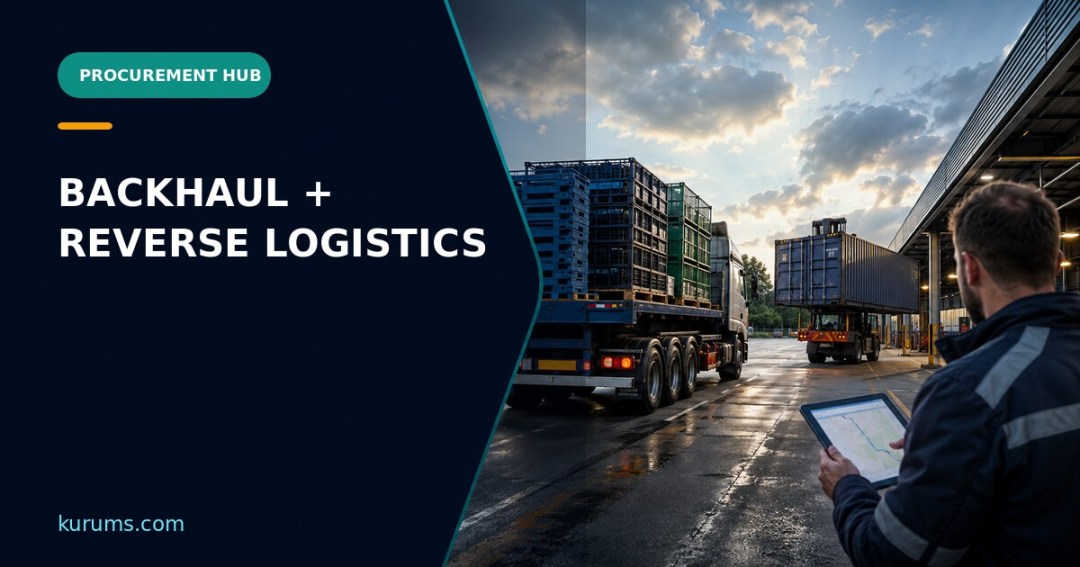
A backhaul is a return movement that can use capacity which would otherwise travel empty. Procurement should treat reverse flows as a designed service—covering product condition, ownership, data, timing, consolidation, liability and customer experience—rather than assume a cheap return trip is automatically available.
- Map outbound, return, repair, reusable-packaging and disposal flows before asking carriers for backhaul savings.
- Separate capacity opportunity from a guaranteed return load; volume, timing and geography must be evidenced.
- Define ownership, inspection, data, packaging, liability, customs and service obligations for returned goods.
- Measure net cost and recovery value, not just the backhaul line rate.
Backhaul Is a Network Opportunity
The SSDER glossary defines BACK HAUL as a return or return load. In a procurement network, the opportunity may be a supplier return, repair loop, reusable packaging collection, spare-parts recovery, customer return, recycling move or a carrier’s empty repositioning. Each has different handling, ownership and service requirements.
Start with a lane map that shows outbound volume, likely return points, timing, equipment, product condition and customs status. A carrier may have a truck or container moving back, but a return load that misses the available window can add handling and delay rather than reduce cost.
Design the Reverse-Flow Service
A reverse-logistics specification should define who authorises the return, who provides packaging, how the unit is identified, what condition is acceptable, where it is inspected, who owns the goods during transit and what happens to damaged or unrepairable material. Include data destruction and environmental controls for equipment or electronics.
Use separate service levels for urgent warranty returns, routine replenishment, reusable assets and end-of-life material. The cheapest backhaul is not useful if it misses a repair window, mixes incompatible goods or leaves a customer waiting for a replacement.
Make Consolidation and Capacity Visible
Backhaul economics improve when the buyer can aggregate compatible returns across suppliers, plants or customers. The consolidation rule should specify cut-off, minimum volume, packaging, segregation, scanning and the decision when the threshold is not met. Do not promise a return schedule that depends on an uncommitted third-party load.
Ask carriers to share lane-level capacity signals without exposing another customer’s confidential freight. A capacity dashboard can show planned outbound, likely empty leg, return candidates, equipment, available date and confidence level. Procurement then chooses between a committed reverse service and an opportunistic backhaul.
Measure Net Recovery and Risk
Track cost per returned unit, empty kilometres avoided, asset-recovery value, cycle time, damage, missing parts, failed pickups, carbon intensity, customer impact and percentage of returns consolidated. Compare the total reverse cost with repair, replacement, disposal and lost-sales consequences.
Review the lane monthly with logistics, quality, service, finance and the carrier. Repeated failures may require better packaging, supplier repair capability, serial-number controls or a different return hub—not merely a lower freight rate.
Worked Example: Cheap Backhaul, Late Repair
A carrier offers a low-cost backhaul from a customer region to the plant whenever an outbound truck returns. The buyer sends warranty units without a fixed cut-off or inspection rule. Some returns wait a week, parts are mixed, and the repair team cannot match the serial numbers to the service case.
The corrected design defines a weekly return window, pre-advice, serial scan, approved packaging, exception handling and a guaranteed fallback service. Procurement compares the true repair cycle and recovery value with the apparent backhaul saving.
Metrics and Governance
For backhaul and reverse logistics procurement, measure both service and evidence quality. Useful indicators include first-pass acceptance, exception rate, response time, unplanned cost, document completeness, damage or discrepancy rate, and the percentage of shipments that follow the approved process. A dashboard should distinguish a supplier failure from a carrier, terminal, broker or internal master-data failure.
Review the metric trend with procurement, logistics, finance, quality and the responsible specialist. Use a monthly exception sample to test whether the control worked in a real transaction, not just whether a field was filled. Repeated exceptions should change the sourcing strategy, contract, lane design or supplier development plan.
Keep the control proportionate to risk. High-value, regulated, time-critical or safety-sensitive cargo needs stronger evidence and faster escalation than a routine shipment. Record the decision owner, approval date, source documents and follow-up action so the next buyer can understand the operating history.
Supplier and Carrier Questions
- Which BACK HAUL or related glossary condition is assumed in your quotation, procedure or service description?
- Which party owns each data field, physical handoff, inspection, document and exception?
- What evidence will be available before release, loading, movement, receipt, invoice approval or claim?
- What changes require advance notice, requalification, a revised price or a new risk decision?
- How will the supplier report incidents, delays, mismatches and corrective actions, and within what response time?
Implementation Sequence
Implement the control in a small, representative lane first. Capture the baseline process, test the required data and evidence, run a real transaction, and review every exception with the people who performed the work. Do not declare the control effective only because a supplier signed a procedure.
After the first three shipments or operating cycles, update the purchase-order clause, work instruction, scorecard and training. Scale the control to other suppliers only when the evidence is repeatable and the owner can explain what happens when the normal path fails.
Common Mistakes to Avoid
- Calling any return trip a backhaul saving without proving timing and capacity.
- Ignoring ownership, customs, product condition, data destruction and environmental obligations.
- Mixing return units without serial, lot, case or packaging controls.
- Measuring the backhaul rate while ignoring repair delay, replacement and handling cost.
- Making a reverse service dependent on another customer's confidential shipment.
Procurement Implementation Checklist
- Map outbound, return, repair, reusable-asset and end-of-life flows.
- Define authorisation, ownership, packaging, inspection and data requirements.
- Set cut-offs, consolidation thresholds, scan events and fallback service.
- Classify capacity as committed, probable or opportunistic.
- Measure net recovery, cycle time, damage, customer impact and avoided empty travel.
- Use recurring exceptions to improve packaging, repair, supplier and hub design.
Frequently Asked Questions
What is a backhaul?
It is a return movement or return load that uses capacity on a vehicle or transport unit after the outbound movement.
Is backhaul always cheaper?
No. Handling, waiting, inspection, packaging, customs, delay and service consequences can outweigh the line-rate saving.
What belongs in a reverse-logistics specification?
Ownership, authorisation, condition, packaging, identifiers, inspection, liability, timing, customs, data and end-of-life treatment.
How should a buyer handle variable returns?
Use a committed base service and identify opportunistic backhaul separately, with a fallback that protects the required service level.
Which metric matters most?
Use a balanced view: net cost and recovery value, cycle time, damage, failed pickups, customer impact and asset utilization.
Related Kurums Guides
- Freight Contracts and Parties
- Shipping Documents for Procurement
- Customs EDI and Entry Data
- Freight Network Design for Procurement
- Cargo Abandonment and Acquittance
- Advanced Charges and Pass-Through Freight
Standards and Authoritative Sources
- U.S. EPA — SmartWay freight efficiency program
- U.S. FHWA — Freight management and operations
- FIATA — Resources for freight forwarding
- U.S. EPA — Sustainable materials management
Glossary terms covered: BACK HAUL, reverse logistics, return load, empty leg, asset recovery, aggregate shipment, carrier capacity
Kurums.com · Procurement, sourcing and business operations
Discover more from Kurums | Business Intelligence
Subscribe to get the latest posts sent to your email.