
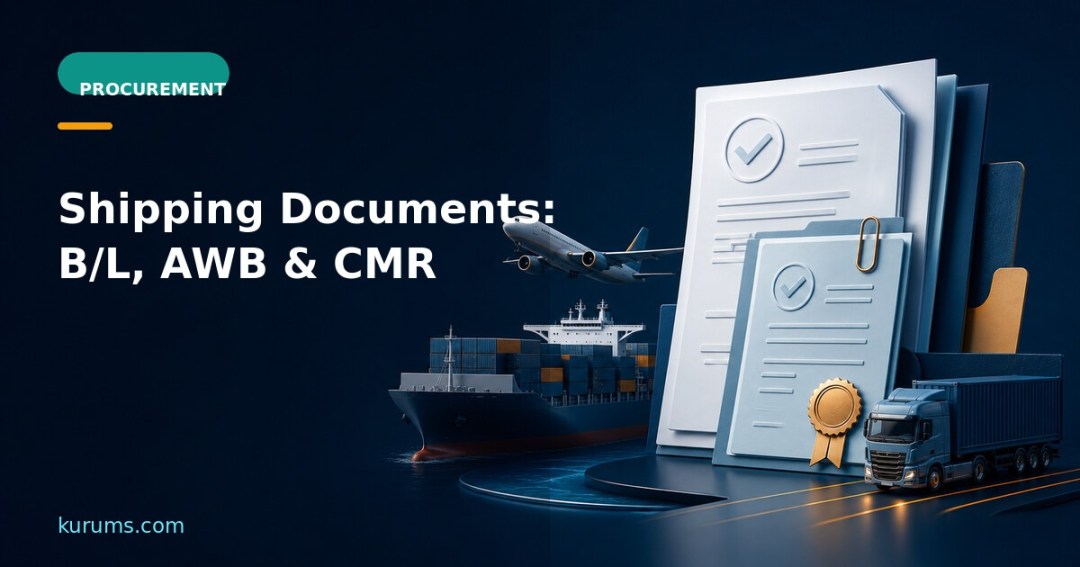
Transport documents do different jobs. A bill of lading may evidence receipt, the contract of carriage and—in negotiable form—rights to delivery; an air waybill is a non-negotiable carriage contract; a CMR note evidences an international road carriage contract. Procurement must specify the correct document, data, issuer and deadline for the chosen mode and payment structure.
Name the exact document
‘Shipping documents’ is too vague for a purchase order or L/C.
Mode determines function
B/L, AWB and CMR records are not interchangeable.
Master and house documents differ
Forwarder documents and carrier documents must be mapped before shipment.
Data consistency prevents holds
Names, quantities, marks, dates and route data should reconcile across the full set.
Procurement teams do not need to become freight-document specialists, but they do need to know which document controls payment, customs clearance, cargo release and claims. A document error can keep compliant goods in storage, trigger demurrage, create an L/C discrepancy or transfer them to the wrong party.
The control objective is a coherent document set. The purchase order, commercial invoice, packing data, transport document, origin evidence, insurance record and inspection certificate should describe the same transaction without ambiguity. Procurement owns the commercial requirements even when a forwarder or supplier creates the record.
Bill of Lading: Three Functions, Several Forms
An ocean bill of lading typically serves as evidence that the carrier received or shipped the goods, evidence of the contract of carriage and, for an order bill, a document through which rights to delivery can be transferred. A straight, non-negotiable bill names a consignee and does not operate in the same way as a negotiable order bill.
A clean bill contains no adverse notation about apparent condition or packaging. ‘Clean’ is not a hidden quality warranty. Carriers usually assess external, apparent condition rather than internal conformity. Procurement should not replace inspection with a clean-document requirement.
State whether originals are required, whether telex or electronic release is permitted, who must be shown as consignee and notify party, and whether on-board notation is needed. Align those instructions with bank and customs requirements.
Master and House Bills
A carrier issues the master bill of lading to the contracting shipper, often a freight forwarder or non-vessel-operating carrier. The forwarder issues a house bill to the underlying cargo owner. Air freight uses a similar distinction between master air waybill and house air waybill.
The document matrix must identify both layers. Who appears as shipper and consignee on each? Which document goes to the bank? Which reference supports arrival notice, customs entry and delivery order? If procurement requests a carrier-issued master document but the route is booked as a consolidation, the supplier may be unable to comply.
Confirm the structure before the L/C or purchase order is final, not after cargo is tendered.
Air Waybill and e-AWB
The air waybill is the contract of carriage between shipper and airline and is non-negotiable. It records routing, parties, pieces, weight, handling information and charges. It does not give the holder title to goods in the way an order bill may support control of sea cargo.
IATA’s e-AWB framework removes the need for the paper AWB contract by using electronic data under the applicable agreement. Procurement should confirm route and stakeholder readiness, retention responsibilities, security declarations and how house data are transmitted for consolidations.
Do not write ‘original negotiable AWB’ into a requirement. That phrase conflicts with the document’s nature and is a common source of avoidable discrepancy.
CMR Consignment Note for Road Freight
The CMR Convention governs qualifying international carriage of goods by road and addresses the carriage contract, consignment note and carrier liability. The note evidences the contract and normally records the sender, carrier, consignee, goods, instructions, charges and reservations.
The CMR note is not a negotiable title document. Signatures and reservations matter for evidence and claims. Procurement should ensure the supplier, carrier and receiving team understand who completes each field, how pallet or seal counts are recorded and how visible damage is noted at delivery.
Electronic CMR can support a paperless process where the legal and operational ecosystem accepts it. Retention, accessibility and integrity controls must be agreed.
Cargo Manifest, Commercial Invoice and Arrival Notice
A cargo manifest summarises shipments carried on a voyage or conveyance. It supports carrier and customs processes but does not replace the commercial invoice or transport contract. The commercial invoice supports valuation and payment; the packing list provides physical packing detail; the arrival notice tells the consignee or agent that cargo has reached the relevant point.
Procurement should require a pre-alert package before arrival. The package should include final invoice, packing information, transport references, origin records, licences and any certificates needed for entry. Waiting until the arrival notice to collect missing records converts a clerical gap into storage cost.
Document-Control Matrix
| Document | Primary creator | Procurement check |
|---|---|---|
| Commercial invoice | Supplier | PO, price, currency, Incoterm, description |
| B/L, AWB or CMR | Carrier or authorised agent | Parties, route, marks, quantity, status |
| Origin or compliance certificate | Authorised issuer | Correct regime, product and period |
For each record, name the owner, issuer, approver, delivery channel, deadline, retention period and correction route. Add a ‘golden data’ tab containing the exact legal names, addresses, tax identifiers, product descriptions and tariff data to be reused across documents.
Worked Example: Multimodal Consolidation
A supplier moves components by truck to a forwarder’s consolidation hub, by air to the destination country and by truck to the plant. The purchase order merely asks for a ‘bill of lading’. The supplier produces a house air waybill, while Accounts Payable expects an ocean original and Customs needs a final commercial invoice showing a different legal consignee.
The corrected process defines a house and master AWB, CMR records for road legs, a commercial invoice data standard, a pre-alert deadline and electronic release workflow. The bank requirement is amended before shipment. One document matrix now connects procurement, supplier, forwarder, broker, bank and receiving team.
Common Mistakes to Avoid
- Requesting a generic ‘bill of lading’ without stating mode, negotiability, originals, release method or on-board status.
- Assuming a clean B/L proves internal quality or quantity rather than apparent external condition.
- Confusing a house document with the carrier’s master document in a consolidation.
- Requesting a negotiable air waybill even though the AWB is non-negotiable.
- Allowing invoice, transport and origin documents to use inconsistent legal names or goods descriptions.
Procurement Implementation Checklist
- Map the physical route, contracting carriers, forwarders and customs brokers.
- Select the correct transport document for every leg and payment instrument.
- Define master versus house document requirements before booking.
- Create golden transaction data and validate the commercial invoice first.
- Require a supplier pre-alert early enough to correct discrepancies.
- Set original, electronic release, retention and access rules.
- Record delivery reservations and preserve claim evidence immediately.
Frequently Asked Questions
Is a bill of lading proof of ownership?
A negotiable order bill can support transfer of rights to delivery, but legal title depends on the transaction and applicable law. Not every B/L is negotiable.
What is the difference between MAWB and HAWB?
The airline or its agent issues the master AWB for the consolidated movement; the forwarder issues a house AWB for the underlying shipment.
Can an air waybill be negotiable?
No. An AWB is a non-negotiable contract of carriage and receipt. Do not treat it as an order bill of lading.
What does a clean bill of lading confirm?
It indicates no adverse notation about the goods’ apparent external condition when received or loaded. It is not a full quality inspection.
Who should own shipping-document accuracy?
The issuer owns creation, but procurement should own commercial requirements and coordinate supplier, logistics, customs, bank and receiving checks.
Related Kurums Guides
- Ocean Bill of Lading Guide
- Letters of Credit Explained
- Global Sourcing Risk Management
- Supplier Onboarding Process
- Key Contract Clauses for Procurement
Standards and Authoritative Sources
- IATA — e-Freight and e-AWB
- UNECE — CMR Convention
- UNECE — Executive Guide on e-CMR
- ICC — UCP 600 Guidance on Transport Documents
Glossary terms covered: advice of shipment, air waybill, master air waybill, house air waybill, arrival notice, B/L, bill of lading, blanket waybill, blind shipment, cargo manifest, carrier certificate, commercial invoice, CMR
Kurums.com · Procurement, sourcing and business operations
Discover more from Kurums | Business Intelligence
Subscribe to get the latest posts sent to your email.

Trackbacks/Pingbacks