
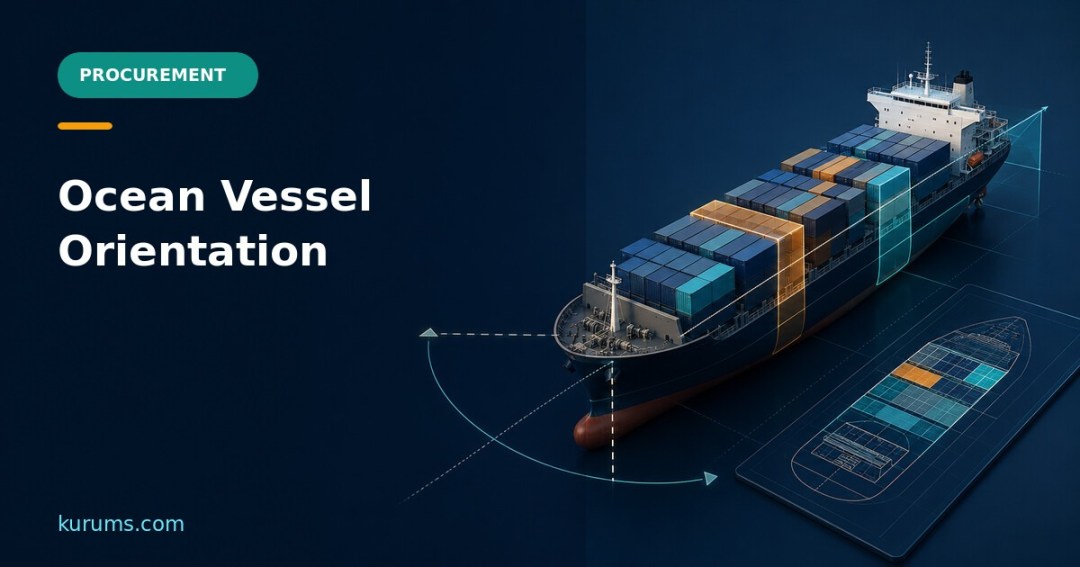
Nautical orientation terms become commercial controls when a procurement specification describes vessel capacity, cargo location, inspection evidence or a loading restriction. Translate the language into measurable requirements and assign it to the carrier, terminal, surveyor or supplier.
- Use bow, aft, abaft, astern, beam and atwartships consistently in vessel and stowage instructions.
- Separate vessel orientation from the legal point where risk or custody transfers.
- Ask for drawings, capacity data or Cargo Securing Manual evidence when a position affects safety or condition.
- Make a marine specialist review ambiguous location language before award or claim settlement.
Why Directional Terms Affect Buying Decisions
A procurement team may receive a quotation that promises a slot aboard a vessel, a stowage position abaft a bulkhead or an inspection near the beam. These are not decorative words. They can affect access, exposure to weather, lashing arrangements, discharge sequence and the evidence available when cargo is damaged.
The glossary uses bow for the front of a vessel, aft for the rear area, astern for a direction behind the vessel, abaft for a position toward the stern, beam for the vessel’s width and atwartships for a transverse direction. Put the accepted definitions in a lane playbook and require diagrams for unusual cargo.
Convert Orientation Into a Specification
A marine-freight request should describe the cargo, unit, dimensions, weight, centre of gravity, lifting points, weather sensitivity and required access. If a location is important, state whether the requirement concerns the vessel, a deck, a hold, a container or a terminal area. “Aft” alone is not enough to define a safe stowage plan.
Procurement can use a three-level rule: preferred position, acceptable alternative and prohibited condition. The carrier confirms feasibility before booking; the terminal confirms handling capability; and the supplier provides packing or lifting evidence.
Aboard Is Not the Same as Delivered
Aboard means the load is on the conveyance. It may be a useful milestone for a shipment tracker, but it does not automatically answer when title, risk, insurance or payment obligations change. Those questions depend on the contract, the selected Incoterm and the transport document.
Keep the operational milestone and the legal milestone as separate fields. This prevents an internal dashboard from implying that a cargo is delivered merely because it has been loaded aboard a vessel.
Inspection, Survey and Claims Evidence
If orientation or location matters to condition, the buyer should request a pre-loading survey, photographs, stowage plan, lashing record and seal record. The evidence should identify the unit, date, location and responsible party. A generic photograph of the vessel is not proof of cargo position.
Classification and certification bodies such as the American Bureau of Shipping provide vessel and marine-asset rules, but a classification reference does not replace a cargo-specific loading instruction. Procurement should verify the exact scope of any certificate cited by a carrier.
Worked Example: A Wind-Sensitive Unit
A supplier proposes a tall machine for deck carriage. The quote says it will be stowed abaft the accommodation block, but it does not state whether the unit is protected from spray, how it will be secured at the beam or how the discharge crane will reach it. The buyer accepts the wording and later receives a change-order request.
A better award package specifies the stowage envelope, permitted orientation, lashing design, survey points, weather protection, discharge equipment and substitution approval. The carrier prices the actual constraint, and the buyer can compare bids without treating marine terminology as a hidden assumption.
Metrics and Governance
For ocean vessel orientation for procurement, measure both service and evidence quality. Useful indicators include first-pass acceptance, exception rate, response time, unplanned cost, document completeness, damage or discrepancy rate, and the percentage of shipments that follow the approved process. A dashboard should distinguish a supplier failure from a carrier, terminal, broker or internal master-data failure.
Review the metric trend with procurement, logistics, finance, quality and the responsible specialist. Use a monthly exception sample to test whether the control worked in a real transaction, not just whether a field was filled. Repeated exceptions should change the sourcing strategy, contract, lane design or supplier development plan.
Keep the control proportionate to risk. High-value, regulated, time-critical or safety-sensitive cargo needs stronger evidence and faster escalation than a routine shipment. Record the decision owner, approval date, source documents and follow-up action so the next buyer can understand the operating history.
Supplier and Carrier Questions
- Which ABAFT or related glossary condition is assumed in your quotation, procedure or service description?
- Which party owns each data field, physical handoff, inspection, document and exception?
- What evidence will be available before release, loading, movement, receipt, invoice approval or claim?
- What changes require advance notice, requalification, a revised price or a new risk decision?
- How will the supplier report incidents, delays, mismatches and corrective actions, and within what response time?
Implementation Sequence
Implement the control in a small, representative lane first. Capture the baseline process, test the required data and evidence, run a real transaction, and review every exception with the people who performed the work. Do not declare the control effective only because a supplier signed a procedure.
After the first three shipments or operating cycles, update the purchase-order clause, work instruction, scorecard and training. Scale the control to other suppliers only when the evidence is repeatable and the owner can explain what happens when the normal path fails.
Common Mistakes to Avoid
- Using aft, astern and abaft interchangeably without a diagram.
- Assuming aboard is a legal delivery event.
- Requesting a vessel certificate without checking its scope and validity.
- Leaving weather exposure, lashing and discharge access outside the purchase order.
- Accepting a carrier's position change without documented engineering and commercial review.
Procurement Implementation Checklist
- Define the vessel, cargo unit and reference direction in the RFQ.
- Record preferred, acceptable and prohibited stowage conditions.
- Request capacity, lashing and handling evidence for non-standard cargo.
- Separate aboard, arrival, delivery, title and risk milestones.
- Require survey photographs and stowage records for sensitive units.
- Route substitutions through procurement, logistics and engineering approval.
Frequently Asked Questions
What does abaft mean?
It describes a position toward the stern, or rear, of a vessel. The exact reference should be stated in the stowage plan.
What is the difference between aft and astern?
Aft normally describes the rear part of the vessel; astern describes a direction behind the vessel. A contract or diagram should remove ambiguity.
What does atwartships mean?
It means across the vessel from side to side, or transversely, rather than along its length.
Does aboard prove delivery?
No. It is an operational loading milestone. Delivery, risk and title depend on the contract and applicable trade terms.
Who should approve a special stowage position?
The carrier or ship operator must confirm feasibility, while the buyer should coordinate logistics, engineering, insurance and the responsible marine specialist.
Related Kurums Guides
- ABC Inventory Analysis in Procurement
- Shipping Documents for Procurement
- Customs Documents for Procurement
- Freight Contracts and Parties
- Freight Network Design for Procurement
- Container Types and Load Securing
Standards and Authoritative Sources
- ABS — Classification Services
- ABS — Rules and Guides
- IMO — SOLAS Convention
- IMO — Cargo Stowage and Securing Code
Glossary terms covered: ABAFT, ABOARD, AFT, ASTERN, ATWARTSHIPS, BEAM, BOW, American Bureau of Shipping
Kurums.com · Procurement, sourcing and business operations
Discover more from Kurums | Business Intelligence
Subscribe to get the latest posts sent to your email.