
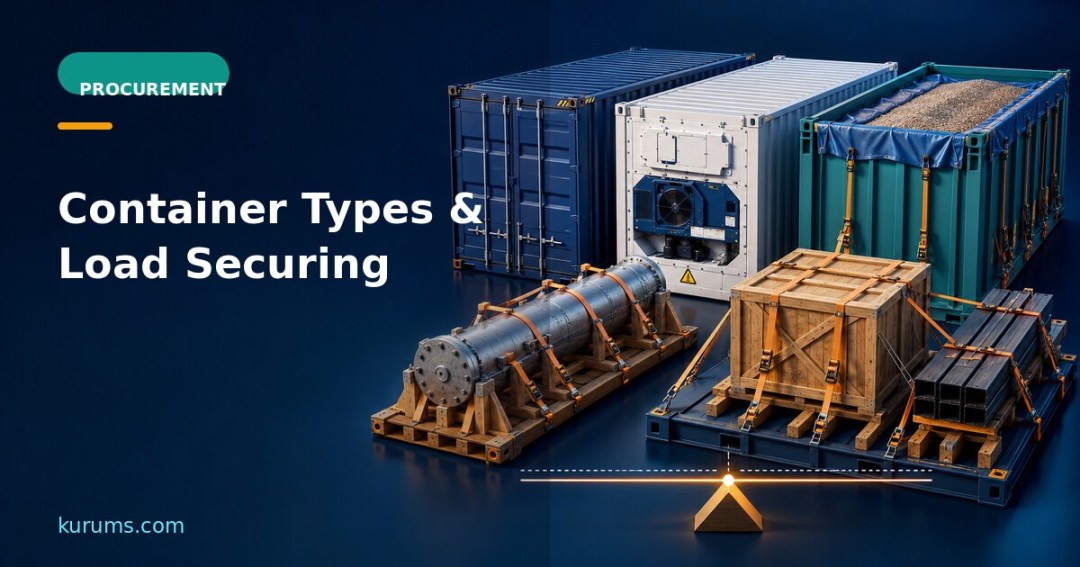
Equipment selection and cargo securing are part of the purchase specification. Procurement must match cargo dimensions, weight, centre of gravity, sensitivity and loading method to the transport unit; assign packing responsibility; require an approved securing plan for non-standard loads; and preserve weight and packing evidence.
Choose equipment from cargo data
Dimensions, mass, lifting points, loading method and route restrictions drive the decision.
Packing is engineered risk control
Blocking, bracing, chocks, cleats, bulkheads and lashings must resist expected forces.
Weight accuracy is mandatory operational data
Packed-container gross mass must be verified before applicable vessel loading.
Inspect before release
Photographic packing records and sign-off prevent arguments after damage.
A low purchase price can disappear when a machine does not fit the booked container, exceeds axle limits, shifts in transit or arrives corroded. These failures originate in specification and supplier management, not only in the freight department.
Procurement should treat transport readiness as a deliverable. The supplier provides verified cargo data and an engineered packing proposal; logistics validates equipment and route; quality checks preservation and securing; the carrier confirms acceptance. No booking should rely on catalogue dimensions or estimated weight.
Standard, Open-Top, Bulk and Temperature-Controlled Units
A standard dry container suits cargo that fits through the doors and tolerates the enclosed environment. An open-top container supports cargo that must be loaded from above or exceeds standard door height, subject to over-dimension limits, tarpaulin and securing requirements. Bulk containers support compatible unpackaged commodities through specialised loading and discharge arrangements.
Temperature-controlled units use integrated or attachable refrigeration systems and controlled air circulation. ‘Ambient’ does not mean risk-free: heat, cold, condensation and humidity can damage electronics, chemicals, food and precision components. Define permissible temperature and humidity, ventilation, pre-conditioning, data logging and excursion response.
Breakbulk is used when cargo is handled as separate pieces rather than inside a standard container. It increases lifting, stowage and weather exposure and needs a purpose-designed handling and securing plan.
CKD, Heavy and Out-of-Gauge Cargo
Completely knocked down cargo is equipment transported in disassembled form for assembly at destination. Disassembly can reduce dimensions but creates part-control, preservation and assembly risk. Packing lists should link each case to drawings, serial numbers and the assembly sequence.
Heavy or out-of-gauge cargo requires verified dimensions, centre of gravity, lifting and lashing points, bearing pressure and route survey. Open-top or flat equipment does not make every load acceptable. Terminal cranes, vessel stowage, bridges, tunnels, road permits and final-site access can control feasibility.
Require transport drawings before manufacture is complete. Designing lifting points after the machine is built is expensive and unsafe.
Chassis, Bogies, Bolsters and Handling Interfaces
A chassis supports a container for road movement; bogies provide wheel assemblies in particular transport contexts; bolsters and related fittings help support or secure units and loads. Procurement does not need to specify every carrier component, but it must identify exceptional axle load, support, twist-lock, lifting or ground-clearance needs.
The interface between factory, truck, terminal, vessel, rail and final site is where assumptions fail. Confirm who supplies chassis or special trailers, who pays waiting and repositioning, whether cranes or forklifts have adequate capacity and whether the cargo can be safely lifted at every transfer.
Include a method statement for high-risk handling and require competent supervision.
Blocking, Bracing and Dunnage
Blocking prevents movement by transferring forces into suitable structural points; bracing supports the cargo against expected motion. Chocks restrain wheels or curved objects, cleats provide stops or reinforcement, bulkheads separate or restrain cargo and lashing points such as rings anchor approved securing equipment.
Materials and methods must suit cargo mass, geometry, fragility and the transport unit. Fastening into a container floor without confirming structural capacity can fail. Timber may face phytosanitary requirements. Sharp edges need protection so they do not cut straps; incompatible goods need separation.
The IMO/ILO/UNECE CTU Code and the IMO CSS Code provide recognised safety guidance. The packer should document the plan, materials, inspection and final condition.
Centre of Gravity and Load Distribution
Centre of gravity determines how a load responds during lifting, braking, cornering and vessel motion. An off-centre or high centre of gravity increases overturning and securing forces. Cargo weight must be distributed within container, vehicle, axle, floor and lifting limits.
Mark the centre of gravity and lifting points on heavy packages. Provide gross and net weights per package and a stow plan. Do not assume equal visual size means equal mass.
Broken stowage is unusable space caused by cargo shape or poor arrangement. Procurement can reduce it through modular packaging, disassembly and packaging design, but space optimisation must not compromise restraint, ventilation or access.
Verified Gross Mass and Weight Evidence
Under the SOLAS verified gross mass requirement, the shipper is responsible for obtaining and documenting the VGM of a packed container before applicable vessel loading. The IMO describes two methods: weighing the packed container or calculating the sum of cargo, packaging, securing materials and container tare under an approved method.
Supplier net weight is not VGM. Packing, pallets, dunnage and securing materials matter. Define who is the shipper for the carrier record, who obtains VGM, the approved weighing method, submission deadline and cost if the terminal must weigh a missing declaration.
Resolve discrepancies before cut-off and preserve scale or calculation evidence.
Worked Example: Open-Top Industrial Press
A supplier quotes an open-top container for a press based on machine height. The first packing drawing later reveals a high off-centre motor, insufficient floor load distribution and no certified lifting points. The booked unit would fit dimensionally but could not be safely handled or secured.
Procurement pauses release. The supplier redesigns the skid, marks centre of gravity, adds engineered lifting and lashing points, supplies a securing calculation and records packed weight. Logistics validates the route and crane plan. The intervention costs less than a rejected terminal move or damaged press.
Common Mistakes to Avoid
- Selecting equipment from product dimensions without allowing for skid, crate, lifting clearance and securing space.
- Using open-top equipment as a universal answer for cargo that lacks safe lifting or load distribution.
- Treating supplier net weight as packed-container verified gross mass.
- Maximising cube utilisation while blocking ventilation, inspection or safe restraint.
- Accepting generic ‘seaworthy packing’ wording without measurable preservation and securing requirements.
Procurement Implementation Checklist
- Obtain final packed dimensions, weights, centre of gravity and lifting points.
- Validate equipment, route, terminal, axle, floor and site constraints.
- Specify corrosion, moisture, shock and temperature protection.
- Require engineered blocking and bracing for heavy or irregular cargo.
- Confirm approved materials, timber compliance and lashing capacity.
- Assign VGM calculation, authorisation and submission responsibility.
- Approve a dated photographic packing dossier before dispatch.
Frequently Asked Questions
When is an open-top container appropriate?
When cargo cannot be loaded through standard doors or exceeds normal height, provided route, over-dimension, weather protection, lifting and securing requirements are accepted.
What is blocking and bracing?
Engineered restraint that prevents cargo movement and transfers expected transport forces safely into suitable structures.
Who is responsible for VGM?
Under the IMO guidance, the shipper named on the bill of lading is responsible for obtaining and documenting the packed container’s verified gross mass.
What is broken stowage?
Space that cannot be used because of cargo shape, packaging or poor stow planning.
Does a reefer automatically control humidity?
Not necessarily. Temperature, ventilation, humidity and data-logging capability depend on equipment and settings and must be specified.
Related Kurums Guides
- Supplier Onboarding Process
- Supplier Performance Scorecards
- Global Sourcing Risk Management
- Total Cost of Ownership in Procurement
- Warehouse-to-Warehouse Marine Insurance
Standards and Authoritative Sources
Glossary terms covered: open-top container, ambient temperature, packaging, bogie, bolster, bottom-air delivery, breakbulk, broken stowage, bulk container, bulkhead, bull rings, centre of gravity, chassis, chock, CKD, cleat, clip-on, blocking or bracing
Kurums.com · Procurement, sourcing and business operations
Discover more from Kurums | Business Intelligence
Subscribe to get the latest posts sent to your email.
Trackbacks/Pingbacks