
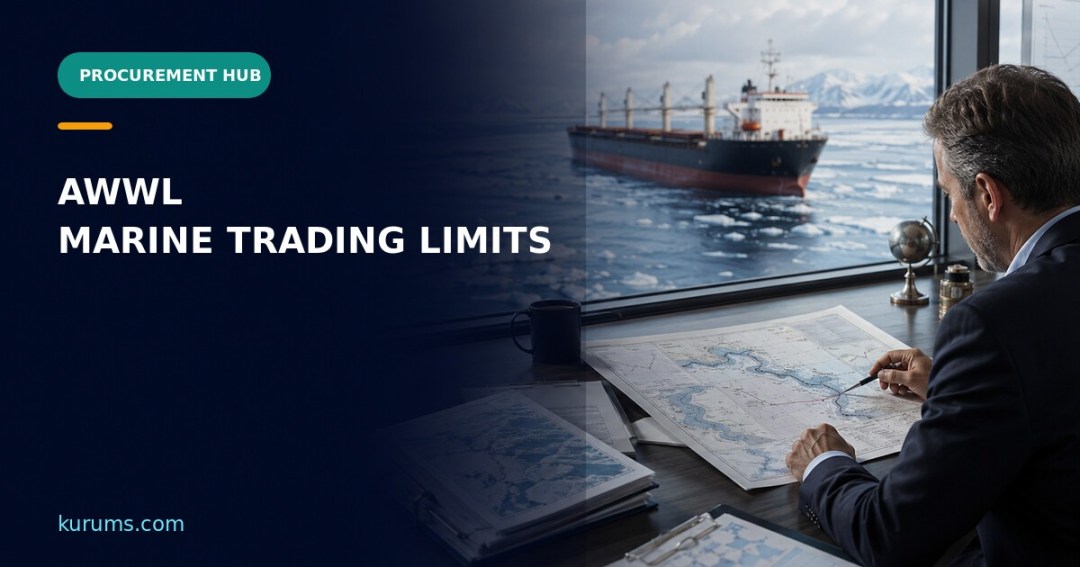
AWWL means Always Within Institute Warranty Limits, a legacy marine-insurance shorthand indicating that a vessel should trade within the geographical limits accepted by its policy. Procurement should not treat it as a universal current rule; confirm the policy, current International Navigating Limits or other trading warranty, route, approval and premium before fixing a vessel.
- Identify AWWL as legacy wording and obtain the actual hull, machinery, cargo, war-risk and charter-party terms.
- Map the planned route, ports, season, ice, war risk, sanctions and deviation exposure against the policy limits.
- Define who obtains insurer approval, pays additional premium and records the evidence before a voyage changes.
- Avoid promising freight or delivery based on a route that is not covered under the vessel's current insurance.
AWWL Is a Route-and-Insurance Condition
The SSDER glossary lists AWWL as Always Within Institute Warranty Limits. In chartering practice, the phrase is associated with geographical trading limits that historically restricted where a vessel could operate under ordinary hull insurance. The wording is often found in older charter parties and shipping correspondence, but its exact effect depends on the policy and contract.
Procurement should treat AWWL as a trigger for verification, not as a complete insurance answer. The current policy may use International Navigating Limits, an underwriter-specific trading warranty or a negotiated route clause. Ask the owner or operator to identify the wording, version, exclusions and approval path before the vessel is fixed.
Compare the Route with the Current Limits
Map load port, discharge port, seasonal route, canals, ice zones, war-risk areas, sanctions exposure, refuge ports and any expected deviation. A voyage can leave the ordinary trading area because of weather, congestion, charterer instructions or a change of discharge port. The route assessment should cover the whole voyage, not only the scheduled port pair.
Check whether the limit applies to hull and machinery, cargo, liability, war risk, crew or another policy. A ship may be technically capable of entering a region while the insurance requires notification, survey, ice-class evidence or additional premium. Record the responsible marine and insurance reviewers.
Put Approval and Premium in the Charter
The charter party should state whether the vessel must remain within the owner’s current trading warranties, who requests permission for an exception, how quickly the owner must respond, and who bears additional premium, deductibles, delay or loss caused by the change. Do not rely on an email assumption that “AWWL” includes every insurer or route.
A substitution, port change, weather diversion or emergency call should trigger a route and insurance review. If the vessel cannot perform within the approved limits, procurement needs a commercial decision: accept delay, nominate another vessel, buy additional cover or terminate under the contract.
Keep Evidence and Claims Rights Aligned
Retain the policy schedule, trading-warranty wording, insurer approval, premium quotation, route plan, notices, charter-party rider and voyage records. If a loss occurs, the claims team will need to show what route was authorised and whether a deviation was permitted. A broker’s informal statement is not a substitute for the policy or endorsement.
The term also interacts with sanctions, war-risk and cargo-insurance decisions. Procurement should coordinate legal, insurance, operations, chartering and finance rather than allowing a low freight rate to conceal an uninsured geographic exposure. Review the control whenever policy wording or voyage plans change.
Worked Example: A Port Change Enters an Ice Zone
A chartered vessel is fixed for a summer port pair, but congestion leads the operator to propose a northern alternative. The original email says AWWL; nobody checks the current trading limits or whether the season and ice conditions require an endorsement. The vessel reaches the area and the owner requests an additional premium and delay allowance.
The corrected tender requires a route map, policy warranty, seasonal limit check and written approval before a port substitution. The cost model includes premium, escort or ice information, delay, fuel and customer impact. The award goes to the vessel with confirmed coverage and a clear change procedure, not simply the lowest base freight.
Metrics and Governance
For AWWL marine trading limits procurement controls, measure both service and evidence quality. Useful indicators include first-pass acceptance, exception rate, response time, unplanned cost, document completeness, damage or discrepancy rate, and the percentage of shipments that follow the approved process. A dashboard should distinguish a supplier failure from a carrier, terminal, broker or internal master-data failure.
Review the metric trend with procurement, logistics, finance, quality and the responsible specialist. Use a monthly exception sample to test whether the control worked in a real transaction, not just whether a field was filled. Repeated exceptions should change the sourcing strategy, contract, lane design or supplier development plan.
Keep the control proportionate to risk. High-value, regulated, time-critical or safety-sensitive cargo needs stronger evidence and faster escalation than a routine shipment. Record the decision owner, approval date, source documents and follow-up action so the next buyer can understand the operating history.
Supplier and Carrier Questions
- Which AWWL or related glossary condition is assumed in your quotation, procedure or service description?
- Which party owns each data field, physical handoff, inspection, document and exception?
- What evidence will be available before release, loading, movement, receipt, invoice approval or claim?
- What changes require advance notice, requalification, a revised price or a new risk decision?
- How will the supplier report incidents, delays, mismatches and corrective actions, and within what response time?
Implementation Sequence
Implement the control in a small, representative lane first. Capture the baseline process, test the required data and evidence, run a real transaction, and review every exception with the people who performed the work. Do not declare the control effective only because a supplier signed a procedure.
After the first three shipments or operating cycles, update the purchase-order clause, work instruction, scorecard and training. Scale the control to other suppliers only when the evidence is repeatable and the owner can explain what happens when the normal path fails.
Common Mistakes to Avoid
- Treating AWWL as a current universal insurance rule with one fixed meaning.
- Checking only the scheduled ports and ignoring seasonal route, deviation and emergency calls.
- Confusing vessel technical capability with insurance permission to trade.
- Leaving additional premium, approval, delay and deductible responsibility unstated.
- Relying on a broker email instead of the current policy, endorsement and charter-party rider.
Procurement Implementation Checklist
- Identify the actual policy wording behind AWWL, IWL or INL language.
- Map ports, route, season, ice, war, sanctions and deviation exposure.
- Assign owner, operator, insurer, broker and procurement approval responsibilities.
- Set permission, premium, delay, deductible and substitution rules in the charter.
- Retain policy, endorsement, route, notice, approval and voyage evidence.
- Recheck trading limits whenever the route, vessel, policy or season changes.
Frequently Asked Questions
What does AWWL mean?
It means Always Within Institute Warranty Limits, a legacy shorthand for keeping a vessel within specified marine-insurance trading limits.
Is AWWL the same as International Navigating Limits?
They are related concepts, but AWWL and historic IWL wording should not be assumed to equal the current policy’s INL or trading-warranty clause. Check the actual documents.
Who pays extra premium outside the limits?
The charter party and policy determine responsibility. State it before the route or port is changed and record the insurer’s approval.
Can an emergency deviation breach AWWL?
It may affect cover or require notice, depending on the policy. Follow the emergency, insurer and charter-party procedure immediately.
Does AWWL cover cargo insurance?
Not automatically. It commonly concerns vessel trading limits, while cargo, war-risk and liability policies have their own terms and exclusions.
Related Kurums Guides
- Center of Gravity Controls
- Cargo Manifest Controls
- Shipping Documents for Procurement
- Freight Measurement and Pricing
- Cargo Insurance and Claims
- Freight Contracts and Parties
Standards and Authoritative Sources
- IUA — Institute Clauses Library
- IUA — Online Clauses Library
- BIMCO — Contractual Clauses
- IMO — Safety of Navigation
Glossary terms covered: AWWL, Always Within Institute Warranty Limits, IWL, INL, trading limits, charter party, additional premium
Kurums.com · Procurement, sourcing and business operations
Discover more from Kurums | Business Intelligence
Subscribe to get the latest posts sent to your email.