
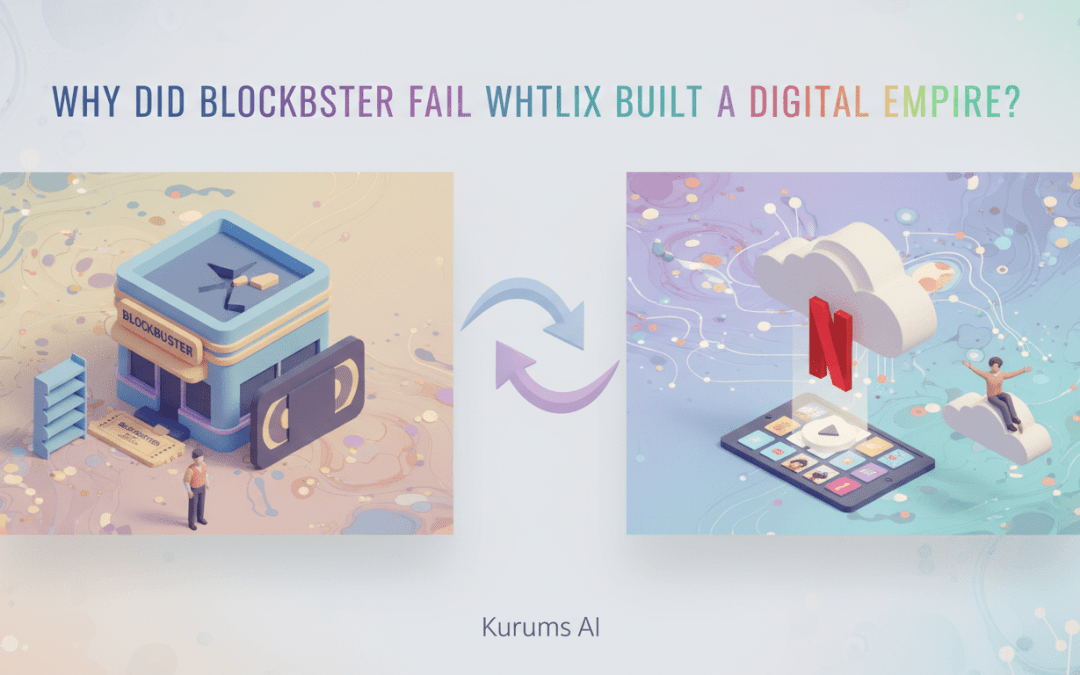
The year was 2000. Reed Hastings, the co-founder of a fledgling DVD-by-mail service called Netflix, walked into the Dallas headquarters of Blockbuster. He offered to sell his company for $50 million. John Antioco, the CEO of Blockbuster—a company then valued at billions with 9,000 stores globally—reportedly laughed him out of the room. Antioco saw Netflix as a “very small niche business” that was losing money.
Fast forward to today: Blockbuster is a nostalgic memory with a single remaining store in Bend, Oregon. Netflix, meanwhile, is a global media titan with a market capitalization that has frequently exceeded $200 billion. But here is the kicker: The failure of Blockbuster was not an accident of fate; it was a deliberate choice driven by corporate governance failures and a refusal to cannibalize its own profitable, yet dying, business model.
In this deep-dive analysis, we will deconstruct the financial, operational, and psychological factors that led to this historic reversal of fortune. We will examine why legacy infrastructure often becomes a “death anchor” and how data-driven agility can turn a startup into a global hegemon.
1. The Revenue Trap: Why Late Fees Were a Poisoned Chalice
To understand why Blockbuster failed, one must look at the balance sheet. In the late 1990s and early 2000s, approximately 16% of Blockbuster’s total revenue came from late fees. Think about that for a second. Nearly one-fifth of the company’s income relied on their customers being unhappy, forgetful, or inconvenienced.
This is what business theorists call “negative value alignment.” When your profit increases as your customer’s experience worsens, you are vulnerable to any competitor who aligns their profit with customer satisfaction. Netflix did exactly that. By offering a subscription model with “No Late Fees,” Netflix didn’t just offer a different service; they offered a different philosophy.
Blockbuster’s reliance on late fees created a “Sunk Cost Fallacy” at the board level. They were afraid to eliminate late fees because it would immediately wipe out hundreds of millions in EBITDA. This short-term focus on quarterly earnings prevented the long-term investment needed to pivot to a subscription-based digital model.
2. CAPEX vs. OPEX: The Heavy Burden of Physical Assets
Blockbuster’s business was incredibly capital-intensive (High CAPEX). Maintaining 9,000 physical locations meant paying thousands of commercial leases, utility bills, and insurance premiums. It also meant managing a massive, decentralized workforce of over 80,000 employees.
Netflix, conversely, focused on an operational expenditure (OPEX) model. In the beginning, their “hubs” were just high-efficiency warehouses near USPS processing centers. As they moved into streaming, they transitioned their infrastructure to Amazon Web Services (AWS), allowing them to scale their computing needs up or down instantly without owning a single server rack.
Comparison of Business Scalability
| Metric | Blockbuster (Legacy Model) | Netflix (Digital Model) |
|---|---|---|
| Primary Asset | Physical Retail Real Estate | Proprietary Algorithms & Content |
| Customer Friction | High (Travel to store, late fees) | Low (Instant streaming, no deadlines) |
| Inventory Management | Limited by shelf space (Physical) | Unlimited (Digital Cloud) |
| Revenue Structure | Transactional (Pay-per-rental) | Recurring (Subscription-based) |
| Data Utilization | Reactive (What sold yesterday?) | Predictive (What will they watch next?) |
But wait, there’s more. The physical nature of Blockbuster’s inventory created a “hits-only” culture. Because shelf space was limited, they had to stock 100 copies of a blockbuster movie and zero copies of an indie documentary. Netflix used the “Long Tail” strategy, providing a massive variety of content that appealed to every niche, effectively capturing the entire market rather than just the top 10%.
3. The Data Moat: How Netflix Knew You Better Than You Knew Yourself
In the traditional rental model, the “recommendation engine” was a teenager working behind a counter who might—or might not—have seen the movie you were asking about. Netflix turned this into a science.
From the very beginning, Netflix invested heavily in its Cinematch algorithm. They didn’t just want to provide movies; they wanted to provide the right movie for you. By collecting data on every pause, every rewind, and every rating, Netflix built a personalized experience that created incredible customer “stickiness.”
This data-driven approach eventually allowed Netflix to move into original content. While traditional studios gambled hundreds of millions on “gut feelings,” Netflix knew with 70% certainty that a show like House of Cards would be a hit because they already had the data on how many people liked David Fincher movies and Kevin Spacey performances.
4. Strategic Inflection Points: The DVD-by-Mail Bridge
One of the most common misconceptions is that Netflix won because they jumped straight into streaming. In reality, Netflix spent a decade mastering the logistics of the DVD-by-mail market. This was a crucial “bridge” strategy.
They built a network of 50+ high-tech distribution centers that could deliver a DVD to 90% of the US population overnight. This required:
- Custom-designed sorting machines that could process thousands of envelopes per hour.
- Sophisticated inventory routing software to ensure DVDs were shipped from the closest possible hub.
- A partnership with the USPS to create the iconic red envelopes that doubled as marketing and functional packaging.
- A “Queue” system that managed customer expectations and optimized inventory turnover.
Blockbuster tried to catch up with “Blockbuster Online,” and they actually gained significant traction. By 2006, Blockbuster’s online service was growing faster than Netflix. However, this is where Corporate Governance failed. The board was divided between the CEO (Antioco), who wanted to invest in the digital future, and activist investors like Carl Icahn, who wanted to cut costs and reinstate late fees to boost immediate dividends.
5. The Innovator’s Dilemma and Internal Cannibalization
Clayton Christensen’s “The Innovator’s Dilemma” perfectly describes the Blockbuster situation. The company was “too good” at its current business to see the value in a new, less profitable (initially) business.
Think about it this way: To truly compete with Netflix, Blockbuster had to tell its store managers that they were going to lose their best customers to an online service. They had to tell their shareholders that the $800 million in late fee revenue was going to zero.
Netflix had the “First-Mover Advantage,” but more importantly, they had the “Nothing-to-Lose Advantage.” They didn’t have to worry about protecting an existing multibillion-dollar retail empire. They could be 100% focused on the future.
6. The Content Shift: From Licensing to Ownership
As the “Streaming Wars” began, Netflix realized another looming threat: The content owners (Disney, NBCUniversal, WarnerMedia) would eventually pull their content to start their own platforms.
Netflix’s response was a masterclass in Vertical Integration. In 2013, they transitioned from being a distribution platform to being a content creator. This was a massive financial risk. Their content spend went from $0 to over $17 billion annually within a decade.
The Evolution of Netflix’s Content Economics
| Era | Core Strategy | Economic Driver |
|---|---|---|
| DVD Era (1997-2007) | Logistics & Long Tail | Low overhead, inventory efficiency |
| Licensing Era (2008-2012) | Mass Acquisition (Starz/Sony deals) | Scaling subscriber base rapidly |
| Originals Era (2013-2018) | Vertical Integration (House of Cards) | Reducing dependency on third-party IP |
| Global/Studio Era (2019-Present) | Localized Global Content (Squid Game) | Global TAM (Total Addressable Market) expansion |
Blockbuster, even at its peak, never truly owned the content. They were a middleman. When the middleman is bypassed by the producer (streaming) or the customer changes their behavior (digital), the middleman vanishes.
7. Agile Governance: The Secret Weapon of the Digital Empire
Netflix’s success is often attributed to its “Culture of Freedom and Responsibility.” While Blockbuster was bogged down by middle management and rigid corporate hierarchies, Netflix eliminated “rules” in favor of “context.”
This organizational agility allowed them to make massive pivots quickly. When they realized the DVD-by-mail business was peaking, they didn’t wait for it to decline. They launched streaming even though the video quality was poor and the library was small. They were willing to interrupt themselves.
8. Operational Efficiency: The Engineering Behind the Stream
How does Netflix deliver 4K video to 230 million people simultaneously without crashing? This is a technical feat that Blockbuster could never have replicated with its legacy IT systems.
Netflix pioneered Chaos Engineering. They created a tool called “Chaos Monkey” that randomly shuts down servers in their production environment to ensure the system is resilient. They also built “Open Connect,” their own Content Delivery Network (CDN), by placing custom-built hardware appliances inside the data centers of Internet Service Providers (ISPs) around the world.
This technical depth created a barrier to entry that was nearly impossible for legacy players to overcome. By the time Blockbuster realized they needed a streaming platform, the “table stakes” in terms of engineering talent and infrastructure were already too high.
9. Critical Success Factors for Modern Enterprises
What can today’s C-level executives learn from the Blockbuster vs. Netflix saga? It boils down to three pillars:
- Asset Lightness: Prioritize scalability and flexibility over heavy physical infrastructure whenever possible.
- Customer-Centric Economics: Ensure your revenue grows when your customer succeeds, not when they fail.
- Algorithmic Decision Making: Use data to remove human bias from strategic choices—especially when those choices involve abandoning “legacy” products.
- Talent Density: Hire high-performers and give them the context to make decisions, rather than building a bureaucracy of “process.”
10. The Psychological Barrier: Why Good Managers Fail
It’s easy to look back and call Blockbuster’s management “stupid.” But John Antioco was actually a highly regarded executive who had saved other companies. The problem wasn’t a lack of intelligence; it was the Psychology of Incumbency.
When you are the market leader, you have a natural bias toward protecting what you have rather than reaching for what could be. You focus on 1% efficiency gains in your current model instead of 1000% growth in a new model.
11. Future Outlook: Is Netflix the Next Blockbuster?
The cycle of disruption never ends. Today, Netflix faces intense competition from TikTok for “attention share,” from YouTube for user-generated content, and from tech giants like Apple and Amazon who don’t even need their streaming services to be profitable.
Will Netflix fall into the same trap as Blockbuster? They are already showing signs of the “incumbent” struggle: cracking down on password sharing (creating customer friction) and introducing ads (changing the core value proposition). However, their massive investment in gaming and cloud-based interactive content suggests they are still trying to disrupt themselves before someone else does.
Conclusion: Building a Digital Empire in a Volatile World
The story of Blockbuster and Netflix is not just about movies; it’s about the velocity of change. In the digital age, a “moat” built of brick and mortar is easily bypassed by a “moat” built of data and agility.
Blockbuster had the brand, the money, and the customers. Netflix had the vision, the data, and the willingness to fail. In the end, the culture of innovation beat the culture of preservation every single time.
Are you ready to audit your own business for “Late Fee logic”? The transition from a legacy mindset to a digital-first empire requires more than just new software; it requires a fundamental shift in how you value your assets and your customers.
Don’t wait until you are the last store in Bend, Oregon. Start your digital transformation today by prioritizing recurring revenue, leveraging predictive analytics, and fostering a culture that isn’t afraid to break things. The digital empire belongs to those who are brave enough to burn their own ships.
Ready to transform your corporate strategy for the digital age? Contact our strategic consulting team today to schedule a “Disruption Audit” and ensure your business stays on the right side of history.
Discover more from Kurums | Business Intelligence
Subscribe to get the latest posts sent to your email.