
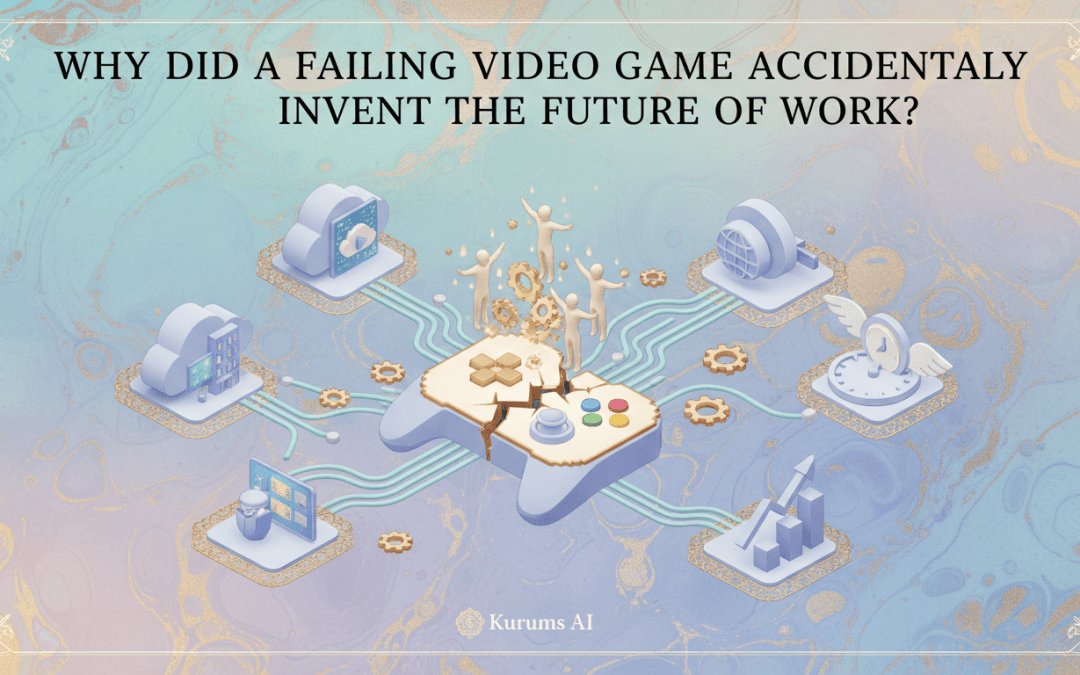
Imagine spending millions of dollars developing a niche online video game, only to realize the project is dead. This was the reality for Stewart Butterfield in 2012. But here is the real issue: while the game ‘Glitch’ failed, the team had built a bespoke communication layer to manage their distributed workflow. That accidental tool is now a $27 billion enterprise staple. Consider this: some of the most profitable software in history wasn’t designed for a market, but for a specific team’s survival.
In the high-stakes world of Silicon Valley, failure is often seen as a prerequisite for success. However, the story of Slack isn’t just about failure; it’s about a paradigm shift in how we conceive, build, and scale enterprise software. It challenges the traditional “Market First” approach and replaces it with “Problem First” development. This article dives deep into the anatomy of a pivot that changed the world.
The Anatomy of a Failed Masterpiece: From Glitch to Glory
Before Slack was a verb used in every corporate office from San Francisco to Singapore, it was an unnamed IRC-style wrapper used by Tiny Speck, a company building an ambitious non-violent MMO called Glitch. The game was beautiful, strange, and ultimately, a commercial disaster. But while the public was ignoring the game, the developers were obsessed with the tool they used to build it.
Why does this matter? Because most software products start with a marketing team identifying a “gap” in the market. Slack started with a group of exhausted engineers trying to keep their messages organized across time zones. They weren’t trying to disrupt the communication industry; they were trying to survive a workday.
But that’s not all. The team didn’t realize they were building the future of work until the very end. When the decision was made to shut down Glitch, Butterfield realized that the most valuable asset they owned wasn’t the game’s code, but the internal system they had used to coordinate the shutdown. This realization marks the birth of “Searchable Log of All Communication and Knowledge”—or SLACK.
Why Internal Tools Outperform Market-Research Driven Products
There is a fundamental difference between building a product for “users” and building a product for “ourselves.” When you build for yourself, you are the most demanding customer you will ever have. You don’t care about “features” that look good on a sales slide; you care about features that save you five minutes of frustration every hour.
Think about it this way: Market research identifies what people think they want. Internal development identifies what people actually need. Slack’s early development was characterized by immediate feedback loops. If a feature was clunky, a developer would walk across the room (or send a message in the tool itself) and fix it. This created a level of UX polish that most SaaS startups take years to achieve.
Comparison: Internal Tool Development vs. Traditional SaaS R&D
To understand why Slack succeeded where others failed, we must look at the structural differences in how it was built versus how a traditional corporate tool is developed.
| Feature | Market-Driven Approach | Internal-Tool (Slack) Approach |
|---|---|---|
| Feedback Loop | Focus groups and surveys (Weeks/Months) | Daily usage by creators (Seconds/Minutes) |
| Primary Goal | Market share and feature parity | Operational efficiency and friction removal |
| UX Focus | Aesthetic appeal for sales demos | Speed, searchability, and reliability |
| Monetization | Subscription tiers defined at start | Value discovered before price is set |
| Tech Debt | High (driven by shipping deadlines) | Low (driven by long-term maintainability) |
The “Dogfooding” Phenomenon: Testing Until It Hurts
In the software world, “eating your own dogfood” refers to using your own product to ensure it’s viable. For Tiny Speck, dogfooding wasn’t a choice; it was their only way of communicating. They were a distributed team across Vancouver, San Francisco, and New York. Email was too slow, and traditional IRC lacked the persistence needed for asynchronous work.
And here is the kicker: Because they were building a game, the culture was centered on “delight” and “fun.” Most enterprise software in 2012 was grey, boring, and painful to use. Slack inherited the DNA of a video game. It had sounds, colorful emojis, and a personality. It didn’t feel like work; it felt like a community. This subtle psychological shift is what allowed Slack to bypass the IT department and go straight to the end-user.
The Technical Architecture of a Billion-Dollar Accident
Technically, Slack was built on a foundation of reliability. They didn’t reinvent the wheel; they perfected it. At its core, Slack was a centralized, searchable database of messages with an incredibly low-latency delivery system. But the real genius was the API-first mentality.
Wait, there’s more. The team knew that no single tool could do everything. Instead of trying to be a project manager, a code repository, and a calendar all in one, they built Slack to be the “central nervous system.” By making it easy for other tools to push data into Slack, they ensured that Slack became the most important window on a developer’s screen.
- Persistence: Unlike IRC, every message was logged and searchable from day one.
- Interoperability: Robust APIs allowed for integrations with Jira, GitHub, and Dropbox.
- Threaded Conversations: Reducing “noise” by allowing sub-discussions.
- Elastic Search: Making sure that a message sent six months ago could be found in milliseconds.
- Universal Sync: A seamless transition between mobile and desktop applications.
The Pivot Strategy: How to Kill Your Darling
Killing a project you’ve spent years on is heartbreaking. When Stewart Butterfield announced that Glitch was shutting down, he had to make a choice: let the company die, or bet everything on a chat app. The transition from a gaming company to a SaaS powerhouse is one of the most studied pivots in business history.
The pivot wasn’t just technical; it was cultural. They had to transition from “game designers” to “productivity experts.” This required a massive rebranding effort. They had to prove that Slack wasn’t just a toy, but a tool that could save a Fortune 500 company thousands of hours in lost productivity.
How did they do it? They started by seeding the product into other tech companies. They knew that if they could convince the “cool” startups in San Francisco to use it, the rest of the world would follow. This is the “Bottom-Up” sales strategy that Slack eventually perfected.
SaaS as an Ecosystem: Why Slack is More Than Chat
If you think Slack is just a chat app, you’re missing the point entirely. Slack is a platform. The distinction is vital. A chat app is a utility; a platform is an ecosystem where other businesses can build their own value.
By opening up the “Slack App Directory,” they created a moat that was impossible for competitors like HipChat to cross. If a company has 50 different custom integrations running through Slack, the cost of switching to another tool isn’t just the cost of the software—it’s the cost of rebuilding their entire operational infrastructure. This is why Salesforce paid $27.7 billion for it. They weren’t buying a chat app; they were buying the operating system of the modern office.
The Hierarchy of SaaS Value
| Level | Type of Tool | Value Proposition |
|---|---|---|
| Level 1 | Utility (e.g., Notepad) | Performs a single task well. |
| Level 2 | Collaborative Tool (e.g., Early HipChat) | Allows multiple people to work together. |
| Level 3 | System of Record (e.g., Salesforce CRM) | The source of truth for specific data. |
| Level 4 | Platform / OS (e.g., Slack) | Integrates all other tools into a single workflow. |
Case Studies: Other Giants Born from Internal Solutions
Slack isn’t the only company to follow this path. In fact, many of the world’s most successful software companies started as internal “fixing of a problem.” Understanding these patterns can help modern entrepreneurs look within their own organizations for the next big thing.
Consider Amazon Web Services (AWS). Amazon didn’t set out to become a cloud provider. They simply needed a way to scale their own retail infrastructure to handle the massive traffic of Black Friday. They built a modular, scalable internal system, realized it was better than anything on the market, and started selling it to others. Today, AWS accounts for the majority of Amazon’s operating income.
Then there is Basecamp. Originally a web design agency called 37signals, they were frustrated by the lack of project management tools that didn’t feel like “homework.” They built Basecamp for their own clients, and eventually, the project management tool became more profitable than the design agency itself.
- AWS: Born from Amazon’s need for scalable infrastructure.
- Basecamp: Born from a design agency’s need for client management.
- Trello: Born from Fog Creek Software’s internal “high-concept” project.
- Shopify: Born because the founders couldn’t find a good platform to sell snowboards online.
The Psychology of the “Internal-to-Global” Pivot
Why does this work so well? Psychologically, it’s about the removal of “Ego-Driven Design.” When a product is built for the market, the founders often want it to be “revolutionary” or “disruptive.” This leads to feature creep and over-complexity.
But when you build an internal tool, your only ego is “I want this to stop annoying me.” This leads to a minimalism that users find incredibly refreshing. Slack’s interface was revolutionary not because of what it added, but because of how it organized the chaos of communication. It leveraged familiar patterns from social media (hashtags, mentions) and applied them to the workplace, reducing the cognitive load on employees.
The Economic Impact: How Internal Tools Reduce CAC
In the SaaS world, Customer Acquisition Cost (CAC) is the silent killer. Most startups fail because they spend more to acquire a customer than that customer is worth over their lifetime (LTV). Slack flipped this script.
Because Slack was “battle-tested” internally, it didn’t need a massive sales team at the start. Word-of-mouth among developers served as a free marketing engine. This “Product-Led Growth” (PLG) model is the holy grail of modern business. When the product is so good that users become your sales team, your margins skyrocket.
But here’s the real issue: many companies try to force this. They try to “design” a viral product. Slack didn’t design virality; it designed utility. The virality was a side effect of people wanting to work more efficiently with their colleagues.
Scaling Challenges: From 30 Users to 30 Million
The transition from an internal tool to a global product isn’t without its technical nightmares. When Tiny Speck was using Slack, they had perhaps 40-50 people on the platform. Scaling that to support millions of simultaneous users requires a complete overhaul of the backend.
Slack had to solve the “thundering herd” problem—where millions of clients try to reconnect to the server simultaneously after a brief outage. They had to develop sophisticated caching layers and edge-computing strategies to ensure that a message sent in Tokyo appeared in London in under 100 milliseconds. This technical debt is often where internal-tools-turned-products fail. They simply weren’t built for the “open ocean” of the global internet.
The Future of Enterprise Software: The “Internal Tool” Gold Rush
As we move further into the 2020s, we are seeing a surge in companies looking inward for their next product. Large corporations are realizing that the bespoke software their IT departments build to solve specific logistics or HR problems might actually be marketable products in their own right.
This is the “SaaS-ification” of the internal workflow. Companies like Stripe and Twilio have shown that providing the “plumbing” of the internet is a trillion-dollar business. The next Slack is likely currently sitting in a repository at a logistics firm or a healthcare provider, waiting for someone to realize its external value.
How to Identify if Your Internal Tool is a Potential Product
- External Interest: Are partners or vendors asking if they can use your tool?
- Generalizability: Does the tool solve a problem that exists in other industries?
- Scalability: Can the core logic be separated from your company’s specific data?
- Emotional Connection: Do your employees complain if the tool is down for 10 minutes?
- Cost-to-Value: Does it save more money in efficiency than it costs to maintain?
Conclusion: Embracing the Productive Failure
The story of Slack is a testament to the power of observation. Stewart Butterfield could have walked away from the failure of Glitch with nothing but a loss for his investors. Instead, he looked at how his team was working and realized that the “how” was more valuable than the “what.”
In the corporate world, we are often blinded by our goals. We focus so hard on the end product that we ignore the innovations we create along the way. Slack reminds us that the future of work isn’t just about better results; it’s about better processes. By turning an internal solution into a global standard, Slack didn’t just invent a new way to chat—it validated the idea that the best tools are the ones born out of necessity.
Are you sitting on the next $20 billion idea? Look at the tools your team has built to make their own lives easier. The solution to your next big market challenge might already be running on your internal servers. It’s time to stop looking for what the market wants and start looking at what your team can’t live without.
Ready to transform your business communication? Whether you are building the next Slack or just trying to survive a Monday, the lesson remains the same: Solve your own problems first, and the world might just pay you for the solution.
Discover more from Kurums | Business Intelligence
Subscribe to get the latest posts sent to your email.