Practical AI use cases for L&D teams, the risks to manage and a step-by-step adoption roadmap.

Hr · Topic
Learning and development guides covering training needs analysis, 70-20-10 model, learning paths, LMS platforms, microlearning, leadership development programs, coaching, mentoring, and measuring learning ROI with Kirkpatrick and Phillips models. For L&D leaders, training managers, and talent development professionals building learning cultures.
Practical AI use cases for L&D teams, the risks to manage and a step-by-step adoption roadmap.

A step-by-step guide to designing, matching, running and measuring a workplace mentoring program.

What new managers struggle with, which skills to teach first, and how to build and measure a first-time manager programme.
How to onboard remote and hybrid employees: pre-boarding, first-week plan, relationships, knowledge transfer, tools and compliance.
A practical 30-60-90 day onboarding plan template: phase goals, role examples, ownership and check-in questions.
What microlearning is, the learning science behind it, when it works and when it does not, and how to design short, spaced units that improve performance at work.
How to design a leadership development programme around real leadership transitions, combining assessment, action learning, coaching and stretch roles, and how to measure it.
What the 70-20-10 learning model says, where it came from, what the evidence supports, and how to use it to design development that blends experience, people and formal learning.
The Kirkpatrick four levels and the Phillips ROI Methodology explained, with how to isolate training’s effect, count fully loaded costs and calculate ROI in a worked example.
How to run a training needs analysis at organisation, role and person level, separate skill gaps from other problems, and turn findings into a ranked, measurable training plan.
Coursera’s completed $2.5 billion combination with Udemy creates a single skills platform with 290 million learners, reshaping how HR and procurement leaders should evaluate their e-learning vendor strategy heading into 2027.
Compare the best learning management systems of 2026 — TalentLMS, Docebo, 360Learning, Absorb LMS and Cornerstone — across pricing, use cases and features, with direct links.
Most training budgets are lost before the first session, because nobody checked whether training was the right fix. Work through these four steps in order and each guide below slots into place.
Run a training needs analysis at organisation, role and person level. Rule out problems that training cannot solve: unclear goals, weak tools, wrong incentives.
Training needs analysis →Blend stretch work, coaching and a small amount of formal content. Give every role a learning path with a clear next step, and tie it to career progression.
Career development →Short modules, practice within a week, and a manager who follows up. Microlearning, coaching and mentoring carry most of the load here.
Microlearning →Track behaviour and business results, not attendance. Use what you learn to cut programmes that do not move a number anyone cares about.
Measuring training ROI →These are the frameworks behind most training strategies, with the one job each is good for.
Compares the capability you need with the capability you have at three levels: organisation, task and person. The output is a ranked list of gaps and a decision on which ones learning can close.
Use it for: deciding what to train, and what not to.
A rule of thumb from the Center for Creative Leadership: roughly 70% of development comes from challenging work, 20% from other people and 10% from formal courses. Treat the ratios as a prompt, not a formula.
Use it for: designing a blend instead of a course catalogue.
Analyse, Design, Develop, Implement, Evaluate. The classic instructional design sequence. Modern teams run it in short loops with a pilot group, not as one long waterfall.
Use it for: building a programme from scratch.
Reaction, Learning, Behaviour, Results. Each level is harder to measure and more useful than the one before. Plan backwards: agree the Level 4 result with the business first.
Use it for: evaluating any programme.
Adds a fifth level that turns results into money, after isolating the effect of training from everything else that changed.
ROI % = (net programme benefits ÷ programme costs) × 100
Use it for: large, expensive or strategic programmes where finance wants a number. A programme that cost $40,000 and produced $100,000 in measured benefit returns 150%.
Next: leadership development programmes · employee development and training · upskilling and reskilling · AI training and upskilling
Choosing a platform? Start with the LMS comparison and the online course platform comparison, then see the latest HR software reviews.
Buyer's guide · HR Best Workforce Planning Software in 2026: Pricing & Comparison We compared four workforce planning platforms on public pricing, scenario modelling, headcount tools and fit so you can shortlist two in ten minutes. By Kurums EditorialPricing checked...
Buyer's guide · HR Best Employee Experience Software in 2026: Pricing & Comparison We compared four employee experience and engagement platforms on public pricing, free or trial options, survey and performance modules, and deployment model so HR and people teams can...
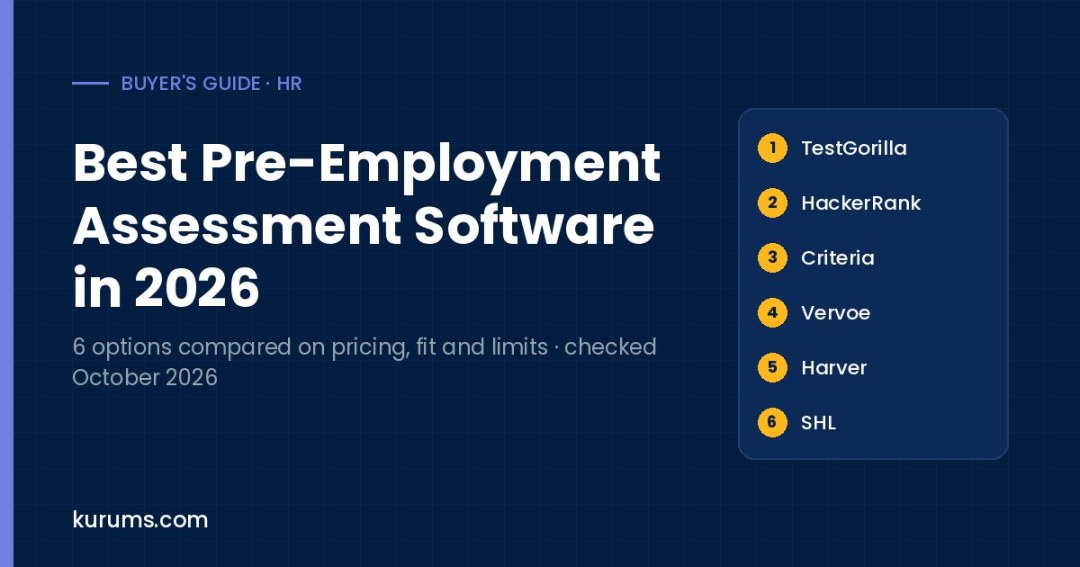
Six pre-employment assessment platforms compared on pricing, free plans and trials, test libraries, AI scoring and the hiring volumes they suit.
Buying learning instead of building it? These guides compare programmes from Coursera, Udemy, edX and LinkedIn Learning by price, time and credential.
Google’s Project Management certificate, PMP, CAPM, PRINCE2, Professional Scrum Master, IBM’s Project Manager certificate and Udemy PMP prep compared for 2026 — what each costs, how long it takes and who it suits.
Michigan’s Leading People and Teams, HEC Paris’s Inspirational Leadership, Harvard Online’s Leadership Principles, edX and Udemy picks: the eight leadership and management courses worth your time and money in 2026.
SHRM-CP, aPHR and PHR, HRCI’s Human Resource Associate certificate on Coursera, Minnesota’s HR Management specialization, people analytics and free options: the HR credentials worth earning online in 2026.
An L&D team finds the skills the business is short of, decides which gaps are worth closing with learning, builds or buys the right experience, and checks whether behaviour and results changed. In practice that covers onboarding, technical and compliance training, manager and leadership development, coaching and mentoring programmes, the learning platform, and reporting on impact.
It is a rule of thumb from research at the Center for Creative Leadership: about 70% of development comes from challenging work, 20% from other people such as managers, coaches and mentors, and 10% from formal courses. The ratios are not a formula. The useful point is that a course alone rarely changes performance unless practice and feedback on the job follow it.
Start with the Kirkpatrick levels: reaction, learning, behaviour and results. The Phillips model adds a fifth level that converts results into money: ROI % = (net programme benefits ÷ programme costs) × 100. Reserve a full ROI study for large, expensive or strategic programmes, and isolate the effect of training with a control group or trend line before claiming the benefit.
A training needs analysis (TNA) compares the capability the organisation needs with the capability it has, at three levels: the organisation (strategy and goals), the task or role (what good performance requires) and the person (who has a gap). It also separates skill gaps from problems training cannot fix, such as unclear goals, poor tools or weak incentives.
Not always. Under roughly 50 people, shared documents, a video library and a tracking spreadsheet often do the job. An LMS starts to pay for itself when you must prove compliance completion, onboard people every month, or deliver the same programme across several sites. Compare per-user pricing, content libraries and HRIS integrations before signing an annual contract.
Upskilling deepens skills for the job someone already has, for example a finance analyst learning automation tools. Reskilling prepares someone for a different job, for example a branch employee moving into a data role. Upskilling is usually run inside the team; reskilling needs a destination role, a longer learning path and a manager on the receiving side.