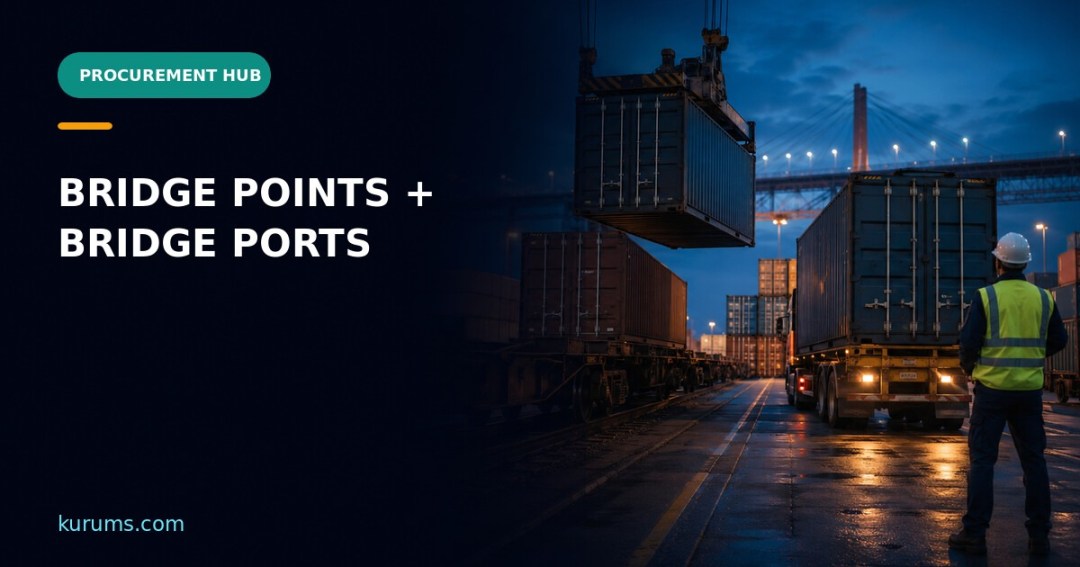
A BRIDGE POINT is an inland collection or transfer point, while a BRIDGE PORT is a port used to gather, containerise or relay cargo before the main sea movement. Procurement should specify the gateway role, custody, equipment, customs status, appointment and fallback route.
- Define whether the node is a collection point, inland terminal, port relay, consolidation site or customs location.
- Make road, rail, terminal, container, seal and document handoffs visible in one shipment timeline.
- Price congestion, missed appointments, storage, chassis, rehandling and customs exceptions before award.
- Use an alternate gateway and recovery route for critical lanes rather than relying on one bridge node.
A Bridge Node Connects More Than Two Modes
The SSDER glossary describes a BRIDGE POINT as an inland pre-carriage point where cargo for a port is collected, and a BRIDGE PORT as a pre-carriage port where cargo is gathered, containerised and moved onward. The modern equivalent may be an inland port, rail terminal, container freight station or port-adjacent consolidation hub.
The procurement risk is a missing boundary. A node may be called a bridge port but perform storage, customs, stuffing, inspection, transloading and final-mile dispatch. Each activity changes cost, custody and service expectations, so the tender must define the actual operating role.
Design the Handoff Map
Map the shipment from supplier pickup to bridge point, rail or truck transfer, bridge port, ocean terminal and final destination. For each leg, record the equipment owner, appointment, cut-off, seal, document set, customs status, scan event, dwell clock and responsible party.
Use one shipment or container identity across the map. If a bridge node creates a new container, pallet or waybill, preserve the parent-child relationship and transmit the mapping to the carrier, broker, terminal and receiving site.
Price Capacity and Congestion Risk
A gateway quote should separate linehaul, terminal handling, lift, drayage, chassis, storage, rehandling, inspection, documentation, fuel and emergency recovery. Ask for capacity commitments by day or sailing, not only a monthly average.
Model congestion and missed appointment scenarios. A low base rate can become expensive when the bridge node has limited gate hours, no chassis, weak rail frequency or a high storage tariff. The buyer should compare total landed cost and service recovery.
Control Customs and Security Status
If cargo moves in bond or under a customs-control regime, the bridge node must maintain the correct status, seal, movement record and proof of arrival. The broker and carrier should agree who submits each message and how a discrepancy is escalated.
Define the inspection, damage, seal break and exception process. A node should not open, consolidate or re-label cargo outside the approved scope. If it does, the contract must define evidence, security, customs and liability consequences.
Worked Example: The Inland Gateway That Became a Bottleneck
A shipper routes imported components through an inland bridge port to reduce coastal congestion. Rail frequency falls, chassis are unavailable and containers remain for four days. The buyer has no alternate gateway, no free-time rule and no evidence that the bridge port received the cargo in bond.
The corrected design sets a capacity floor, a dwell trigger, a second gateway, a chassis responsibility and a customs evidence matrix. The buyer keeps the bridge option but pays only for the service actually delivered and activates recovery when the clock expires.
Metrics and Governance
For bridge point bridge port procurement controls, measure both service and evidence quality. Useful indicators include first-pass acceptance, exception rate, response time, unplanned cost, document completeness, damage or discrepancy rate, and the percentage of shipments that follow the approved process. A dashboard should distinguish a supplier failure from a carrier, terminal, broker or internal master-data failure.
Review the metric trend with procurement, logistics, finance, quality and the responsible specialist. Use a monthly exception sample to test whether the control worked in a real transaction, not just whether a field was filled. Repeated exceptions should change the sourcing strategy, contract, lane design or supplier development plan.
Keep the control proportionate to risk. High-value, regulated, time-critical or safety-sensitive cargo needs stronger evidence and faster escalation than a routine shipment. Record the decision owner, approval date, source documents and follow-up action so the next buyer can understand the operating history.
Supplier and Carrier Questions
- Which BRIDGE POINT or related glossary condition is assumed in your quotation, procedure or service description?
- Which party owns each data field, physical handoff, inspection, document and exception?
- What evidence will be available before release, loading, movement, receipt, invoice approval or claim?
- What changes require advance notice, requalification, a revised price or a new risk decision?
- How will the supplier report incidents, delays, mismatches and corrective actions, and within what response time?
Implementation Sequence
Implement the control in a small, representative lane first. Capture the baseline process, test the required data and evidence, run a real transaction, and review every exception with the people who performed the work. Do not declare the control effective only because a supplier signed a procedure.
After the first three shipments or operating cycles, update the purchase-order clause, work instruction, scorecard and training. Scale the control to other suppliers only when the evidence is repeatable and the owner can explain what happens when the normal path fails.
Common Mistakes to Avoid
- Using bridge point and bridge port as vague synonyms for any warehouse or terminal.
- Breaking the container or shipment identity at the intermodal handoff.
- Ignoring chassis, gate, appointment, storage and rehandling exposure.
- Leaving customs status, seal control and proof of arrival to informal emails.
- Selecting one gateway without a capacity floor or recovery route.
Procurement Implementation Checklist
- Define the bridge node's physical, commercial and customs role.
- Map every road, rail, terminal, container and document handoff.
- Set capacity, appointment, dwell, free-time and recovery rules.
- Allocate chassis, lift, storage, inspection and rehandling costs.
- Preserve shipment identity, seal, customs and proof-of-arrival evidence.
- Test an alternate gateway and route during the award process.
Frequently Asked Questions
What is a bridge point?
It is an inland collection or transfer point used to gather cargo before it moves to a port or another transport leg.
What is a bridge port?
It is a port or inland gateway used to gather, containerise or relay cargo before its onward movement.
Is an inland port always a bridge port?
Not necessarily. Define the actual services, custody and customs role rather than relying on the label.
Who owns a seal break at a bridge node?
The contract should assign custody, inspection, notification, re-sealing and claims responsibility at each handoff.
Which gateway metric matters most?
Track end-to-end dwell, on-time handoff, capacity acceptance, storage, exceptions and recovery cost by gateway and lane.
Related Kurums Guides
- Freight Rates and Surcharges
- Shipping Documents for Procurement
- Freight Network Design
- Freight Contracts and Parties
- CFR vs CIF vs CIP
- Transfer Centers and Cross-Dock Handoffs
Standards and Authoritative Sources
- U.S. FHWA — Freight intermodal connectors
- U.S. FHWA — Freight intermodal distribution
- FIATA — Freight forwarding resources
Glossary terms covered: BRIDGE POINT, BRIDGE PORT, intermodal gateway, transfer, inland port, last mile, handoff
Kurums.com · Procurement, sourcing and business operations
Discover more from Kurums | Business Intelligence
Subscribe to get the latest posts sent to your email.