
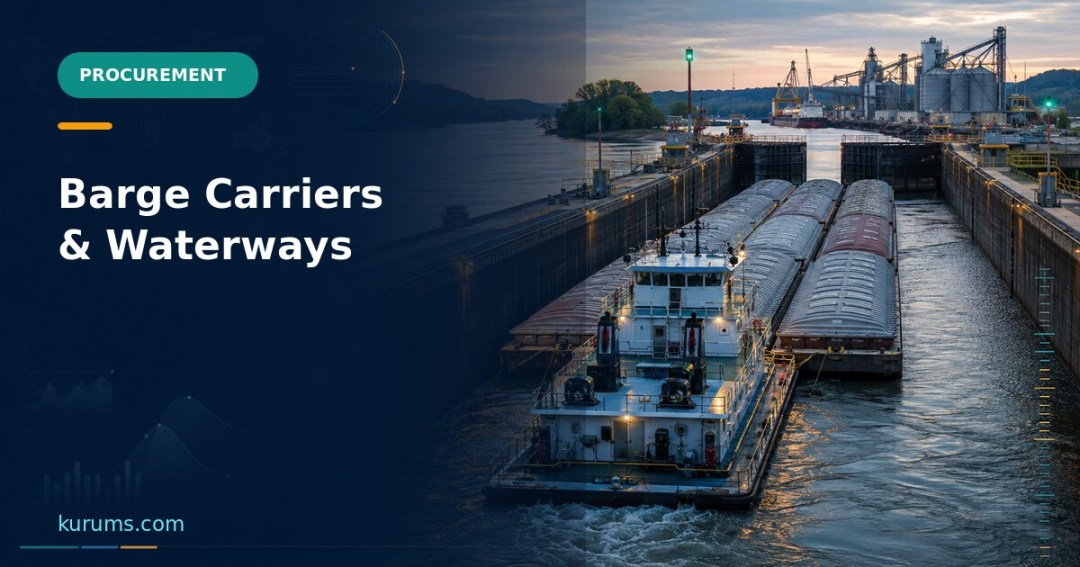
Barge procurement is a network and terminal decision, not just a water rate. Buyers must match cargo, tow configuration, draft, locks, fleeting, loading and discharge equipment, weather windows and custody evidence to the actual inland-waterway route.
- Price the complete waterway movement, including origin handling, fleeting, locks, terminal and final cartage.
- Validate draft, tow size, channel, bridge, lock and seasonal constraints against the route and commodity.
- Define who owns cargo condition, contamination, shortage, delay and demurrage at each terminal handoff.
- Use a lane-specific barge scorecard that balances cost, reliability, safety and environmental performance.
What Makes Barge Procurement Different
The SSDER glossary defines barge carriers as vessels designed to move barges and identifies inland transport concepts such as bridge points, cartage and bulk cargo. A barge movement often combines towboat, non-self-propelled barges, fleeting areas, locks, terminals and a final truck or rail leg. The cheapest water rate can lose its advantage if a transfer point or lock creates a long dwell.
USACE describes inland navigation as a system that moves large volumes of bulk commodities through channels, locks and dams. Procurement should therefore buy a service envelope: origin access, tow availability, water depth, terminal throughput, documentation, contingency and final delivery—not a single port-to-port number.
Specify Capacity, Draft and Tow Configuration
A barge RFQ should state cargo type, density, package or bulk form, target tonnage, loading rate, discharge method, draft limit, air-draft or bridge restrictions, covered or open equipment, heating or cleaning requirements and acceptable tow configuration. Ask the carrier to confirm whether the quoted capacity is per barge, per tow or per sailing window.
Seasonal water levels can change draft and payload. The contract should define the measurement source, notice period and commercial response if the tow must be light-loaded, split or delayed. A buyer should compare the cost of a smaller reliable tow with the cost of a large tow that cannot safely clear the route.
Control Terminals and Handoffs
The barge carrier may not control the origin elevator, fleeting area, lock queue, bridge point or destination terminal. Define the handoff record for quantity, seal, condition, temperature, contamination, sampling and time. The receiving party should sign an ATF-like custody record where the operating model needs one, even when the cargo is bulk.
Terminal appointment, unloading rate, storage capacity and cleaning standards should be priced and measured. If a barge waits because the destination terminal is full, the contract must say whether the delay is carrier, terminal, buyer or force-majeure exposure and what evidence proves the cause.
Evaluate Safety, Equipment and Continuity
Ask for towboat and barge particulars, inspection status, maintenance plan, navigation experience, emergency response, cargo compatibility and incident history. For sensitive or regulated materials, require the relevant safety plan, cleaning certificate and transfer procedure. BargeHIRE or another suitable charter form may help allocate control, but the parties still need cargo-specific clauses.
Continuity planning should identify alternate terminals, substitute barges, truck or rail relief capacity, low-water triggers, ice or flood actions and communication times. An annual rate is not resilient if the buyer has no approved response when the waterway closes or the terminal loses power.
Worked Example: Low Water Changes the Economics
A buyer awards a six-barge movement for bulk raw material based on a full-load rate. Low water reduces allowable draft, so the carrier proposes a four-barge tow with two partial loads. The origin terminal cannot hold the overflow and the final truck leg becomes an emergency purchase.
The better contract defined a low-water trigger, payload measurement, overflow terminal, priority windows and a pre-priced relief mode. The sourcing analysis compared normal and constrained scenarios, and the scorecard measured delivered tons per day, delay cost and variance to the agreed route plan.
Metrics and Governance
For barge carriers procurement, measure both service and evidence quality. Useful indicators include first-pass acceptance, exception rate, response time, unplanned cost, document completeness, damage or discrepancy rate, and the percentage of shipments that follow the approved process. A dashboard should distinguish a supplier failure from a carrier, terminal, broker or internal master-data failure.
Review the metric trend with procurement, logistics, finance, quality and the responsible specialist. Use a monthly exception sample to test whether the control worked in a real transaction, not just whether a field was filled. Repeated exceptions should change the sourcing strategy, contract, lane design or supplier development plan.
Keep the control proportionate to risk. High-value, regulated, time-critical or safety-sensitive cargo needs stronger evidence and faster escalation than a routine shipment. Record the decision owner, approval date, source documents and follow-up action so the next buyer can understand the operating history.
Supplier and Carrier Questions
- Which BARGE CARRIERS or related glossary condition is assumed in your quotation, procedure or service description?
- Which party owns each data field, physical handoff, inspection, document and exception?
- What evidence will be available before release, loading, movement, receipt, invoice approval or claim?
- What changes require advance notice, requalification, a revised price or a new risk decision?
- How will the supplier report incidents, delays, mismatches and corrective actions, and within what response time?
Implementation Sequence
Implement the control in a small, representative lane first. Capture the baseline process, test the required data and evidence, run a real transaction, and review every exception with the people who performed the work. Do not declare the control effective only because a supplier signed a procedure.
After the first three shipments or operating cycles, update the purchase-order clause, work instruction, scorecard and training. Scale the control to other suppliers only when the evidence is repeatable and the owner can explain what happens when the normal path fails.
Common Mistakes to Avoid
- Comparing only the line-haul water rate.
- Ignoring draft, lock, bridge and seasonal channel restrictions.
- Failing to define bulk quantity and condition evidence at each handoff.
- Assuming a charter form covers terminal, cleaning and relief-mode decisions.
- Waiting until a low-water event to identify substitute capacity.
Procurement Implementation Checklist
- Map every waterway, lock, terminal, fleeting and final cartage handoff.
- Specify commodity, density, tonnage, draft, tow size and equipment type.
- Define low-water, weather, closure, overflow and substitute-service triggers.
- Require condition, quantity, cleaning and transfer records.
- Price normal, constrained and emergency delivery scenarios.
- Score reliability, safety, cost, emissions and terminal performance together.
Frequently Asked Questions
What is a barge carrier?
It is a carrier or vessel operator providing movement by barge, often using a towboat and one or more non-self-propelled barges.
Why does draft matter?
Draft determines how deeply the equipment sits in the water and therefore how much cargo can be carried safely on a particular channel and water level.
Who owns a terminal delay?
The contract should allocate it by cause and evidence. A full destination terminal, a lock closure and a carrier equipment failure are different events.
Is BargeHIRE suitable for every barge movement?
No. BIMCO describes BargeHIRE as a bareboat charter party for unmanned, non-self-propelled seagoing barges. Obtain legal and operational advice for the actual service.
How should barge performance be measured?
Use delivered tons per day, schedule reliability, low-water recovery, condition/quantity exceptions, total landed cost and safety or environmental indicators.
Related Kurums Guides
- Customs EDI and Entry Data
- Freight Rates and Surcharges
- Freight Contracts and Parties
- Freight Network Design
- Bulk Cargo Procurement
- Rail and Port Intermodal Equipment
Standards and Authoritative Sources
- USACE — Inland Navigation Fast Facts
- USACE — Inland Waterways Value to the Nation
- BIMCO — BARGEHIRE 2021
Glossary terms covered: BARGE CARRIERS, BARGE, BARGEHIRE, CARGO, CARTAGE, BRIDGE POINT, BULK CARGO
Kurums.com · Procurement, sourcing and business operations
Discover more from Kurums | Business Intelligence
Subscribe to get the latest posts sent to your email.