
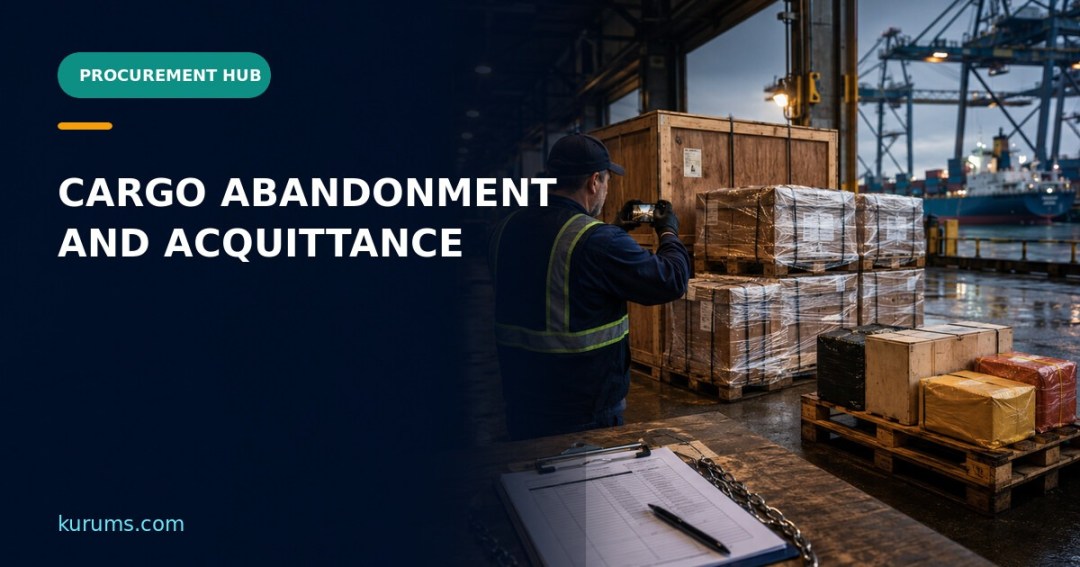
Abandoning cargo and signing an acquittance are different decisions. Procurement should first establish title, customs status, custody, condition, value, insurance and disposal authority; then document whether goods are released, re-exported, salvaged, destroyed or accepted in full and final settlement.
- Separate a commercial decision to stop pursuing cargo from a legal or customs process for unclaimed merchandise.
- Confirm ownership, liens, customs status, dangerous-goods risk, insurance notification and disposal authority before acting.
- Use acquittance language only after the settlement scope, payment, exclusions and evidence are reviewed by the responsible specialists.
- Keep a chain of custody and final disposition record that closes inventory, finance, claims and compliance obligations together.
Abandonment Is Not an Informal Write-Off
The SSDER glossary defines ABANDON as the shipper or consignee leaving the goods. In a live supply chain, that phrase can conceal several different events: a buyer declining delivery, an importer failing to clear cargo, a carrier placing goods into a general-order process, or an owner authorising a disposal or salvage route. Each event has different authority and cost consequences.
Procurement should open a controlled disposition case rather than send an email saying “abandon.” Identify the shipment, owner, importer of record, carrier, terminal, customs status, storage clock, cargo condition, commercial value and contractual decision-maker before any irreversible instruction.
Define Acquittance and the Settlement Boundary
An acquittance is evidence that a party releases or gives up claims against cargo or a counterparty. It should not be treated as a generic receipt. The document needs a defined claim, parties, consideration, released period, cargo or shipment scope, exclusions, governing law and authority to sign.
Finance, insurance, legal and operations should agree whether the release covers physical loss, delay, storage, duty, salvage, warranty, fraud or unknown claims. If the buyer receives a credit but retains a latent-damage claim, the exception must be written rather than assumed.
Run the Disposition Decision Gate
The case owner should compare hold and clear, customs abandonment, re-export, return to supplier, sale or salvage, destruction, donation and delivery under reservation. For each option, record customs approval, environmental or dangerous-goods controls, storage and handling cost, recovery value, timing, data destruction and beneficiary or customer impact.
Do not let a low invoice value make the decision automatically. A small shipment can contain regulated material, confidential equipment, counterfeit risk or a part needed for production. The right option is the one that closes legal, safety, financial and operational exposure together.
Preserve Chain of Custody and Evidence
Retain the purchase order, bill of lading, arrival notice, customs record, terminal notices, photographs, survey, temperature or condition logs, correspondence, title documents, approvals, disposal certificate, salvage offer and final receipt. Link every record to one shipment and disposition ID.
CBP’s public material on unclaimed or abandoned merchandise illustrates why customs custody and disposition cannot be handled only as a commercial negotiation. The applicable authority, port and country determine the route; procurement should preserve the evidence and obtain the required instruction rather than improvise.
Worked Example: Credit Accepted, Claim Accidentally Released
A consignee refuses a wet shipment and negotiates a 40% credit with the carrier. The carrier sends an acquittance that broadly releases all claims, while the buyer is still investigating whether the packaging defect affected a second shipment. The buyer signs to stop storage charges and later discovers the release is wider than intended.
The corrected process defines the affected shipment, credit amount, known damage, reserved rights and final disposition before signature. Operations photographs and surveys the cargo, customs status is confirmed, and the settlement is linked to the inventory and insurance record.
Metrics and Governance
For cargo abandonment and acquittance controls, measure both service and evidence quality. Useful indicators include first-pass acceptance, exception rate, response time, unplanned cost, document completeness, damage or discrepancy rate, and the percentage of shipments that follow the approved process. A dashboard should distinguish a supplier failure from a carrier, terminal, broker or internal master-data failure.
Review the metric trend with procurement, logistics, finance, quality and the responsible specialist. Use a monthly exception sample to test whether the control worked in a real transaction, not just whether a field was filled. Repeated exceptions should change the sourcing strategy, contract, lane design or supplier development plan.
Keep the control proportionate to risk. High-value, regulated, time-critical or safety-sensitive cargo needs stronger evidence and faster escalation than a routine shipment. Record the decision owner, approval date, source documents and follow-up action so the next buyer can understand the operating history.
Supplier and Carrier Questions
- Which ABANDON or related glossary condition is assumed in your quotation, procedure or service description?
- Which party owns each data field, physical handoff, inspection, document and exception?
- What evidence will be available before release, loading, movement, receipt, invoice approval or claim?
- What changes require advance notice, requalification, a revised price or a new risk decision?
- How will the supplier report incidents, delays, mismatches and corrective actions, and within what response time?
Implementation Sequence
Implement the control in a small, representative lane first. Capture the baseline process, test the required data and evidence, run a real transaction, and review every exception with the people who performed the work. Do not declare the control effective only because a supplier signed a procedure.
After the first three shipments or operating cycles, update the purchase-order clause, work instruction, scorecard and training. Scale the control to other suppliers only when the evidence is repeatable and the owner can explain what happens when the normal path fails.
Common Mistakes to Avoid
- Using “abandon” as a casual synonym for cancelling a purchase order.
- Disposing of cargo without confirming title, customs, environmental or dangerous-goods authority.
- Signing an acquittance before defining the shipment, payment, exclusions and released claims.
- Ignoring storage, salvage, duty, data destruction and beneficiary consequences.
- Closing finance or inventory without a final disposition and chain-of-custody record.
Procurement Implementation Checklist
- Open a disposition case with shipment, owner, importer, carrier and custody details.
- Confirm title, liens, customs status, insurance notice and specialist approvals.
- Compare hold, return, re-export, salvage, destruction and delivery options.
- Define acquittance scope, consideration, exclusions and signatory authority.
- Preserve notices, photographs, surveys, approvals and final-disposition evidence.
- Close inventory, finance, claims, customs and supplier records together.
Frequently Asked Questions
What does cargo abandonment mean?
It can describe a decision not to collect or pursue goods, but the legal and customs process depends on the country, port, title and shipment status.
What is an acquittance?
It is a document or statement releasing defined claims or acknowledging settlement. Its scope must be reviewed before signature.
Can a buyer destroy imported cargo?
Not automatically. Confirm customs, environmental, dangerous-goods, title, insurance and local disposal requirements first.
Should an acquittance release unknown damage?
Only if that is an intentional, reviewed settlement outcome. State known losses, reservations and exclusions explicitly.
Who owns the disposition case?
Assign one case owner, but require customs, legal, insurance, finance, quality and operations approvals appropriate to the risk.
Related Kurums Guides
- Cargo Insurance and Claims
- Freight Rates and Surcharges
- Freight Contracts and Parties
- Customs Documents for Procurement
- Customs EDI and Entry Data
- Container Cells and Cell Guides
Standards and Authoritative Sources
- CBP — Unclaimed or abandoned merchandise
- CBP — Form 7553, notice to export, destroy or return merchandise
- CBP — General Order and unclaimed merchandise
Glossary terms covered: ABANDON, ACQUITTANCE, cargo release, disposal, salvage, customs custody, claim closure
Kurums.com · Procurement, sourcing and business operations
Discover more from Kurums | Business Intelligence
Subscribe to get the latest posts sent to your email.