
Taste Note - Amazon Operations Best Sellers
Gemba Kaizen: Continuous Improvement Where the Work Actually Happens
A Kurums Book Taste review of Gemba Kaizen for procurement and operations leaders who want low-cost, commonsense improvement instead of big-budget transformation.
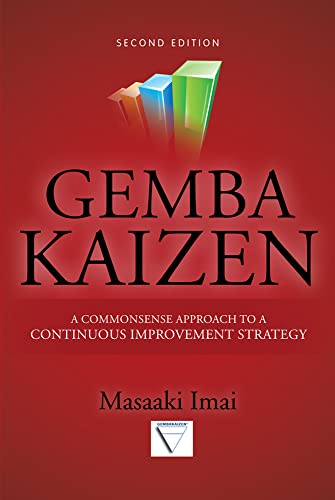
Why this book fits Kurums
Imai coined 'kaizen' for Western readers and this book plants it where it belongs: the gemba, the real place where value is created - the shop floor, the warehouse dock, the service desk. Its thesis is that most improvement requires common sense and discipline rather than capital: standardize, keep the workplace in order with 5S, eliminate muda, and improve in small daily steps that compound.
For the Kurums Procurement audience the book works twice. Inside your own operation it is the playbook for receiving, inspection, and logistics improvements that need no budget approval. Outward, it is a supplier-audit lens: a vendor's gemba tells you more about future quality and delivery than any certificate - if you know how to read standards, housekeeping, and whether problems surface or hide.
What the book argues
The foundational argument is that improvement lives at the gemba and management's job is to go there. Decisions made from reports are decisions made from abstractions; Imai's golden rules - when a problem arises, go to the gemba first, check the actual objects, take temporary countermeasures on the spot, find root cause, standardize to prevent recurrence - form a management style, not a technique. The enemy is the office-bound executive for whom the workplace is a cost to be squeezed rather than the source of all data.
The methodological core is the house of gemba: standardization, 5S workplace organization, and muda elimination as the three load-bearing activities. Standards are the baseline of improvement - without a standard there is no deviation, and without deviation nothing to improve. 5S (sort, straighten, scrub, systematize, sustain) is not housekeeping theater but the discipline that makes abnormality visible in seconds. Muda hunting targets the seven wastes - overproduction, inventory, waiting, transport, motion, over-processing, defects - and Imai insists the biggest gains are embarrassingly cheap: most case studies in the book spent almost nothing and recovered double-digit capacity.
The organizational argument is that kaizen is a culture with infrastructure, not an event. Quality circles, suggestion systems that respond within days, supervisors trained as teachers, and visual management that lets anyone see normal-versus-abnormal at a glance - these institutions make a thousand small improvements routine. Imai contrasts this with Western innovation-only habits: dramatic projects that spike performance which then erodes, versus small steps that never retreat because each is locked in by a new standard. The chapters on applying kaizen in services and the supplier-development cases argue the method travels anywhere work has a sequence.
Key ideas, translated to your desk
Go see, don't ask for a summary
Root causes are visible at the workplace and invisible in reports. Make gemba walks - yours and your suppliers' - a scheduled habit with a checklist, not a crisis response.
No standard, no improvement
Every process needs a current best-known method, written and visible. Deviation from standard is your improvement signal; without it you only have opinions.
Buy capacity with discipline, not capital
The seven wastes hide 20-30 percent of capacity in most operations. Hunt muda before approving any expansion request - the cheapest plant is the one you already run properly.
Use it at work
- Schedule monthly gemba walks for your own receiving, warehousing, and fulfillment areas - golden rules in hand.
- Add a gemba audit to supplier qualification: 5S state, visible standards, how abnormalities surface. Weight it alongside price.
- Run one muda hunt per quarter on a core process; log recovered hours and avoided capex.
- Install a suggestion system with a 72-hour response rule - the response speed, not the reward size, determines participation.
Read it if
- You run or buy from physical operations - plants, warehouses, logistics, service centers.
- You want improvement methods that need discipline rather than budget.
- You audit suppliers and want to read a facility beyond its certificates.
You can skip it if
- Your work is purely digital product - read The DevOps Handbook for the same philosophy in software.
- You want lean's strategic treatment - pair this with a value-stream text; Imai stays deliberately at the workplace.
- You expect novelty - the power here is codified common sense, consistently applied.
This book appears in
Curated Tasting Menus that chain this title into a reading route.
Discover more from Kurums | Business Intelligence
Subscribe to get the latest posts sent to your email.