
Taste Note - Amazon Corporate Finance Best Sellers
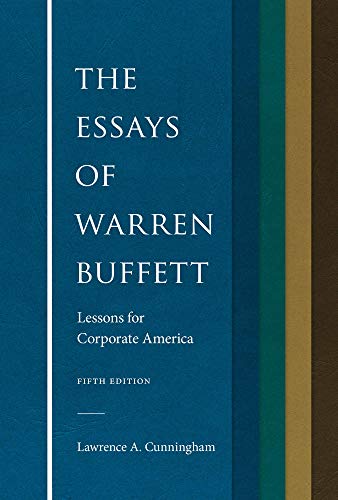
The Essays of Warren Buffett: The Shareholder Letters as a Finance Leader's Manual
A Kurums Book Taste review of The Essays of Warren Buffett for CFOs and finance leaders who want a coherent philosophy of capital allocation, reporting and owner-minded management.
Why this book fits Kurums
Warren Buffett's annual letters to Berkshire Hathaway shareholders are among the most widely read documents in finance, but read year by year they are scattered across decades. Lawrence Cunningham rearranged them by theme, so the reader gets Buffett's views on governance, capital allocation, acquisitions, valuation and accounting as one connected body of thinking rather than a stack of annual reports.
For the Kurums Finance audience, this is the closest thing to a manual for thinking like an owner instead of a reporter of numbers. It covers questions a CFO faces every year: when to buy back stock, when to retain earnings, how to judge an acquisition, which accounting measures to trust and how to talk honestly to shareholders.
What the book argues
The book opens with Buffett's owner-related business principles. Shareholders are partners, managers should think and report as owners, and the goal is to increase intrinsic value per share over the long run rather than size or reported earnings. Governance follows from that: boards should act for owners, compensation should reward real performance, and candor in reporting, including about mistakes, builds the trust a company needs.
The central sections deal with capital. Buffett argues that every retained dollar must earn its keep, so a business should keep earnings only if it can create at least a dollar of market value for each dollar kept. Share repurchases make sense only when the price is below intrinsic value. Acquisitions are judged by what the buyer gives up, not by growth, and he is blunt about how often deals destroy value for the acquirer, especially when paid for with undervalued stock.
The later essays turn to valuation and accounting. Buffett separates intrinsic value from book value and market price, explains economic goodwill versus accounting goodwill, and introduces owner earnings as a better gauge than reported profit. He criticizes measures that ignore real costs, such as treating depreciation as irrelevant, and argues that a manager who cannot explain the numbers simply probably does not understand them.
Key ideas, translated to your desk
Retain only what you can compound
Test retained earnings against the market value they create. If a dollar kept is worth less than a dollar to shareholders, return it.
Buybacks are a price decision
Repurchase shares only when they trade below a conservative estimate of intrinsic value, never to support the price or offset dilution by habit.
Owner earnings over headline profit
Look at cash the business generates after the reinvestment needed to keep its position. It is a more honest number than EBITDA for planning and valuation.
Use it at work
- Add an intrinsic-value estimate and a hurdle test to every share repurchase proposal you bring to the board.
- Report owner earnings alongside reported earnings in your internal management pack.
- Write a post-mortem for your last two acquisitions comparing value received with value given, including stock issued.
- Draft this year's shareholder or investor letter with one section that openly explains a mistake.
Read it if
- You allocate capital, approve buybacks or evaluate acquisitions.
- You want a single source of Buffett's thinking instead of decades of separate letters.
- You liked The Outsiders and want the philosophy of its best-known capital allocator in his own words.
You can skip it if
- You want a technical corporate finance textbook with models and formulas.
- You need guidance on short-term trading or market timing.
- You have already read every Berkshire letter closely and in order.
This book appears in
Curated Tasting Menus that chain this title into a reading route.
Discover more from Kurums | Business Intelligence
Subscribe to get the latest posts sent to your email.