Buyer's guide · Accounting
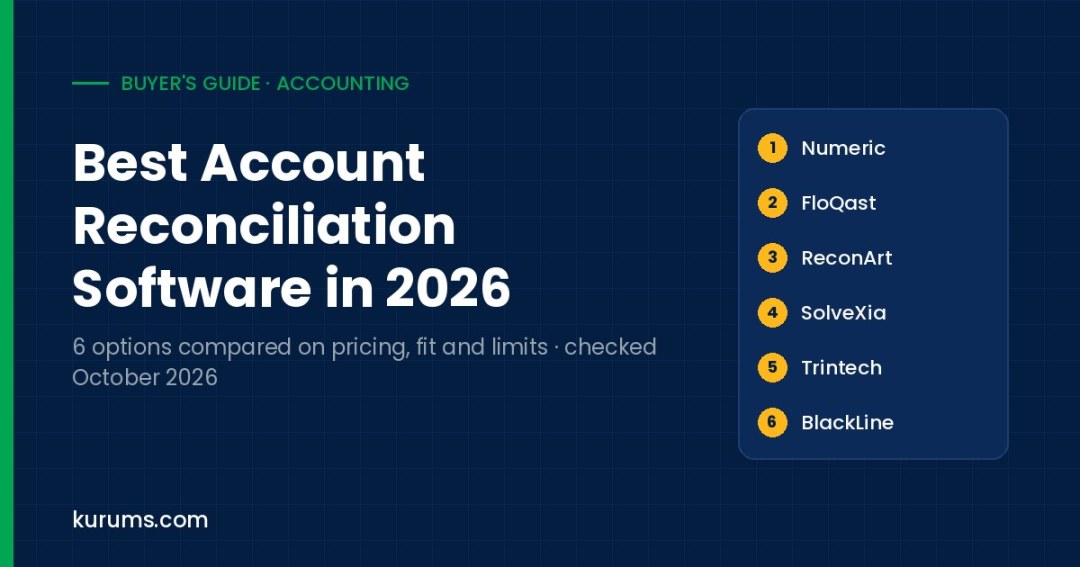
We compared six account reconciliation platforms on pricing model, trial access, reconciliation automation, transaction matching, ERP integrations and audit controls, and noted the main limitation each finance team should test.
- Fast-growing mid-market teams: Numeric — Combines auto-reconciliations, flux analysis and close checklists with live NetSuite, QBO, Xero and Sage Intacct integrations.
- Accountant-led close teams: FloQast — Pricing has no per-user fees, and Close AI adds AI matching and automated reconciliations to the close checklist.
- High-volume matching needs: ReconArt — Essentials edition matches up to 25 million transactions a year with a fixed 60 or 80-hour implementation.
- Operations-heavy data reconciliations: SolveXia — Matching engine with fuzzy logic and AI rules covers bank, payment, intercompany and NAV reconciliations.
- Large and public enterprises: BlackLine — Verity Prepare AI agent prepares reconciliations, with high-frequency matching for daily or on-demand reconciling.
Account reconciliation software compares general ledger balances with supporting evidence such as bank statements, subledgers, schedules and third-party data, then routes differences for investigation, review and sign-off. It replaces spreadsheets and shared drives with standardized templates, automated matching, risk-based review and an audit trail for each account. Most products also cover the wider month-end close: checklists, journal entries, variance or flux analysis and intercompany matching. Buyers are controllers, assistant controllers and close managers at mid-market and enterprise companies, especially those adding entities, preparing for an audit or IPO, or operating under SOX. Shared service centers and finance operations teams with high transaction volumes are also core users.
We assessed each product on six fields: published pricing, free plan or trial, reconciliation automation, transaction matching, ERP integrations, and the main limitation. Products are listed in practical buyer order, from mid-market and accountant-led tools to enterprise platforms, and the order is not a quality ranking. Prices and plans were checked on official vendor pages on 12 October 2026. None of the six vendors publishes a price for reconciliation software, so each is marked Quote-based, and we describe the pricing basis where the vendor states one.
Account Reconciliation Software compared at a glance
| Platform | Pricing | Best for | Link |
|---|---|---|---|
| 1. Numeric | Quote-based; priced on transactions and seats | Mid-market teams on NetSuite | Site → |
| 2. FloQast | Quote-based; no per-user fees | Accountant-friendly close and reconciliations | Site → |
| 3. ReconArt | Quote-based annual editions; fixed 60 or 80-hour implementation | High-volume transaction matching | Site → |
| 4. SolveXia | Quote-based; free 30-minute consultation | Complex, multi-source data reconciliations | Site → |
| 5. Trintech (Adra and Cadency) | Quote-based for Adra and Cadency; demo | Mid-enterprise to global R2R programs | Site → |
| 6. BlackLine | Quote-based; demo | Large finance operations and SOX | Site → |
Pricing checked 12 October 2026 on each vendor's official pricing or product pages. Prices are list prices in USD unless stated; "Quote-based" means the vendor does not publish a price. Order follows buyer fit and pricing transparency, not a quality score. Confirm billing basis, minimums and taxes with the vendor before you buy. Methodology is described below.
The 6 options in detail
Numeric
Best for mid-market teams on NetSuiteBest for: Fast-growing companies on NetSuite, QuickBooks Online, Xero or Sage Intacct that want reconciliations, flux and close tracking in one modern tool.
| Attribute | Numeric |
|---|---|
| Published pricing | No: custom pricing based on factors from transaction count to seats |
| Free plan or trial | No free plan or trial listed; demo |
| Reconciliation automation | Automated balance sheet reconciliations with exception-only review; transaction monitors flag anomalies |
| Transaction matching | Cash management matching with flexible rules on any field; vendor cites up to 95% of bank transactions |
| ERP integrations | NetSuite, QuickBooks Online, Xero and Sage Intacct; live ERP integrations |
| Main limitation | Several advanced features require its ERP Replacement product |
- Close checklists, reconciliations, flux analysis and reporting sit together, so reviewers see variances and reconciliations in the same place.
- Each module can be bought separately and added to your existing ERP, so you can start with close management only.
- Pricing is not published, and features such as agentic subledgers and App Studio require the ERP Replacement product.
Our take: Numeric is a newer financial data platform that many teams adopt first for close management. Its Close Management and Analytics product includes a close checklist, live ERP integrations, automated reconciliations, transaction monitoring, flux analysis and review notes. Cash Management adds bank transaction matching with flexible rules, and the vendor says it can match up to 95% of bank transactions. Named integrations are NetSuite, QuickBooks Online, Xero and Sage Intacct, which fits venture-backed and mid-market companies. Pricing is custom and considers transaction volume and seats. In a demo, connect a sandbox ERP and watch how a reconciliation updates when a late journal entry posts, and check the review trail for SOX. Compared with FloQast, Numeric leans more toward analytics and AI drafting of flux explanations. Compared with BlackLine or Trintech, it is lighter to deploy but has fewer enterprise-scale connectors listed for SAP or Oracle.
FloQast
Best for accountant-friendly close and reconciliationsBest for: Mid-size and enterprise accounting teams that want a structured close checklist, reconciliations and controls without per-user pricing.
| Attribute | FloQast |
|---|---|
| Published pricing | No: Close Management, Close AI and Risk and Compliance packages are quote-based; no per-user fees |
| Free plan or trial | No free plan or trial listed |
| Reconciliation automation | Account reconciliations in Close Management; Close AI adds automated amortization, depreciation and subledger recs |
| Transaction matching | AI matching in the Close AI package; AI variance analysis drafts flux explanations |
| ERP integrations | NetSuite, Sage Intacct, SAP, Workday, Microsoft and Xero |
| Main limitation | AI matching and automated reconciliations require the higher Close AI package |
- Pricing is based on outcomes rather than seats, so adding reviewers or auditors does not raise license cost.
- Risk and Compliance can be bought alone or added to a Close package for controls, audit readiness and testing.
- AI matching and automated reconciliations sit in the Close AI package, so the base package relies more on manual preparation.
Our take: FloQast is built around how accountants already work, with a close checklist that ties tasks to reconciliations and supporting files. The Close Management package covers the checklist, account reconciliations, accounting operations and ERP integration, while Close AI adds AI agents, AI matching, automated reconciliations for amortization, depreciation and subledgers, and journal entry posting. A separate Risk and Compliance package handles controls and audit readiness. The pricing page states there are no per-user fees. Integrations listed include NetSuite, Sage Intacct, SAP, Workday, Microsoft and Xero. In a demo, ask to see how a bank reconciliation is prepared in each package and how review sign-offs are recorded for auditors. Compared with Numeric, FloQast has a longer track record with audit-driven teams; compared with BlackLine, it is generally positioned for faster adoption by teams without dedicated system administrators.
ReconArt
Best for high-volume transaction matchingBest for: Finance and operations teams that need configurable, high-volume transaction matching plus period-end certification under one annual subscription.
| Attribute | ReconArt |
|---|---|
| Published pricing | No: Essentials, Plus, Certify and Close editions on annual subscription; prices by quote |
| Free plan or trial | No free plan or trial listed; scoping call or demo |
| Reconciliation automation | Certify edition covers period-end balance sheet reconciliation, certification and approval workflows |
| Transaction matching | Essentials matches up to 25 million transactions a year; Plus up to 50 million with certification |
| ERP integrations | Configurable data imports; NetSuite use case published on the vendor blog |
| Main limitation | Close modules such as task management and variance analysis must be chosen in combinations of two or more |
- Published edition capacities of 25 million and 50 million transactions a year make volume planning easier.
- A fixed-scope 60 or 80-hour implementation package and two major releases a year with no upgrade fees keep costs predictable.
- Dollar prices are not published, and the edition structure means you need to scope matching versus certification needs carefully.
Our take: ReconArt is a long-standing reconciliation platform with a clear edition structure. Essentials covers transaction matching and exceptions management for up to 25 million transactions a year. Plus adds period-end balance sheet reconciliation and certification with capacity for 50 million transactions. Certify focuses on balance sheet certification with approval workflows, and Close lets you combine certification, task management, variance analysis and journal entry modules. All editions are annual subscriptions with support and upgrades included, and implementation is a fixed 60 or 80-hour package using a train-the-trainer approach. That suits teams that want predictable rollout costs and in-house ownership. In a demo, load a real bank and card file and see how matching rules handle partial and many-to-one matches. Compared with SolveXia, ReconArt is more reconciliation-specific; compared with BlackLine or Trintech, it is lighter on enterprise close orchestration.
SolveXia
Best for complex, multi-source data reconciliationsBest for: Finance and operations teams in financial services, retail, travel and health that reconcile large volumes from many data sources.
| Attribute | SolveXia |
|---|---|
| Published pricing | No: quote-based; pricing page offers a demo and consultation |
| Free plan or trial | No free plan or trial; free one-on-one consultation |
| Reconciliation automation | Covers bank, payment, GL, balance sheet, AP/AR, intercompany, credit card and NAV/holdings reconciliations |
| Transaction matching | Matching engine with simple and complex rules, fuzzy logic and AI-powered matching rules |
| ERP integrations | Pulls bank feeds, ERP data, invoices and payment files; specific connectors not named on the page |
| Main limitation | Less focused on close checklists and SOX certification than close-management suites |
- Fuzzy logic and AI matching rules help with messy data such as payment references that do not match invoice numbers exactly.
- A 7-Eleven case study cited by the vendor reconciles about 500,000 transactions a day.
- It is a broader finance automation platform, so close task management and certification depth should be checked against FloQast or BlackLine.
Our take: SolveXia is a finance automation platform with a strong reconciliation use case. Its matching engine supports simple and complex rules, fuzzy logic and AI-powered matching, and the vendor lists bank, payment, GL, balance sheet, AP and AR, intercompany, credit card and NAV or holdings reconciliations. It is used in financial services, fintech, retail, travel and health, and cites a 7-Eleven case reconciling around 500,000 transactions daily. Workflows, approvals and audit trails are built in, and dashboards surface discrepancies. Pricing is quote-based; the pricing page offers a demo and a free consultation, and the vendor states a 6 to 12 month return on investment, which you should test against your own volumes. In a demo, bring two messy data sources such as a payment processor file and bank statement. Compared with ReconArt it is broader, covering reporting and other processes; compared with Numeric or FloQast, it is less centered on the month-end checklist.
Trintech (Adra and Cadency)
Best for mid-enterprise to global R2R programsBest for: Finance teams that want a reconciliation vendor with two tiers: Adra for faster deployment and Cadency for large, complex, public or global companies.
| Attribute | Trintech (Adra and Cadency) |
|---|---|
| Published pricing | No: quote-based for both Adra and Cadency |
| Free plan or trial | No free plan or trial listed |
| Reconciliation automation | Adra Balancer auto-reconciles with variance thresholds; Cadency standardizes reconciliation workflows with risk alerts |
| Transaction matching | Adra Matcher for multi-way matching; Cadency auto-match with exceptions and intercompany matching |
| ERP integrations | Cadency: SAP-certified connector, pre-built Oracle ERP and NetSuite connectors, APIs; Workday JE routing case |
| Main limitation | Two separate products, so confirm which one fits your size and scope |
- Cadency has an SAP-certified connector and pre-built Oracle and NetSuite connectors for large ERP estates.
- Adra auto-reconciles accounts within customizable variance thresholds, which reduces review effort on low-risk accounts.
- Pricing is not published for either product, and choosing between Adra and Cadency requires scoping with sales.
Our take: Trintech offers two reconciliation platforms. Adra is designed to be quick to implement: Adra Balancer carries matched transactions into balance sheet reconciliations and auto-reconciles accounts within variance thresholds, while Adra Matcher handles multi-way transaction matching. Cadency is the large-enterprise record-to-report suite, with standardized reconciliations, transaction matching, close management, journal entries, intercompany and governance tools, plus an audit-ready eBinder. Cadency lists an SAP-certified connector and pre-built connectors for Oracle ERPs and NetSuite, and a case study describes journal entry routing with Workday. Both are quote-based. In evaluation, decide early whether you need Cadency's breadth or Adra's speed, and ask for references in your industry. Compared with BlackLine, Trintech offers a similar enterprise scope with a separate mid-tier product. Compared with FloQast or Numeric, it is better suited to complex, multi-ERP groups.
BlackLine
Best for large finance operations and SOXBest for: Large and public companies that need enterprise reconciliation, high-frequency matching and AI-assisted preparation across many entities.
| Attribute | BlackLine |
|---|---|
| Published pricing | No: quote-based through a demo request |
| Free plan or trial | No free plan or trial listed |
| Reconciliation automation | Verity Prepare AI agent prepares reconciliations; flags anomalies and errors; prior reconciliations viewable |
| Transaction matching | Automated transaction matching linked to exception handling; high-frequency option for daily or on-demand recs |
| ERP integrations | ERP connectivity covered in demo; Smart Close for SAP offered as a separate product |
| Main limitation | Enterprise scope and implementation effort exceed what a small team needs |
- Verity Prepare handles reconciliation preparation with an audit trail of AI actions, so staff focus on review.
- High-frequency reconciliation groups transactions into one view so operations teams can reconcile daily or on demand.
- No published pricing, and the public reconciliation page does not list supported ERPs, so integration scope needs confirmation.
Our take: BlackLine is a broad financial operations platform used by large finance organizations. Its account reconciliation product automates preparation through review, with the Verity Prepare AI agent preparing reconciliations and keeping an audit trail of AI actions. Transaction matching is connected to exception handling, and a high-frequency option lets operations teams reconcile daily or on demand rather than only at month end. The vendor cites customers such as Kempinski Hotels and eBay. BlackLine also offers Smart Close for SAP as a separate product. Pricing is quote-based. In a demo, test a reconciliation with a large unmatched population and ask how AI-prepared items are reviewed and evidenced for SOX. Compared with Trintech Cadency, BlackLine covers a similar enterprise scope; compared with Numeric or FloQast, it is a larger implementation better suited to groups with dedicated close and systems teams.
How to choose account reconciliation software
Separate balance sheet recs from transaction matching
Balance sheet reconciliation proves that each GL account is supported at period end; transaction matching pairs individual records, such as bank lines and ledger entries, across sources. Some teams need mostly the first, others need heavy matching every day. ReconArt sells these as distinct editions, Trintech splits Balancer and Matcher in Adra, and FloQast places AI matching in its Close AI package. Count your accounts and your monthly transaction volumes before demos so each vendor sizes the right module. Volumes also drive price, so share them in writing.
Check ERP and data source coverage
Reconciliations are only as current as the data feeding them. List every source: ERPs, banks, payment processors, payroll, card programs and subledgers. Numeric names NetSuite, QuickBooks Online, Xero and Sage Intacct; FloQast lists NetSuite, Sage Intacct, SAP, Workday, Microsoft and Xero; Trintech Cadency has an SAP-certified connector. Ask how often data refreshes, how failed loads are flagged, and whether bank feeds are direct or file-based. A tool that requires manual uploads will slow the close. Test one source end to end during the trial or demo, including how a failed load is corrected.
Look at risk-based review and auto-certification
Not every account needs the same scrutiny. Good tools let you set risk ratings, variance thresholds and review frequency so low-risk accounts reconcile automatically and high-risk ones get full review. Trintech Adra auto-reconciles within variance thresholds, and BlackLine uses an AI agent to prepare reconciliations. Confirm how auto-reconciled accounts are evidenced for auditors, and whether thresholds and rules are versioned. This is where most time savings come from. Ask to see the rule configuration screen, not only the results, and check who is allowed to change a threshold mid-period.
Plan for audit and SOX evidence
Auditors want to see who prepared and reviewed each reconciliation, when, with what support, and how exceptions were resolved. Check that sign-offs are timestamped, that supporting documents are attached in the tool, and that completed periods are locked. Ask for a sample auditor view or binder export. If you operate under SOX, involve internal audit in the demo and ask how AI-generated preparations are documented, since that is a new area for many audit teams. Also confirm how long reconciliation history and attachments are retained after the contract ends.
Match implementation effort to team capacity
A tool your team cannot configure will not deliver. ReconArt offers a fixed 60 or 80-hour implementation, Numeric and FloQast position themselves for quick adoption, and BlackLine and Trintech Cadency are larger programs often delivered with partners. Ask who will own matching rules after go-live, how much admin time is needed each month, and what training is included. Pilot with a few high-volume accounts first, then expand once the team trusts the results. Reference calls with customers of a similar size are the best check on real effort.
How account reconciliation software pricing works
None of the six vendors on this page publishes a dollar price for reconciliation software, so every product here is quote-based. The pricing basis varies. Numeric says it prices on factors from transaction count to seats. FloQast states that its packages carry no per-user fees and are priced on business outcomes. ReconArt licenses editions on an annual subscription, with matching capacity tied to transaction volumes of 25 million or 50 million a year. Enterprise platforms such as BlackLine and Trintech Cadency are typically priced on modules, entities, volumes and users, and quotes reflect the scope of the close program.
Implementation is a separate line item in most deals. ReconArt publishes a fixed-scope implementation of 60 or 80 hours, which makes services cost easier to estimate. For larger platforms, implementation is often delivered by the vendor or a certified partner and can involve data integration, matching rule design, account risk ratings and training. Ask each vendor to break the quote into subscription, implementation and optional services, and to state the assumptions behind each, including number of entities, accounts and monthly transactions. Comparing those assumptions line by line is often more revealing than comparing headline subscription totals.
Before signing, ask how price changes when you add entities, users or transaction volume, whether AI features are included or sold as a higher tier, and what renewal caps apply. Prices and plans were checked on official vendor pages on 12 October 2026. Ask for multi-year pricing in writing and confirm whether sandbox environments and premium support are included or billed separately.
Kurums Match: which one fits you?
Pick the situation closest to yours. Each answer jumps to the matching card above.
We run NetSuite and want a faster, modern closeVenture-backed mid-market
Numeric → Numeric combines reconciliations, flux analysis and close tracking with a live NetSuite integration and modular buying.
I need reconciliations tied to a close checklistAccounting team, audit-driven
FloQast → FloQast links checklist tasks to reconciliations and has no per-user fees, which helps when adding reviewers.
We match millions of bank and card lines a yearHigh-volume finance operations
ReconArt → ReconArt's Essentials and Plus editions are sized at 25 million and 50 million transactions a year.
Our data arrives in messy, inconsistent formatsFinancial services or retail
SolveXia → SolveXia's fuzzy logic and AI matching rules are designed for imperfect references across many sources.
We are a global group on SAP and OracleLarge or public enterprise
Trintech (Adra and Cadency) → Trintech Cadency has an SAP-certified connector, Oracle and NetSuite connectors and intercompany workflows.
Buying tip
Run a pilot on your five most time-consuming accounts, including at least one bank account and one intercompany account, and measure hours saved over two closes before committing to a full rollout. This guide is informational and not accounting or audit advice.
Account Reconciliation Software: frequently asked questions
What is account reconciliation software?
It is software that compares general ledger balances with supporting data such as bank statements, subledgers and schedules, matches transactions, flags differences and records preparation and review. It replaces spreadsheet reconciliations with standard templates, automated matching and an audit trail. Many products also include month-end close checklists, variance analysis and journal entry workflows.
How much does account reconciliation software cost?
None of the vendors on this page publishes prices, so you will need quotes. Pricing bases differ: Numeric considers transaction count and seats, FloQast says it has no per-user fees, and ReconArt sells annual editions by transaction capacity with a fixed implementation package. Enterprise tools such as BlackLine and Trintech Cadency are priced by scope. Information was checked on 12 October 2026.
What is the difference between reconciliation and transaction matching?
Reconciliation confirms that an account balance is supported and correct at a point in time, usually period end. Transaction matching pairs individual records between two or more sources, such as bank lines and ledger entries, often daily. Matching feeds reconciliation by clearing most items automatically, leaving only exceptions for review. Some vendors license these capabilities separately.
Can small businesses use these tools?
The products on this page are aimed mainly at mid-market and enterprise finance teams. Very small businesses usually reconcile inside QuickBooks Online or Xero. A growing company on NetSuite, QuickBooks Online, Xero or Sage Intacct may find Numeric a practical step up, while FloQast also serves mid-size teams. Ask each vendor about minimum contract sizes before a demo.
Does AI replace accountants in reconciliation?
No. Tools such as BlackLine Verity Prepare, FloQast Close AI and Numeric use AI to prepare reconciliations, suggest matches or draft variance explanations, but accountants still review exceptions and sign off. Auditors will expect evidence of human review and clear documentation of how AI outputs were checked. This is general information and not audit advice.
How long does implementation take?
Smaller rollouts focused on a few entities can go live within weeks, while enterprise programs with many ERPs and entities can take several months. ReconArt publishes a fixed 60 or 80-hour implementation package. Ask each vendor for a dated plan, the customer resources required, and which accounts will be live by the first close.
Related comparisons
Last updated 13 October 2026 · Pricing checked 12 October 2026.
Disclosure: Kurums is reader-supported through advertising. We currently have no affiliate, sponsorship or partnership relationship with any product compared on this page; if that changes, this page will say so and affected links will carry sponsored attributes.
Discover more from Kurums | Business Intelligence
Subscribe to get the latest posts sent to your email.