
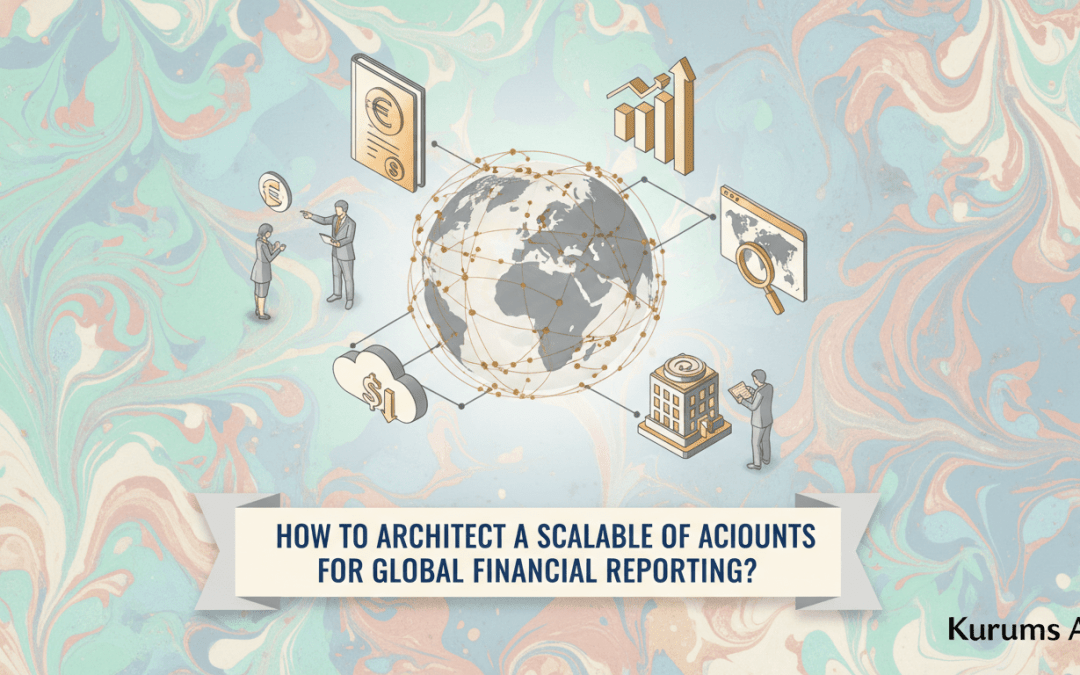
What is a Scalable Chart of Accounts (CoA)? It is a multidimensional financial framework designed to support business growth, multi-entity consolidation, and global regulatory compliance without requiring a redesign every time the company expands.
Why is hierarchical classification vital? It enables 35% faster closing cycles by automating data aggregation and provides the granular visibility needed for real-time decision-making and precise IFRS/GAAP reporting.
How does it reduce costs? A standardized CoA reduces audit fees by up to 20% and slashes manual data reconciliation efforts, allowing finance teams to focus on strategic analysis rather than data entry.
The foundation of every robust ERP system begins with a meticulously structured Chart of Accounts (CoA). Most CFOs and financial controllers underestimate how a poorly categorized ledger can stifle decision-making speed and inflate operational costs. But here is the real catch: a Chart of Accounts is not just a list of names and numbers; it is a multi-dimensional map of your entire business operation. In the world of global finance, your CoA is your data DNA. If the DNA is flawed, the entire corporate organism will struggle to scale.
As organizations move toward digital transformation, the need for a “Global Chart of Accounts” (GCoA) has become a non-negotiable priority. Whether you are managing a mid-sized enterprise or a multinational conglomerate, the architecture of your financial reporting determines whether you will lead the market or be buried under spreadsheets. This comprehensive guide explores the blueprint for a professional, scalable CoA structure that thrives in the face of complexity.
1. The Hierarchical Imperative: Why Structure Dictates Strategy
A hierarchical classification provides a logical path for data aggregation, allowing stakeholders to drill down from high-level balance sheets to individual transactions. Without a clear hierarchy, your financial data remains a “flat file”—useful for basic bookkeeping but useless for strategic forecasting. In a global setting, hierarchy ensures that a marketing expense in Berlin is treated identically to one in Tokyo when it hits the consolidated income statement.
But how do we achieve this? The secret lies in the “Parent-Child” relationship. By establishing header accounts (Parent) that aggregate data from sub-accounts (Child), you create a natural flow of information. This isn’t just about tidiness; it’s about speed. When your ERP system understands that account 5100 (Direct Labor) is a child of 5000 (Cost of Goods Sold), your month-end reports generate themselves.
Furthermore, hierarchy is the primary tool for managing “Drill-Down” capabilities. When an auditor asks why “Miscellaneous Expenses” spiked in Q3, a hierarchical CoA allows you to click through the aggregate total and see the underlying vendor invoices in seconds. This transparency is what separates modern finance departments from legacy ones.
2. Designing the Numeric Coding System: A Blueprint for Growth
Think of your numeric coding system as the postal codes for your financial data. If the codes are too short, you run out of “addresses.” If they are too long, they become impossible for humans to memorize and process. A professional-grade CoA typically uses a 4-to-7 digit base account structure, often supplemented by segment codes.
Here is a classic, scalable numeric framework used by top-tier global firms:
- 1000 – 1999: Assets (Current assets, fixed assets, intangibles).
- 2000 – 2999: Liabilities (Accounts payable, short-term debt, long-term obligations).
- 3000 – 3999: Equity (Retained earnings, common stock, treasury stock).
- 4000 – 4999: Revenue (Product sales, service revenue, discounts/returns).
- 5000 – 5999: Cost of Goods Sold (COGS) (Direct materials, direct labor, overhead).
- 6000 – 7999: Operating Expenses (OPEX) (Marketing, R&D, G&A).
- 8000 – 8999: Other Income/Expenses (Interest income, taxes, foreign exchange gains/losses).
Now, let’s go deeper. Within the “1000 Assets” range, you must leave “gaps” in the numbering. For instance, jumping from 1100 (Cash) to 1200 (Accounts Receivable) leaves 99 available slots for new cash-related accounts as you open new international bank accounts. This “Gap Analysis” is the hallmark of a scalable architecture.
3. Segmented vs. Flat CoA: The Great Debate
One of the most critical decisions an architect makes is choosing between a segmented (linear) string and a dimensional (relational) structure. In legacy systems, you might see a code like 01-100-6100-US, where 01 is the entity, 100 is the department, 6100 is the account, and US is the geography. This is a segmented CoA.
Modern ERPs like NetSuite, Workday, or SAP S/4HANA prefer a “Natural Account” base with attached “Dimensions.” This is significantly more powerful. Why? Because you can add a new department without adding 500 new combinations to your Chart of Accounts. It keeps the “Core” stable while the “Metadata” evolves.
Comparison: Segmented vs. Dimensional Architecture
| Feature | Segmented (Legacy) | Dimensional (Modern) |
|---|---|---|
| Account Volume | High (Thousands of combinations) | Low (Focus on natural accounts) |
| Ease of Reporting | Difficult; requires string parsing | Dynamic; drag-and-drop dimensions |
| Scalability | Low; adding a segment is a project | High; add dimensions on the fly |
| Error Rate | High (Manual code entry errors) | Low (Validated dropdowns) |
4. Global Compliance: Bridging IFRS, GAAP, and Local Statutory Needs
When you operate in multiple countries, you face the “Dual Reporting” challenge. Your US headquarters needs reports in US GAAP, but your French subsidiary must comply with the Plan Comptable Général (PCG). If your CoA isn’t designed to handle this, your finance team will spend weeks manually mapping accounts in Excel.
The solution is a Global Mapping Layer. In this architecture, you maintain a “Corporate CoA” (The Standard) and use a “Local Mapping Table” to translate those transactions into statutory formats. This allows for a “Single Source of Truth” at the group level while remaining 100% compliant with local tax authorities.
To succeed here, your CoA must be “Granular enough for the strictest regulator, but broad enough for the most general corporate view.” If France requires 5 digits for “Social Security Tax,” but the US only needs 1 account for “Payroll Taxes,” your global standard should default to the more granular level to ensure data captures everything needed for everyone.
5. The Intercompany Conundrum: Eliminating the Friction
As businesses scale, intercompany transactions (buying/selling between subsidiaries) become a nightmare. Without a dedicated section in the CoA, these transactions get lost in general revenue or expense accounts. The result? Your consolidated balance sheet shows inflated assets because you forgot to “eliminate” the debt Subsidiary A owes to Subsidiary B.
A scalable CoA includes dedicated Intercompany (IC) Segments. This involves:
- Creating specific “Due To/Due From” accounts for each entity pair.
- Assigning an “Intercompany Dimension” to every transaction.
- Ensuring that the “Sender” and “Receiver” use matching account codes.
When you have a dedicated IC structure, the “Elimination” process at month-end becomes a push-button exercise. If the accounts don’t balance to zero, you know exactly where the discrepancy lies, rather than hunting through thousands of lines of data.
6. Reducing Audit Costs Through Structural Integrity
Did you know that a messy CoA can increase your audit fees by 15-20%? Auditors charge by the hour, and they spend those hours trying to understand your data flow. A clean, hierarchical, and well-documented CoA acts as a roadmap for the auditor. It proves that you have “Internal Controls over Financial Reporting” (ICFR).
When the CoA follows a logical flow, auditors can use Analytical Procedures—comparing this year’s “Travel Expense” to last year’s—with confidence. If your accounts are a “catch-all” for various types of spend, the auditor cannot rely on high-level analysis and must resort to “Substantive Testing” (checking every single receipt). The latter is expensive and slow.
7. Implementing the “Clean-Up” Project: A Step-by-Step Roadmap
If you are currently struggling with a legacy CoA, the thought of a redesign can be daunting. You can’t just “change the numbers” overnight; it’s a surgical procedure on your financial heart. But the ROI is undeniable. Here is how you execute a successful CoA transformation:
- Phase 1: Discovery. Export your current CoA and identify “Dead Accounts” (those with zero balance for 24 months).
- Phase 2: Standard Design. Create the new hierarchy based on the 4-7 digit numeric logic discussed earlier.
- Phase 3: Mapping. Create a “Crosswalk” table that maps every old account to a new one.
- Phase 4: Pilot Testing. Run a previous month’s data through the new CoA structure in a sandbox environment.
- Phase 5: Go-Live & Training. Train the staff not just on the new numbers, but on the logic behind the change.
8. Technical Infrastructure: The Role of the MDM
In massive organizations, a CoA is managed through Master Data Management (MDM). This is a centralized software layer where changes are made. If a controller in the UK wants a new account for “Brexit-related Logistics Costs,” they submit a request in the MDM. Once approved by the Global Controller, the new account is automatically pushed to all ERP instances worldwide.
This level of control prevents “CoA Drift.” Over time, without central governance, different offices will start to interpret account definitions differently. “Miscellaneous” becomes a dumping ground for anything from office snacks to legal settlements. Governance is the guardrail that keeps your CoA scalable.
Data Governance Metrics for CoA Health
| Metric | Target Value | Why it matters |
|---|---|---|
| Account Usage Rate | > 85% Active | Reduces clutter and simplifies training. |
| Description Standardization | 100% Match | Ensures global searchability and AI mapping. |
| Consolidation Speed | < 3 Business Days | A healthy CoA enables rapid aggregation. |
9. Future-Proofing with AI and Machine Learning
The future of the Chart of Accounts is “Self-Healing.” Modern Fintech companies are now using Machine Learning (ML) to suggest the correct account for a transaction based on the vendor, amount, and department. But here’s the kicker: ML needs a clean training set. If your CoA is a mess, the AI will learn your bad habits.
By building a hierarchical CoA today, you are laying the groundwork for the Autonomous Finance office of tomorrow. In this future, the CoA becomes a dynamic taxonomy that auto-adjusts to new tax laws or reporting requirements, with the system suggesting where a new transaction should live with 99.9% accuracy.
10. Common Pitfalls to Avoid in CoA Architecture
Even the best intentions can lead to architectural disasters. Through years of consulting with Fortune 500 companies, we have seen three recurring mistakes that destroy CoA scalability:
1. The “Kitchen Sink” Account: Creating a “Miscellaneous” or “Other” account that eventually accounts for 15% of total spend. This is a black hole for data. If you can’t categorize it, you can’t manage it.
2. Inconsistent Numbering: Using 4 digits for assets but 6 digits for expenses. This confuses the ERP’s logic and makes it impossible to use wildcard searches (e.g., 1***) for reporting.
3. Ignoring the Business Model: A SaaS company needs a different CoA structure than a manufacturing plant. A SaaS company needs to track Customer Acquisition Cost (CAC) and Churn-related credits specifically. Do not use a “generic” template; customize the hierarchy to your specific industry’s value drivers.
11. Conclusion: Your CoA is Your Competitive Advantage
We have moved past the era where the Chart of Accounts was just a “back-office task” for the accounting team. In the modern, data-driven economy, the architecture of your financial ledger is a strategic asset. A scalable, hierarchical CoA allows you to move faster, pivot with agility, and maintain the trust of investors and regulators through transparent reporting.
The journey toward a perfect Chart of Accounts is not a one-time project; it is a commitment to data integrity. As your company grows, your CoA will evolve, but with the right foundational hierarchy, that evolution will be seamless rather than painful.
Ready to transform your financial reporting? Start by reviewing your top 20 accounts by transaction volume. If they aren’t perfectly aligned with your strategic goals, it’s time to rethink your architecture. The speed of your business depends on the clarity of your numbers. Build a structure that doesn’t just record history, but helps you write the future.
Discover more from Kurums | Business Intelligence
Subscribe to get the latest posts sent to your email.