
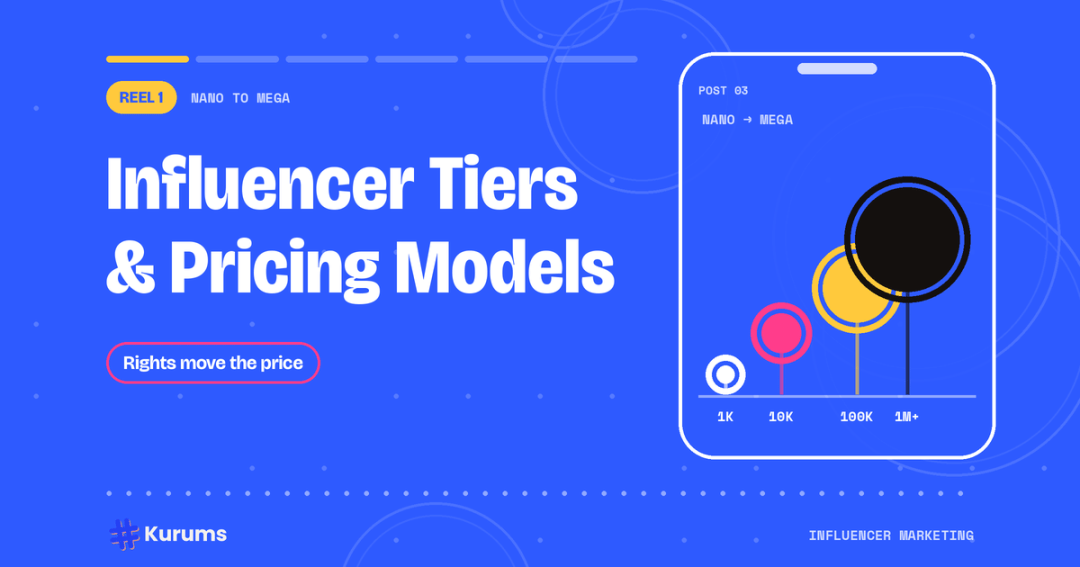
The industry sorts creators by audience size: nano (roughly 1,000 to 10,000 followers), micro (10,000 to 100,000), macro (100,000 to 1 million) and mega (above 1 million). Tiers describe reach, not price. A rate is built from the deliverables, the audience's quality and fit, production effort, usage rights, exclusivity and timing. Brands pay through flat fees, performance models such as affiliate commission, free product, or a mix. More than half of the respondents in Influencer Marketing Hub's 2026 survey planned to use more nano- and micro-influencers.
Influencer tiers are the first vocabulary a marketer learns and the first one that misleads. Two creators with 80,000 followers can differ tenfold in what they deliver and what they charge, because audience, format and rights matter more than the number on the profile. This guide defines the tiers, then explains how rates are actually constructed and which pricing model fits which objective. It belongs to the industry section of the Influencer Marketing hub; to run your own numbers, use the Influencer Marketing Calculator.
What are the influencer tiers?
Nano, micro, macro and mega, by follower count. The exact boundaries vary by source; the most common convention is shown in the table below.
Does a bigger following mean a higher engagement rate?
Usually the opposite. Engagement rates tend to fall as audiences grow, which is one reason brands are moving budget to smaller creators.
What changes the price most?
Usage rights and exclusivity. Permission to run the content as advertising, and a ban on working with competitors, can cost as much as the post itself.
What are the influencer tiers?
The tiers group creators by follower count on a given platform. They are a convention, not a standard, and platforms, agencies and software vendors draw the lines in slightly different places.
| Tier | Typical follower range | What brands use it for | Typical arrangement |
|---|---|---|---|
| Nano | About 1,000 to 10,000 | Local reach, niche communities, authentic reviews, content at volume | Free product, small fees, affiliate codes |
| Micro | About 10,000 to 100,000 | Targeted awareness and conversion in a defined niche | Flat fee per deliverable, often with commission |
| Macro | About 100,000 to 1 million | Broad awareness within a category | Negotiated fee, usually through a manager |
| Mega and celebrity | Above 1 million | Mass reach, launches, cultural moments | Bespoke contracts with usage and exclusivity priced separately |
Some sources add a mid-tier between micro and macro, and business-to-business marketers often ignore the scale altogether, because a consultant with 8,000 followers who are all procurement directors can outweigh a lifestyle creator with a million.
Why are brands moving towards smaller creators?
Because smaller creators cost less per collaboration, tend to earn higher engagement rates and let a brand spread risk across many voices. In Influencer Marketing Hub's 2026 benchmark survey, 51.43% of respondents expected to expand their use of nano-influencers and 52.83% their use of micro-influencers.
The trade-off is management. Fifty nano-creators mean fifty briefs, fifty approvals, fifty disclosures to check and fifty payments. That workload is the reason software platforms exist, and the reason programmes built on small creators usually run on standard terms: a fixed product gift, a fixed fee or a commission rate that is the same for everyone.
Large creators still have a role. A launch that must be noticed in a week needs reach that no number of small accounts can assemble in time.
How is an influencer's rate actually built?
A rate is the sum of several components: the deliverables, the audience, the work involved, the rights the brand wants and the restrictions it imposes. Follower count influences the first two and none of the others.
- Deliverables: the number and type of pieces, for example one video, three stories and a link.
- Audience: size, but also country, age, purchasing power and how closely it matches the buyer.
- Production: scripting, filming, editing, travel, props and revisions.
- Usage rights: whether the brand may repost the content, use it on its website or run it as paid advertising, and for how long.
- Whitelisting or partnership ads: permission to advertise through the creator's own handle.
- Exclusivity: a promise not to work with competitors for a period.
- Timing: rush fees and seasonal demand, especially before the year-end holidays.
This is why published "rate cards by follower count" are of limited use. They average over all of these variables, and the variance within a tier is larger than the difference between tiers.
Which pricing models do brands use?
Five models cover almost every deal: flat fee, performance-based pay, free product, hybrid and retainer. The right one depends on whether the goal is awareness, content or sales.
| Model | How it works | Best for | Watch out for |
|---|---|---|---|
| Flat fee | A fixed price per deliverable or package | Awareness campaigns; established creators | No link between cost and results |
| Cost per thousand views (CPM) | Fee tied to expected or delivered views | Comparing creators with other media | Views are not attention |
| Cost per engagement (CPE) | Fee tied to likes, comments, shares or clicks | Consideration goals | Engagement can be bought or inflated |
| Affiliate commission | A percentage of tracked sales via link or code | Conversion; always-on programmes | Under-credits creators who drive awareness |
| Free product (gifting) | Product in exchange for possible content | Seeding, nano-creators, reviews | No obligation to post unless agreed; still requires disclosure |
| Hybrid | A lower flat fee plus commission or bonus | Aligning both sides | More tracking and administration |
| Retainer or ambassadorship | A monthly fee for ongoing work | Long-term brand building | Needs clear deliverables and review points |
The benchmark survey found that promo and discount codes were the most widely adopted measurement tool, used by 45.9% of respondents, which shows how common commission-style tracking has become even in campaigns paid by flat fee.
How do you judge whether a rate is fair?
Convert the quote into unit costs and compare them with your other options. The three useful ratios are cost per thousand views, cost per engagement and, where sales can be tracked, cost per acquisition.
For a quote of 2,000 in any currency and an expected 80,000 views, the cost per thousand views is 25. If the creator's posts typically earn 4,000 engagements, the cost per engagement is 0.50. Set those against what the same money buys in paid social or search, and against other creators' quotes for the same brief.
Use the creator's recent averages, not their best post, and ask for screenshots of reach and audience demographics from the platform's own analytics. Our Influencer Marketing Calculator does the arithmetic, and the Decoded entry on engagement rate explains why the figure differs depending on who calculates it.
What do usage rights and exclusivity add?
They can add as much as the content fee, because they restrict what the creator can earn elsewhere and extend the value the brand takes from the work.
Organic usage, meaning the right to repost on the brand's own channels, is often included for a limited time. Paid usage, the right to run the content as advertising, is normally charged extra and priced by duration, commonly in blocks of 30, 60 or 90 days. Exclusivity is priced by how wide the category is and how long it lasts: "no other skincare brands for six months" costs far more than "no other vitamin C serums for thirty days".
Define all three in writing. We explain the clauses in the influencer brief, contract and usage rights and the terms themselves in the Decoded entries on usage rights and whitelisting.
How do rates differ by platform and format?
Rates follow the work a format demands and how long it keeps earning views. A produced long-form video costs more than a short clip, and a short clip more than a story that disappears in a day.
Three things drive the difference. The first is production: a ten-minute YouTube video with scripting and editing can take days, while a story takes minutes. The second is shelf life: search-driven platforms keep sending viewers to a video for months, whereas a feed post does most of its work in the first two days. The third is intent: an audience that came to watch a review is closer to buying than one scrolling past.
That is why an integration inside a long video is usually quoted per expected view, why a dedicated video costs a multiple of an integration, and why live-stream sponsorships are quoted per hour or per stream. Our platform playbooks cover the formats in detail: Instagram, LinkedIn and Twitch and live streaming.
- Stories and short clips: low production, short life, often sold in bundles.
- Feed posts and short-form video: the standard unit of most rate cards.
- Long-form video: highest production cost and longest life.
- Live streams: priced by time, with integrations such as on-screen overlays and chat commands.
- Raw content for the brand's own channels: priced as production work, independent of the creator's following.
How do you negotiate without damaging the relationship?
Negotiate the scope, not the creator's worth. Removing a deliverable, shortening a usage period or narrowing an exclusivity clause lowers the price without telling the creator their audience is worth less.
Start by sharing the brief and the budget range honestly; creators and managers respond better to a real number than to a request for a rate card. Offer things that cost you little and matter to them: prompt payment, a longer-term commitment, creative freedom, product, or a commission that rewards results. Ask for things that cost them little and matter to you, such as an extra story with a link, raw footage or a second cut.
Put the result in writing, however small the deal. A one-page agreement that lists deliverables, dates, approvals, disclosure, usage and payment prevents most disputes. The benchmark survey's finding that most brands intend to raise budgets also means good creators have alternatives, so the brands that pay on time and brief clearly get the first reply.
What mistakes do brands make with tiers and rates?
The most common mistake is buying followers instead of an audience. The second is comparing quotes that include different rights.
- Choosing by follower count: a large audience in the wrong country or age group is waste.
- Ignoring views: on video platforms reach depends on the algorithm, so recent median views tell you more than followers.
- Comparing unlike quotes: one creator's price includes ninety days of paid usage and another's does not.
- Paying mega rates for nano goals: if you need reviews and content, many small creators do it for less.
- Treating gifting as free: product, shipping, staff time and the legal duty to disclose all have a cost.
- Paying everything up front: stage payments against delivery and approval.
A simple discipline avoids most of these: write down the goal, the audience and the rights you need before you ask anyone for a price.
Which tier should you start with?
Start with the smallest tier that can reach your buyer, then add reach only when the content is proven. For most small and mid-sized brands that means micro-creators in a specific niche.
A practical first programme is ten to twenty micro- or nano-creators on identical terms, one clear brief and a unique code or link each. After a month you will know which creators, formats and messages work, and you can spend the larger fees on amplifying proven content or on a macro-creator who fits the same pattern.
For where to find them, see Best influencer discovery tools for small business; for who can run it for you, see platforms, agencies and talent managers.
Frequently Asked Questions
How many followers does a micro-influencer have?
By the most common convention, between about 10,000 and 100,000 on a given platform.
What is a nano-influencer?
A creator with roughly 1,000 to 10,000 followers, usually with a local or niche audience.
Do you have to pay nano-influencers?
Not always. Many collaborate for free product or commission, but any incentive creates a duty to disclose the relationship.
Why do two creators with the same follower count charge different rates?
Because rates reflect deliverables, audience quality, production effort, usage rights and exclusivity, not follower count alone.
Discover more from Kurums | Business Intelligence
Subscribe to get the latest posts sent to your email.