
Holiday 2026 rewarded visible human effort in creative and clear, credible offers in promotion, and both lessons are affordable for mid-size brands planning next year.
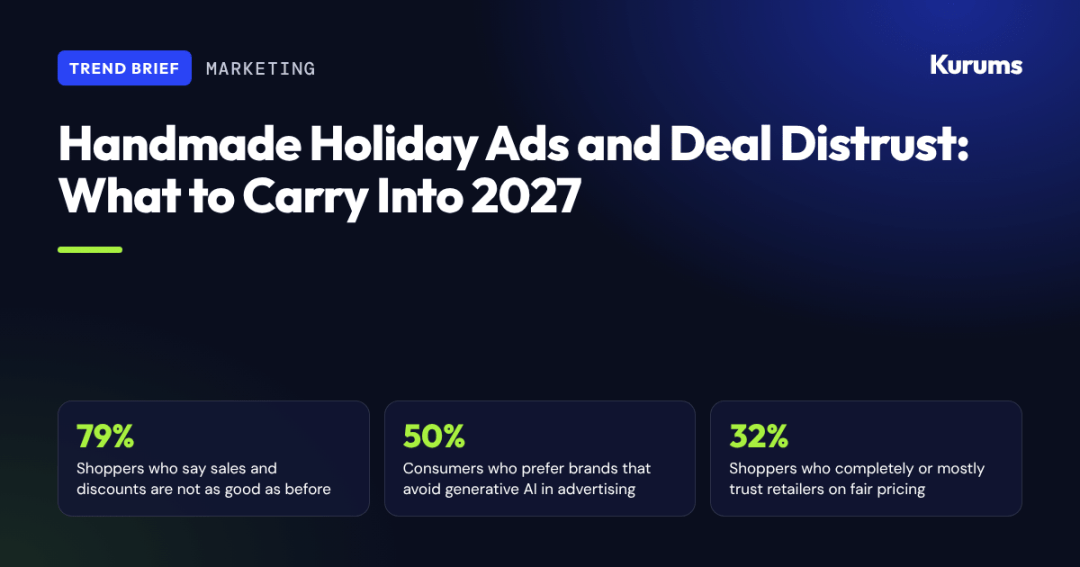
Major brands including Coca-Cola, Levi's, Geico and Chewy built holiday 2026 campaigns on stop-motion, live action and real people as a counter to AI-ad fatigue. At the same time, a Harris Poll survey found 79% of shoppers think discounts are worse than they used to be, even as Google Trends shows deal searches peaking on schedule. For 2027, set a clear AI boundary, put human craft where audiences see it, and simplify offers instead of deepening them.
What happened this week
The run-up to Thanksgiving produced holiday launches that share one production choice: visible human labor. Marketing Dive’s holiday roundup, published November 25, names handmade craft as a major theme of the season and ties it to consumers who have grown weary of AI-generated ads. It also cites Nielsen research showing 11% more holiday ads ran in September than a year earlier.
- Coca-Cola launched its “Enjoy Joy” spots on November 19 with real people in traditional live action. Marketing Dive reports that its generative AI holiday ads of the previous two years beat internal benchmarks but divided consumers.
- Geico premiered a two-minute stop-motion film, “How 15% Saved Christmas,” during the Macy’s Thanksgiving Day Parade broadcast, according to Marketing Dive.
- Chewy used stop-motion in a national TV spot for the first time, with hand-built puppets and, per its chief brand officer, no AI.
- Tiffany & Co. built its global campaign around a two-minute film starring Amanda Seyfried and directed by Derek Cianfrance, shot in New York.
On the promotional side, a Harris Poll survey reported by Marketing Brew found deep skepticism about Black Friday deals.
Why craft became the differentiator
When any team can generate a passable campaign in minutes, the output stops signalling effort. Gartner analyst Emily Weiss made that point to Marketing Dive: if a campaign takes 20 minutes to make, there is little reason for an audience to spend time caring about it. A 2026 Gartner study cited in Marketing Dive’s coverage of Levi’s found half of consumers prefer brands that do not use generative AI in advertising.
Stop-motion is the clearest answer because the labor is obvious on screen. Levi’s says its 60-second claymation spot took four hours of filming for each second of animation.
Craft is also being paired with familiar assets. Geico united its Gecko, Caveman and Maxwell the Pig characters in one holiday campaign for the first time. Walmart rebuilt the sets of “The Muppet Christmas Carol” and is running one campaign all season instead of separate pushes. For a mid-size brand, the transferable idea is consistent, recognisable brand assets, which cost far less than a puppet studio.
How brands are drawing the AI line
AI has not left the production process. The useful detail is where each brand put the boundary and how openly it described it.
| Brand | Visible craft | Stated AI position |
|---|---|---|
| Coca-Cola | Live-action spots with real people; creator-led social series | Pivoted away from generative AI used in the prior two holiday campaigns |
| Levi’s | 60-second claymation, handmade set and characters | No AI used in filming, per the brand |
| Chewy | Stop-motion with hand-crafted puppets | No AI used, per its chief brand officer |
| Geico | Hand-sketched characters, handmade puppets | AI used in pre-visualization; backgrounds mix AI imagery with practical sets |
Geico’s hybrid approach is the realistic model for most teams: AI behind the scenes, human hands on what the audience sees, and a plain account of both. Hair-care brand Oribe described the same split to Marketing Brew.
The risk sits in the claim, not the tool. The same piece notes that Dior faced backlash last month over a holiday ad described as hand-drawn that many viewers said looked AI-generated; the director told Variety an automated interpolation system was used for very small parts of the process. If you say “handmade,” be ready to show the making-of.
The Black Friday trust problem
The discount side of Q4 has its own credibility gap. In the Harris Poll findings reported by Marketing Brew on November 24:
- 79% of respondents said sales and discounts are not as good as they used to be.
- 78% said brands feel less generous.
- Nearly three-quarters agreed Black Friday and Cyber Monday are more hype than genuine savings.
- More than half said the longer sales window makes it harder to know when to buy.
One agency executive quoted in the piece says offers from the brands that agency works with are largely unchanged year over year. Perception shifted because a month of promotions removes urgency. Separately, Akeneo data cited by Marketing Dive found only 32% of shoppers completely or mostly trust retailers to offer a fair or competitive price.
Responses vary. Bark is redirecting sale-promotion ad dollars into a campaign to get shelter dogs adopted. Aquasonic and Pure Daily Care stagger product-level deals across the month instead of running one long sale. JCPenney publishes a weekly cheat sheet of its top deals. A paywalled Performance Marketing World report, of which only the headline and summary were readable, says Black Friday marketing budgets rose 50% while marketers shift focus from discounts to profit.
What Google Trends shows about attention
Google Trends data for the US, August 26 to November 26, 2026, shows what the public is searching for. These are relative search-interest indices on a 0 to 100 scale, where 100 is the peak among the compared terms. They are not search volumes.
- “black friday deals” averaged 9.8 over the 90 days and 12.7 over the prior 30 days, then 65.7 over the last seven days. The latest reading, a partial day on November 26, is 100, the period peak.
- “black friday ads” averaged 2.3 over the last seven days, with a latest reading of 4.
- “cyber monday deals” averaged 1.3 over the last seven days, latest 2.
- “AI ads” averaged 0.5 across 90 days and registered 0.0 in the last week.
In a separate comparison, “black friday” alone rose from 43 on November 20 to 100 on November 26, while “cyber monday” stayed at 1 to 2. Two cautious conclusions follow. First, distrust has not dampened deal-seeking: interest is spiking on schedule and so far dwarfs Cyber Monday. Second, AI ad fatigue is not something people search for. It shows up in surveys and creative choices, so search data cannot confirm or size it.
Search interest: black friday deals vs cyber monday deals
Google Trends, United States, Aug 26, 2026 to Nov 25, 2026. Daily index, 0–100, relative to the highest point among the terms compared; it shows relative attention, not search volume.
Where the money and the discovery are moving
Media plans are shifting alongside creative. In a Digiday+ Research survey of 90 brand and retailer professionals, 45% plan to use CTV or streaming ads this holiday season, up from 23% in 2025, and 33% plan TV ads, up from 13%. Gift guide use fell 19 points, even though 31% of respondents named gift guides their best historical performer.
Philadelphia Cream Cheese raised holiday marketing spend 15%, and Marketing Dive reports its creator program has drawn nearly 1 million organic views since November 2, according to the brand. A talent executive told Digiday that more brand contracts now bar creators from using AI in campaign content, while allowing it for preparation.
Shoppers are using AI even as they resist it in ads. A Brainlabs survey of 2,800 US and UK shoppers, reported by Digiday, found the share using AI for product research rose from 6% to 13% in a year. In a PMG analysis for one client, the brand’s own site supplied just 24 of 203 links cited in AI answers. Third-party coverage shapes those answers, a reason not to cut gift guides too quickly.
What mid-size marketers should take into 2027
This is analysis of one season’s signals, not advice for any single business. Four lessons travel well.
- Spend craft where it is seen. One hero asset with obvious human effort, plus behind-the-scenes content, can carry a campaign.
- Write down your AI boundary. Decide which stages may use AI and what you will say publicly.
- Make the offer legible. Fewer, clearer deals with stated dates address the “when should I buy” confusion better than a deeper discount.
- Treat AI as a discovery channel. Product data and third-party coverage affect whether an assistant shortlists you.
What to do next
- Record this season's offer calendar and note which deal windows overlapped or confused customers.
- Draft a one-page AI-in-creative policy: permitted stages, disclosure wording, and who signs off on any "handmade" or "no AI" claim.
- Add AI-use language to creator contracts for 2027, specifying what is barred in finished content and what is allowed in preparation.
- Audit how AI assistants describe your top five products and list the third-party sources they cite.
- Compare margin, not just revenue, across staggered product deals and sitewide discounts before setting 2027 promotional depth.
Frequently asked questions
Do holiday ads need to be completely AI-free to benefit from this trend?
No. Geico used AI in pre-visualization and for parts of its backgrounds while keeping hand-sketched characters and handmade puppets, according to Marketing Dive. What matters is that the visible work is human and that any public claim about how it was made is accurate.
Is consumer distrust reducing interest in Black Friday deals?
Not in search behavior. Google Trends shows US interest in "black friday deals" hitting its 90-day peak on November 26. The Harris Poll data reported by Marketing Brew describes skepticism about deal quality, yet agency executives there say shoppers still see deals as a necessity.
How can a mid-size brand show craft without a stop-motion budget?
Concentrate effort in one visible asset and document how it was made. Oribe, a hair-care brand, commissions a single artist each holiday and shares behind-the-scenes content, and told Marketing Brew this year's response was unusually strong. Consistent brand characters or platforms also add recognition cheaply.
Should we cut gift guides and creator content next year?
Be careful. Digiday's survey shows marketers reducing gift guide use even though respondents rank them as their best historical performer, and one executive expects them to matter more as AI search tools draw on curated lists. Fewer, better creator partnerships look more durable than volume.
- Marketing Dive: Brands turn to handmade craft, handfuls of creators for holiday season (2026-11-25)
- Marketing Dive: Geico unites brand icons in holiday ad mixing human craft, nostalgia (2026-11-25)
- Marketing Dive: Chewy jumps on stop-motion animation trend lighting up holiday ads (2026-11-24)
- Marketing Dive: Campaign Trail: Tiffany tells human holiday story with Hollywood talent (2026-11-20)
- Marketing Dive: Philadelphia whips up bigger holiday marketing spend amid brand revamp (2026-11-23)
- Marketing Dive: Coca-Cola pivots from divisive AI-generated ads for holiday campaign (2026-11-19)
- Marketing Dive: Levi's claymation holiday campaign celebrates handmade craft amid AI bloat (2026-11-03)
- Marketing Dive: Why JCPenney is taking on deal fatigue for its holiday campaign (2026-11-02)
- Marketing Dive: Holiday marketing hits inflection point in 2026: What brands need to know (2026-11-17)
- Marketing Dive: Walmart CMO breaks down retailer's Muppet-fueled holiday campaign (2026-10-26)
- Marketing Brew: Consumer trust around Black Friday deals is down. Some marketers are trying a different approach (2026-11-24)
- Marketing Brew: Why hair-care brand Oribe keeps going back to handmade holiday campaigns (2026-11-24)
- Performance Marketing World: Black Friday marketing budgets rise 50%…but brands are ditching deep discounts (paywalled; headline and summary only) (2026-11-25)
- Digiday: In Graphic Detail: How shoppers are adopting AI for product research ahead of Black Friday (2026-11-25)
- Digiday: D+ Research: Brand's holiday marketing tactics shift in 2026 (2026-11-23)
- Digiday: Why brands are writing no-AI clauses into creator deals (2026-11-24)
Search-interest figures are from Google Trends (United States, 90 days to November 26, 2026). This article is analysis for operators, not legal, tax or investment advice. Last updated November 26, 2026.
Discover more from Kurums | Business Intelligence
Subscribe to get the latest posts sent to your email.