
The Live Nation verdict dates from April, but its unresolved remedies phase is a working guide to how exclusives, bundling, sales pressure and chat logs become antitrust evidence.
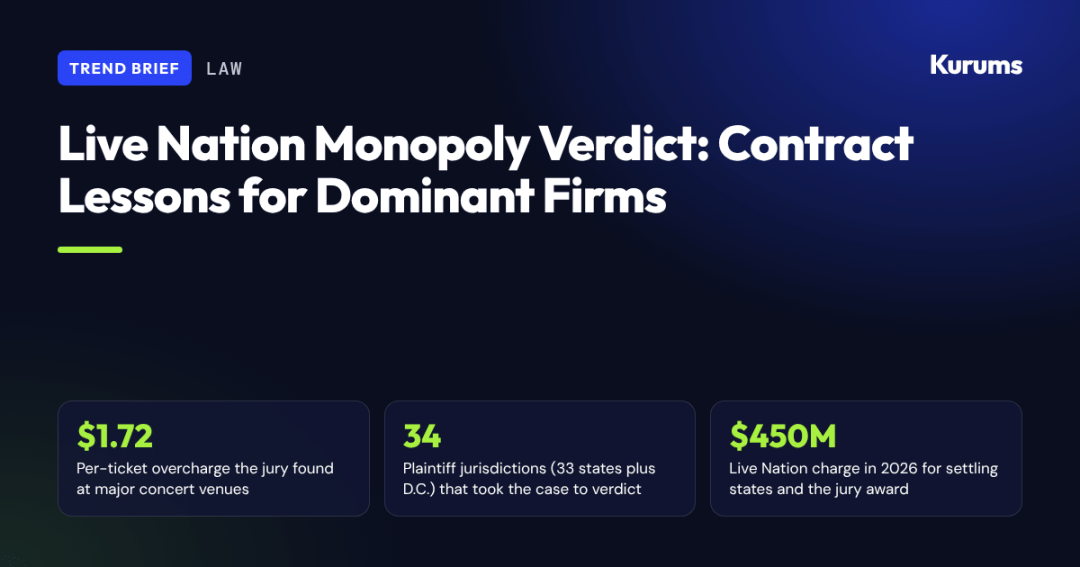
A Manhattan federal jury found Live Nation and Ticketmaster liable on April 15, 2026 for monopolizing primary ticketing and large amphitheaters and for unlawful tying, in a case finished by 33 states and D.C. after the Justice Department settled. It set a $1.72 per-ticket overcharge. Post-trial motions, the federal settlement review and a remedies trial expected in 2027 remain open. For companies with market power, the exposure sits in long exclusives, linked products, account-team pressure and informal messages.
What the jury decided, and when
First, a correction to the way this story is circulating. The TicketNews headline that resurfaced in news feeds this week describes a verdict returned on April 15, 2026, not a new one. The case has since moved into post-trial motions and a remedies fight, which is where the practical lessons now sit.
According to TicketNews and the Associated Press (via PBS News), a federal jury in the Southern District of New York, before Judge Arun Subramanian, found Live Nation and its Ticketmaster subsidiary liable after roughly five to six weeks of trial and four days of deliberation. The plaintiffs were state attorneys general. The Justice Department, which filed the case in May 2024, settled about a week into trial; 33 states and the District of Columbia carried on.
A Paul, Weiss client memorandum summarises the findings: unlawful monopolization of primary ticketing services for major concert venues, monopolization of the market for artists’ use of large amphitheaters, unlawful tying of amphitheater access to concert promotion services, and liability on every state-law claim submitted. The jury did not reject any claim put to it. One nuance matters for contract drafters: Paul, Weiss notes that a standalone Section 1 exclusive-dealing claim survived summary judgment but was dropped by the plaintiffs during trial, so exclusive contracts were judged as part of the monopolization case rather than on their own.
The money so far
The jury set a per-ticket overcharge of $1.72 on tickets Ticketmaster sold at major concert venues, applied in the 22 jurisdictions that reached the damages question. No total has been entered. AP reported the figure could reach hundreds of millions of dollars. Live Nation’s own estimate, as relayed by Paul, Weiss, is that the award covers tickets at 257 venues and amounts to less than $150 million before trebling. TicketNews reports that the company’s third-quarter filing shows a $450 million charge for the first nine months of 2026 covering the settling states and the jury’s award.
Live Nation’s stated position has not changed. It said the verdict is “not the last word”, renewed its motion for judgment as a matter of law, is challenging the states’ damages expert, and has said it will appeal.
Where the case stands: three tracks, not one
Reports often blend separate proceedings. They should be kept apart.
| Track | Forum | Status in sources we opened |
|---|---|---|
| States’ case (the verdict) | S.D.N.Y., Judge Subramanian | Liability found April 15. States asked on May 21 for a Ticketmaster divestiture, amphitheater sell-offs, limits on exclusives, a monitor and monetary relief. The judge heard post-trial motions on July 31 and no ruling was reported in coverage we opened through November 6. Hypebot puts a remedies bench trial as early as February 2027. |
| DOJ settlement | Same court, Tunney Act review | Proposed terms include a $280 million fund, a 15% service-fee cap at certain venues, a four-year cap on exclusive ticketing deals, non-retaliation commitments and divesting control of 13 amphitheaters. Still awaiting approval in the latest coverage. |
| Private and FTC suits | Federal courts in California | A consumer class action (Heckman) was certified in December 2025, and an FTC case filed in September 2025 is pending, per Hypebot’s tracker. Neither is the jury verdict. |
Sources differ on small points, including how many states joined the federal settlement (six in one account, ten in another), so treat counts as approximate. We could not open a report confirming any ruling after early November.
Four lessons for any company with a strong market position
This is analysis for business readers, not legal advice. The verdict may still be narrowed or reversed. Even so, the conduct the states put in front of the jury is a useful checklist of what attracts scrutiny.
1. Exclusives: length and coverage carry the risk
Long-term exclusive ticketing contracts were alleged to foreclose rivals. Both the federal settlement (a four-year cap, with venues offered exclusive and non-exclusive proposals) and the states’ requests target duration and the lack of a non-exclusive option. If a large share of your customers is locked up on long terms with staggered renewals, document the customer benefit and offer a genuine alternative.
2. Tying can be found without a clause that says so
The tying finding concerned access to amphitheaters and promotion services. At the July hearing the judge pressed the states for evidence that artists did not want the tied service, and TicketNews called it possibly the most exposed finding. The exposure comes from how pricing and access work in practice, so review sales playbooks as well as contract text.
3. Retaliation claims rest on what account teams say
The states alleged threats to divert shows from venues that chose a rival ticketer. Nothing in a master agreement would show that; negotiation emails and call notes would. Train commercial staff that linking one product’s supply to a customer’s choice of supplier for another is an escalation point.
4. Internal chat is evidence
Slack messages from 2021 to early 2023, in which an employee joked about “robbing them blind”, became public during trial, AP reported via ABC7. Live Nation called them “off-the-cuff banter, not policy”. That argument did not keep them out of the public record.
What customers and counterparties of a dominant platform can do
- Ask for a non-exclusive quote. The proposed federal terms would require Ticketmaster to offer one. Asking creates a record even where the supplier declines.
- Negotiate term and exit. Use the four-year benchmark in talks on renewal length, termination rights and data portability.
- Record pressure when it happens. Note dates, names and exact words if supply of one product is linked to your choice on another.
- Know your enforcers. State attorneys general won this case after the federal government settled. In California, the COMPETE Act gives public enforcers a single-firm monopolization claim from January 1, 2027, though not private plaintiffs.
- Preserve purchase records. Overcharge findings in a government case tend to feed private claims.
What Google Trends says about attention
Google Trends figures for the United States covering August 26 to November 26, 2026 are relative indices from 0 to 100, not search volumes. On that scale, “live nation” averaged 12.1 over 90 days, 13.3 in the prior 30 days and 6.7 in the last seven, with a peak of 59 on October 21. “Antitrust” averaged 15.4 over 90 days and 5.7 in the last seven, peaking at 100 on September 27; we did not find a source confirming what drove that peak. “Ticketmaster refund” sat near 0.9 and “ticketmaster lawsuit” near zero.
Public search interest is falling, which fits a verdict that is seven months old. The legal exposure has not fallen with it: the rulings that decide the outcome are still to come.
Search interest: antitrust vs live nation
Google Trends, United States, Aug 26, 2026 to Nov 25, 2026. Daily index, 0–100, relative to the highest point among the terms compared; it shows relative attention, not search volume.
What to watch next
Three decisions will set the size of the precedent: the ruling on Live Nation’s motions to overturn the verdict or order a new trial, the Tunney Act decision on the federal settlement, and the remedies trial. Manatt points out that no court has previously reviewed a Justice Department antitrust settlement alongside a jury verdict in the same case, and Paul, Weiss notes that divestiture is rare in conduct cases. An appeal is expected whatever the outcome.
What to do next
- List every exclusive customer or supplier contract in markets where your share is high, with term, renewal date and termination rights.
- Check whether customers can buy each product separately at a commercially realistic price, and keep the evidence.
- Add a rule to sales playbooks: no linking supply of one product to a customer's choice of rival for another without legal review.
- Run a short refresher on chat and email habits for commercial and pricing teams, with real trial examples.
- Confirm retention and legal-hold settings cover Slack, Teams and similar tools.
- If you buy from a dominant platform, request a non-exclusive proposal at the next renewal and log the response.
Frequently asked questions
Is the Live Nation verdict new?
No. The jury returned its verdict on April 15, 2026 in federal court in Manhattan. The story resurfaced in news feeds this week. What remains live is the post-trial challenge, the review of the federal settlement and a remedies trial that trackers place in early 2027.
Who won the verdict, the Justice Department or the states?
The states. The Justice Department filed the case in 2024 but settled about a week into trial in March 2026. Thirty-three states and the District of Columbia continued and won on every claim submitted to the jury, according to Paul, Weiss and TicketNews.
Has Ticketmaster been ordered to separate from Live Nation?
No. The states asked for a Ticketmaster divestiture and amphitheater sell-offs in a May 21 filing, and Live Nation opposes both. In the coverage we could open, the judge had not ruled on remedies or on the company's motions to overturn the verdict.
Are exclusive contracts now unlawful?
No. Exclusives remain common and often lawful. The risk rises with market share, contract length, the share of customers covered and the absence of a real non-exclusive option. This case treated long exclusives as one part of a wider monopolization claim. Take legal advice on specific terms.
Is the consumer class action the same case?
No. The Heckman consumer class action and the Federal Trade Commission's lawsuit are separate proceedings in federal courts in California. The jury's overcharge finding came in the states' case in New York, and any consumer payments would depend on later rulings.
- TicketNews: Live Nation and Ticketmaster Operate as an Illegal Monopoly, Jury Finds in Landmark Antitrust Trial (2026-04-15)
- Associated Press via PBS News: Ticketmaster and Live Nation had monopoly over big concert venues, jury finds (2026-04-15)
- Paul, Weiss: Live Nation/Ticketmaster Antitrust Verdict: Key Takeaways from the States' Jury Trial Win (2026-04-20)
- Manatt, Phelps & Phillips: Federal Jury Finds Live Nation and Ticketmaster Act as Monopoly in Antitrust Trial
- TicketNews: Live Nation Responds to Monopoly Verdict With Defiance, Vows to Fight Jury Findings (2026-04-16)
- TicketNews: States Seek Ticketmaster Breakup, Live Nation Venue Selloffs After Monopoly Verdict (2026-05-22)
- TicketNews: Judge Probes Evidence Behind Live Nation Monopoly Verdict, Leaves Ruling Pending (2026-08-03)
- TicketNews: California COMPETE Act Gives Bonta New Monopoly Tool After Ticketmaster Verdict (2026-10-01)
- TicketNews: Live Nation Q3 2026 Earnings: $10.1B Revenue Amid Antitrust Fight (2026-11-06)
- Hypebot: Live Nation Legal Battles: What Happens Next in 2026–2027 (2026-09-14)
- Hypebot: Live Nation, Ticketmaster Lawsuit Tracker: Pending Cases (2026-05-25)
- Associated Press via ABC7 New York: Live Nation employee mocks customers as 'so stupid' in internal messages released in court case (2026-03-13)
Search-interest figures are from Google Trends (United States, 90 days to November 26, 2026). This article is analysis for operators, not legal, tax or investment advice. Last updated November 26, 2026.
Discover more from Kurums | Business Intelligence
Subscribe to get the latest posts sent to your email.