
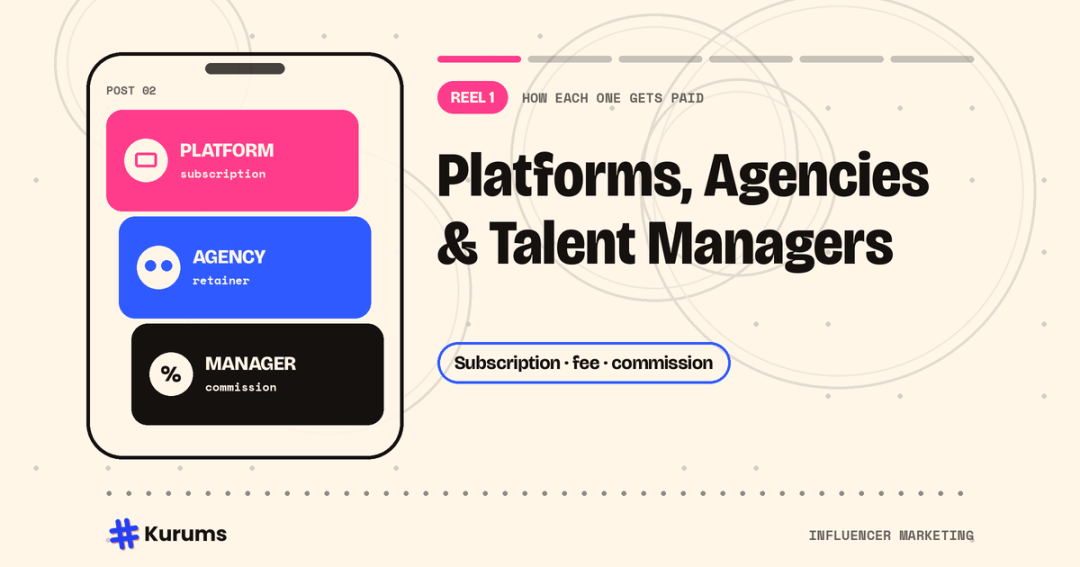
Four kinds of intermediary stand between a brand and a creator, and each is paid differently. Software platforms charge a subscription, sometimes with a fee on payments: GRIN's plans run from free with a 20% wallet fee to $1,500 a month with 5%, and Modash starts at $199 a month billed yearly. Marketplaces take a percentage of each deal: Collabstr charges brands 10% and creators 15%. Agencies charge retainers or project fees and may mark up creator costs. Talent managers work for the creator and take a commission from the creator's fee.
An influencer marketing platform, an agency and a talent manager can all tell you they will "handle your creators", and they mean three different things. One gives your team tools, one replaces your team, and one sits on the other side of the table. Knowing who is paid by whom, and for what, is the fastest way to read a proposal. This guide explains each model with prices the companies publish themselves. It belongs to the industry section of the Influencer Marketing hub.
What is the difference between a platform and an agency?
A platform is software your own team uses; an agency is a service team that plans and runs campaigns for you, often using a platform of its own.
Who pays the talent manager?
The creator, through a commission on each deal. The manager negotiates against the brand, not for it.
Which model is cheapest?
For occasional campaigns, a marketplace or a free platform tier. For continuous programmes, a subscription usually costs less than transaction fees.
What are the four intermediary models?
Software platforms, marketplaces, agencies and talent managers. The first three sell to brands; the fourth represents creators. Many companies combine two models, so the label on the website matters less than the contract.
| Model | You get | You pay | Best when |
|---|---|---|---|
| Software platform | Discovery, vetting, CRM, contracts, payments and reports for your own team | Monthly or annual subscription, sometimes plus a fee on payments | You run programmes continuously in-house |
| Marketplace | A catalogue of creators with prices, ordering and escrow | A percentage of each order | You run occasional or small campaigns |
| Agency | Strategy, casting, briefing, production, reporting, paid media | Retainer or project fee, sometimes a markup on creator fees | You lack the team or need creative firepower |
| Talent manager | Access to a represented creator | Nothing directly; the creator's price includes commission | You want a specific, established creator |
The social networks add a fifth option that costs nothing: their own creator directories, such as TikTok One or the creator marketplace inside Instagram, where brands can search and contact creators directly.
How do software platforms charge?
Most charge a subscription that depends on seats, the number of creator profiles you can open and the creators you track. Enterprise products are sold on annual contracts with prices on request; self-serve tools publish prices and bill monthly.
| Company | Type | Headquarters | Pricing | Known for |
|---|---|---|---|---|
| GRIN | Self-serve and enterprise platform | Sacramento, USA | Free plan; paid from $200 a month plus a wallet fee | Gifting, affiliate and UGC campaigns with a Shopify connection and the Gia AI agent |
| Modash | Discovery and tracking platform | Tallinn, Estonia | From $199 a month billed yearly | 380M+ creator profiles on Instagram, TikTok and YouTube; 14-day free trial |
| Heepsy | Discovery platform for small teams | Bilbao, Spain | Free plan; paid from $69 a month billed yearly | 20M+ creators; filters, CRM and outreach on low-cost plans |
| Upfluence | All-in-one platform | Lyon, France and New York, USA | Custom quote; annual plans | 15M+ creators; Shopify, WooCommerce and Amazon integrations; fixed fee, no cut of sales |
| CreatorIQ | Enterprise platform | Los Angeles, USA | On request | 1,300+ brands and agencies; 20M searchable creators; customers include Unilever, Nestlé and Sephora |
| HypeAuditor | Analytics and discovery platform | Indianapolis, USA | Custom quote | 227M+ influencer profiles; audience-quality and fraud analysis |
Pricing and figures as published on each company's website on 27 November 2026. Full list: Solutions Directory.
The published examples show the range. Modash charges $299 a month on monthly billing or $199 a month billed yearly for its Essentials plan, which covers two users, 300 opened profiles and 100 tracked creators a month; its Performance plan is $599 or $499. Heepsy has a free plan and paid tiers from $69 a month billed yearly. Upfluence quotes individually and requires a minimum of twelve months on annual plans, but states that each plan is a fixed fee and that it takes no percentage of tracked sales.
GRIN changed the pattern in the mid-market by publishing self-serve plans: a free tier with a 20% fee on money moved through its wallet, Starter at $200 a month with 10%, Growth at $500 with 7% and Scale at $1,500 with 5%, all month to month, plus custom enterprise agreements.
How do marketplaces charge?
Marketplaces charge a transaction fee. The brand browses creators who list prices for defined deliverables, pays into escrow, and the money is released when the content is delivered.
Collabstr is a clear example. Brands can search more than 1.3 million creators on a free plan and pay a 10% marketplace fee on orders; the fee falls to 5% on its Premium plan at $333 a month billed annually. Creators pay a 15% fee on their payout. The marketplace therefore earns from both sides of each deal.
The model suits brands that need a few pieces of content quickly, including user-generated content that will run on the brand's own channels. It is less suited to long relationships, because every renewal carries the fee again and the marketplace's rules may restrict taking the relationship elsewhere.
How do agencies charge?
Agencies charge for people's time. Common structures are a monthly retainer for an always-on programme, a project fee for a campaign, and a fee calculated as a percentage of the budget they manage. Creator fees and paid media are passed through, with or without a markup.
An agency's price buys things software cannot: a strategy, creative ideas, relationships with creators and their managers, production crews, legal review and someone to call when a post goes wrong. The largest also bring proprietary tools; Viral Nation, for example, sells campaign and brand-safety software alongside its services.
Transparency is the point to negotiate. Ask whether creator fees are passed through at cost, whether the agency receives rebates or volume discounts from creators or platforms, and whether paid amplification is bought on your ad account or theirs. Our Best influencer marketing agencies comparison sets out who owns each agency, which matters now that Publicis, WPP and Accenture have bought several of them.
| Company | Type | Headquarters | Pricing | Known for |
|---|---|---|---|---|
| Viral Nation | Agency with technology | Toronto, Canada | Project and retainer fees | CreatorOS and VN Secure tools; clients include Amazon, Google and Walmart |
| Billion Dollar Boy | Agency | London, UK | Project and retainer fees | London and New York; clients include IKEA, Puma and Lipton |
| Whalar | Agency (Accenture Song) | London, UK | Project and retainer fees | Acquired by Accenture Song in 2026; clients include Nike, NFL and Disney |
| The Goat Agency | Agency (WPP) | London, UK | Project and retainer fees | 650+ staff across 37+ markets; clients include L'Oréal, Unilever and Dell |
| Obviously | Agency (WPP) | New York, USA | Project and retainer fees | 152,000+ influencer collaborations; clients include Ulta, Converse and Google |
| Influential | Agency and network (Publicis Groupe) | Las Vegas, USA | Project and retainer fees | 18M+ creators in network; bought by Publicis in 2024 for a reported $500 million |
Pricing and figures as published on each company's website on 27 November 2026. Full list: Solutions Directory.
What does a talent manager do, and who pays?
A talent manager represents the creator: finding deals, negotiating fees and usage terms, reviewing contracts and chasing payment. The manager is paid a commission from the creator's earnings, commonly somewhere between a tenth and a fifth of each deal.
From the brand's side, a manager changes the negotiation. Rates are firmer, usage rights and exclusivity are priced separately, and contracts are read carefully. That is not a disadvantage: managed creators are usually more reliable on deadlines, disclosure and approvals, because someone's job is to keep the relationship professional.
Remember whose side the manager is on. An agency that also manages talent has a conflict when it recommends its own creators for your campaign; ask whether any proposed creator is represented by the agency or its sister companies.
Which model should a brand choose?
Choose by how often you will work with creators and how much time your team has. Frequency favours owning the tools; scarcity of time favours buying a service.
- A few campaigns a year, small budget: a marketplace or a free platform tier, plus the social networks' own creator directories.
- Always-on gifting or affiliate programme: a self-serve platform with e-commerce integration.
- Large, multi-country programme: an enterprise platform with an agency for strategy and local casting.
- A launch that needs big names and big ideas: an agency, which will deal with talent managers for you.
Many mature programmes use two models at once: software as the system of record for every creator relationship, and an agency for the campaigns that need creative weight.
What should you check in the contract?
Check the term, the fees on payments, data ownership and exit. These four clauses decide what the relationship costs and how hard it is to leave.
- Term and renewal: enterprise platforms usually run for twelve months and renew automatically; note the notice period.
- Payment fees: percentage fees on wallets, payouts or currency conversion add up.
- Data: confirm that you can export creator lists, contracts, content and performance history.
- Content rights: make sure usage rights sit with you, not with the intermediary.
- Exclusivity and non-solicitation: some marketplaces and agencies restrict direct deals with creators you met through them.
For the creator-side contract, see our guide to the influencer brief, contract and usage rights.
How do the free tools from social platforms fit in?
They are a good first filter and a weak system of record. The platforms know their own creators' audience data better than any third party, and they charge nothing for search.
Their limits are the mirror image of their strengths. Each covers one network, the data stays inside the platform, and there is no contract management, payment handling across networks or independent fraud check. Teams commonly use them to shortlist and verify audience figures, then manage the relationship elsewhere. Our Best influencer discovery tools for small business list compares the free and low-cost options.
Frequently Asked Questions
Does GRIN have a free plan?
Yes. GRIN lists a free plan with a 20% wallet fee and paid self-serve plans from $200 a month.
How much does Modash cost?
From $199 a month billed yearly, or $299 on monthly billing, for the Essentials plan.
What fee does Collabstr charge?
Brands pay a 10% marketplace fee on the free and Pro plans and 5% on Premium; creators pay 15% on their payout.
Do talent managers charge brands?
Not directly. Their commission comes out of the creator's fee, which is reflected in the price the brand is quoted.
Discover more from Kurums | Business Intelligence
Subscribe to get the latest posts sent to your email.