
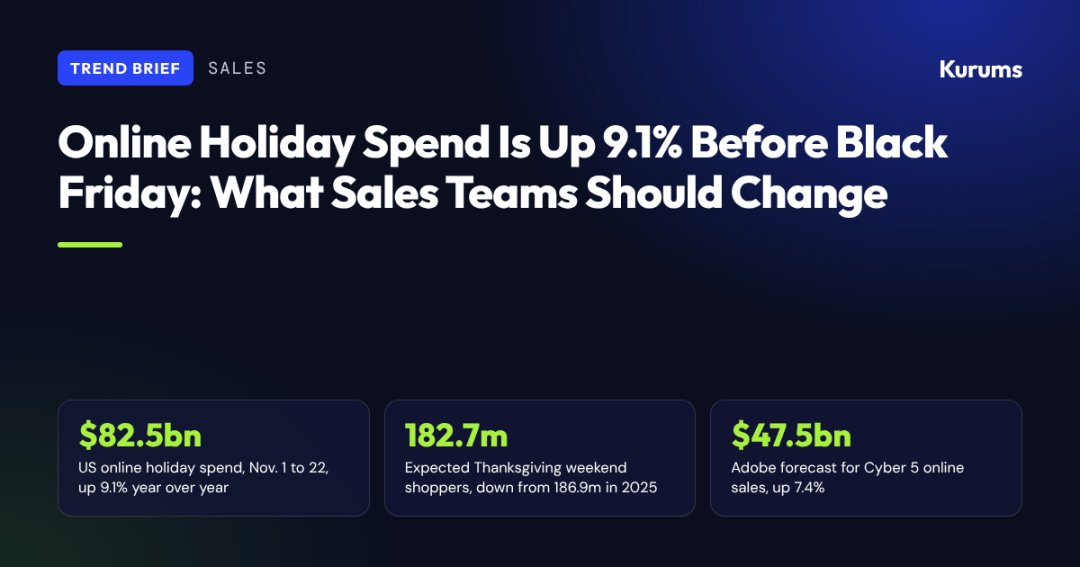
Adobe counts $82.5bn in US online holiday spend by Nov. 22 while NRF expects fewer weekend shoppers. The peak has spread out, and plans should follow.
US shoppers spent more than $82.5 billion online from Nov. 1 to Nov. 22, up 9.1% on last year, according to Adobe Analytics. At the same time, NRF expects 182.7 million Thanksgiving weekend shoppers, about 4.2 million fewer than in 2025. Demand has moved earlier and spread across weeks of promotions. Sales teams should judge the season on month-to-date pacing, margin and December carry-over, and treat Black Friday and Cyber Monday as two checkpoints inside a longer event.
What the data shows
US shoppers spent more than $82.5 billion online between Nov. 1 and Nov. 22, up 9.1% year over year, according to Adobe Analytics figures reported by Digital Commerce 360 on Nov. 25. Every one of those 22 days cleared $3 billion in online spend. In 2025, 21 of the comparable 22 days did. Two days reached at least $4 billion, which Adobe analysts said had not happened before in the weeks ahead of Thanksgiving.
That pace is faster than the season Adobe planned for. In its holiday forecast published Sept. 28, Adobe projected $275.1 billion in US online sales for Nov. 1 to Dec. 31, up 6.7%, with the five days from Thanksgiving to Cyber Monday (the Cyber 5) contributing $47.5 billion, up 7.4%. By our arithmetic, the $82.5 billion already spent equals roughly 30% of the full-season forecast, booked before the first Cyber 5 day began. If the Cyber 5 forecast is met, at least 47% of the season’s projected online revenue will be in by the end of Cyber Monday, Nov. 30.
The individual day forecasts remain forecasts. Adobe expects $6.9 billion for Thanksgiving (up 8.5%), $12.9 billion for Black Friday (up 9.2%) and $15.1 billion for Cyber Monday (up 6.2%). We could not find published actuals for Thanksgiving Day at the time of writing, so treat every Cyber 5 number in this brief as a projection.
Salesforce reads the week the same way on a wider base. According to a Nov. 19 summary of its Shopping Index data, Salesforce predicts $357 billion in global online sales for Nov. 24 to Nov. 30, up 6%, including $84 billion in the US, also up 6%. The same data shows US online sales up 4.7% since early October, US discount rates up 8% in November and average selling prices for physical goods down 1%.
Fewer weekend shoppers, more early money
The spending is up while the head count for the weekend is down. The National Retail Federation and Prosper Insights & Analytics expect about 182.7 million people to shop from Thanksgiving through Cyber Monday, compared with 186.9 million last year. That is a drop of roughly 4.2 million shoppers, a little over 2%. The survey of 7,956 adults ran Oct. 30 to Nov. 9, with a margin of error of plus or minus 1.1 percentage points.
The reason is timing, not withdrawal. Sixty percent of consumers had started holiday shopping by the beginning of November, up from 56% before the pandemic. NRF’s Allison Zeller put it this way in the release:
“Holiday shopping continues to be pulled forward, but Thanksgiving weekend remains an important shopping event for consumers.”
Black Friday is still the anchor. NRF expects 126 million people to shop that day, 69% of holiday shoppers, and 66.1 million on Cyber Monday. Retailers stretched the calendar to match. As Retail Dive reported, Walmart ran early Black Friday deals from Nov. 12 to Nov. 15, then a week-long Black Friday event, with Cyber Monday deals running Nov. 30 to Dec. 2.
Budgets are tight underneath the growth. In the same NRF survey, 82% of consumers said they are cutting holiday costs, and 20% said they are waiting until Thanksgiving weekend to do most of their shopping. Dollar Tree chief executive Mike Creedon told analysts the chain expects customers to “buy closer to need” this season, according to Retail Dive, after Halloween sales came in modestly below plan.
Search interest shows two peaks, not one
Google Trends data for the US, covering Aug. 27 to Nov. 27, 2026, supports the pull-forward picture. Trends reports a relative index from 0 to 100, not search volume. Interest in “early black friday deals” peaked at 28 on Nov. 12, the day Walmart’s early event opened, then faded to between 7 and 11 through Thanksgiving week before rebounding to 27 on Black Friday. “Cyber monday deals” climbed steadily from 12 on Nov. 12 to 56 on Thanksgiving and hit the period high of 100 on Nov. 27, three days before Cyber Monday itself. Its last-seven-day average is 45.9 against 10.0 for the prior 83 days. The Nov. 27 reading covers a partial day and may be revised.
Search interest: early black friday deals vs cyber monday deals
Google Trends, United States, Aug 27, 2026 to Nov 27, 2026. Daily index, 0–100, relative to the highest point among the terms compared; it shows relative attention, not search volume.
Rising related queries include “are early black friday deals better” and retailer-specific early-deal searches for Target, Costco, Kohl’s and Walmart. Shoppers are checking whether the first offer is the best offer.
Why it matters for sales teams
- Year-over-year comparisons by day are less reliable. When demand spreads over four weeks, a soft Black Friday can sit inside a strong month, and a strong Black Friday can hide weak December demand that was already spent.
- Growth is being bought with price. Salesforce’s data shows deeper US discounts and lower average selling prices alongside a 3% rise in basket size. Adobe’s forecast puts peak Cyber Week discounts at up to 30%, against up to 14% in early November and 10% to 15% through December. Revenue growth and margin growth are different stories this year.
- The buyer is deal-led and late-deciding. Eight in ten shoppers are trimming costs, and a fifth are holding their main shop for this weekend. Conversion in the next four days depends on offer clarity and availability more than on reach.
How to respond, by role
Retail and e-commerce sales leaders
Report November as a month to date against plan, then show the Cyber 5 as a share of it. Adobe’s forecast implies the Cyber 5 is about 17.3% of online season revenue. If your own share is far higher, you are more exposed to a single weak day or a site problem. Track discount depth and average selling price beside revenue each morning, so a volume win that erodes margin is visible on Monday, not at month end.
Store and field sales managers
NRF data shows 67% of Black Friday shoppers are likely to visit stores and 89% to shop online, so most customers will do both. Staff for assisted selling and pickup, not only for door traffic. Brief associates on which early-November offers are still live and which have changed, because shoppers who saw a Nov. 12 price will ask about it.
B2B account executives selling into retail
Your customers’ sell-through curve moved earlier, so replenishment conversations should too. Ask retail accounts for month-to-date sell-through by week, not weekend totals, before proposing December reorders. If shoppers buy closer to need, as Dollar Tree expects, late-December top-up orders become more likely and smaller. Have available-to-ship quantities and cut-off dates ready before the buyer asks.
Revenue operations and forecasting
Rebuild the December forecast from a pacing curve, not last year’s daily shape. Mark which promotions shifted dates versus 2025 and annotate the comparison. Coordinate with IT on change freezes: Gartner analyst Brad Jashinsky told Retail Dive, “Most retailers are not taking any chances on rolling out things during this critical period,” after recent outages at several large companies. Pricing, checkout and CRM changes requested by sales this week should wait.
Forecast scorecard for the next four days
| Measure | Figure | Change vs. 2025 | Status and source |
|---|---|---|---|
| US online spend, Nov. 1 to 22 | $82.5bn+ | Up 9.1% | Reported, Adobe Analytics |
| Thanksgiving Day online | $6.9bn | Up 8.5% | Forecast, Adobe |
| Black Friday online | $12.9bn | Up 9.2% | Forecast, Adobe |
| Cyber Monday online | $15.1bn | Up 6.2% | Forecast, Adobe |
| Cyber 5 online, US | $47.5bn | Up 7.4% | Forecast, Adobe |
| Full season online, US | $275.1bn | Up 6.7% | Forecast, Adobe |
| Cyber Week online, US (Nov. 24 to 30) | $84bn | Up 6% | Forecast, Salesforce |
| Thanksgiving weekend shoppers | 182.7m | Down from 186.9m | Survey projection, NRF and Prosper |
Adobe and Salesforce measure different things over different windows, so their totals are not comparable with each other. Adobe’s figures cover direct online transactions at US retail sites. Salesforce’s Cyber Week runs seven days from the Tuesday before Thanksgiving.
Risks and open questions
- December hangover. If early spending is borrowed from later weeks, December will run below the season’s average growth. Adobe’s 6.7% season forecast against a 9.1% start already implies some slowing. Nobody has data on this yet.
- Buy now, pay later dependence. Adobe reports $6.1 billion in buy now, pay later purchases from Nov. 1 to Nov. 22, up 6.5%. That supports conversion today and says little about January demand.
- Forecast spread. Not every forecaster is positive. Retail Dive cites a Circana range for fourth-quarter holiday sales from a 1% decline to a 2.5% increase, and a Simon-Kucher estimate that household holiday budgets will fall 5.5% to an average of $1,018. Online growth can coexist with flat or lower total spend.
What to do next
- Switch daily reporting to November month-to-date against plan, with Cyber 5 revenue shown as a share of the month.
- Put discount depth, average selling price and basket size next to revenue in every morning report through Dec. 2.
- Annotate every promotion whose dates moved versus 2025 before anyone reads a year-over-year daily comparison.
- Ask retail accounts for weekly sell-through since Nov. 1 and confirm December reorder cut-off dates this week.
- Agree a change freeze with IT covering pricing, checkout and CRM integrations until after Cyber Monday deals end.
- Rebuild the December forecast from this year's pacing curve and state the assumed slowdown explicitly.
- Compare your results with Adobe's and Salesforce's published actuals when they are released, noting their different windows.
Frequently asked questions
How much have US shoppers spent online so far this holiday season?
Adobe Analytics data reported by Digital Commerce 360 shows more than $82.5 billion in US online spending from Nov. 1 to Nov. 22, 2026, up 9.1% year over year. Every day in that period exceeded $3 billion and two days reached at least $4 billion. Adobe's full-season forecast, covering Nov. 1 to Dec. 31, is $275.1 billion.
Is Black Friday getting less important for sales?
It is still the largest shopping day of the weekend by head count. NRF expects 126 million people to shop on Black Friday, and Adobe forecasts $12.9 billion in online sales, up 9.2%. What has changed is its share of the season, because 60% of consumers had started shopping by early November.
Why are fewer people expected to shop over Thanksgiving weekend?
NRF and Prosper Insights & Analytics project 182.7 million weekend shoppers, down from 186.9 million last year. NRF attributes the shift to holiday shopping being pulled forward by earlier and longer sales events. The projection comes from a survey of 7,956 adults conducted Oct. 30 to Nov. 9, so it reflects intentions, not measured traffic.
How should a sales team forecast December after a strong November?
Start from month-to-date pacing and not from last year's daily pattern, because promotion dates moved. Adobe's season forecast of 6.7% growth sits below the 9.1% growth seen through Nov. 22, which implies slower weeks later. Model a base case with that slowdown, and watch discount depth and reorder timing as early signals.
- Digital Commerce 360: Adobe data shows online holiday spending up 9.1% ahead of Thanksgiving (2026-11-25)
- Adobe: Adobe: U.S. Holiday Shopping Season to Hit Record $275.1 Billion Online, Rising 6.7% YoY (2026-09-28)
- National Retail Federation: 183 Million Consumers Expected to Shop During Thanksgiving Weekend (2026-11-19)
- Retail Dive: Black Friday, Cyber Monday shopping projected to slip (2026-11-23)
- The Agile Brand Guide: Salesforce Data: Record Cyber Week Expected to Deliver $75.8B in AI-Driven Sales (2026-11-19)
- Retail Dive: Retailers brace for Black Friday after widespread tech outages (2026-11-24)
- Retail Dive: Dollar Tree predicts holiday shoppers will 'buy closer to need' (2026-11-24)
Search-interest figures are from Google Trends (United States, 90 days to November 27, 2026). This article is analysis for operators, not legal, tax or investment advice. Last updated November 27, 2026.
Discover more from Kurums | Business Intelligence
Subscribe to get the latest posts sent to your email.