
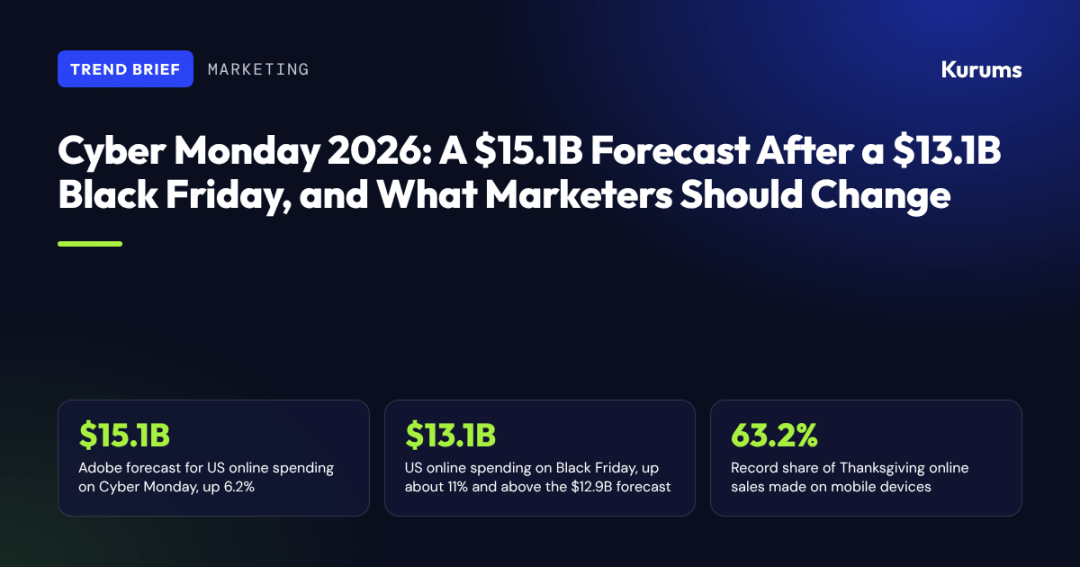
Thanksgiving and Black Friday both beat Adobe's forecast by about $200 million. The question for Monday is how much demand is left, and what it will cost to reach.
Adobe Analytics forecasts $15.1 billion of US online spending on Cyber Monday, 30 November 2026, up 6.2%. Thanksgiving ($7.1 billion) and Black Friday ($13.1 billion) each beat forecast by about $200 million and grew 10% to 11%, so demand arrived early. Discounts peak near 30% in electronics, mobile took 63.2% of Thanksgiving sales, and AI-referred visits are growing fast and converting better, though no tracker has published an agreed share. Marketers should pace Monday budgets by the hour, separate AI referrals in reporting and plan for shallower December discounts.
What is confirmed going into Cyber Monday
Cyber Monday falls tomorrow, 30 November 2026. Adobe Analytics forecasts $15.1 billion of US online spending for the day, up 6.2% on last year, according to Reuters. If that holds, it would be the first single day above $15 billion in Adobe’s data.
The first two days of Cyber Week both beat Adobe’s September forecast. Thanksgiving Day (26 November) brought in $7.1 billion online, up 10.4%, against a forecast of $6.9 billion, Digital Commerce 360 reported. Black Friday (27 November) reached $13.1 billion, up about 11%, against a forecast of $12.9 billion, Reuters reported.
Adobe projected $6.1 billion for Saturday (up 6%) and $6.4 billion for Sunday (up 7.5%), according to an earlier Reuters report carried by Investing.com. Final weekend figures were not available in the pages reviewed for this article.
Adobe’s September forecast put the five days from Thanksgiving to Cyber Monday at $47.5 billion, up 7.4%, and the full November to December season at $275.1 billion, up 6.7%. Reuters was still citing the $47.5 billion figure on 28 November. Adding the two reported days to Adobe’s own projections for the remaining three gives roughly $47.8 billion. That sum is our arithmetic; Adobe has not published a revised total in the material we reviewed.
The detail that matters: what the numbers cover
| Day (2026) | Adobe forecast, September | Result or latest projection | Year-on-year |
|---|---|---|---|
| Thanksgiving, 26 Nov | $6.9bn | $7.1bn (result) | +10.4% |
| Black Friday, 27 Nov | $12.9bn | $13.1bn (result) | about +11% |
| Saturday, 28 Nov | Not broken out | $6.1bn (projection) | +6% |
| Sunday, 29 Nov | Not broken out | $6.4bn (projection) | +7.5% |
| Cyber Monday, 30 Nov | $15.1bn | Pending | +6.2% (forecast) |
These are US online figures only, and they are not adjusted for inflation. Reuters put inflation at 3.8% and noted that in-store visits on Black Friday fell 2.2% to nearly 930 million, citing the analytics firm PassBy. Part of the online growth is price, and part is a shift of channel.
Discounts. Adobe’s forecast set peak Cyber Week discounts at 30% for electronics, 29% for toys, 23% each for televisions, computers and apparel, and 18% each for appliances and furniture. On Thanksgiving the observed peaks were slightly shallower: electronics 29%, toys 26%, apparel 23%, computers 22% and televisions 21%, per Digital Commerce 360. Adobe expects electronics to reach 30% and computers 23% on Cyber Monday, then discounts of 10% to 15% through December.
Mobile. A record 63.2% of Thanksgiving online sales, about $4.5 billion, came from mobile devices. Adobe forecast 57.4% for the season as a whole.
Buy now, pay later (BNPL). Adobe expects instalment payment services to carry $1.09 billion of Cyber Monday spending, up 5.3%, and $21.3 billion across the season. It forecast that 82% of BNPL spending would happen on mobile.
AI-referred traffic. Adobe measured traffic to US retail sites from AI services up 162% on Thanksgiving, and said those visitors converted 74% better than other traffic, compared with 39% better in 2025. For Black Friday, Reuters reported that traffic from chatbots and AI-enabled browsers converted 68% more effectively than a year earlier. Adobe’s forecast for Cyber Monday was AI traffic growth of 88%.
None of these is a share of total traffic. The closest share figure comes from Salesforce, which predicted that 20% of holiday e-commerce traffic would come from AI chat agents, a number that includes automated activity rather than purchases, according to Forbes, republished by Yahoo Finance. Salesforce also said 23% of holiday orders so far were influenced by AI, Digital Commerce 360 reported. TechRadar reported Salesforce data showing only 8% of consumers have let an AI complete a purchase for them.
Salesforce’s totals differ from Adobe’s because it tracks a different set of sites. It reported $8.8 billion of US online sales on Thanksgiving, up 5.1%, and projected $18.7 billion for US Black Friday, up 4%. The two series should not be mixed in one report.
Why it matters for marketing and e-commerce teams
The pattern so far is demand arriving earlier in the week than forecast. Thanksgiving and Black Friday grew at 10% to 11%, while Adobe’s forecast for Cyber Monday is 6.2%. Teams that held most of their budget for Monday may find a larger share of the week’s demand has already been served.
Shoppers are spending, but with a deal in hand. The Conference Board survey published on 18 November put average planned holiday spending at $1,049, up 5.9%, yet still 6.4% below 2024 after inflation. “The bargain hunt was part of the budget,” said Fergus McCormick, senior economist at The Conference Board. Reuters reported shoppers stocking up on cleaning, pet care and hygiene products alongside electronics and gaming.
Media is not cheap. A benchmark round-up by NAMEX, an agency, cites Lebesgue data showing the median Meta advertiser paid 71% more per thousand impressions on Cyber Monday 2025 than its own September average. It also cites Skai figures for the third quarter of 2026: paid social cost per thousand impressions up 20% year on year, paid search cost per click up 7%, and retail media cost per click down 11%. These are vendor figures, and none measures Cyber Week 2026 itself.
Channel mix is moving too. Salesforce said social media supplied 23% of global e-commerce referral traffic on Thanksgiving. “We’re seeing social media graduate from a browsing tool to a buying engine,” said Caila Schwartz, head of agentic commerce shopper insights at Salesforce. Adobe’s forecast had revenue share from social up 17%, affiliates and partners up 12%, and paid search up 4%.
Search interest: Black Friday towers over Cyber Monday
Google Trends data for the US over the last 90 days shows “black friday” peaking at the index maximum of 100 on 27 November. Its average over the last seven days was 35.4, against 2.2 across the prior 86 days, and the latest reading on 29 November was 16. “Cyber monday” peaked at just 3 on 28 November, averaged 1.3 over the last seven days against zero before that, and stood at 3 on the latest reading. Rising related queries for Black Friday were all marked as breakouts and were practical: store opening times at Target and Walmart, and streaming offers from HBO Max, Disney Plus and Peacock. The index measures relative attention on a 0 to 100 scale, not search volume, and Cyber Monday searches usually rise on the day itself. Even so, the gap suggests that “Black Friday” remains the term shoppers use for the whole event.
Search interest: cyber monday vs black friday
Google Trends, United States, Aug 29, 2026 to Nov 29, 2026. Daily index, 0–100, relative to the highest point among the terms compared; it shows relative attention, not search volume.
How to respond, by role
Chief marketing officer
Reforecast December against actual Thanksgiving and Black Friday performance rather than the September plan. Adobe expects discounts to fall to 10% to 15% after Cyber Week, so decide now whether December is about margin recovery or volume, and brief the board on which tracker your targets use.
Performance marketing lead
Pace Cyber Monday spend against marginal return by hour, not against last year’s daily curve. With mobile above 63% of Thanksgiving sales and 82% of BNPL spending forecast on mobile, check mobile landing pages and instalment messaging before raising bids. Protect brand search terms against lookalike advertisers.
E-commerce and merchandising lead
Match offer depth to the category benchmarks rather than applying one sitewide discount. Electronics is expected to hit 30% on Monday; apparel has held at 23%. Promote essentials and bundles, which Adobe expected to spike during Cyber Week, and keep price, stock, delivery and returns data accurate for AI assistants that read it.
Analytics and measurement lead
Create a separate channel grouping for AI referrals before Monday, so those sessions stop landing in “referral” or “direct”. Report their conversion rate, basket size and return rate separately. Adobe’s July survey found 69% of shoppers who used AI said they were less likely to return an item; test that against your own data in January.
Risks and open questions
- Demand pulled forward. If Thursday and Friday borrowed from Monday, the $15.1 billion forecast could be missed even as the week sets a record. Adobe has not said whether it will revise the figure.
- Nominal growth. With inflation at 3.8%, an 11% rise in spend is a smaller rise in units. Category and order-count data have not been published in the sources reviewed.
- AI traffic definitions. Adobe reports growth and conversion for AI referrals; Salesforce reports traffic share and “influenced” orders. Neither discloses the share of revenue from purchases completed by agents.
- Brand safety. The Better Business Bureau warns that scammers “mimic popular stores and promote deals that are too good to be true”, and points shoppers to guidance on sponsored ad scams and lookalike websites. Impersonation harms the real brand’s customers and its paid media results.
- Ad cost data gap. No measured figures for Cyber Week 2026 media costs were found. Last year’s pattern and third-quarter trends are the only guide for now.
What to do next
- Compare your own Thanksgiving and Black Friday growth with Adobe's 10.4% and 11% before setting Monday's budget ceiling.
- Pace Cyber Monday media by hourly marginal return and set a stop rule for campaigns that fall below target.
- Check every Monday offer against the category discount benchmarks, starting with electronics at 30% and apparel at 23%.
- Test mobile checkout and buy now, pay later messaging on the top ten landing pages tonight.
- Add an AI-referral channel group in your analytics tool and tag known assistant and AI-browser referrers.
- Search for your brand name in paid social and search results, and report lookalike ads and sites to the platforms.
- Draft a December plan that assumes market discounts of 10% to 15% and states where you will hold price.
Frequently asked questions
How much will US shoppers spend online on Cyber Monday 2026?
Adobe Analytics forecasts $15.1 billion, up 6.2% on 2025, which would be the first single day above $15 billion in its data. That forecast dates from September and was still being cited by Reuters on 28 November. Thanksgiving and Black Friday both came in about $200 million above Adobe's forecasts, but Adobe has not published a revised Cyber Monday number.
What share of retail traffic comes from AI assistants?
There is no agreed figure. Adobe reports growth, with AI-referred traffic up 162% on Thanksgiving, and says those visitors convert better than other traffic. Salesforce predicted 20% of holiday e-commerce traffic would come from AI chat agents, but that includes automated activity. Salesforce data also shows only 8% of consumers have let an AI complete a purchase.
How deep are Cyber Monday discounts expected to be?
Adobe expects electronics discounts to peak at 30% and computers at 23% on Cyber Monday. Its season forecast put toys at 29%, televisions and apparel at 23%, and appliances and furniture at 18%. Observed Thanksgiving peaks were slightly lower in toys and televisions. After Cyber Week, Adobe expects discounts of 10% to 15% through December.
Why do Adobe and Salesforce report different sales totals?
They track different sets of retail sites and use different methods, so the totals are not comparable. Adobe reported $7.1 billion of US online sales on Thanksgiving, up 10.4%, while Salesforce reported $8.8 billion, up 5.1%. Marketing teams should pick one tracker as a benchmark, state which one in reports and avoid combining the two series.
- Adobe: Adobe: U.S. Holiday Shopping Season to Hit Record $275.1 Billion Online, Rising 6.7% YoY (2026-09-28)
- Reuters (via NTD): Black Friday Online Spend Rises 11 Percent to a New High of $13.1 Billion (2026-11-28)
- Reuters (via Investing.com): US Black Friday online sales to cross $13 billion, Adobe says (2026-11-27)
- Digital Commerce 360: Thanksgiving Day ecommerce sales set record in 2026 with help from AI (2026-11-27)
- The Conference Board: Holiday Spending Plans Rise in 2026 (2026-11-18)
- Better Business Bureau: Shop with confidence on Cyber Monday (2026-10-20)
- TechRadar: Black Friday 2026 could be the biggest shopping week ever seen, with AI agents playing a bigger role than ever (2026-11-23)
- Forbes (via Yahoo Finance): Black Friday 2026: Brands Face A New Battle To Win AI Recommendations (2026-11-17)
- NAMEX: Black Friday Ad Costs 2026: Meta CPMs Ran 59% to 80% Above September (2026-11-12)
Search-interest figures are from Google Trends (United States, 90 days to November 29, 2026). This article is analysis for operators, not legal, tax or investment advice. Last updated November 29, 2026.
Discover more from Kurums | Business Intelligence
Subscribe to get the latest posts sent to your email.