
An engineering consultancy spends eleven weeks finding a senior project lead. The preferred candidate, Amara, is enthusiastic at the final interview. Then the offer takes nine days to arrive, because the finance director is travelling and the grade needs sign-off. When it comes, it is a PDF attached to a two-line email from a recruiter she has never spoken to. The salary is 6% above her current pay. Her current employer’s bonus, which she would forfeit by leaving in October, is not mentioned. She is asked to confirm by Friday.
Amara asks for the weekend. She is told the deadline is firm. On Friday afternoon she declines and accepts a counteroffer from her employer that she had not been seeking. The consultancy’s post-mortem concludes that she “was never serious”. In fact she had been serious for eleven weeks and stopped being serious in the nine days after the final interview.
By the time an offer is made, the employer has done most of its thinking. The candidate is just starting theirs. They are about to exchange a known situation for an unknown one, and the way the offer is framed, timed and delivered shapes how risky that exchange feels.
Hiring teams often treat the offer as paperwork. The research on how people actually make decisions under uncertainty suggests it is the most psychologically loaded moment in the whole process. This guide covers the main effects and what to do about each.
Losses outweigh gains.
Candidates feel what they give up about twice as strongly as what they gain. Find out what it is and address it.
Speed is a message.
Delay after the final interview is read as doubt. Pre-approve the range and call within 48 hours.
Pressure buys a weak yes.
Deadlines need a reason and some flexibility, or acceptance comes without commitment.
Why do candidates not just compare the numbers?
Because people evaluate outcomes as gains and losses from a reference point, not as absolute amounts. This is the core of prospect theory, developed by Daniel Kahneman and Amos Tversky, and one of the most replicated findings in behavioural science.
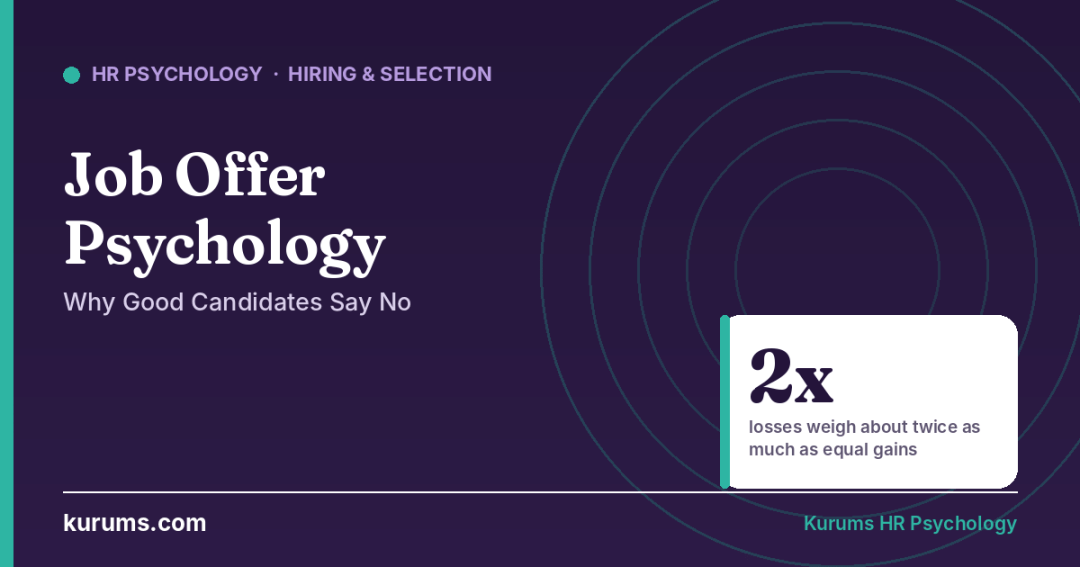
People weigh losses more heavily than gains of the same size, typically by a factor of around two. A change is judged against a reference point, usually the status quo, and what would be given up looms larger than what would be gained.
For a candidate, the reference point is their current job. Everything they would give up is a loss: the bonus due in March, the manager who trusts them, the commute they have optimised, four days of extra holiday earned through service. Everything you offer is a gain. If gains and losses are of equal size on paper, the losses win.
This is why a modest rise in base pay so often fails to move someone who seemed keen. It is also why candidates accept counteroffers. Staying requires no loss at all.
When a choice is uncertain, doing nothing feels safest, because any bad outcome that follows a change will feel like your own fault. Candidates need a reason to move that is clearly larger than the discomfort of moving.
What should an employer do about loss aversion?
Find out what the candidate would lose, and deal with it explicitly. That means asking, before the offer is drafted: “If you joined us, what would you be giving up that matters to you?” Most candidates will say. Then the offer can address those items instead of leaving the candidate to do the subtraction alone.
- Unvested bonus or equity. A sign-on payment that covers a forfeited bonus converts a loss into a neutral. It usually costs less than restarting the search.
- Service-related benefits. Matching holiday entitlement or waiving a probationary period for benefits costs little and removes a visible step backwards.
- Security. Someone leaving a ten-year job for a new one is taking on risk. A longer notice period in their favour, or a clear statement of how the role is funded, speaks to that.
- Relationships. You cannot replace a trusted manager, but an hour with the future manager and two future colleagues before the offer deadline does more than any number.
Present the whole package, not just base salary. A one-page total reward summary that sets out base, bonus, pension, benefits and time off side by side with what the candidate has now, as far as you know it, prevents the comparison being made on the single number where you may look weakest.
How does anchoring shape the offer?
The first number mentioned in a negotiation pulls the final outcome toward it. This “anchoring” effect is robust: experienced negotiators show it, and so do people who are warned about it.
In hiring, the anchor is often set long before the offer, by the range in the job advertisement or by the first figure anyone says aloud. A candidate who saw “up to 85,000” in the advert will experience 78,000 as a loss of 7,000, even if 78,000 is a large rise. Advertise a range you intend to use, and explain where in the range a given candidate sits and why.
A growing number of jurisdictions restrict asking about salary history or require pay ranges in advertisements, partly because anchoring on previous pay carries old inequities forward. Even where it is legal, basing an offer on what someone earned before means paying for their last employer’s decisions. The negotiation side of this is covered in salary negotiation psychology for managers.
Do exploding offers work?
An exploding offer is one with a short, firm deadline, designed to stop the candidate comparing it with alternatives. It sometimes produces a yes. It produces a worse yes.
Negotiation researchers have found that people who accept under time pressure feel less committed to the decision and are more likely to regret it. A candidate who was pushed is a candidate who keeps looking. There is also a signalling cost: a deadline that seems arbitrary tells the candidate how the organisation behaves when it has power over them.
| Deadline approach | What the candidate hears | Likely result |
|---|---|---|
| “We need an answer by Friday.” (no reason) | They are afraid I’ll get a better offer | Decline, or accept and keep interviewing |
| “Take as long as you need.” | They are in no hurry; perhaps I’m a backup | Drift, and a competing offer arrives |
| “We’d like to hear by the 14th because the second candidate is waiting and I owe them an answer. If you need longer, tell me what for.” | A fair process with a real reason | A considered answer, usually on time |
A reasonable period is long enough to talk to family and sleep on it, typically three to seven days, with a stated reason and some flexibility.
Why does a slow offer lose candidates?
Because candidates read meaning into time. From the inside, a nine-day gap is a sign-off queue. From the outside, it is information: they are having doubts, I was the second choice, this is how slowly they do everything. In the absence of an explanation, people supply the least flattering one, the same mechanism that makes ghosting rejected candidates so damaging.
Momentum matters psychologically as well. Enthusiasm peaks at the final interview, when the candidate has just spent an hour imagining themselves in the job. Each day afterwards, the current job reasserts itself, and with it the pull of the status quo.
Never let a candidate hear nothing between the final interview and the offer. If sign-off is delayed, the hiring manager should call and say so: “You are our preferred candidate. The paperwork needs one more signature and I expect to have it on Wednesday.” That sentence costs nothing and holds the candidate.
Who should make the offer, and how?
The hiring manager, by phone or in person, before anything is sent in writing. People take jobs to work for people. A call that begins “I’d really like you to join my team, and here is what we’d like to offer” carries information no PDF can: that the manager wants this specific person.
The peak-end rule applies here. People remember an experience largely by its most intense moment and by how it ended. For a candidate, the offer is the end of the hiring process. A warm, specific, well-organised offer rewrites the memory of a long process favourably. A cold one does the reverse.
What about counteroffers and the weeks before day one?
Assume a strong candidate will receive a counteroffer, and raise it before it happens: “When you resign, your employer may well try to keep you. What would you want to think about if they do?” Having rehearsed the moment, the candidate is far less likely to be swayed by a flattering conversation with a director who had not previously noticed them. Remind them, without pressure, why they started looking.
Acceptance is not the finish line. Between signing and starting, the candidate is serving notice among colleagues who are sorry to see them go, with nothing from the new employer but a contract. Buyer’s remorse is normal after any large decision. A weekly message from the manager, an invitation to a team event, early access to something useful about the role, all reduce the chance of a late withdrawal. The psychology of those first weeks, and the unwritten expectations formed during them, is the subject of our guide to the psychological contract.
In the consultancy’s case, the fix was not more money. The firm now agrees the range and the sign-off before final interviews, the hiring partner makes every offer by phone within two days, and the first question on the offer checklist is “What is this person giving up?”
Frequently asked questions
Why do candidates reject job offers after seeming enthusiastic?
The commonest reasons are a slow or impersonal offer, an unaddressed loss such as a forfeited bonus, a counteroffer from the current employer, and a number that falls below an anchor set earlier in the process. Enthusiasm at interview is real, but it fades quickly if the days afterwards send mixed signals.
How long should a candidate have to consider an offer?
Three to seven days is reasonable for most roles, longer for senior moves or relocations. Give a reason for the date and be open to a short extension. Very short deadlines without explanation tend to produce either a refusal or a reluctant acceptance.
Should the offer be made by phone or in writing?
Both, in that order. A call from the hiring manager makes the offer personal and lets you gauge the reaction and answer questions. The written offer, with a clear summary of the whole package, should follow the same day.
How can employers reduce counteroffer losses?
Discuss the likelihood of a counteroffer openly before the candidate resigns, make sure your offer addresses what they would lose by leaving, keep in close contact during the notice period and have the future manager and team stay visible.
Discover more from Kurums | Business Intelligence
Subscribe to get the latest posts sent to your email.