
Applicant tracking systems for in-house recruiting teams
Applicant tracking systems manage job requisitions, postings, candidate pipelines, interview scheduling, feedback and offers in one place, so hiring teams can run consistent, auditable recruitment. Sponsored listings are paid placements ordered by daily bid; every other company below is listed free by our editors.
Sponsored listings
Claim #1 · $5/dayPick your daily bid and 7, 15 or 30 days, pay once through iyzico, and you are live the moment the payment clears. No account to create first, no subscription, no stored card.
Today's board
Paid today · resets 00:00 UTC · all categoriesAll applicant tracking systems
Free listings · A to Z · sponsor yours from $5/dayAshby
All-in-one recruiting platform combining ATS, CRM, scheduling and analytics for scaling companies.
Breezy HR
Visual pipeline ATS for small businesses with job posting, scheduling and candidate questionnaires.
Greenhouse
Structured-hiring ATS with scorecards, interview kits and reporting for growing and enterprise teams.
iCIMS
Talent acquisition platform for large employers, spanning ATS, CRM, onboarding and career sites.
JazzHR
Straightforward applicant tracking for small businesses posting jobs and managing candidates.
Jobvite
Talent acquisition suite with ATS, recruitment marketing and onboarding for mid-market and enterprise employers.
Lever
Combined ATS and candidate relationship management for sourcing, nurturing and tracking applicants.
Manatal
Cloud recruitment software for agencies and in-house teams, with candidate sourcing and client management.
Pinpoint
UK-built applicant tracking system for in-house teams, with configurable workflows and reporting.
SmartRecruiters
Enterprise talent acquisition suite covering ATS, CRM, job marketing and hiring workflows.
Teamtailor
Swedish ATS with built-in employer branding career sites for small and mid-sized companies.
Tellent Recruitee
Collaborative, customisable applicant tracking system from Europe for small and mid-sized hiring teams.
Workable
Recruiting software with job board distribution, sourcing and pipeline tools for small and mid-sized employers.
Sell in this category? List your product — from $5/day, one payment, no account or stored card. How it works.
What does an applicant tracking system actually do?
An applicant tracking system (ATS) is the record of every hiring process: the approved requisition, the job advert and where it was posted, each applicant, who reviewed them, what interviewers said and how the offer was made. Its practical value is consistency. When every candidate moves through the same stages with the same scorecards, hiring managers stop working from their inboxes and you can show why a decision was taken.
Most products also handle job board distribution, a branded careers page, interview scheduling, email templates, offer letters and basic reporting such as time to hire and source of hire. Beyond that, the market splits: some tools add a sourcing CRM for passive candidates, others lean into high-volume screening, and others are deliberately simple for companies hiring a handful of people a year.
An ATS does not fix a weak hiring process on its own. It makes the process visible, which is useful precisely because it shows where candidates stall, which interviewers are slow to give feedback and which sources produce hires rather than applications. Before buying, write down your current stages, approval steps and who owns each one; that document becomes both your requirements list and your configuration plan.
Should you buy a standalone ATS or use your HR suite's recruiting module?
Many HRIS and HCM suites now include a recruiting module, which makes this the first real decision. The trade-off is depth of recruiting features versus a single employee record.
| Option | Strengths | Typical fit |
|---|---|---|
| Standalone ATS | Deeper pipeline, scorecard, sourcing and careers-site features; recruiter-friendly interface; broad job board integrations | Organisations hiring continuously with a dedicated recruiting team |
| Recruiting module in HR suite | One vendor and data model; new hires flow straight into core HR and payroll; simpler licensing | Companies hiring occasionally, or whose HR team also runs recruitment |
| ATS with built-in CRM | Talent pools, nurture campaigns and event management alongside tracking | Employers competing for scarce technical or specialist talent |
| Agency or staffing ATS | Client, job order and placement management with candidate databases | Recruitment agencies and in-house teams running agency-style models |
If you choose a standalone ATS, confirm how the hire record passes to your HRIS. A reliable integration that creates the employee profile on offer acceptance removes a surprising amount of re-keying and error.
What should you compare before you shortlist?
Run each vendor through the same questions, ideally using one of your real open roles in the demo.
| Criterion | What to ask |
|---|---|
| Hiring manager experience | Can a manager review candidates and submit feedback from email or mobile without training? |
| Structured interviewing | Are scorecards, interview kits and required feedback enforceable per stage and per role? |
| Job distribution | Which job boards are native in our countries, and which cost extra or need a third party? |
| Scheduling | Does it read calendar availability for panels and handle rescheduling without recruiter involvement? |
| Data protection | How are consent, retention periods and deletion requests handled for candidates in each jurisdiction? |
| Reporting | Can we report pipeline conversion by stage, source and recruiter without exporting to spreadsheets? |
| Integrations | Is there a maintained connector to our HRIS, background-check and assessment providers, or only an open API? |
How are applicant tracking systems priced?
Small-business tools usually charge a flat monthly fee tied to the number of active job openings or users. Mid-market and enterprise vendors typically price annually by employee headcount, sometimes with a minimum contract value, and quote add-ons such as CRM, advanced analytics, onboarding or premium job board packages separately. Implementation and data migration fees are common above small-business tier.
Watch the metric. A per-job model can become expensive when you keep evergreen roles open, while a per-employee model charges you for growth that has nothing to do with recruiting volume.
Ask for renewal caps in writing. Recruiting volume swings with the economy, and some contracts make it hard to reduce seats or tiers when hiring slows.
What usually goes wrong?
The most common failure is hiring managers not using the system. If feedback still arrives by chat message, the ATS data becomes incomplete and reporting is meaningless. Make feedback submission part of the process, and pick the tool whose manager interface your least technical manager can use.
Other frequent problems are over-customised pipelines with a dozen stages nobody maintains, migrations that bring years of stale candidate data and create retention liabilities, careers pages that break brand consistency, and integrations with background checks or HRIS that are assumed rather than tested. Agree a small, standard set of stages, clean data before migrating, and test the end-to-end path from application to employee record before go-live.
Finally, candidate experience is easy to damage. Long application forms, forced account creation and silence after an interview reflect on your employer brand. Apply to one of your own jobs on a mobile phone during the trial and fix whatever frustrates you.
Frequently asked questions
What is the difference between an ATS and a recruiting CRM?
An ATS manages people who have applied to a specific job, moving them through stages to a decision. A recruiting CRM manages relationships with potential candidates before they apply, through talent pools and nurture campaigns. Some products combine both; others integrate with a separate CRM.
Does a small company need an applicant tracking system?
If you hire more than a few people a year or involve several interviewers, an entry-level ATS usually pays for itself in saved admin time and a better candidate experience. It also gives you a defensible record of how decisions were made. Very occasional hiring can still work from a shared inbox and a structured spreadsheet.
How long does ATS implementation take?
Simple self-serve tools can be live within days. Mid-market deployments with integrations, careers site configuration and approval workflows commonly take four to ten weeks. Enterprise rollouts across countries and business units take longer, mainly because of process agreement rather than technology.
Do applicant tracking systems reject CVs automatically?
Most do not reject candidates on their own unless you configure knockout questions or screening rules. Some platforms offer automated matching or ranking features, which should be reviewed for bias and checked against local employment and data protection rules before use.
How this directory is compiled
Every company on this page was added by our editors from publicly available information: the product name, what it does in one line, and a link to the vendor's own site. No company paid to be listed in the free section, none was asked for approval, and inclusion here is not a recommendation — it is a starting point for a shortlist you should verify yourself.
The block at the top of the page is different and is labelled as such. Positions there are paid: a company chooses a daily bid and a number of days, pays once, and sits above the free listings for that period, ordered by bid. That is advertising, it is disclosed on every listing, and it has no influence on our editorial comparisons or on the Kurums Trust badges, which are earned against published criteria and are never for sale.
Pricing, feature and availability details change constantly in these categories, so we deliberately keep vendor descriptions here short and factual, and leave verified pricing to the dated editorial comparisons. Check the vendor’s own pricing page before you make a decision, and treat anything you read in a directory — including this one — as a list of candidates rather than an answer.
Best Workforce Planning Software in 2026: Pricing & Comparison
Buyer's guide · HR Best Workforce Planning Software in 2026: Pricing & Comparison We compared four workforce planning platforms on public pricing, scenario modelling, headcount tools and fit so you can shortlist two in ten minutes. By Kurums EditorialPricing checked...
Best Employee Experience Software in 2026: Pricing & Comparison
Buyer's guide · HR Best Employee Experience Software in 2026: Pricing & Comparison We compared four employee experience and engagement platforms on public pricing, free or trial options, survey and performance modules, and deployment model so HR and people teams can...
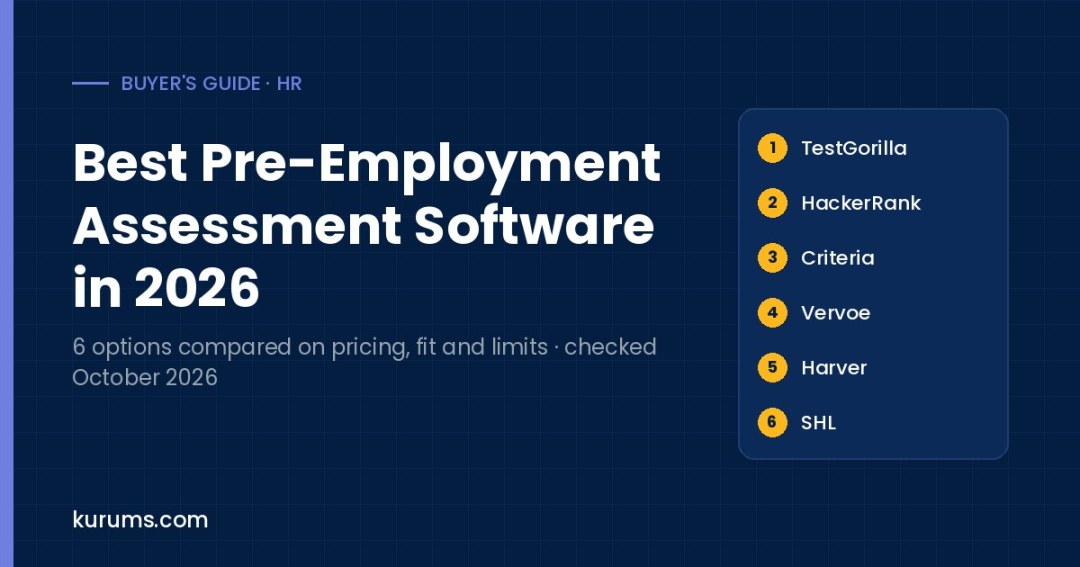
Best Pre-Employment Assessment Software in 2026: Skills Tests Compared
Six pre-employment assessment platforms compared on pricing, free plans and trials, test libraries, AI scoring and the hiring volumes they suit.