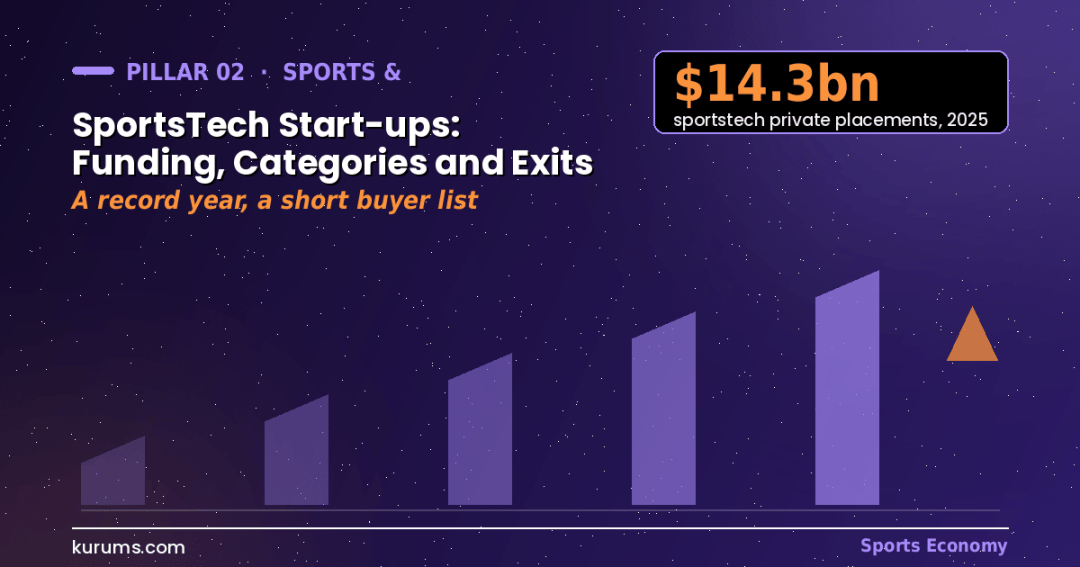
Sportstech had its largest year on record in 2025. Drake Star’s Global Sports Tech Report counts roughly $200bn of disclosed deal value across 1,026 transactions, of which $156bn was M&A (450 deals) and a record $14.3bn was private placements (500 deals), up from $4.5bn in 2024. Two mega-deals, Netflix’s proposed $82.7bn purchase of Warner Bros. Discovery’s streaming unit and the $55bn take-private of Electronic Arts, inflate the M&A figure. The biggest raises were DAZN ($2.4bn), Polymarket ($2.2bn), Kalshi ($1.5bn) and Oura ($900m). Exits go to strategic buyers and private equity, not public markets.
SportsTech start-ups funding and exits have moved from a niche inside consumer internet to a category that private-equity firms, sovereign funds and media groups now track on its own. This article is part of the Sports Economy hub and complements our analysis of the athlete as entrepreneur and of how sport learned to raise capital.
How much money went into sportstech in 2025?
About $14.3bn of private placements across 500 deals, a record, plus $156bn of M&A across 450 deals, according to Drake Star’s Sports Tech Report 2025 published in January 2026. Private-placement value more than tripled from $4.5bn in 2024 even though deal count fell from 661.
Which categories attract the capital?
Fantasy, esports and betting raised the most money in 2025, driven by prediction markets Polymarket and Kalshi; wearables and performance, led by Oura, and fan engagement produced the most deals. Media and broadcasting dominated M&A.
How do sportstech start-ups exit?
Mostly through trade sales to consolidators such as Hudl, Catapult, Genius Sports and Sportradar, or to private equity, which took Learfield ($2bn, TPG) and Teamworks (valued above $1.5bn, Hg) in 2026. IPOs remain rare; listed sportstech indices nonetheless beat the S&P 500 in 2025.
What counts as a sportstech start-up?
Any company whose product sells into the production, distribution, performance or monetisation of sport. Drake Star tracks six segments: media and broadcasting; fan engagement and experience; data and analytics; wearables and performance; sponsorship and venues; and esports, fantasy and betting. The borders are porous, which is why totals vary by source.
The definitional problem matters for anyone reading headline figures. Drake Star’s roughly $200bn for 2025 includes Netflix’s proposed $82.7bn acquisition of Warner Bros. Discovery’s streaming and studios division and the $55bn acquisition of Electronic Arts by Saudi Arabia’s Public Investment Fund with Silver Lake, because both targets carry sports rights or sports games. Neither is a sportstech start-up in any useful sense. Strip the two out and 2025 M&A is roughly $18bn.
Within the six segments, the economics differ enough that an investor should treat them as separate markets. Performance and analytics tools such as Catapult, Hudl, StatsBomb and Teamworks sell subscriptions to teams, leagues and universities; the buyer universe is small, perhaps 10,000 professional and elite-college organisations worldwide, so growth comes from price, product breadth and acquisition. Consumer wearables and fitness apps such as Oura, WHOOP and Strava sell to individuals, which gives them venture-scale markets and consumer-scale churn. Betting, fantasy and prediction-market companies run on regulated licences and gross gaming revenue, with margins that look like fintech. Media and fan-engagement businesses live or die by rights costs, the economics described in our article on streaming’s entry into sport.
How much capital did sportstech start-ups raise in 2025 and 2026?
A record $14.3bn of private placements across 500 deals in 2025, per Drake Star, against $4.5bn across 661 deals in 2024 and $5.7bn in 2023. The money concentrated: 23 raises of $100m or more, a four-year high, accounted for most of the value while early-stage rounds made up 82% of deal count.
The largest raises tell the story of where capital went. DAZN raised $2.4bn across three rounds, including the roughly $1bn investment from SURJ Sports Investment, the PIF’s sports arm, announced around its FIFA Club World Cup rights deal. Polymarket raised $2.2bn over two rounds and Kalshi $1.5bn over three as prediction markets became the fastest-growing adjacent category to sports betting; Dakota’s May 2026 sports-investing report records Kalshi’s subsequent $1bn Series F at a $22bn valuation. Oura’s $900m round, which valued the smart-ring maker at roughly $11bn according to contemporaneous reports, was the biggest in wearables. Below them sat NEP Group ($700m), CR Fitness ($350m) and Teamworks ($235m).
Deal count falling while value tripled is the signature of a market in which late-stage investors returned before early-stage ones: a Series B in a proven category was easier to raise in 2025 than a seed round in an unproven one.
The first half of 2026 continued the pattern. Dakota’s May 2026 report lists an InStudio Ventures $50m sports and performance fund, Gamma Waves Partners raising €55m of a €100m target with Agnelli, Chiellini and Benetton family backing, Mark Cuban’s Harbinger Sports Partners closing $450m of a $750m target, and the L Catterton and Patricof Co vehicle CHAMP at $500m with more than 250 athletes committing over $50m between them. In August 2026 Unrivaled, the women’s basketball league and athlete-equity platform founded by Napheesa Collier and Breanna Stewart, closed a $106m Series C at a $650m valuation led by Ten Pillars Sports Fund with Bessemer, Carmelo Anthony, Alex Morgan and Geno Auriemma participating.
| Segment | Business model | 2025 marker deals | Typical exit |
|---|---|---|---|
| Media & broadcasting | Rights, subscriptions, production services | DAZN $2.4bn raised; NEP $700m; Netflix–WBD $82.7bn (proposed) | Strategic sale to media group or sovereign fund |
| Fantasy, esports & betting | Gross gaming revenue, take rate, licences | Polymarket $2.2bn; Kalshi $1.5bn; PrizePicks–Allwyn $4.15bn | Sale to licensed operator; occasional listing |
| Wearables & performance | Hardware plus subscription; team SaaS | Oura $900m; Teamworks $235m, later valued above $1.5bn | PE buyout or consolidator (Catapult, Hudl) |
| Data & analytics | B2B data feeds, integrity, betting data | Catapult–IMPECT (Oct 2025); Hudl–StatsBomb (2024) | Sale to Genius, Sportradar, Stats Perform or Hudl |
| Fan engagement | Ticketing, apps, loyalty, OTT platforms | Unrivaled $106m at $650m (Aug 2026); PlayReplay $12m | Sale to league, ticketing major or PE |
| Sponsorship & venues | Agency fees, multimedia rights, venue tech | Learfield ~$2bn to TPG (2026); several $1bn+ venue deals | PE buyout; agency roll-up |
Which sportstech categories grow fastest, and why?
Prediction markets and betting-adjacent products grew fastest in 2025 by capital raised; wearables and fan engagement grew fastest by deal count. The driver in both cases is a regulatory or platform shift: US federal treatment of event contracts for prediction markets, and the move of wearables from fitness accessory to health-data subscription.
Prediction markets are the clearest 2025 story. Kalshi’s and Polymarket’s combined $3.7bn of raises, and Kalshi’s later $22bn valuation, rest on a legal position that lets them offer sports-event contracts under US commodities regulation rather than state gambling licences. Several state regulators contest that position, which makes the category the highest-beta corner of sportstech. Our piece on the sports betting economy covers the regulated side of the same market.
Wearables grew for a different reason. Oura, WHOOP and their rivals converted one-off hardware sales into recurring subscriptions by positioning the device as a health monitor rather than a training tool, which widened the market from athletes to anyone who sleeps. The public-market analogue is Drake Star’s Athlete Performance and Analytics index, which returned 19.74% in 2025 against 16.65% for the S&P 500, with Digital Media and OTT returning 39.21%.
Team-side performance software grows more slowly but exits more reliably. Catapult, listed on the Australian Securities Exchange, works with more than 5,000 teams in over 40 sports and has used acquisitions, including Formula One video specialist SBG and, in October 2025, German football data firm IMPECT, to broaden a subscription product whose customers rarely churn. Hudl, private and based in Lincoln, Nebraska, has absorbed Wyscout, StatsBomb, Instat and Volleymetrics to become the default video and data platform from high school to the professional level. Teamworks, which started as a team-communication app, raised $235m in 2025 and was valued above $1.5bn in a 2026 growth round led by Hg, having bought a string of nutrition, compliance and recruiting tools. These are roll-ups: the market is small enough that a consolidator can own most of it.
How do sportstech start-ups actually exit?
Overwhelmingly through trade sales and private-equity buyouts. Drake Star counted 450 sportstech M&A deals in 2025 against 76 public-market transactions, and most of the public figure is secondary activity in existing listed companies. The strategic buyers are a short list: Hudl, Catapult, Genius Sports, Sportradar, Stats Perform, the ticketing majors and the large agencies.
The 2025 and 2026 exit list shows the pattern. PrizePicks, the daily-fantasy operator, sold to lottery group Allwyn for $4.15bn, the largest pure-play sportstech sale of the year. Excel Sports Management was reported to have sold a stake to Goldman Sachs at a valuation around $1bn. Learfield, the college-sports multimedia-rights company, agreed a roughly $2bn sale to TPG in 2026. Teamworks took growth capital from Hg at a valuation above $1.5bn. Sportsbox AI, a golf-swing analytics start-up, sold to Bryson DeChambeau’s ANU Golf group for an undisclosed eight-figure sum. Pickleball Inc., parent of Major League Pickleball and the PPA Tour, took $225m from Apollo Sports Capital and Dundon Capital. None of these was an IPO.
The IPO window for sportstech opened briefly in 2021, when Genius Sports and Sportradar listed through a SPAC and a conventional IPO respectively, and has barely reopened since. Founders raising today should assume the exit is a sale, which means late-round valuations are anchored to what a strategic buyer will pay, and the acquirer list is short enough to name at the Series A.
Private equity is the newest exit route and the fastest growing. The firms that moved into club ownership after 2019, Arctos, Sixth Street, RedBird, CVC and Silver Lake, now also buy the companies that sell to clubs, and the specialist sports funds described in our article on private equity in sport treat sportstech as a lower-risk way to get sector exposure without league approval processes.
Where does sportstech capital come from, geographically?
The United States still accounts for the majority of value, driven by betting, media and college sport, but the Gulf became the single most important source of mega-round capital in 2025 through the PIF’s SURJ unit, and Europe supplies most of the performance and data companies that get acquired.
The US dominates because its three largest sportstech categories, legal betting, prediction markets and college-sports rights, barely exist elsewhere at scale. PrizePicks, Kalshi, Polymarket, Learfield and Teamworks are all American and all sell into regulatory or institutional structures that are peculiar to the US. Add the NFL, NBA and MLB ownership groups, now limited partners in funds such as Courtside Ventures and Will Ventures, and the capital base supports the 23 rounds of $100m or more that Drake Star recorded in 2025.
The Gulf’s role is newer and more concentrated. SURJ’s investment in DAZN, the PIF–Silver Lake purchase of Electronic Arts and the PIF’s broader portfolio across golf, boxing, esports and football mean that a single sovereign fund was behind roughly two-thirds of the headline 2025 deal value. The sums are real, but they depend on one investor’s strategy; the sale of 70% of Al Hilal to Prince Alwaleed for $373m in early 2026 and LIV Golf’s search for outside investors after the PIF signalled an end to direct funding show that the strategy can change. Our country playbook on Saudi Arabia, Qatar and the UAE as sports investors covers the policy behind the money.
Europe supplies product rather than capital. StatsBomb (UK), IMPECT (Germany), Wyscout (Italy), Instat (originally Russian, now Luxembourg-based) and SBG (UK) were all built in Europe and sold to American or Australian consolidators. The companies reach €10–30m revenue, find no domestic buyer at scale and sell to Hudl or Catapult. Türkiye fits the European pattern in miniature. Istanbul has produced match-analysis and fan-app start-ups serving Süper Lig clubs, and the Galatasaray and Fenerbahçe fan bases are among the largest digital audiences in European football, but the local venture market has yet to fund a sportstech company to the point where it becomes an acquirer rather than a target.
What are the biggest risks in sportstech investing?
Dependence on a rights holder that can withdraw access, regulatory reversal in betting and prediction markets, hardware margins in wearables, and valuation inflation from a small number of sovereign-backed mega-rounds. Each has produced losses in the last three years.
Rights-holder dependence is the structural risk. A fan-engagement app that relies on a league’s official data feed, a ticketing platform whose main client is one federation, or a media start-up built on a single rights package can lose its business at the next tender. DAZN’s history illustrates the point from the other direction: its $2.4bn of 2025 raises were needed in part because rights costs in Italy, Germany and Spain exceeded subscription revenue for years.
Regulatory reversal is the betting-adjacent risk. The fan-token and NFT boom of 2021–2022, examined in our article on what survived of digital fan monetisation, destroyed most of the capital invested in it when the crypto market and consumer interest collapsed together. Prediction markets could follow if the US federal position on sports event contracts is overturned; the $22bn valuation attached to Kalshi assumes it will not be.
Valuation inflation is the subtlest. When a single investor’s $1bn cheque accounts for a large share of a year’s category total, the implied prices for everyone else rise without any change in their fundamentals. The 2025 private-placement figure of $14.3bn would be far less remarkable without DAZN, Polymarket, Kalshi and Oura; the remaining 496 deals shared roughly $7bn, which is an ordinary year. Seed founders who price rounds off the headline will find the consolidators have not changed their multiples.
How does sportstech compare with fintech and healthtech as a venture category?
It is smaller, more exit-constrained and more dependent on a few buyers, but it has a cheaper customer-acquisition channel than either and a track record of profitable consolidators. The $14.3bn raised in 2025 is roughly a tenth of global fintech venture funding in a normal year, and most of it went to a handful of companies.
The comparison is useful because fintech and healthtech are where many sportstech investors came from. Fintech’s advantage is a market of every business and consumer on earth; its disadvantage is that incumbents are banks with regulatory moats. Sportstech’s market is far smaller, but its distribution advantage is unusual: fans will download a club’s app, wear a sponsor’s ring and watch an athlete’s content without being paid to, which lowers acquisition cost to a level consumer fintech cannot reach. Athlete investors exploit exactly this, as the athlete-led brand case studies in this pillar show.
Healthtech is the closer analogue, and the two are converging. Oura and WHOOP are now sold as health devices; Catapult’s and Teamworks’ athlete-monitoring tools are being adapted for corporate wellness and military use; and the corporate wellness market is one of the largest adjacent buyers of sports-derived technology. A sportstech founder whose product can cross into health or enterprise has a larger exit universe than one who stays inside sport, and the 2025 valuations reflect it: Oura at roughly $11bn is a health company that started in sport, while the pure team-analytics companies trade at a fraction of that.
Frequently Asked Questions
How much venture funding did sportstech raise in 2025?
Drake Star’s Sports Tech Report 2025, published in January 2026, records a record $14.3bn of private placements across 500 deals, up from $4.5bn across 661 deals in 2024. The total is concentrated: DAZN ($2.4bn), Polymarket ($2.2bn), Kalshi ($1.5bn) and Oura ($900m) account for roughly half, and 23 rounds of $100m or more set a four-year high. Early-stage deals were 82% of the count but a small share of the value.
Who buys sportstech start-ups?
A short list of consolidators and, increasingly, private-equity firms. Hudl (which owns Wyscout, StatsBomb and Instat), Catapult (SBG, IMPECT), Genius Sports, Sportradar and Stats Perform buy data and performance companies; licensed operators such as Allwyn, which paid $4.15bn for PrizePicks, buy betting and fantasy businesses; and PE firms such as TPG (Learfield, about $2bn) and Hg (Teamworks, valued above $1.5bn) buy subscription businesses with contracted revenue. IPOs have been rare since 2021.
Which sportstech segment is riskiest?
Prediction markets and betting-adjacent products. Kalshi and Polymarket raised $3.7bn between them in 2025 and Kalshi was later valued at $22bn, but the business model depends on US federal commodities treatment of sports event contracts that several state regulators dispute. Fan tokens and NFTs showed in 2022 how quickly a sports-adjacent category can lose most of its invested capital when the underlying market turns.
Did listed sportstech companies perform well in 2025?
Yes, on Drake Star’s equally weighted indices. Digital Media, OTT and Content returned 39.21% between January and December 2025, Athlete Performance and Analytics 19.74%, against 16.65% for the S&P 500; Fantasy, Esports and Betting returned 9.88% and listed Sports Franchises 9.26%. The indices are small and dominated by a few names such as Genius Sports, Sportradar and Catapult, so treat them as indicative rather than as a benchmark.