
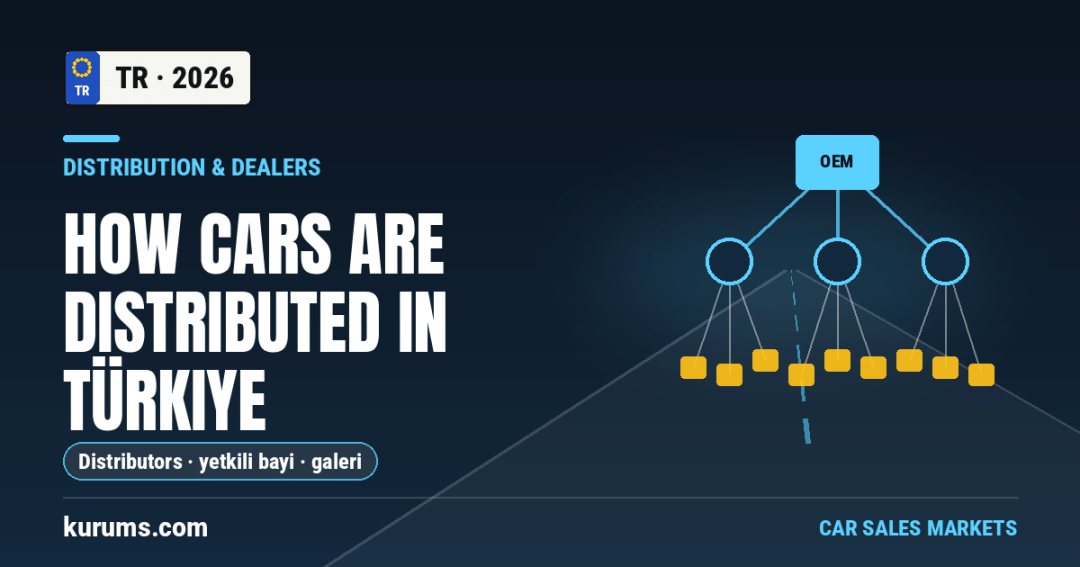
Türkiye’s car market is built on importer-distributors: national companies — many owned by Turkish conglomerates — that hold exclusive rights to a brand, import or source cars from local factories, set prices and appoint authorised dealers (yetkili bayi). Doğuş Otomotiv (Volkswagen Group brands), Borusan Otomotiv (BMW, MINI, Land Rover), Tofaş (Fiat and, since 2025, Stellantis’s Peugeot, Citroën, Opel and DS), MAİS/Oyak Renault (Renault, Dacia), Mercedes-Benz Türk, Toyota Türkiye, Hyundai Assan and Ford Otosan are among the largest. They are represented by ODMD. Togg sells through its own network, and Chinese brands have arrived through new distributors and BYD’s local subsidiary. Used cars are traded by authorised dealers and tens of thousands of independent galeri businesses that must hold a Ministry of Trade authorisation certificate.
Türkiye’s car distributors are among the most powerful players in the country’s economy. The market’s structure — exclusive national distributors, many tied to local factories, selling through authorised dealer networks — reflects the history of Turkish industrial conglomerates partnering with foreign manufacturers. Understanding who distributes which brand is the first step for any company selling into, financing or partnering in Turkish car retail. This guide explains the structure in 2026; it complements our Türkiye car market overview and our guide to Turkish online car marketplaces, part of the Car Sales Markets hub.
Who sells cars in Türkiye?
National distributors with exclusive brand rights, which appoint authorised dealers; the distributors’ association ODMD publishes the official sales data.
Who are the biggest distributors?
Doğuş Otomotiv, Tofaş, Oyak Renault/MAİS, Borusan Otomotiv, Mercedes-Benz Türk, Toyota Türkiye, Hyundai Assan and Ford Otosan, among others.
How are used cars traded?
Through authorised dealers and independent galeri businesses, all of which need a second-hand vehicle trade authorisation certificate; sales are completed at notaries.
How does car distribution work in Türkiye?
Car distribution in Türkiye follows an importer-distributor model. For each brand, a single national company holds the distribution rights. That company — either a subsidiary of the manufacturer or an independent Turkish firm — imports cars or buys them from Turkish factories, sets list prices and campaigns, and appoints and supervises authorised dealers (yetkili bayi) and service points (yetkili servis). Dealers buy cars from the distributor and sell them to customers, earning margins, bonuses and service income.
The model gives distributors enormous influence. They decide which models and trims are offered, how prices respond to tax (ÖTV) brackets and exchange-rate movements, how stock is allocated across dealers and which financing campaigns run with partner banks or the distributor’s own finance company. ODMD — the Automotive Distributors and Mobility Association — represents them and publishes the official monthly sales figures that the market follows.
Who distributes which car brands in Türkiye?
The table below shows the main distributors. Several are joint ventures that also manufacture in Türkiye, which gives their brands a cost and tax advantage on locally built models.
| Distributor | Main brands | Notes |
|---|---|---|
| Doğuş Otomotiv | Volkswagen, Audi, Škoda, SEAT, Cupra, Porsche, Bentley, Lamborghini | Doğuş Group; also commercial vehicles and used-car operations |
| Tofaş | Fiat; Peugeot, Citroën, Opel, DS (from 2025) | Koç–Stellantis JV; Bursa factory; took over Stellantis Türkiye distribution |
| MAİS / Oyak Renault | Renault, Dacia | Oyak Renault factory in Bursa |
| Ford Otosan | Ford | Koç–Ford JV; Kocaeli plants, LCV leader |
| Toyota Türkiye | Toyota, Lexus | Sakarya factory |
| Hyundai Assan | Hyundai | Kibar Group–Hyundai JV; İzmit factory |
| Mercedes-Benz Türk | Mercedes-Benz cars and commercial vehicles | Daimler subsidiary; bus and truck plants |
| Borusan Otomotiv | BMW, MINI, Land Rover | Borusan Group |
| Doğan Trend Otomotiv | Suzuki, MG and others | Doğan Group |
| Togg | Togg | Domestic EV brand; own network |
| BYD Türkiye and Chinese distributors | BYD, Chery, others | BYD plant planned in Manisa |
Smaller and premium brands are distributed by other groups and subsidiaries — Volvo, Honda, Nissan, Kia, Peugeot’s former structures and Japanese brands have moved between independent distributors and manufacturer subsidiaries over the years — so it is always worth checking the current distributor before approaching a brand in Türkiye.
How do authorised dealers work?
Authorised dealers (yetkili bayi) are independent companies — often family businesses and regional groups — appointed by the distributor to sell and service a brand in a territory. Many dealer groups hold several brands from different distributors in separate showrooms. Large groups such as Otokoç Otomotiv (Koç Group’s retail arm, which sells Ford and other brands and operates the Avis and Budget franchises and used-car businesses), Doğuş’s own retail outlets, Borusan’s retail locations and large regional dealers account for a growing share of sales.
Dealers earn money from new-car margins and distributor bonuses, financing and insurance commissions, used cars taken in trade, and after-sales service. In periods of high demand and supply shortages, as in 2021–2023, dealers could sell cars above list price; the government’s response — the listing restriction and the six-month rule for used cars — was partly aimed at speculative trading by dealers and individuals. In the normalisation of 2025–2026, margins tightened as campaigns and discounts returned.
How has Togg changed car distribution?
Togg, the domestic electric brand that started deliveries in 2023, built its own distribution model. Its cars are sold through Togg-owned experience centres in major cities and partner showrooms, with online pre-orders and a digital customer platform (Trumore) connected to the car. Togg used online lotteries and pre-sales to allocate early production, and later moved to open ordering. Service is provided through its own and partner service points.
Togg’s approach shows a hybrid of direct and partner models that resembles NEV brands in China. With about 39,000 sales in 2025 and plans to expand in Germany, Togg is a test of whether a new domestic brand can scale with a lean, digitally led network in a market dominated by established distributors.
How have Chinese brands entered Turkish distribution?
Chinese brands have become a major force in Türkiye since 2023. Türkiye imposed additional duties on vehicles imported from China in 2024 — a 40% additional tariff with a minimum per-vehicle amount — while offering exemptions to manufacturers that commit to local investment. BYD agreed in 2024 to build a plant in Manisa with significant annual capacity, and sells through BYD Türkiye’s dealer network. Chery has expanded through its own Turkish subsidiary and brands such as Omoda and Jaecoo; MG is distributed by Doğan Trend; and other Chinese brands have appointed Turkish distributors or entered through dealer groups.
For established distributors and dealers, Chinese brands are both competition and opportunity: several Turkish dealer groups have added Chinese franchises to replace lost volume, and some distributors have taken on Chinese brands alongside their existing portfolios.
How are used cars traded in Türkiye?
Used cars in Türkiye are traded by authorised dealers, which take trade-ins and sell certified used cars, and by tens of thousands of independent used-car dealers known as galeri (oto galeri). Private individuals also sell directly, mainly through online platforms. Since 2018, the Ministry of Trade’s regulation on the trade of second-hand motor vehicles has required anyone trading used vehicles commercially — defined in practice as selling more than three a year — to hold a second-hand motor vehicle trade authorisation certificate (yetki belgesi).
Authorised traders must have an expertise (ekspertiz) report prepared by an accredited inspection company before sale, provide the buyer with the report, give a warranty on qualifying vehicles, display prices and complete the transfer at a notary. Since 2022, the six-month/6,000 km rule and listing restrictions — extended to 1 January 2027 — limit how quickly new cars can be resold by traders. Online platforms verify traders’ authorisation status before allowing them to list as corporate members.
Large distributors and dealer groups have built organised used-car brands: Doğuş’s used-car operations, Borusan’s and Otokoç’s used-car businesses, and online-first retailers such as VavaCars buy cars from consumers and sell them with inspection and warranty.
How are car dealers and distributors regulated in Türkiye?
Car distribution agreements are subject to Turkish competition law and the Competition Authority’s block exemption communiqué for the motor vehicle sector, which, like the EU rules, sets conditions for selective and exclusive distribution and protects independent service providers’ access to spare parts and technical information. The Competition Authority has investigated and fined distributors and dealers over the years on issues such as resale price maintenance and information exchange, and in 2026 accepted commitments from sahibinden.com concerning its Otobid vehicle-purchase service.
Consumer protection is governed by the Consumer Protection Law and the regulation on motor vehicle trade, which set warranty, after-sales and information obligations for new cars, and by the second-hand trade regulation for used cars. The Ministry of Trade enforces both and has fined dealers and individuals for breaches of the six-month rule and listing restrictions.
What does Türkiye’s distribution model mean for international companies?
For international car brands, Türkiye offers a large market with a high used-to-new ratio, strong local manufacturing and access to export markets through the EU customs union for industrial goods — but entry runs through distributors. A brand without a Turkish distributor must either set up a subsidiary or partner with a conglomerate that has dealer networks, finance arms and political relationships.
For suppliers, lenders and technology providers, the distributors and large dealer groups are concentrated buyers, and the used-car trade — with its authorisation, inspection and notary requirements — creates demand for inspection, history-check and payment services. The best way to see the market is through its listings, which mostly run on sahibinden.com — read our sahibinden.com review and the Turkish marketplaces guide.
How do financing and campaigns shape car sales through Turkish dealers?
Financing is where Turkish distributors and dealers compete hardest. Because the banking regulator caps the maturity and amount of car loans by vehicle price, and because interest rates have been very high during the disinflation programme, distributors run their own financing campaigns — zero- or low-interest loans on selected models for 12 to 18 months, often subsidised by the distributor and offered through partner banks or the distributor’s own finance company. Such campaigns can move hundreds of thousands of buyers between brands and are announced monthly, so the “campaign calendar” is a core part of how the Turkish market works.
Alternative financing channels have also grown. Savings-based financing companies (tasarruf finansman şirketleri), regulated since 2021, let customers save toward a car and receive it after a waiting period, without conventional interest, and have become a significant channel. Fleet leasing companies — operational leasing is popular with companies because of tax advantages — buy large volumes from distributors and later sell the cars into the used market. Dealers earn commissions on loans, insurance (kasko and traffic insurance) and extended warranties, which can matter as much as the vehicle margin.
Frequently Asked Questions
Who distributes Volkswagen in Türkiye?
Doğuş Otomotiv distributes Volkswagen Group brands in Türkiye, including Volkswagen, Audi, Škoda, SEAT, Cupra, Porsche, Bentley and Lamborghini.
What is ODMD?
The Automotive Distributors and Mobility Association (Otomotiv Distribütörleri ve Mobilite Derneği), which represents car distributors in Türkiye and publishes the official monthly sales data.
Do you need a licence to sell used cars in Türkiye?
Yes, if you trade commercially — in practice, if you sell more than three used vehicles a year. You need a second-hand motor vehicle trade authorisation certificate from the Ministry of Trade.
Is BYD building a factory in Türkiye?
Yes. BYD agreed in 2024 to build a plant in Manisa, which also exempts it from Türkiye’s additional duty on vehicles imported from China.