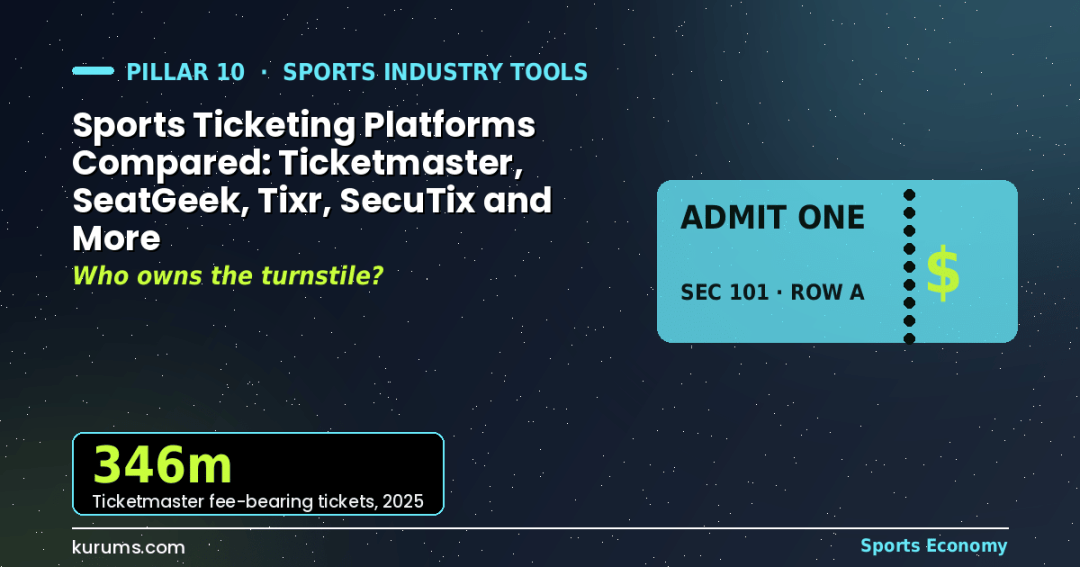
Ticketmaster sold 346 million fee-bearing tickets in 2025 and booked $3.1 billion of ticketing revenue, but a New York jury found in April 2026 that it illegally monopolised ticketing and overcharged fans by $1.72 a ticket on average. SeatGeek runs the box office at Liverpool, Manchester City and Leeds; Tixr has processed close to $2 billion; SecuTix, AXS, Paciolan and Eventbrite serve federations, arenas, colleges and small clubs. Fee models range from a flat $0.30 per ticket to 13 percent of face value, so the right platform depends on who keeps the service fee and who owns the fan data.
Sports ticketing platforms decide three things for a club: how much of each ticket the club keeps, whether it controls resale, and who owns the buyer’s name and e-mail afterwards. This independent comparison of seven platforms, from Ticketmaster to Eventbrite, is part of the Sports Economy hub and complements our reviews of club and league management software and fan engagement and OTT platforms, which cover the systems a ticketing platform must plug into.
Which platform dominates sports ticketing?
Ticketmaster, with 346 million fee-bearing tickets in 2025 and league deals with the NFL, NBA and NHL. Its 2026 settlement with the US Department of Justice caps service fees at 15 percent of face value at Live Nation venues.
Who is winning the challenger market?
SeatGeek in the Premier League and MLS, Tixr in mid-sized US clubs, SecuTix with European federations, and AXS with AEG-linked arenas and the seven Melbourne clubs it signed in August 2026.
What does a platform actually cost?
From a $0.30 flat fee per ticket (Ticket Tailor) to 13 percent of face value (Dice). Enterprise sports vendors publish no rate cards; they negotiate a service-fee share, a per-ticket royalty and often a signing bonus against expected volume.
What do sports ticketing platforms actually do?
A sports ticketing platform is the system of record for seat inventory, pricing, sales, access control and the fan database. It issues the barcode or digital token, handles payment, runs resale and feeds attendance data into the club’s CRM, sponsorship and hospitality systems.
The market splits into tiers. At the top are enterprise platforms built for a 60,000-seat stadium with season-ticket renewals, priority windows, hospitality and anti-bot protection. In the middle sit challengers pitching a cleaner fan experience and better data terms. At the bottom are self-serve tools where a semi-professional club lists tickets in an afternoon for a per-ticket fee.
The economics differ at every tier. Enterprise vendors earn a share of the service fee charged above face value and may pay the venue a per-ticket royalty or a signing payment for exclusivity; self-serve tools charge a published fee per ticket that lands on the organiser unless passed on.
The ticket is also a data asset. Every purchase produces a name, an e-mail address, a postcode and a behavioural record, and vendors that keep that data for their own marketplace are charging a second, invisible fee.
How big is the ticketing market, and who controls it?
Live Nation’s ticketing segment reported revenue of $3.08 billion in 2025 and adjusted operating income of $1.13 billion, from 346 million fee-bearing tickets. No other primary ticketing company discloses figures of that scale; the next largest, AXS, is private within AEG.
Live Nation’s full-year 2025 results, published in February 2026, showed group revenue of $25.2 billion, up 9 percent, with 159 million fans attending events. Ticketmaster’s adjusted operating income at roughly 37 percent of segment revenue explains why incumbents fight to keep exclusive venue contracts: the concerts business managed a 3.3 percent margin.
In sport, Ticketmaster’s position rests on league-level deals rather than venue by venue sales. It has extended its NHL agreement by ten years, renewed with the NBA and holds the NFL’s ticket exchange relationship, meaning most North American major-league clubs sell primary inventory through it by default.
Europe is more fragmented. The Premier League has no league-wide ticketing contract, so SeatGeek, Ticketmaster, SecuTix and smaller UK vendors coexist in one division. Bundesliga clubs mostly use CTS Eventim or in-house systems, and in Türkiye the state-mandated Passolig scheme, run by Aktif Bank with its Passo app, has been the compulsory entry layer for Süper Lig matches since 2014, so Galatasaray or Fenerbahçe can change their front-end but not the identity layer beneath it.
How did the 2026 antitrust cases change the rules?
In March 2026 Live Nation settled the US Department of Justice case by agreeing to cap Ticketmaster service fees at 15 percent of face value at Live Nation venues, open parts of its platform to rival ticketers, end exclusive booking at 13 amphitheatres and fund $280 million for state claims. A separate jury verdict in April found illegal monopolisation.
The DOJ sued in May 2024 and the trial opened in Manhattan on 2 March 2026. Roughly a week later the federal government settled on the terms above, including an eight-year extension of the consent decree that has governed Live Nation since its 2010 merger with Ticketmaster. According to Hypebot’s May 2026 case tracker, a court ruling on the final judgment was expected in September or October 2026.
Thirty-three states and the District of Columbia refused the settlement and went to trial. On 15 April 2026 a jury found unanimously that Live Nation and Ticketmaster had illegally monopolised primary ticketing and large amphitheatre markets, and that Ticketmaster overcharged consumers by $1.72 per ticket on average. A remedies hearing, in which the states may seek structural separation, is not expected before early 2027.
A third action, filed by the Federal Trade Commission in September 2025, alleges that Ticketmaster tolerated brokers buying in bulk through fake accounts and that fees reaching 44 percent of ticket prices generated $16.4 billion between 2019 and 2024; a motion to dismiss was pending in mid-2026. A Ticketmaster contract signed in 2026 may therefore carry fee caps and interoperability obligations that older agreements did not.
How do the seven main platforms compare?
The table compares Ticketmaster, SeatGeek, Tixr, SecuTix, AXS, Paciolan and Eventbrite on fit, pricing model, standout feature and weakness. Pricing checked October 2026; enterprise vendors quote individually, so their pricing rows describe deal structure rather than a rate.
| Product | Best for | Pricing model | Standout feature | Weakness |
|---|---|---|---|---|
| Ticketmaster (Live Nation) | Major-league franchises and large arenas | Service-fee share plus venue royalty; multi-year exclusivity; 15% fee cap at Live Nation venues from 2026 | 346m fee-bearing tickets in 2025; integrated resale; SafeTix mobile tickets | Antitrust liability; fan resentment over fees; rigid data terms |
| SeatGeek | Premier League, EFL, MLS and NWSL clubs wanting one primary-plus-resale stack | Enterprise contract; revenue share on primary fees and marketplace resale; no public rate card | Native primary and secondary in one app; Liverpool, Manchester City, Leeds, Philadelphia Union | Marketplace brand can blur the club’s resale policy; smaller services footprint |
| Tixr | Mid-sized clubs, MLS and USL sides, county cricket, tennis events | Custom contract; no published fee table; per-ticket service fee shared with organiser | Tickets, merchandise, concessions and resale in one wallet; nearly $2bn processed for 700-plus brands | Younger and smaller than incumbents; fewer league-level integrations |
| SecuTix (ELCA) | Federations, stadium operators and European clubs | Enterprise SaaS licence plus per-ticket fee; Swiss-headquartered, quote only | Tixngo secure mobile ticket and S-360 single platform, used at Hampden Park and Euro 2020 | No consumer marketplace of its own; implementation projects are long |
| AXS (AEG) | Arena tenants and multi-club precincts, especially AEG venues | Service-fee share with venue; bundled with AEG venue management deals | Precinct-wide deals such as the seven Melbourne Park clubs signed in August 2026 | Weaker where AEG has no venue presence; smaller sports footprint in Europe |
| Paciolan (Comcast Spectacor) | US college athletics departments and performing-arts centres | White-label licence; institution keeps its brand and fees; secondary via SeatGeek partnership | Donor and fundraising integration built for athletic departments | Little presence outside North America; dated interface by challenger standards |
| Eventbrite | Amateur and semi-pro clubs, one-off events, mass-participation sport | Published: 3.7% plus $1.79 per paid ticket before card processing; optional plans from $15 to $100 a month | Self-serve setup in minutes; built-in discovery marketplace | No reserved-seating depth, season tickets or access-control integration for stadiums |
For the smallest organisations, Ticket Tailor charges a flat $0.30 to $0.85 per ticket and TicketSpice $0.99, according to TickPick’s July 2026 fee survey; on a $100 ticket that compares with $5.49 at Eventbrite and roughly $13 at Dice.
Which platform fits which type of club?
Match the platform to volume: major-league franchises default to Ticketmaster or AXS through league and arena deals; European clubs with 20,000 to 60,000 seats choose between SeatGeek, SecuTix and Ticketmaster; mid-sized clubs favour Tixr; colleges use Paciolan; amateur sport uses Eventbrite or flat-fee tools.
SeatGeek’s European growth shows the challenger pitch. It renewed with Leeds United in September 2025 after three seasons, citing Liverpool and Manchester City as fellow Premier League partners, and has also signed Bournemouth, Watford, Wolves and Sheffield United. In the United States it added Philadelphia Union in June 2025, runs Nashville SC’s portfolio and holds the secondary-market partnership for Paciolan’s college clients. The argument is one native app in which the fan buys, transfers and resells without leaving the club’s brand.
Tixr occupies the segment beneath. The San Jose Earthquakes moved their 18,000-seat PayPal Park to Tixr for the 2026 MLS season on a deal bundling tickets, premium seating, merchandise and concessions in one wallet. Houston Dynamo, the Winnipeg Goldeyes, the ATX Open and Leicestershire County Cricket Club use the same platform, and the NFL added Tixr to its Ticket HQ resale line-up. The company says it has processed nearly $2 billion across more than 700 brands in 40 countries since 2013.
SecuTix sells to institutions that worry most about security and identity. The Scottish FA adopted its S-360 platform, Tixngo mobile tickets and S-Pay processing for every event at Hampden Park from early 2024, after SecuTix handled Euro 2020 matches there. AXS grows wherever AEG operates venues: its August 2026 agreement with Melbourne Storm, Melbourne Victory, Melbourne City, Melbourne United, the Vixens, the Mavericks and South East Melbourne Phoenix put seven Melbourne Park clubs on one platform.
How much do the fees really cost a club and its fans?
On enterprise platforms the fan typically pays a service fee of 10 to 25 percent above face value and the club receives part of it back as a royalty; the 2026 DOJ settlement caps Ticketmaster’s fee at 15 percent at Live Nation venues. On self-serve platforms the organiser pays a published fee, from under one dollar to 13 percent.
The state attorneys general put the Ticketmaster overcharge at $1.72 per ticket on average; across 346 million fee-bearing tickets that is close to $600 million a year in disputed revenue. Whether the figures survive the courts, they have changed club behaviour: more clubs now negotiate the right to set all-in pricing on their own channels and to receive a transparent per-ticket rebate rather than an opaque share.
Fee exposure interacts with price. Premier League season tickets for 2026/27 range from £425 at Manchester City’s cheapest tier to £1,171 for Arsenal’s cheapest adult seat and £3,084 for Fulham’s top tier, according to SeatPick’s club-by-club survey, with five clubs freezing prices. At those prices UK clubs usually negotiate a fixed per-ticket amount for season tickets and a percentage on single-match and resale inventory. For where matchday income sits in a club’s accounts, see our analysis of Premier League revenue distribution.
Resale is where the money moves fastest: a platform running the official resale market earns a fee from seller and buyer, typically 10 percent each side. English clubs that cap resale at face value give up that margin for supporter goodwill; US franchises generally allow market pricing and share in it.
Who owns the fan data, and why does it matter more than the fee?
Data ownership determines who can market to the buyer afterwards. Platforms with consumer marketplaces (Ticketmaster, SeatGeek, Eventbrite) retain a direct relationship with the fan; white-label systems (SecuTix, Paciolan) leave it with the club.
The distinction is worth real money. A club with 40,000 identifiable buyers can sell that audience to sponsors and retarget lapsed fans; if the vendor also markets concerts and secondary listings to the same people, the club is competing for its own supporters’ attention. Enterprise contracts now specify who is data controller, whether the vendor may use purchase data for its marketplace, and how data is exported on termination.
Identity-based ticketing raises the stakes. Türkiye’s Passolig system links every Süper Lig ticket to a named, verified card, which gave Aktif Bank a complete database of match-going fans; clubs received the security benefit but not the data asset. SecuTix’s Tixngo and Ticketmaster’s SafeTix use the same rotating, identity-tied barcode principle, but who holds the resulting profile depends on the contract.
What happens to ticketing economics around mega-events and new stadiums?
Mega-events and new stadiums reset the market because the rights-holder or venue owner, not the club, chooses the platform. FIFA ran its own dynamic-priced ticketing for the 2025 Club World Cup and the 2026 World Cup; new arenas often bundle ticketing into the operator’s deal.
FIFA’s adaptive pricing at the 2025 Club World Cup in the United States drew criticism when group-game prices moved sharply, but it signalled demand-based pricing for the 2026 World Cup across 16 host cities. For vendors, a tournament of that size is a technology contract rather than a fee share, and the systems that handle it become references for club deals afterwards.
New venues work differently: when an operator finances or runs a stadium, ticketing is often part of the operating agreement, which is how AEG-managed venues end up on AXS. Clubs moving into a new building should read our guide to stadium financing before assuming they will choose their own box office; the lender or operator may already have decided.
How we compared
We weighted five criteria for a professional club: fee structure and transparency (25 percent), resale control and fan experience (20 percent), data ownership and integration (25 percent), security (15 percent) and track record in sport (15 percent). Evidence came from vendor pricing pages checked in October 2026, Live Nation’s FY2025 results, court records summarised by trade press in 2026 and club announcements. We did not test the software and accepted nothing from any vendor.
Frequently Asked Questions
What is the cheapest ticketing platform for a small sports club?
Flat-fee tools are cheapest for a club selling a few thousand tickets a season: Ticket Tailor charges $0.30 to $0.85 per ticket and TicketSpice $0.99, with no monthly fee, according to TickPick’s 2026 survey. Eventbrite costs 3.7 percent plus $1.79 but brings a discovery marketplace. None handle reserved season tickets or turnstiles well, so clubs above roughly 3,000 average attendance usually need a sports-specific platform.
Does the 2026 Live Nation settlement affect clubs outside the United States?
Not directly. The fee cap, the amphitheatre divestments and the platform-access obligations apply to Live Nation venues in the United States. Indirectly, the April 2026 jury verdict strengthens the hand of clubs everywhere negotiating with Ticketmaster, and the UK and EU are pursuing their own rules on all-in pricing and resale caps that will shape European contracts from 2027.
Should a club run its own resale market or use the platform’s marketplace?
Running official resale inside the primary platform, as SeatGeek and Ticketmaster offer, keeps fans in one app and gives the club a share of both sides of every resale fee, at the cost of the vendor’s brand sitting between club and supporter. Clubs that cap resale at face value should insist on contractual control of pricing rules and on receiving the resale buyer’s data, not just the seller’s.
How long does switching ticketing platforms take?
Plan for a full off-season. Migrating season-ticket holders, seat maps, membership tiers and purchase history typically takes four to six months for a 30,000-seat stadium, and scanners may need new firmware. The San Jose Earthquakes announced their Tixr move in mid-2025 for the 2026 season, and the Scottish FA signed SecuTix in January 2024 for events from that spring.