
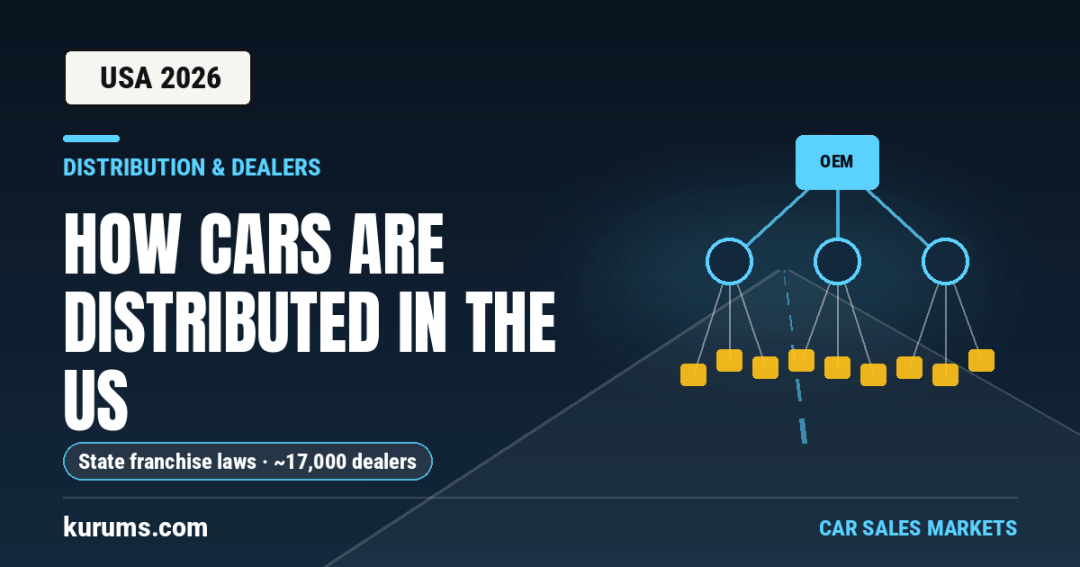
In the United States, manufacturers generally may not sell new cars directly to consumers. Every state has a motor-vehicle dealer franchise law that protects independent dealers’ territories and restricts manufacturer-owned retail, so nearly all of the 16.2 million new light vehicles sold in 2025 went through roughly 17,000 franchised dealerships, which generated more than $1.3 trillion in sales. Public groups such as AutoNation, Lithia, Penske, Group 1, Sonic and Asbury own a growing share of those stores. Tesla, Rivian and Lucid sell direct where states allow it. Used cars flow through franchised dealers, independent lots, online retailers and wholesale auctions such as Manheim, ACV and OPENLANE.
The US car dealer franchise system is the most legally entrenched distribution model in the automotive world. It explains why American car buyers still haggle at dealerships, why the dealership business is so profitable and so consolidated, and why electric-vehicle start-ups have spent years in state courts fighting for the right to sell their own cars. This guide explains how new and used cars reach US buyers in 2026. It complements our overview of the US car market and our guide to American car marketplaces, within the Car Sales Markets hub.
Why can’t car makers sell directly in the US?
State dealer franchise laws in most states prohibit or restrict manufacturer ownership of dealerships and direct sales to consumers, to protect independent dealers who invested in facilities.
How many dealers are there?
Roughly 17,000 franchised new-car dealerships employing about 1.12 million people, plus tens of thousands of independent used-car dealers.
Who sells direct?
Tesla, Rivian, Lucid and some start-ups sell direct in states that permit it; legacy brands such as Ford and GM must use dealers, even for EVs.
How does the US car dealer franchise system work?
A franchised dealer is an independent business that signs a sales and service agreement with a manufacturer. The dealer buys new vehicles from the manufacturer at wholesale (invoice) prices, usually financed through a “floor plan” credit line, and resells them to consumers at whatever price it negotiates. In return, the dealer gets the right to use the brand, receive allocations of new vehicles, perform warranty repairs paid for by the manufacturer and sell certified pre-owned vehicles under the brand’s programme.
The manufacturer sets standards — facility design, sales and customer-satisfaction targets, training, IT systems — and pays incentives, holdbacks and bonuses that often make up much of a dealer’s new-car margin. But it does not own the store, does not set the final retail price and, under state law, cannot easily terminate or relocate the dealer. Most dealerships are “dualled” or part of groups that hold franchises for several brands at different locations.
Why do state franchise laws protect dealers?
The franchise laws date back to the 1930s–1950s, when car makers held overwhelming bargaining power over small family dealers. Dealers lobbied state legislatures for protection, and every state passed a motor-vehicle franchise act. The specifics vary, but most laws share core features:
- No direct sales or manufacturer-owned stores, or strict limits on them, in the manufacturer’s own brand.
- Relevant market area protection: a manufacturer cannot appoint a new same-brand dealer within a defined radius of an existing one without justification, and existing dealers can protest.
- Termination protection: a manufacturer needs “good cause” to end a franchise and must usually pay compensation, including for facilities.
- Warranty reimbursement: manufacturers must pay dealers retail rates for warranty parts and labour.
- Limits on facility mandates and allocation discrimination.
Supporters argue the laws keep prices competitive through intra-brand competition, guarantee local service and warranty work, and protect communities’ investments. Critics — including the Federal Trade Commission’s staff in past advocacy letters and many economists — argue they raise prices and block more efficient models such as direct online sales. The debate has intensified with the arrival of EV makers that never had dealers.
How do Tesla and other EV makers sell cars in the US?
Tesla has never used franchised dealers. It sells through its own website and galleries, with prices fixed nationally. Because most franchise laws prohibit a manufacturer from competing with its own dealers, and Tesla has none, several states allowed it to sell directly; others, including Texas and Michigan for many years, banned direct sales, forcing buyers to order online and take delivery across state lines or via Tesla-owned galleries that cannot take orders. Rivian, Lucid and Polestar follow similar approaches, and the legal map is a patchwork that changes every legislative session.
Legacy manufacturers cannot follow Tesla’s lead without fighting their own dealers. Ford tried to impose certification requirements and fixed pricing on EV-selling dealers in 2022–2023 and backed off; Volkswagen’s Scout Motors, launched as a separate brand to sell direct, has faced lawsuits from Volkswagen dealers. Most legacy brands instead use “one price” programmes, online ordering with dealer delivery and agency-like pilots that keep the dealer in the transaction.
Who are the biggest dealer groups in the US?
US car retail has consolidated steadily for three decades. The six large public groups — AutoNation, Lithia Motors (Driveway), Penske Automotive Group, Group 1 Automotive, Sonic Automotive and Asbury Automotive — together own well over a thousand new-car franchises and also operate used-car, collision and finance businesses. Lithia and Penske have become international, buying dealerships in the UK (Pendragon, Sytner) and Canada; Group 1 bought much of Inchcape’s UK retail business.
Large private groups are just as important: Hendrick Automotive Group, Berkshire Hathaway Automotive (formerly Van Tuyl), Ken Garff, Larry H. Miller and Morgan Automotive each have dozens to hundreds of stores. Even so, the top 150 groups own perhaps a quarter of dealerships, and thousands of single-point family dealers remain. Buy-sell activity stayed high in 2024–2026 as private-equity-backed groups and public companies paid strong multiples for profitable stores, particularly in the Sun Belt.
How do dealers make money?
A modern US dealership makes money in four departments. New-vehicle sales bring traffic and manufacturer incentives but thin front-end margins. Used-vehicle sales carry higher per-unit gross profit, especially on trade-ins acquired below market. Finance and insurance (F&I) — arranging loans and leases and selling service contracts, GAP insurance and other products — earns commissions and is one of the most profitable activities per car. Service and parts — warranty work, customer-paid repairs and parts sales — covers a large part of the dealership’s fixed costs and is the most stable business through the cycle.
NADA’s data show the average franchised dealership’s revenue rose about 4.5% in 2025, with new vehicles 54.9% of revenue, used 31.8% and service and parts 13.3%. Profitability, which reached record highs in 2021–2022 when inventory was scarce, has normalised but remains well above pre-pandemic levels for well-run groups. Dealer software — the dealer management system, CRM, desking, digital retail and inventory tools — is a large market of its own; our comparisons of dealer management systems and automotive CRMs cover the leading vendors.
How do used cars move through the US market?
Used cars reach buyers through several channels. Franchised dealers sell trade-ins, off-lease cars and certified pre-owned vehicles; independent dealers — tens of thousands of them — sell older and cheaper cars; national used-car retailers such as CarMax and Carvana sell at scale online and from megastores; and private sellers sell directly through marketplaces and social media.
Behind the retail layer sits the wholesale market. Cars that dealers do not want to retail — older trade-ins, off-lease returns, rental fleet disposals and repossessions — are sold at wholesale auctions. Cox Automotive’s Manheim is the largest, with physical lanes and digital auctions; ACV Auctions and OPENLANE (formerly KAR) run dealer-to-dealer digital marketplaces; and America’s Car-Mart, rental companies and banks sell through their own channels. Wholesale prices, tracked by the Manheim Used Vehicle Value Index, are the market’s main price signal. Our wholesale auction platform comparison explains how each works.
Online buying has also reshaped how dealers acquire stock from consumers. Instant-offer services from Carvana, CarMax, dealer groups and marketplaces compete to buy cars directly from owners, bypassing trade-ins. That competition for supply is one of the defining features of the 2025–2026 used market.
What about vehicle importers and distributors in the US?
The US has no separate national importer-distributor layer for most brands — unlike Türkiye or many smaller markets where an independent company holds a brand’s national rights. Foreign manufacturers operate their own US subsidiaries (Toyota Motor North America, Hyundai Motor America, BMW of North America), which import or build vehicles and sell them to franchised dealers. A few exceptions persisted historically — Southeast Toyota Distributors and Gulf States Toyota are independent regional distributors that still distribute Toyota vehicles to dealers across several southeastern states — but they are unusual.
Ports and logistics matter, though. Imported vehicles arrive through processing centres in Baltimore, Jacksonville, Brunswick, Port Hueneme, Long Beach and other ports, where they are inspected, accessorised and trucked or railed to dealers. The 2025 tariffs on imported vehicles and parts made that supply chain more expensive and pushed manufacturers to move production into US plants.
| Channel | Who operates it | Role in 2025–2026 |
|---|---|---|
| Franchised new-car dealers | ~17,000 stores, family and group-owned | Almost all new-car sales, CPO, warranty service |
| Public dealer groups | AutoNation, Lithia, Penske, Group 1, Sonic, Asbury | Consolidators; also big in used and F&I |
| Direct sales | Tesla, Rivian, Lucid, start-ups | Legal state by state |
| Used-car megaretailers | CarMax, Carvana | Carvana sold 596,641 retail units in 2025 |
| Independent used dealers | Tens of thousands of lots | Older, cheaper used cars; buy-here-pay-here |
| Wholesale auctions | Manheim, ACV, OPENLANE | Dealer-to-dealer and fleet remarketing |
Is the US dealer model changing?
Slowly, at the edges. The core franchise structure is protected by law and by dealers’ political influence in every state, so a wholesale move to the European-style agency model is unlikely in the near term. But change is happening inside the system: online ordering with dealer delivery, transparent “no haggle” pricing, digital F&I, home delivery and centralised reconditioning have all spread since the pandemic. Big groups increasingly run their own online used-car brands (Lithia’s Driveway, AutoNation’s online platform) and compete with Carvana head on.
The FTC’s attempted CARS Rule on dealer pricing and add-ons was vacated by a federal appeals court in January 2025, but state attorneys general and the FTC continue to target junk fees and misleading advertising, and several states have passed their own price-transparency laws. Expect more disclosure requirements, more online transactions and continued consolidation — but the franchised dealer will remain the backbone of US new-car distribution in 2026. For a contrasting model, read how Germany and the UK are experimenting with agency sales.
What does this mean for companies entering the US market?
For a manufacturer entering the US, the first strategic decision is whether to build a franchised dealer network or attempt direct sales. Dealers bring capital, real estate, local service capacity and political protection, but they take margin and control the customer relationship. Direct sales give control and data but require huge investment in service, delivery and legal battles, state by state. Chinese brands, effectively blocked from the US by tariffs and connected-vehicle software rules, have not yet had to make that choice.
For suppliers, fintechs and software companies, dealers are the gatekeepers: they buy DMS and CRM software, digital marketing, inventory tools, financing and insurance products, reconditioning and logistics services. Selling to dealer groups means understanding how they measure performance — gross profit per vehicle, F&I per retail unit, service absorption — and fitting into existing DMS integrations.
Frequently Asked Questions
Why can’t Ford or GM sell cars directly to customers?
Because state franchise laws prohibit or restrict manufacturers from competing with their own franchised dealers. Ford and GM have thousands of dealers, so they must sell new cars through them.
How many car dealerships are there in the US?
About 17,000 franchised new-car dealerships, according to NADA, plus a much larger number of independent used-car dealers.
Which is the largest car dealer group in the US?
AutoNation and Lithia Motors are the largest by revenue and store count, followed by Penske Automotive, Group 1, Sonic, Asbury and large private groups such as Hendrick.
What is a floor plan in car dealerships?
A floor plan is a revolving credit line, usually from a manufacturer’s finance arm or a bank, that dealers use to finance new-vehicle inventory. Interest on it is a major cost when inventory is high.