
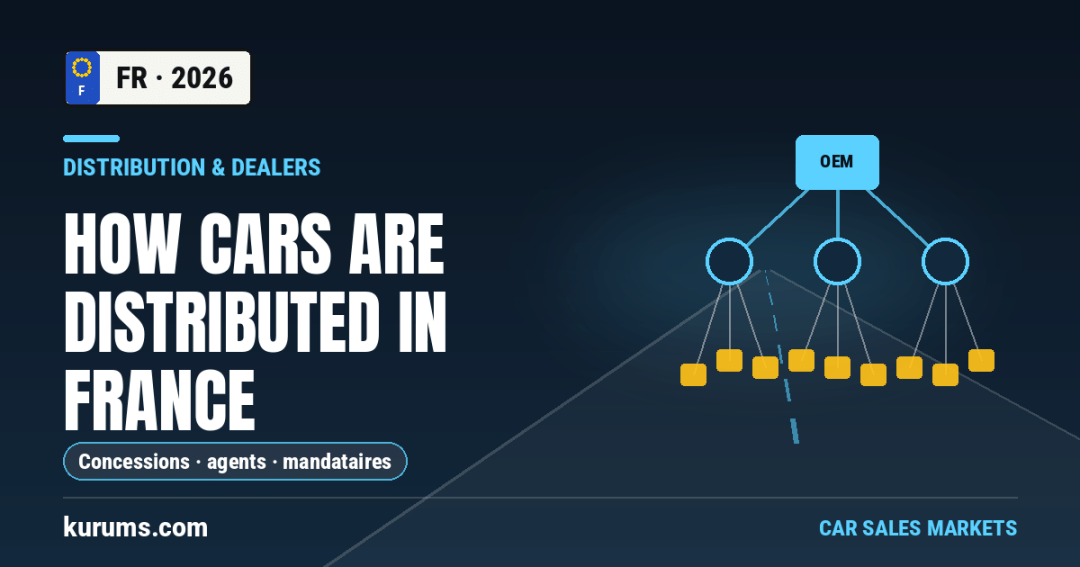
France distributes new cars through a two-tier network: franchised dealers (concessionnaires) appointed by each brand, and a dense layer of smaller brand agents (agents de marque) — often village garages — that sell and service cars on the dealer’s behalf. Dealer groups such as Emil Frey France, Groupe Bernard, By My Car, Car Lovers, Jean Lain Mobilités, Neubauer and others are consolidating the network quickly. Stellantis and Renault, which sell about half of all new cars, have restructured their networks and own retail arms. Independent brokers called mandataires source cars from across the EU and sell them at discounts, and leasing (LLD and LOA) dominates how private buyers finance new cars.
French car distribution combines Europe’s densest rural sales and service network with a fast-consolidating dealer sector and a distinctive grey channel of EU-sourced cars. Two domestic groups, Renault and Stellantis, set the tone for how cars are sold, while foreign brands compete through importers and dealer groups. This guide explains how cars reach French buyers in 2026; it complements our France car market overview and our guide to French online car marketplaces, part of the Car Sales Markets hub.
How are new cars sold in France?
Through franchised dealers (concessionnaires) and smaller brand agents (agents) that sell and service on the dealer’s behalf, plus manufacturer-owned retail outlets in big cities.
What is a mandataire?
An independent intermediary that buys new or nearly-new cars from dealers elsewhere in the EU and sells them to French customers, often at significant discounts to French list prices.
Who are the biggest dealer groups?
Emil Frey France, Groupe Bernard, By My Car, Car Lovers, Jean Lain Mobilités and other regional groups, which have grown through acquisitions.
How are new cars distributed in France?
Each manufacturer selling in France has a national sales company — Renault France, Stellantis’s French organisation, Volkswagen Group France, Toyota France and so on — that imports or sources cars and manages a network of authorised dealers. Dealers sign selective-distribution contracts governed by EU competition rules and the Motor Vehicle Block Exemption Regulation, extended to May 2028.
The French specificity is the second tier. Beneath the concessionnaires, thousands of agents de marque — small independent garages in towns and villages — sell new cars on behalf of a dealer, earning a commission, and carry out servicing and repairs. Renault and Peugeot built extraordinarily dense agent networks over decades, which is one reason the domestic brands remain so strong in rural France. The agent network has shrunk as manufacturers and dealers rationalised and as rural garages struggle with succession, but it still reaches places no foreign brand can match.
How have Renault and Stellantis changed their networks?
The two French groups have reshaped distribution in recent years. Stellantis, formed in 2021 from PSA and Fiat Chrysler, ended all its European dealer contracts and introduced new contracts from 2023 that allow multi-brand Stellantis showrooms and a move toward agency-style sales for some brands and markets. It has postponed full agency in several countries, including Germany, while running its own retail operation, Stellantis &You, in major French cities. Leapmotor, the Chinese EV brand in which Stellantis holds a stake, is sold through Stellantis’s networks.
Renault Group restructured its own retail arm, which owned a large number of dealerships in France, and reorganised its brands into separate businesses for combustion and electric cars. Dacia’s growth has relied on low distribution costs, with dealers sharing facilities with Renault. Both groups use online ordering and fixed-price offers on some models, especially EVs, while keeping dealers at the centre of delivery and service.
Who are the biggest car dealer groups in France?
France’s dealer sector has consolidated rapidly over the last decade. The largest groups include Emil Frey France (part of the Swiss Emil Frey Group, which bought several French groups), Groupe Bernard, By My Car, Car Lovers (formerly Car Avenue), Jean Lain Mobilités, Neubauer and many strong regional players across the country. Foreign investors — Swiss, Belgian and Scandinavian groups among them — have been active buyers.
Consolidation is driven by manufacturers’ demands for larger, better-capitalised partners, by the investment needed for EVs and digital retail, by the shrinking profitability of new-car sales and by founder retirements. Large groups typically represent many brands across regions, run used-car hubs and centralised preparation centres, and build their own digital sales platforms.
What are mandataires and how do they work?
Mandataires automobiles are independent intermediaries that sell new and nearly-new cars to French customers at prices below French dealers’ list prices. EU competition law allows consumers to buy a new car in any member state, and allows intermediaries acting on a customer’s mandate to buy on their behalf. Mandataires use that freedom to buy cars from dealers in other EU countries — or from French dealers with excess stock — where prices or discounts are better, then deliver them in France with the European manufacturer’s warranty.
The channel is large in France: mandataires such as Aramisauto (in its early days), Autodiscount, Elite Auto and many smaller firms offer discounts commonly quoted at 15–25% off list on certain models. Manufacturers and dealers dislike the channel because it undermines their pricing, but it is legal and important for budget-conscious buyers. Key risks are delivery delays, equipment differences between countries and after-sales friction — the car’s warranty is valid at any authorised dealer in the EU, but buyers must ensure the paperwork is correct.
How do leasing companies and fleets distribute cars in France?
Leasing is now the dominant way French private buyers acquire new cars. Long-term rental (LLD, location longue durée) and lease with purchase option (LOA, location avec option d’achat) account for the majority of new-car purchases by private customers, according to industry data, because they lower monthly payments and pass residual-value risk to the lender. The manufacturers’ captive banks — Mobilize Financial Services (Renault) and Stellantis Financial Services — and the leasing subsidiaries of banks (Ayvens, Arval, Crédit Agricole Leasing) dominate.
Fleets are a major channel for new-car registrations, and companies face strong tax incentives to choose low-emission cars. The French government’s “social leasing” scheme, which offered eligible low-income households electric cars at around €100–150 a month, ran through dealers and leasing partners and showed how leasing can be used as a policy tool. When leases end, cars return to funders and flow into the used market through auctions, dealer-to-dealer platforms and the leasing companies’ own retail channels.
How are used cars distributed in France?
France’s used-car market — about 5.5 million transactions a year — is served by franchised dealers (with brand-certified programmes such as Renault Occasions, Spoticar for Stellantis, Das WeltAuto), dealer-group used-car hubs, independent garages and used-car specialists, online retailers such as Aramisauto (majority-owned by Stellantis) and Autohero, and private sales.
Wholesale is handled by remarketing companies and auctions — BCA France, VPauto, Alcopa Auction and others — and by dealer-to-dealer platforms. The marketplaces where most retail used cars are advertised — leboncoin, La Centrale, AutoScout24, ParuVendu and dealer groups’ own sites — are covered in our French marketplaces guide.
| Channel | Key players | Role |
|---|---|---|
| Franchised dealers | Brand concessionnaires | New-car sales, service, certified used |
| Brand agents | Agents de marque (local garages) | Rural sales and service on dealer’s behalf |
| Manufacturer retail | Stellantis &You, Renault-owned sites | Big-city retail |
| Dealer groups | Emil Frey France, Groupe Bernard, By My Car, Car Lovers | Consolidators across brands |
| Mandataires | Autodiscount, Elite Auto and others | EU-sourced cars at discount |
| Leasing | Mobilize FS, Stellantis FS, Ayvens, Arval | LLD/LOA dominate private new-car finance |
| Used-car retail online | Aramisauto, Autohero | Online used-car sales |
How is French car distribution regulated?
Beyond EU competition law, French distribution is shaped by consumer law and specific rules. The Consumer Code gives buyers from professionals a two-year legal guarantee of conformity (reducible to one year for used goods by agreement), the commercial code governs the termination of distribution contracts and “brutal” breaks in established commercial relationships — a doctrine that gives French dealers stronger remedies than in many countries — and the Autorité de la concurrence monitors competition in after-sales and distribution. Price displays must include total cost, including the malus, which buyers often discover late.
The obligation to provide a recent contrôle technique for used cars over four years old, and the Histovec vehicle-history service, increase transparency in used sales. Data access for independent repairers — via the MVBER and EU type-approval rules — is a growing regulatory battleground as cars become connected.
What does French distribution mean for new entrants?
For a car brand entering France, the domestic brands’ dense networks and loyal customers are formidable. Successful entrants partner with large multi-brand dealer groups for coverage, build leasing offers with major funders, and price models to fit the malus thresholds and the environmental-score rules for EV incentives. Chinese brands have mostly chosen dealer-group partnerships; MG built a network of independent dealers, while BYD, Xpeng and others partnered with groups and importers.
For investors and suppliers, the consolidation of dealer groups, the growth of leasing and online used-car retail, and the expansion of after-sales create opportunities — and France’s distinctive mandataire channel shows how price transparency across the EU continues to reshape car retail. Compare with Germany’s agency debate and the UK’s group-dominated model.
How do French dealers make money?
French dealers face some of the thinnest new-car margins in Europe. Manufacturers pay a base margin plus variable bonuses tied to volume, quality and EV targets, and the price competition from mandataires and online offers limits what dealers can earn on each car. Profit therefore comes mostly from elsewhere: used cars, where groups invest in reconditioning hubs and certified programmes; after-sales, including servicing, tyres, bodywork and parts; and finance and insurance, through commissions on LLD and LOA contracts and associated services such as maintenance packages and gap insurance.
The shift to leasing has changed the dealer’s role. Instead of selling a car outright, the dealer increasingly arranges a lease, earns a commission from the funder, and gets the car back three or four years later for remarketing. Groups that control both the lease-return flow and the used-car retail channel capture more of the vehicle’s lifetime value. Electric cars add another dimension: lower service revenue over time, but new income from charging installation, battery diagnostics and energy services that some groups are beginning to sell.
Frequently Asked Questions
What is the difference between a concessionnaire and an agent in France?
A concessionnaire is a franchised dealer appointed by the manufacturer; an agent de marque is a smaller local garage that sells new cars on behalf of the concessionnaire and services them.
Is it legal to buy a car through a mandataire in France?
Yes. EU rules allow consumers to buy a new car anywhere in the EU and to mandate an intermediary to do so. The manufacturer’s warranty applies at any authorised dealer in the EU.
How do most French buyers finance a new car?
Mostly through leasing: long-term rental (LLD) or lease with purchase option (LOA), which together account for the majority of private new-car purchases.
Who owns Aramisauto?
Aramis Group, the operator of Aramisauto, is majority-owned by Stellantis and is listed on Euronext Paris.