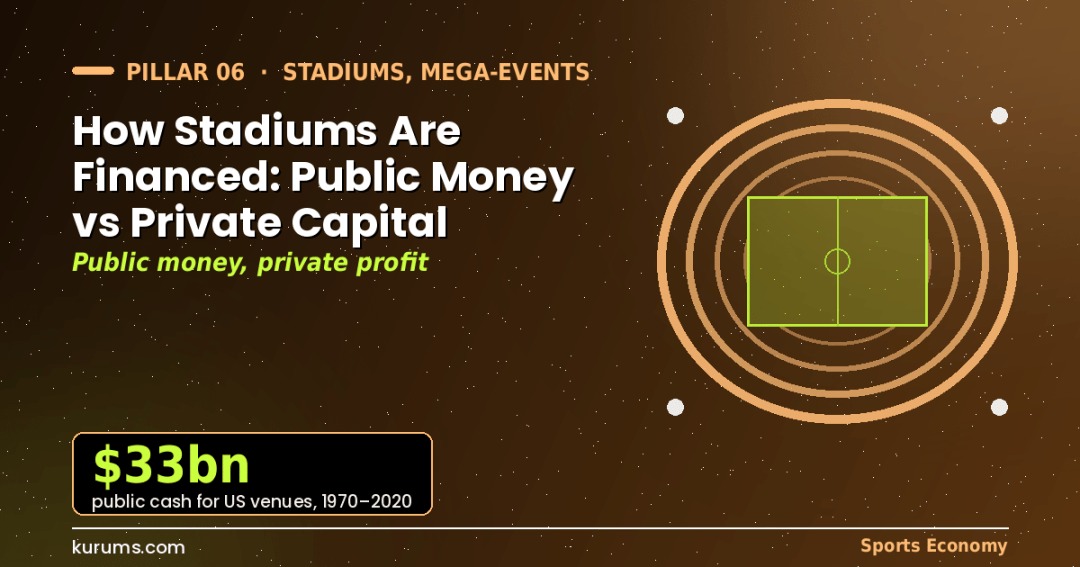
Stadium financing runs on two models. In North America taxpayers still carry most of the bill: Bradbury, Coates and Humphreys counted $33 billion of public money for major-league venues between 1970 and 2020, a median public share of 73%, and 2025 added roughly $1 billion of District funds for the Commanders’ $3.7 billion stadium and Kansas STAR bonds covering up to 70% of a $3.3 billion Chiefs project. In Europe clubs borrow: Tottenham carries £831 million of net debt on a £1 billion ground, and Real Madrid sold Sixth Street a share of future Bernabéu income for €360 million. The academic literature finds that public subsidies rarely pay the public back.
How stadiums are financed is the clearest test of who pays for sport and who profits from it. A modern 60,000-seat venue now costs between $1.5 billion and $3.7 billion, and the capital has to come from somewhere: municipal bonds, club borrowing, seat licences, naming rights, or an investor who buys a slice of future revenue. This article is part of the Sports Economy hub and complements our analyses of whether the Olympic Games pay off and what a mega-event really does for a host city.
How much of a US stadium does the public pay for?
Historically a median of 73% of construction cost; the 2025 Commanders deal (about 27% public) and the Chiefs’ Kansas deal (60–70% public) show the range is widening.
How do European clubs pay without taxpayers?
With debt secured on stadium cash flows: Tottenham pays an average 3.07% on £831 million of net debt, while Real Madrid financed a €1.4 billion rebuild partly by selling a 20-year share of stadium operations.
Do public stadium subsidies pay off?
Rarely. More than 130 peer-reviewed studies reach what the survey authors call near-universal consensus that venues do not generate large local economic gains.
Where do the billions come from when stadiums are financed?
A stadium is financed by stacking four layers: public contributions (bonds, land, tax breaks), owner equity, debt secured on future stadium revenue, and pre-sold income such as seat licences and naming rights. The mix depends on who owns the building and whether local politics allows taxpayer money.
The first layer is public money, which in the United States usually arrives as municipal bonds repaid from hotel or sales taxes, plus free land and property-tax exemptions. The second is owner equity, often smaller than headlines suggest because owners count league loans and seat-licence proceeds as their “contribution”. The third is debt: bank construction loans refinanced into long-dated bonds or private placements once the stadium is open and the cash flows are proven. The fourth is pre-sold revenue: seat licences, naming rights and hospitality contracts signed before the first match and used to service the debt.
The NFL adds a fifth layer: a league stadium programme that lends clubs several hundred million dollars at favourable terms. Front Office Sports reported in March 2025 that the Buffalo Bills planned to borrow $200 million through it and sought a debt-ceiling exception to borrow $650 million in total. With league money in the stack, owners present a smaller equity cheque than the headline “private” share implies.
Ownership changes everything. Most US stadiums are owned by a public authority and leased to the team, which enables tax-exempt bond financing and pushes construction risk, and frequently cost overruns, onto the public. Most European grounds are owned by the club, which carries the debt and the risk but keeps every pound of matchday, hospitality and non-football event income.
How much public money went into American stadiums in 2025 and 2026?
By one trade-press tally, state and local governments committed more than $12 billion to stadium and arena projects in 2025 alone, including roughly $1 billion from Washington DC, Kansas STAR bond capacity for the Chiefs, $600 million from Ohio for the Browns and up to $1.3 billion from San Antonio for the Spurs.
The Washington Commanders deal is the largest single project. In September 2025 the DC Council approved a $3.7 billion plan for a 65,000-seat enclosed stadium on the former RFK Stadium site, with the team contributing $2.7 billion and the District about $1 billion for demolition, site preparation and infrastructure, according to Axios and Bloomberg reports on the vote. At roughly 27% public it is below the historical median but still the District’s largest ever cheque to a private business.
The Kansas City Chiefs went the other way. In December 2025 the Kansas legislature voted to issue STAR bonds for a $3.3 billion domed stadium, headquarters and training complex, with the Missouri Independent reporting that incentives would cover up to 70% of the stadium cost and owner Clark Hunt describing the public share as about 60%. The venue is due to open in autumn 2031. STAR bonds are repaid from sales taxes generated inside the district, so the public is betting that the stadium zone will create enough new taxable spending to pay for itself.
The Buffalo Bills opened the new Highmark Stadium in 2026 with $850 million of New York State and Erie County money against a final cost that Front Office Sports put at about $2.2 billion, up from a $1.4 billion original estimate; under the deal the team absorbs the overruns. The pattern is constant: a credible relocation threat, a legislature that fears losing the franchise, and a bond issue that commits taxpayers for 30 years.
Why do European clubs borrow instead of asking taxpayers?
European clubs own their grounds, so they finance them with debt secured on stadium cash flows, supplemented by shareholder loans and, increasingly, by selling a share of future stadium revenue to investors. Public money is politically toxic, which is why Manchester United insists its £2 billion stadium will be privately financed.
Tottenham Hotspur is the reference case. The club built a roughly £1 billion, 62,850-seat stadium that opened in 2019 and funded it with bank debt later termed out into long-dated private-placement bonds; a £637 million refinancing in 2019 and later tranches left net debt at £831.2 million on 30 June 2025, according to The Esk’s analysis of the 2024/25 accounts. The economics justify the leverage: group revenue reached a record £565.3 million, matchday income rose to £126.5 million on 1.7 million paying attendances, and the stadium hosted two NFL games, a rugby Premiership fixture, boxing and six Beyoncé concerts in one year. Net bank interest was £29.1 million at an average 3.07%.
Everton shows the riskier version. The Hill Dickinson Stadium at Bramley-Moore Dock, opened in August 2025, was carried at £730 million on the balance sheet by June 2024 and is estimated to have cost £750–800 million. During construction the money came from owner Farhad Moshiri’s interest-free loans and high-interest facilities from Rights and Media Funding, MSP Sports Capital and 777 Partners. Only after the Friedkin Group’s takeover did the club secure a £350 million long-term facility arranged with JP Morgan in March 2025 that refinanced the expensive debt; the naming-rights deal with law firm Hill Dickinson is reported at £6–10 million a year. A stadium built on bridge finance nearly sank its club.
Manchester United’s 100,000-seat, roughly £2 billion stadium, announced in March 2025 with public support confined to transport, sits at the top of the scale; with debt near £1.3 billion, the club is exploring the Real Madrid model of selling a share of future stadium income.
What do bonds, seat licences, naming rights and revenue-share investors each contribute?
Each instrument covers a different slice of the stack: public bonds and owner equity fund construction, PSLs and naming rights are pre-sold to reduce the debt, and revenue-share investors such as Sixth Street buy a defined cut of future stadium operations in exchange for upfront cash.
The table shows how the instruments combine in five current projects. Percentages are approximate and based on the totals reported by the sources named in this article.
| Project | Cost | Public share | Main private instruments | Status (Oct 2026) |
|---|---|---|---|---|
| Washington Commanders, RFK site | $3.7bn | ~27% (about $1bn) | Owner equity, NFL loan, PSLs, naming rights | Approved Sept 2025, target 2030 |
| Kansas City Chiefs, Kansas | $3.3bn | 60–70% (STAR bonds) | Owner equity, NFL loan, district development | Approved Dec 2025, target 2031 |
| Buffalo Bills, Highmark Stadium | ~$2.2bn | ~39% ($850m, fixed) | PSLs ($129m+), NFL loan, owner debt up to $650m | Opened 2026, team bears overruns |
| Tottenham Hotspur Stadium | ~£1bn | 0% | £525m bonds plus bank debt; non-football events | Net debt £831m, revenue £565m (FY25) |
| Real Madrid, Santiago Bernabéu | €1.41bn | 0% | Long-dated bank loans; €360m Sixth Street revenue share | Open; stadium revenue +11% in 2025/26 |
Personal seat licences are the most under-reported instrument: a one-off payment, often $5,000 to $50,000 per seat, for the right to buy season tickets. The Bills had raised at least $129 million from PSLs by early 2025 according to The Buffalo News. Economically a PSL is a zero-interest loan from fans that is never repaid, which is why owners count it as private contribution.
The revenue-share model is the newest layer. In 2022 Real Madrid received €360 million from Sixth Street and Legends in exchange for a share of income from the Bernabéu’s non-football operations for about 20 years. The club reported in July 2026 that total investment in the rebuild had reached €1.408 billion, that operating revenue hit €1.221 billion in 2025/26 with stadium income up 11% and more than double its 2018/19 level, and that net debt excluding the stadium financing was just €9 million. The investor took the operating risk on concerts and events; the club kept its balance sheet clean enough to keep buying players.
Do publicly funded stadiums pay the public back?
Almost never. The 2023 survey by Bradbury, Coates and Humphreys in the Journal of Economic Surveys reviewed more than 130 studies over 30 years and found near-universal agreement that stadiums do not produce large local economic gains, because fan spending mostly substitutes for other local spending.
The mechanism is substitution. A household that spends $400 on a Sunday at the stadium usually spends $400 less on restaurants, cinemas and shops in the same metropolitan area over the following month. Most money that enters the stadium flows out again to players and owners.
The counter-argument is “non-use value”: residents value having a team in town even if they never attend. Contingent-valuation studies typically find a willingness to pay of around 15% of construction cost, far below the 60–73% shares that legislatures approve.
Kansas and Missouri are running a live experiment. Jackson County voters rejected a sales-tax extension for the Chiefs in April 2024; Kansas then offered STAR bonds to lure the team across the state line. Economists quoted by the Missouri Independent warn of a revenue drain for Missouri with no new net spending for the region: a 15-mile relocation creates a winning and a losing government and no new economy.
How do Türkiye and the Gulf build stadiums differently?
State-led models skip the bond market. In Türkiye the housing agency TOKİ financed roughly 20 new stadiums in the 2010s for about $1.55 billion; in Saudi Arabia the state is directly funding World Cup 2034 venues and in October 2026 cut its plan from 15 stadiums to 10 on cost grounds.
Türkiye’s programme, announced in 2010 and delivered over the following decade, replaced ageing municipal grounds in Istanbul, Bursa, Konya, Trabzon, Antalya and more than a dozen other cities. The buildings are state-owned and leased to clubs on long terms, which is why Galatasaray’s 53,978-seat home could be renamed from Türk Telekom Arena to Rams Park when a new naming partner arrived, and why Fenerbahçe and Beşiktaş sell naming rights to Ülker and Tüpraş while the state retains the land. The model delivered infrastructure quickly but left clubs with little stadium equity and the state with venues in smaller cities that struggle to fill 30,000 seats; co-hosting Euro 2032 with Italy is the next test of those assets.
The Gulf is the extreme case. Qatar spent an estimated $200 billion on World Cup-related infrastructure before 2022 and has since dismantled Stadium 974 as planned. Saudi Arabia’s 2034 bid promised 15 stadiums across five cities, including a NEOM venue 350 metres above ground; Inside World Football reported on 15 October 2026 that five venues, including NEOM, Qiddiya Coast, King Abdullah Economic City, Roshn and New Murabba, are being dropped because of cost, leaving six new builds and four refurbishments. Even sovereign wealth has a budget line.
What should a CFO look for in a stadium business plan?
Test four numbers: the non-football event calendar, the share of revenue pre-sold before opening, the interest rate relative to projected stadium EBITDA, and who holds the overrun risk. Tottenham passes all four; Everton failed the third until its 2025 refinancing.
The non-football calendar is where modern stadium economics live. Tottenham’s NFL games, concerts, boxing and rugby sit inside commercial and other income of £277.1 million; Real Madrid’s Sixth Street deal exists because the investor valued a concert pipeline, although noise disputes and cancelled concerts in 2024 and 2025 show the pipeline is not guaranteed. A stadium dark 330 days a year is a stranded asset carrying a billion of debt.
Pre-sold revenue reduces the debt to be serviced: naming rights, founding-partner sponsorships and multi-year hospitality contracts signed before lenders close convert a projection into a contract. Finally, compare the cost of debt with stadium cash flow: Tottenham’s 3.07% against roughly £400 million of matchday and commercial income is comfortable; Everton’s pre-2025 facilities against a club fighting relegation were not. For how clubs borrow more generally, see our guide to club debt, bonds and stadium loans, and for where stadium income sits in a club’s model, our breakdown of Premier League revenue and distribution.
Frequently Asked Questions
What is a personal seat licence and why does it matter?
A personal seat licence (PSL) is a one-off fee, often several thousand dollars, that gives a fan the right to buy season tickets for a specific seat. Teams sell PSLs before a stadium opens to reduce construction debt; the Buffalo Bills raised more than $129 million this way before Highmark Stadium opened in 2026. Because the money is never repaid, owners count it as private contribution.
Why can European clubs borrow so much against a stadium?
Because they own the building and all its cash flows. Lenders secure the debt on matchday, hospitality, naming-rights and concert income, which is predictable for a club with a large, loyal fan base. Tottenham’s £831 million of net debt costs an average of 3.07% because its stadium generates well over £300 million a year. Clubs with smaller brands or relegation risk pay far more, as Everton did before its 2025 refinancing.
What are STAR bonds and how do they fund the Chiefs’ stadium?
Sales Tax and Revenue (STAR) bonds let Kansas borrow against future sales taxes generated within a designated district. For the Chiefs’ $3.3 billion complex, approved in December 2025, STAR bonds can cover up to 70% of stadium cost, with the team describing the public share as about 60%. If the district generates less taxable spending than projected, the state carries the shortfall; economists expect most spending to be displaced from elsewhere in the metro area.
Did the Real Madrid and Sixth Street deal sell part of the stadium?
No. Real Madrid kept ownership of the Santiago Bernabéu. In 2022 Sixth Street and Legends paid €360 million for a share of the revenue from the stadium’s non-football operations for roughly 20 years. The club used the money to complete a €1.41 billion rebuild while reporting net debt of only €9 million excluding stadium financing in 2025/26. The investor carries the risk that events underperform; the club carries the risk that it gave away too much upside.