
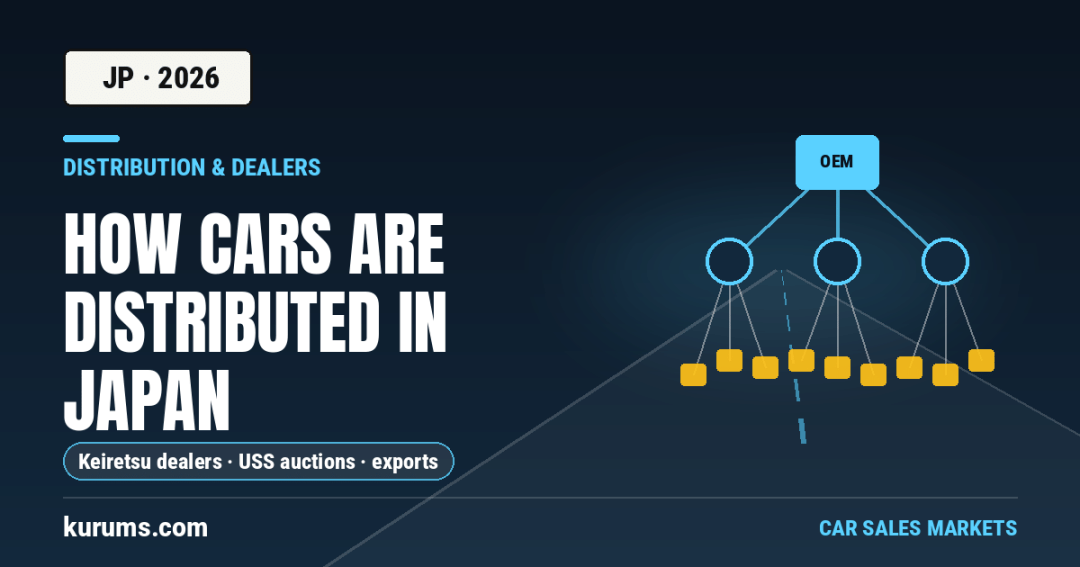
Japan distributes new cars through dense networks of dealers aligned to a single manufacturer, mostly independent regional companies (and some manufacturer-owned) that sell, service, inspect and insure cars for customers who often stay loyal for decades. Kei cars are also sold through thousands of small garages acting as sub-dealers. Used cars are priced and traded through a highly organised wholesale auction system — led by USS, the largest auctioneer — where dealers buy and sell hundreds of thousands of cars a month, increasingly online. Those auctions also supply Japan’s used-car export trade, which reached record levels in 2025 as a weak yen made Japanese cars cheap abroad.
Japan’s car dealer networks and auctions form one of the most distinctive distribution systems in the world. New-car retail is relationship-based and brand-loyal; used-car pricing is set almost scientifically by electronic auctions with standardised inspection grades; and a large share of older cars leaves the country to become the backbone of car fleets from Kenya to New Zealand. This guide explains how it works in 2026. It complements our Japan car market overview and our guide to Japan’s used-car websites, within the Car Sales Markets hub.
How are new cars sold in Japan?
Through dealers dedicated to one manufacturer, mostly regionally owned companies with brand-standard outlets, plus small garages that act as sub-dealers, especially for kei cars.
What role do auctions play?
Wholesale auctions such as USS set used-car prices: dealers sell trade-ins and buy stock there, using standardised inspection grades, in person or online.
Why are exports important?
Japan exports more than a million used vehicles a year; demand from abroad competes with domestic dealers at auction and pushes up prices.
How are new cars sold in Japan?
New cars in Japan are sold through dealer networks aligned to each manufacturer. Toyota’s network is the largest: thousands of outlets run by around 250 dealer companies, most of them independent regional businesses with deep local roots, plus some Toyota-owned dealers in big cities. Until 2020 Toyota ran four separate sales channels (Toyota, Toyopet, Corolla and Netz), each selling different models; since 2020 every channel sells the full line-up, increasing competition between Toyota dealers. Honda, Nissan, Mazda, Subaru, Mitsubishi, Suzuki and Daihatsu run similar but smaller networks, with a higher share of manufacturer-owned dealer companies at some brands.
Below the main dealers sits a layer of sub-dealers (fukudairiten): independent garages, body shops and service stations that sell cars on behalf of the dealer in exchange for a commission. They are especially important for kei cars in rural areas, where Suzuki and Daihatsu sell a large share of their volume through local garages that customers know personally.
Why are Japanese car buyers so loyal to their dealer?
The dealer in Japan is a service relationship more than a shop. Japanese cars must pass the shaken roadworthiness inspection three years after first registration and every two years thereafter, and most owners have their dealer handle it, along with maintenance, insurance, tyre storage and eventually the trade-in. Dealers maintain detailed customer records and contact customers proactively before inspections — the moment when many people decide to replace the car.
That relationship creates high loyalty and predictable replacement cycles, and it is why new brands find Japan so hard to enter. It also explains dealers’ business model: new-car margins are modest, but inspections, maintenance, insurance commissions and trade-ins make the customer profitable over a decade or more.
How do Japan’s used-car auctions work?
Japan’s used-car wholesale market runs through auctions. USS (Used car System Solutions) is the largest operator, with auction sites across the country and a dominant share of volume; other major operators include TAA (Toyota’s auction), CAA, HAA, JU-affiliated auctions and Honda’s and others’ brand auctions. Each week, hundreds of thousands of cars are offered.
The system’s strength is standardisation. Every car is inspected by the auction house before sale and given an auction grade — typically from 1 to 5 or S, with interior and exterior grades — and an auction sheet documenting damage, repairs and mileage verification. Bidding takes place in fast electronic lanes: a car may sell in under a minute, with dealers bidding in the hall or remotely through the auction’s online system or through third-party bidding platforms. Prices from these auctions are the reference point for every used-car price in Japan.
Dealers use the auctions in both directions: they sell trade-ins that do not fit their retail stock and buy cars to retail. Exporters, who buy on behalf of overseas importers, are major bidders, and their demand directly affects domestic prices.
How big is Japan’s used-car export trade?
Japan is the world’s largest exporter of used cars. The Japan Used Vehicle Exporters Association reported a record of about 1.84 million used vehicles exported in 2025, up around 12%, according to industry reports, driven by a weak yen. Major destinations include the United Arab Emirates (largely for re-export to Africa and Central Asia), Russia (via Central Asian and direct routes for vehicles under the sanction limits), Mongolia, Kenya, Tanzania, New Zealand, Chile, Malaysia and Sri Lanka. Right-hand-drive countries take most of the volume.
Exporters such as BE FORWARD, SBT Japan, Japan Partner and hundreds of smaller firms buy at auction or from dealers, arrange inspection and shipping, and sell to importers or directly to consumers abroad through their websites. Export demand has pushed domestic auction prices up sharply for popular models — reports cited auction prices up around 20% year on year for some segments — squeezing domestic dealers and buyers.
How is Japan’s used-car retail organised?
Used-car retail in Japan is fragmented. Franchised new-car dealers sell certified used cars (Toyota’s T-Value and similar programmes); large used-car chains such as Gulliver (IDOM), Nextage, Vehicle Dealers and WECARS (the business formerly known as Bigmotor, taken over by an Itochu-led consortium in 2024) operate hundreds of stores; and thousands of small independent dealers sell locally. Most used-car stock is advertised on the two dominant portals, Goo-net and Carsensor — see our Japan websites guide.
The Bigmotor scandal of 2023, in which the chain was found to have deliberately damaged customers’ cars to inflate insurance claims and to have harmed street trees outside its stores, triggered a review of dealer–insurer relationships and tighter oversight by the Financial Services Agency. It also accelerated consolidation in used-car retail.
| Layer | Main players | Notes |
|---|---|---|
| Manufacturer-aligned dealers | Toyota (~250 dealer companies), Honda, Nissan, Suzuki, Daihatsu networks | Sales, shaken, service, insurance |
| Sub-dealers | Local garages and body shops | Key for kei cars in rural areas |
| Wholesale auctions | USS, TAA, CAA, HAA, JU auctions | Standardised grades, online bidding |
| Used-car chains | Gulliver/IDOM, Nextage, WECARS | National store networks |
| Exporters | BE FORWARD, SBT and many others | ~1.8 million exports in 2025 |
| Online portals | Goo-net, Carsensor | Advertising for nearly all used stock |
How are imported brands distributed in Japan?
Imported brands use importers, which are mostly manufacturer subsidiaries: Mercedes-Benz Japan, BMW Japan, Volkswagen Group Japan, Stellantis Japan. Their dealer networks are run largely by specialist import-car dealer groups such as Yanase, historically the dominant importer of European brands, and by dealer groups linked to trading houses. BYD entered with its own subsidiary and a growing dealer network, while Hyundai sells online-only with a small number of customer experience centres.
How is Japanese car distribution changing?
Several forces are reshaping the system. Japan’s population is shrinking and ageing, so manufacturers are consolidating dealer companies and outlets — Toyota has merged dealer companies in several prefectures. Car subscription services such as KINTO, and online sales trials, offer an alternative to the dealer relationship for younger buyers. Electrification will reduce maintenance revenue over time, though slowly given Japan’s low EV share. And export demand has made the auction system more international, with overseas buyers and exporters bidding alongside domestic dealers.
For businesses abroad, Japanese distribution offers two opportunities: importing Japanese used cars through the auction-export channel, and selling software and data services to Japan’s dealers and auctions. For a comparison of how auctions work in other markets, see our wholesale car auction platforms comparison, and for a contrasting dealer model, read about US franchise law.
What does this mean for foreign companies?
Entering Japan as a car brand means building a dealer network, usually with a partner. Import-car specialists, trading-house-linked groups and large regional dealers are the natural partners, and success depends on after-sales capacity — especially the ability to handle shaken inspections — as much as on product. Online-only entry, as Hyundai has shown, struggles to reach scale.
For exporters and importers of Japanese used cars, the opportunity is significant but competitive: margins depend on auction access, inspection quality, shipping logistics and compliance with destination countries’ age limits and import rules, many of which restrict how old an imported car may be. Partnering with an established exporter that has auction memberships and a track record is the safest route.
How do Japanese dealers handle trade-ins and pricing?
Trade-ins are central to how Japanese dealers sell new cars. When a customer replaces a car — often timed to a shaken inspection — the dealer appraises the old car using auction price data and offers a trade-in value that is usually bundled into the new-car deal. Dealers then either retail the trade-in as a certified used car, if it is young and in good condition, or send it straight to auction. Because auction prices are visible to dealers in near real time, trade-in values in Japan track the wholesale market closely, and there is less room for the large trade-in discrepancies common in some Western markets.
Independent purchase specialists compete for those cars. Chains such as Gulliver built their business on buying cars from consumers and selling them at auction, and online appraisal services now let owners get multiple bids from buyers within hours. Many Japanese consumers compare a dealer trade-in offer with one or two independent buyers before deciding, which keeps dealers honest and makes the trade-in a competitive market of its own.
New-car pricing, by contrast, is relatively stable. Discounts exist — typically through accessory packages, free maintenance plans or improved trade-in allowances rather than headline price cuts — but the aggressive end-of-month discounting seen in the US or the price wars in China are rare in Japan.
How do kei-car specialists distribute their cars?
Suzuki and Daihatsu, the two kei specialists, rely on a distribution model very different from Toyota’s showroom networks. Alongside their own dealers, each works with tens of thousands of small “sub-dealer” garages across rural Japan — independent mechanics, body shops and local service stations that sell a few cars a month on commission and service them afterwards. For an elderly rural customer, buying a kei car from the mechanic who has maintained the family’s vehicles for decades is the norm.
That network is a competitive moat: it gives Suzuki and Daihatsu reach into every village, and it is one reason foreign or new brands struggle to sell small cars in Japan. It is also under pressure, because many of these small garages face succession problems as owners retire without heirs — a trend that will push more kei sales toward larger dealer companies and online channels in the coming decade.
Frequently Asked Questions
How do car auctions work in Japan?
Dealers and exporters bid electronically on cars inspected and graded by the auction house. USS is the largest operator. Each car has an auction sheet with its grade, damage map and verified mileage.
Can foreigners buy cars at Japanese auctions?
Not directly — auctions are members-only for licensed dealers. Overseas buyers use exporters or bidding agents that hold memberships.
Why do Japanese used cars have low mileage?
Japanese drivers cover relatively short distances, and the costly shaken inspections encourage owners to replace cars young, so used cars come to market with low mileage and good condition.
Who is the largest used-car auction in Japan?
USS (Used car System Solutions), which operates auction sites nationwide and handles the largest share of auction volume.
Discover more from Kurums | Business Intelligence
Subscribe to get the latest posts sent to your email.