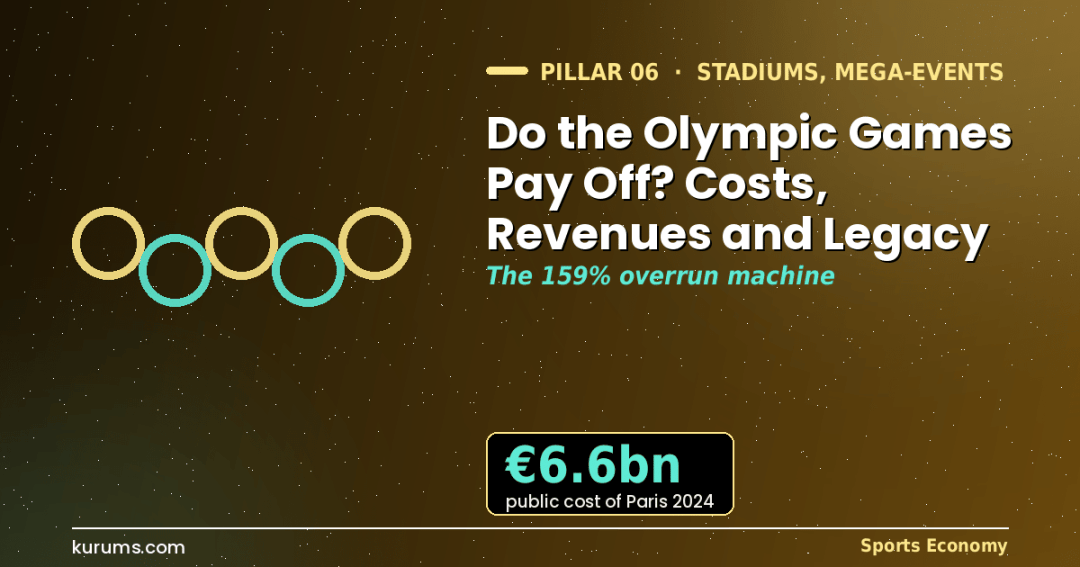
The Olympic Games are a reliable business for the IOC and an unreliable one for hosts. The IOC earned $7.7 billion in the 2021–2024 cycle, 91% of it from broadcasting and TOP sponsorship, and has $7.7 billion already contracted for 2025–2028. Hosts face different arithmetic: the Oxford Olympics Study 2024 puts the average real cost overrun at 159% across 23 Games, Paris 2024 cost the French public €6.6 billion for a GDP effect of about 0.07 percentage points according to the Cour des comptes, and Milan Cortina 2026 closed with an organising-committee deficit of roughly €310 million. LA28’s $7.15 billion privately funded budget and Brisbane’s A$7.1 billion venue programme are the next tests.
Whether the Olympic Games pay off is the oldest question in sports economics and still the most expensive one to get wrong. A host commits to a seven-year programme with a fixed deadline and a bill that history says will roughly double. This article is part of the Sports Economy hub and sits alongside our guides to how stadiums are financed and what a mega-event really does for a host city.
What did Paris 2024 actually cost?
About €6.6 billion of public money (€3.0 billion for organisation and security, €3.6 billion for infrastructure) according to the Cour des comptes, against a €75.7 million organising-committee surplus and roughly €294 million of tax receipts.
How much does the IOC make?
$7.7 billion per four-year cycle, of which the IOC says it redistributes around 88%; it holds reserves of $4.9 billion and booked a $331 million operating loss in non-Games year 2025.
Do hosts ever come out ahead?
Rarely in direct financial terms. Overruns average 159% in real terms, and audited GDP effects are small; the case for hosting rests on infrastructure that would have been built anyway and on legacy that takes decades to measure.
How does the money flow in an Olympic Games?
Olympic money flows through three separate budgets: the IOC’s global revenue, the host organising committee’s operating budget funded mostly by IOC contributions and domestic sponsorship, and the public infrastructure budget borne by governments. Only the third is large, and only the third is routinely over budget.
The IOC sells the two scarce assets, worldwide broadcast rights and the TOP sponsorship programme, and collects the cash centrally. In the 2021–2024 quadrennium that produced $7.7 billion, with broadcasting at 55% and TOP at 36%, according to the IOC’s annual report as summarised by The Sports Examiner. The IOC then redistributes a share to the organising committee of each Games, to the National Olympic Committees and to the international federations; it reports a distribution rate of 88.3%, although independent analysis of its accounts puts the figure closer to 74%.
The organising committee (OCOG) receives the IOC contribution, sells domestic sponsorship, tickets, hospitality and licensing, and uses the proceeds to stage the event: overlay, workforce, technology, ceremonies. This is the budget that is “privately funded” and the one organisers cite when they claim the Games broke even. Paris 2024’s OCOG reported a profit of €75.7 million; LA28’s $7.15 billion budget is entirely of this type.
The public budget is everything else: permanent venues, athletes’ villages, transport, security and the civil-service time that never appears in an organising committee’s accounts. Governments fund this directly, and this is where the overruns live. The Cour des comptes put France’s public bill for Paris 2024 at €6.6 billion, more than double the OCOG’s budget, and that is for a Games marketed as the cheap, re-use-everything model.
How much does hosting the Olympic Games cost, and why does it always overrun?
The Oxford Olympics Study 2024 by Flyvbjerg and colleagues finds that every Games since 1960 with reliable data has overrun its budget, with a mean real-terms overrun of 159% and a median of 118%, and that costs have been rising since 2008 despite the IOC’s reforms.
The study measures sports-related costs only: OCOG operating costs plus direct capital spending on venues and villages, excluding roads, airports and railways. On that basis Rio 2016 cost $23.6 billion in 2022 prices with a 352% real overrun, London 2012 cost $16.8 billion with a 76% overrun, and Tokyo 2020 cost $13.7 billion on the official accounting, which the authors argue understates excluded items by a wide margin. Paris 2024 came in at $8.7 billion in 2022 prices, cheaper than its three predecessors but still 115% over its bid-stage budget.
The reasons are structural. The deadline cannot move, so when problems arise the only variable is money. The scope is set by the IOC’s requirements, accepted at bid stage before detailed design. Bids reward optimism, and no city hosts often enough to learn from the last time, the Oxford authors’ “eternal beginner” problem. And host-city contracts require governments to guarantee any shortfall, so the party with the least information holds the downside.
Milan Cortina 2026 illustrates each point. Organisers laid out a €1.5 billion plan in 2019; by 2023 the cost of staging was expected to pass €2 billion, according to SportBusiness. The Cortina sliding-track renovation rose from €81 million to €118 million. After the Games, FrancsJeux reported in May 2026 that the organising committee was heading for a deficit of roughly €310 million, with about €230 million of cost increases and €80 million of revenue shortfall, after the IOC refused a request for €100 million of extra aid. Sponsorship of €550–580 million was the lowest for a Winter Games since Turin 2006.
| Games | Sports-related cost (2022 USD) | Real cost overrun | Public funding model |
|---|---|---|---|
| London 2012 | $16.8bn | 76% | £9.3bn public package; lottery, Treasury, London council tax |
| Rio 2016 | $23.6bn | 352% | Federal, state and city; several venues now unused |
| Tokyo 2020 | $13.7bn (official) | Rising; authors estimate far higher true cost | National and Tokyo metropolitan government; no spectators |
| Paris 2024 | $8.7bn | 115% | €6.6bn public per Cour des comptes; OCOG privately funded, €75.7m surplus |
| Milan Cortina 2026 | Over €2bn staging (SportBusiness) | OCOG deficit ~€310m | Italian state and regions for venues and sliding track |
| Los Angeles 2028 | $7.15bn OCOG budget | Up from $5.3bn bid estimate | Privately funded; city liable for first $270m overrun, state next $270m |
What did Paris 2024 teach us about Olympic Games economics?
Paris proved that an organising committee can break even while the taxpayer pays €6.6 billion, and that a well-run Games in a global tourist city still produces a GDP effect the French auditors measured at just 0.07 percentage points, because regular tourism was partly crowded out.
The Cour des comptes’ June 2025 report is the most rigorous audit of a modern Games. It counted €3.02 billion of public spending on organisation and security and €3.63 billion on infrastructure, including the athletes’ village in Seine-Saint-Denis, the aquatics centre and the €1.4 billion programme to make the Seine swimmable. Against that it found about €293.6 million of public revenue from taxes and commercial activity. The organising committee, funded by the IOC contribution, sponsorship and ticketing, closed with a €75.7 million profit. The auditors concluded that the economic impact was modest and long-term benefits uncertain.
The tourism data explain the small multiplier. Oxford Economics had forecast international arrivals to Paris 14% above 2019 levels, but hotel bookings fell year on year in the month before the Games, museum attendance dropped sharply during them, and Air France warned of a roughly $190 million revenue hit as regular visitors stayed away. Hotel prices ran 41–64% above the annual average, according to Lighthouse data cited by Oxford Economics: good for hotel owners, bad for the restaurants and retailers whose usual customers never came.
What Paris did get was legacy infrastructure in the poorest department of mainland France: the athletes’ village is becoming housing for about 6,000 residents, the aquatics centre is a community pool that hosted the 2026 European Championships, and the Seine clean-up opened public swimming sites in 2025. Whether €3.6 billion was the cheapest way to achieve those outcomes is the question every future host should ask.
Where does the IOC’s revenue go?
The IOC collected $7.7 billion in 2021–2024, 91% from broadcasting and the TOP sponsors, and says it redistributed 88% to organising committees, federations and national committees while holding $4.9 billion in reserves. In 2025, a year without a Games, it booked an operating loss of $331 million.
The 2025 annual report shows how lumpy the model is. Revenue in 2025 was just $650 million with nothing from broadcast rights, which are recognised in Games years; the $331 million operating loss was cushioned by a $292 million investment gain, leaving a net loss of $39.6 million. In the same year the IOC advanced $892 million of broadcast money and $95 million of TOP money to Milan Cortina, and $392 million and $99 million to LA28. The reserves bridge the non-Games years and give the IOC the power to refuse a bailout, as it did with Milan Cortina’s €100 million ask.
For a host, the IOC contribution is the largest line in the OCOG budget and the reason organising committees can claim to be privately funded. But it is fixed in advance, so inflation, security costs and venue problems fall on the host. The IOC has already contracted $7.7 billion for 2025–2028 and its NBC deal runs to 2036, so its revenue is secure regardless of how the next three Games go for their cities. For comparison with the other global mega-event, see our analysis of the economics of the 2026 World Cup, where FIFA’s cycle revenue is now roughly double the IOC’s.
Can a privately funded Games such as LA28 change the equation?
LA28 is the strongest test of the “no new venues” model: a $7.15 billion budget with no permanent construction, $2 billion of sponsorship already signed by December 2025 against a $2.52 billion target, and a ticketing and hospitality line of $2.5 billion. Even so, the budget has risen from $5.3 billion at bid stage.
The Los Angeles plan uses existing venues almost entirely, SoFi Stadium, the Coliseum, Crypto.com Arena, the Rose Bowl and university facilities, with temporary overlay rather than new builds, removing the infrastructure budget that sank Rio and strained Paris. The organising committee reported in late 2025 that 15 domestic partnerships had taken sponsorship past $2 billion and that 14 million tickets would go on sale from January 2026 with about a third priced under $100, according to the Tribune report on LA28’s year-end update.
The weaknesses are the ones the model cannot engineer away. Security is a public cost: the 2026 World Cup required $625 million of federal security grants for 11 US host cities, and LA28’s bill will sit outside the private budget. Transport upgrades are being paid by public agencies, and the overrun guarantee remains public. If LA28 lands on budget it will be the first Summer Games in the Oxford dataset to do so.
What does Brisbane 2032 tell us about the new host model?
Brisbane 2032 shows that the IOC’s “New Norm” of using existing venues bends under local politics: after three venue reviews, Queensland settled in March 2025 on a new 63,000-seat stadium at Victoria Park and a new national aquatic centre inside an A$7.1 billion venue programme split between the state and federal governments.
The 2021 bid proposed a modest upgrade of the Gabba cricket ground. By 2025 a 100-day review had replaced that with a 17-venue plan anchored by the Victoria Park stadium, widely reported at around A$3.8 billion, with the state allocating A$5.15 billion alongside A$3.4 billion of federal money in a mid-2025 intergovernmental agreement, according to Austadiums. The stadium will outlast the Games as a home for cricket and AFL, which is the legacy argument; the counter-argument is that a city that did not need a 63,000-seat stadium in 2021 is building one for a 17-day event in 2032.
The lesson for 2036 candidates, including Istanbul, which has bid repeatedly and holds the Atatürk Olympic Stadium as a ready-made centrepiece, is that the venue plan at bid stage is not the plan that gets built. Politicians inherit the bid, re-open it and expand it, and the overrun begins before a contract is let.
How should a city decide whether the Olympic Games pay off for it?
A city should host only if the infrastructure it will build is infrastructure it would fund anyway on a similar timeline, if its venue plan is at least 80% existing or temporary, and if it can absorb a public cost of two to three times the OCOG budget without crowding out other capital spending.
The first test is counterfactual infrastructure. London 2012’s Queen Elizabeth Olympic Park is the best recent case: it draws more than 20 million visits a year, East Bank has attracted more than £600 million of mayoral investment, and the legacy corporation targets 33,000 homes and 40,000 jobs around the site by the mid-2030s, according to its 2025 media pack. That happened because the Games accelerated a regeneration of Stratford that London had wanted for decades. Rio’s abandoned venues are the opposite case.
The second test is the ratio of public cost to OCOG budget. Paris’s ratio was roughly 2:1 on a Games designed for restraint; Tokyo’s was far higher once the pandemic removed ticket revenue. A city whose public budget cannot withstand a 118% median overrun on its infrastructure line should not bid.
The third test is who benefits. Hotel owners, construction firms, broadcasters and the IOC capture most direct revenue; residents receive civic pride, crowding, higher prices and whatever legacy survives. For how that calculation plays out across World Cups, Super Bowls and Grands Prix, see our analysis of mega-event host-city impact, and for the sponsorship money that funds the OCOG side, our guide to the global sports sponsorship market.
Frequently Asked Questions
Did Paris 2024 make a profit?
The organising committee did: it reported a surplus of €75.7 million on a budget funded mainly by the IOC contribution, sponsorship and ticketing. The French state did not. The Cour des comptes counted about €6.6 billion of public spending on organisation, security and infrastructure against roughly €294 million of tax and commercial receipts, and estimated the effect on 2024 GDP growth at 0.07 percentage points. Whether that was worth it depends on the long-term value of the housing, pools and Seine clean-up it left behind.
Why do Olympic costs always overrun?
Because the deadline is fixed, the scope is set by the IOC before detailed design, bids reward optimism and the host guarantees the shortfall. The Oxford Olympics Study 2024 finds a mean real overrun of 159% and a median of 118% across 23 Games, with costs rising since 2008. Milan Cortina 2026 followed the pattern: its sliding-track renovation rose from €81 million to €118 million and the organising committee closed with a deficit of roughly €310 million.
How much does the IOC give to a host city?
The IOC contributes a share of its broadcast and TOP sponsorship revenue to each organising committee. In 2025 alone it advanced $892 million of broadcast money and $95 million of TOP money to Milan Cortina 2026, and $392 million plus $99 million to LA28, according to its annual report. The contribution is fixed in advance and does not rise with costs, which is why the IOC could refuse Milan Cortina’s 2026 request for €100 million of additional support.
Is LA28 really privately funded?
The $7.15 billion organising budget is: it is covered by the IOC contribution, a $2.52 billion domestic sponsorship target that passed $2 billion in 2025, and about $2.5 billion of ticketing and hospitality. Security, transport upgrades and any overrun are not. Los Angeles guarantees the first $270 million of shortfall and California the next $270 million. The 2026 World Cup needed $625 million of federal security funding for 11 US cities, which gives a sense of the public bill LA28 will carry outside its private budget.
Discover more from Kurums | Business Intelligence
Subscribe to get the latest posts sent to your email.