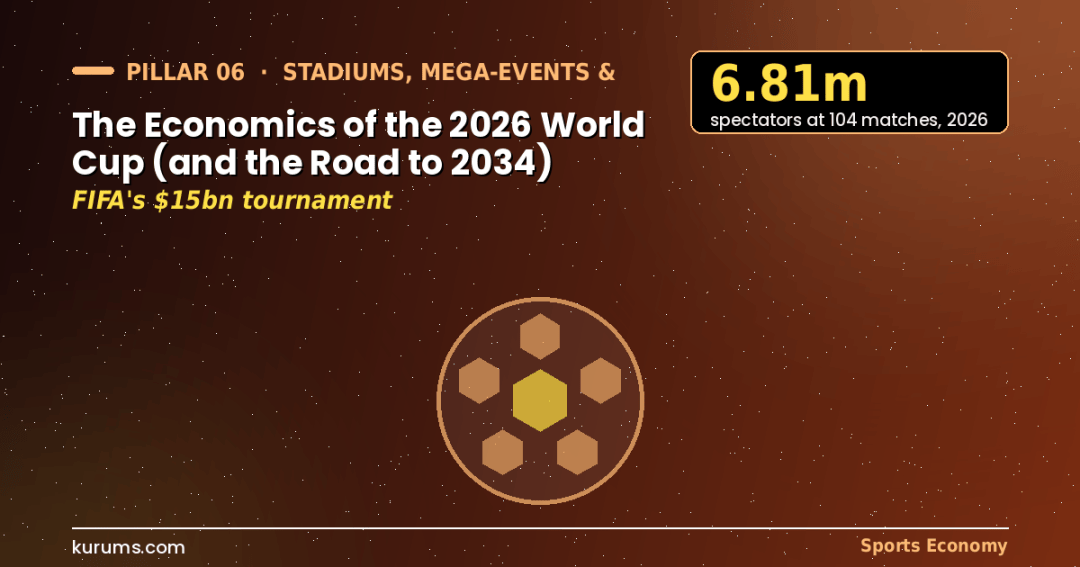
The 2026 World Cup across the United States, Canada and Mexico was the largest commercial event in sports history. FIFA told member associations in July 2026 that revenue for the 2023–2026 cycle had passed $15 billion, against an original $11 billion budget; 6,810,966 spectators attended the 104 matches, nearly double the 1994 record; prize money reached $871 million, with $50 million for champions Spain; and ticket and hospitality sales exceeded $5 billion on GlobalData’s estimate. The hosts’ side is less flattering: Canada’s Parliamentary Budget Officer put Canadian public spending at about $1.07 billion, Vancouver’s bill reached around $578 million for seven matches, and US host cities waited until March 2026 for $625 million of federal security grants. FIFA’s claimed $40.9 billion global GDP boost remains a projection that independent economists dispute.
2026 World Cup economics break into two accounts that rarely meet: FIFA’s, which closed the tournament with the largest surplus in its history, and the host cities’, which carried security, transit and fan-festival costs that no broadcast contract repays. This article is part of the Sports Economy hub and complements our analyses of whether the Olympic Games pay off and what a mega-event really does for a host city.
How much did FIFA make from the 2026 World Cup?
More than $15 billion over the 2023–2026 cycle according to FIFA’s July 2026 update to members, up from an $11 billion budget; the 2019–2022 cycle, which included Qatar 2022, generated $7.6 billion.
What did it cost the hosts?
No new stadiums, but large operating bills: about $1.07 billion of Canadian public money for 13 matches, $625 million of US federal security grants plus local policing, and city budgets such as Toronto’s $380 million and Vancouver’s roughly $578 million.
Was the economic impact real?
Attendance, hotel rates and stadium-district sales spiked, but FIFA’s $40.9 billion GDP projection counts gross spending and ignores displacement; research on past World Cups finds 12 of the last 14 produced net losses for hosts.
How did FIFA turn the 2026 World Cup into a $15 billion cycle?
By expanding the tournament from 32 to 48 teams and 64 to 104 matches, staging it in the world’s richest sports market with existing NFL stadiums, and pricing tickets dynamically from $60 to $6,730. FIFA’s cycle revenue rose from $7.6 billion in 2019–2022 to more than $15 billion in 2023–2026.
The expansion did most of the work. Forty extra matches meant roughly 2.15 million more tickets than a 32-team tournament, according to GlobalData, and every one of them was sold in a market where the NFL has trained fans to pay four-figure sums for premium seats. FIFA’s 2023–2026 budget, as analysed by The Esk in May 2026, allocated $3.92 billion to television rights, $2.69 billion to marketing, $3.0 billion to hospitality and ticketing and $3.39 billion to licensing and other income, for a revised total of $13 billion; the final outcome exceeded even that, with FIFA informing members in July 2026 that the cycle had passed $15 billion, as reported by The Guardian and Adweek.
Hospitality and ticketing were the swing factor. FIFA confirmed in 2025 that it would use dynamic pricing for the first time at a World Cup, with group-stage tickets starting at $60 and the most expensive final seats listed at $6,730, according to ESPN; the secondary market went far higher. GlobalData reported that 89% of matches reached at least 99% capacity, 69% sold out, and ticket and hospitality revenue was expected to surpass $5 billion, against the $3.0 billion budgeted. The Esk’s independent projection put the eventual ticketing and hospitality range at $7.4–9.0 billion. Those numbers explain why FIFA’s reserves, about $4 billion at the end of 2022, were projected to reach $5.5–6.5 billion by the end of 2026.
Broadcast rights grew more slowly because most deals were signed before expansion: Fox paid $485 million for US English-language rights, and its 38.9 million audience for the Spain–Argentina final was a US record for football. Sponsorship more than doubled, from $1.07 billion to $2.69 billion. For how those rights fit the wider market, see our analysis of the global sports media rights market.
Where did FIFA’s money go?
FIFA budgeted $3.76 billion of direct spending on the 2026 tournament, including $1.12 billion of operations, $871 million of prize money, $355 million for the Club Benefit Programme that compensates clubs for releasing players, and $421 million for venues and competition. Host cities received none of this for their own costs.
Prize money is the headline. FIFA raised the pot from $440 million at Qatar 2022 to $727 million in its April 2026 announcement and then to $871 million in the final accounts analysed by The Esk, with the champion receiving $50 million, every qualified team at least $10.5 million including a $1.5 million preparation payment, and group-stage exits earning $9 million. For a mid-sized federation, a single World Cup appearance is now worth more than a decade of domestic sponsorship.
The $355 million Club Benefit Programme pays clubs for each day a player spends at the tournament, so European clubs with large international contingents collected the most. Together with the $1.02 billion of prize and participation money, more than a third of FIFA’s direct tournament spending went to teams and clubs rather than host territories.
What FIFA does not fund is the public cost of hosting: security, policing, transit, fan festivals and city services fall on host governments, while FIFA retains almost all broadcast, sponsorship and ticketing income.
| Item | Qatar 2022 | USA / Canada / Mexico 2026 | Source |
|---|---|---|---|
| Teams / matches | 32 / 64 | 48 / 104 | FIFA |
| FIFA cycle revenue | $7.6bn (2019–22) | Over $15bn (2023–26) | FIFA annual report; Guardian / Adweek, July 2026 |
| Total attendance | 3.4m | 6.81m (record) | FIFA, July 2026 |
| Prize money | $440m | $871m ($50m to winner) | FIFA; The Esk |
| New stadiums built | 7 of 8 | 0 of 16 | Host documents |
| Host public spending | ~$200bn incl. national infrastructure | ~$1.07bn Canada; $625m US federal security plus local budgets; Mexico unpublished | IMF estimates; Canadian PBO; FEMA |
What did the host cities actually pay?
Host cities paid for security, transit, fan festivals and stadium adaptations with little direct FIFA support. Canada’s Parliamentary Budget Officer estimated about $1.07 billion of Canadian public spending for 13 matches, or roughly US$59.6 million per match, and the 11 US host cities relied on $625 million of federal security grants that arrived only in March 2026.
Canada published the most transparent accounts. The PBO’s 2026 estimate, reported by BlogTO, split the $1.07 billion into $473 million of federal money, including $220 million from Canadian Heritage for host-city operations, $145 million from Public Safety Canada and $79 million for the RCMP, and $593 million from provinces, cities and public bodies. Vancouver’s total, covering seven matches at BC Place, training sites and a fan festival, was projected to approach $578 million, with the City of Vancouver’s own share at $246–276 million funded largely by a temporary hotel tax expected to raise about $230 million through 2030. Toronto’s budget for six matches was $380 million, of which $236 million was operating cost and $144 million capital.
In the United States the money was slower and more political. FEMA’s $625 million FIFA World Cup Grant Program for the 11 host cities missed an internal January 2026 deadline, was frozen during a partial government shutdown that began in February, and was finally approved on 18 March 2026 after White House intervention, according to Front Office Sports. Because the grants were reimbursements, cities such as Miami and Kansas City had to fund police overtime from their own budgets first. A separate $250 million FEMA programme for drone policing ran alongside.
Vancouver’s hotel-tax model is the clearest example of a city designing its own repayment mechanism rather than relying on FIFA. Mexico’s three host cities published no comparable consolidated figures.
Did the 2026 World Cup deliver the economic impact FIFA promised?
Gross activity was real and large: record attendance, hotel occupancy spikes in Dallas, Miami, Houston and Atlanta, and stadium-district restaurant and bar sales up 200–400% on match days. Net impact is far smaller, because FIFA’s $40.9 billion projection counts spending that displaces other tourism and ignores leakage to FIFA, airlines and hotel chains.
FIFA and the WTO projected $40.9 billion of additional global GDP and about 824,000 jobs, with $17.2 billion for the United States, $3 billion for Mexico and C$3.8 billion for Canada. Statistics of the World, reviewing the claim in June 2026, pointed out that the US figure is under 0.1% of GDP, that Tourism Economics’ projection of 1.24 million international visitors used the same $17.2 billion number, and that the hotel occupancy and spending surges reported by Natixis were observed in stadium districts rather than measured net of visitors who stayed away.
The displacement evidence from previous tournaments is consistent. Victor Matheson of the College of the Holy Cross, quoted by Newsweek, described host-committee revenue estimates as promotional; University of Toronto research cited by Newsweek found 12 of the last 14 World Cups produced net losses for hosts; and Atradius estimated cumulative host-city losses from the 1994 US tournament at up to $9.3 billion. Brazil 2014 cost $19.7 billion for about 0.1% of GDP growth; Qatar 2022 cost roughly $200 billion for a 0.7–1.0% contribution on IMF estimates.
What makes 2026 different from Brazil, Russia and Qatar is the absence of stadium construction. Sixteen existing venues, most of them NFL stadiums already financed by the public bond deals we describe in our guide to stadium financing, meant the capital cost was close to zero and the loss, where there was one, was an operating loss. Vancouver’s $578 million against seven matches is expensive; Qatar’s $200 billion against 64 was something else entirely.
How did fans, sponsors and broadcasters fare?
Fans paid the highest ticket prices in World Cup history, sponsors reported record engagement, and Fox’s 38.9 million for the final set a US record. The tournament confirmed that the North American market can absorb NFL-style pricing for football, which is the commercial template FIFA will now apply to 2030 and 2034.
Dynamic pricing was the controversy. Fan groups objected to list prices that rose with demand, with final tickets at $6,730 before resale; FIFA pointed to the $60 entry price and sell-out rates above 99% at most matches. The economic logic is simple: if 89% of matches reach 99% capacity, the old fixed tariffs were under-pricing. The social logic, that the World Cup’s live audience should reflect the global game, lost.
Sponsors received a 39-day, 16-city platform at a scale no other event offers; FIFA’s marketing revenue of $2.69 billion was up 152% on 2019–2022. Broadcasters, who had largely locked in rights before expansion, got 40 extra matches at no extra fee, which is why the 2030 and 2034 rights cycle is where FIFA expects the largest growth.
In Türkiye the tournament’s commercial reach showed differently: Turkish Airlines, a long-standing UEFA and basketball sponsor, used the summer to promote its North American network, and Süper Lig clubs sold players on the strength of World Cup performances in the transfer window that opened as the final was played.
What does the road to 2030 and 2034 look like?
The 2030 tournament returns to the stadium-building model, with Spain, Portugal and Morocco building or renovating venues including Morocco’s planned 115,000-seat Hassan II stadium, while Saudi Arabia’s 2034 plan was cut in October 2026 from 15 stadiums to 10 because of cost, according to Inside World Football.
Morocco is the test of whether a middle-income country can host at 48-team scale without the Qatari budget: its six proposed venues include the Grand Stade Hassan II near Casablanca, intended to be the world’s largest football stadium, plus upgrades in Rabat, Marrakech, Tangier, Fez and Agadir. Spain and Portugal will mostly use existing club stadiums, including the rebuilt Bernabéu and Camp Nou, which limits their capital exposure.
Saudi Arabia’s 2034 plan was conceived at the top of the cycle and is being trimmed as it descends. The bid promised 15 stadiums in five cities, including the NEOM stadium 350 metres above ground; by mid-October 2026 Reuters reported the NEOM venue shelved, and Semafor, via Inside World Football, reported that King Abdullah Economic City, Qiddiya Coast, Roshn and New Murabba would also be dropped, leaving six new builds and four refurbishments, four of which will first host the 2027 Asian Cup. Even with the cut, the kingdom will spend more on stadiums for 2034 than the 2026 hosts spent on everything. For the strategy behind that spending, see our analysis of the Gulf playbook in sports investment.
FIFA’s trajectory is set: with reserves heading towards $6 billion and broadcast deals to be renegotiated for a 104-match format, the next cycle budget will start above $15 billion. Whether any of that growth reaches hosts is the open question, and the 2026 accounts suggest it does not.
What should businesses take from the 2026 World Cup economics?
Three lessons: existing infrastructure turns a capital loss into a manageable operating cost; dynamic pricing works in markets with high willingness to pay but transfers the surplus from fans to the organiser; and public money is slow, so every host needs its own revenue mechanism.
For hospitality businesses, the pattern matters more than the headline. Demand concentrated in stadium districts and match days while regular leisure travel softened; a hotel operator in a 2030 or 2034 host city should plan for 39 days of peak pricing and a quieter shoulder on either side, not a season-long boom. The same logic applies to the broader sports tourism industry, where the measurable money sits in participation events and regular fixtures rather than in once-a-generation finals.
For host governments, the lesson is Vancouver’s: a dedicated hotel tax, a published budget with contingency and a willingness to say no to unfunded requests are the difference between an expensive but controlled event and an open-ended liability.
Frequently Asked Questions
How much money did FIFA make from the 2026 World Cup?
FIFA told its member associations in July 2026 that revenue for the 2023–2026 cycle had exceeded $15 billion, against an original budget of $11 billion and a revised target of $13 billion. The previous cycle, which included Qatar 2022, generated $7.6 billion. Ticketing and hospitality were the main source of the upside, with GlobalData estimating more than $5 billion against a $3 billion budget, helped by dynamic pricing and 89% of matches reaching 99% capacity.
Who won the 2026 World Cup and what did they earn?
Spain beat Argentina 1–0 after extra time at MetLife Stadium on 19 July 2026 in front of 80,663 spectators, with Ferran Torres scoring the winner. Spain’s federation received $50 million in prize money from a total pot of $871 million, nearly double the $440 million paid at Qatar 2022. Every qualified team received at least $10.5 million, including a $1.5 million preparation payment.
Did host cities make money from the 2026 World Cup?
Most will not in direct fiscal terms. Canada’s Parliamentary Budget Officer estimated $1.07 billion of public spending for 13 matches, Vancouver’s cost approached $578 million and Toronto budgeted $380 million. US cities relied on $625 million of federal security grants that arrived in March 2026. Gross visitor spending was large, but independent economists note that much of it displaced regular tourism and that FIFA retained the broadcast, sponsorship and ticket income.
How many stadiums will Saudi Arabia build for the 2034 World Cup?
Fewer than promised. The bid listed 15 stadiums across five cities, including a NEOM venue 350 metres above ground. In October 2026 Reuters reported the NEOM stadium shelved and Inside World Football, citing Semafor, reported that five venues in total would be dropped on cost grounds, leaving six new builds and four refurbishments. The King Salman International Stadium and Prince Mohammed bin Salman Stadium in Riyadh are proceeding, and four venues will first host the 2027 Asian Cup.
Discover more from Kurums | Business Intelligence
Subscribe to get the latest posts sent to your email.