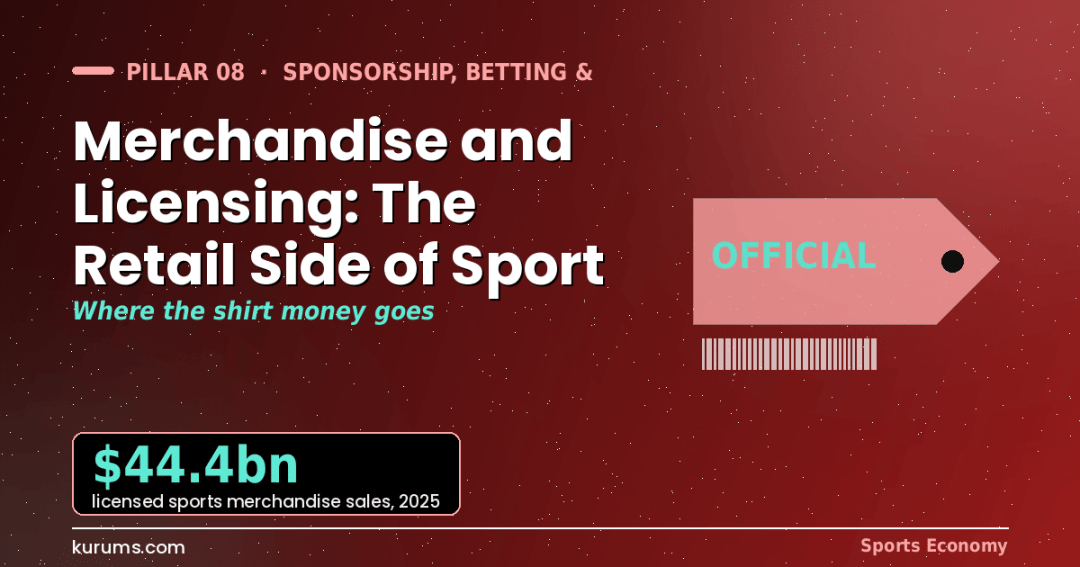
Licensed sports merchandise generated $44.4 billion of sales in 2025, up 8.5 percent, the fastest-growing property type in Licensing International’s $389.8 billion global licensing study. Kit-supplier contracts are now the largest single commercial deals in football: Manchester City’s Puma extension is worth about £1 billion over ten years, Manchester United’s Adidas deal £900 million, and Real Madrid’s Adidas renewal an estimated €120 million a season to 2034. Commercial income, which includes merchandise and licensing, reached €5.3 billion across Deloitte’s top 20 clubs in 2024/25, 43 percent of their €12.4 billion. Most clubs outsource retail; the few that run it themselves capture far more of the margin.
Sports merchandise and licensing is the part of the sports economy that lives in shops, stadium concourses and online baskets rather than in broadcast contracts. It covers replica shirts, caps, scarves, trading cards, video-game rights, co-branded consumer products and the royalties flowing from each. It is smaller than media rights or sponsorship for most properties, but it is the line most directly tied to fan identity. This article sizes the market in 2025 and 2026, explains how kit-supplier contracts and licensing royalties work, and compares the operating models clubs use. It is part of the Sports Economy hub and complements our guides to shirt sponsorship and naming rights and the global sponsorship market.
How big is sports licensing?
$44.4 billion of licensed sports merchandise and services sales in 2025, an 11.4 percent share of the $389.8 billion global licensing market and the fastest-growing segment at 8.5 percent (Licensing International).
How do kit deals work?
The supplier pays a guaranteed minimum against royalties on shirt and product sales, typically 10 to 15 percent of wholesale value, plus performance bonuses. Manchester City (Puma, about £100 million a year) and Real Madrid (Adidas, about €120 million) hold the biggest.
Who captures the margin?
A club that licenses everything to a partner such as Fanatics keeps a royalty of 10 to 20 percent of sales. A club that runs its own retail, as Bayern Munich and Galatasaray do, keeps the full gross margin but carries inventory, staff and e-commerce costs.
How big is the sports merchandise and licensing market?
Licensing International’s 2025 global study puts sales of licensed sports merchandise and services at $44.4 billion, 11.4 percent of a $389.8 billion licensing market and the fastest-growing property type at 8.5 percent. Add unlicensed team-run retail and kit-supplier product, and the sports merchandise economy is well above $50 billion.
The licensing figure counts retail sales of products carrying a licensed sports mark: a team crest, a league logo, a player’s name and likeness or an event brand. Sports ranks third among property types, behind entertainment and characters ($161.8 billion) and corporate brands ($98 billion), but it outgrew both in 2025. The drivers were the Club World Cup in the United States, anticipation of the 2026 World Cup, the continued expansion of the NFL and NBA abroad, the growth of women’s leagues and a trading-card boom that has made Fanatics’ Topps division one of the most profitable licensees in sport.
Club accounts show how merchandise sits within commercial revenue. Deloitte’s 2026 Football Money League reports commercial income of €5.3 billion across the top 20 clubs in 2024/25, 43 percent of their record €12.4 billion and larger than broadcast income (€4.7 billion). Real Madrid’s commercial revenue reached €594 million, up 23 percent, with the renovated Bernabéu’s retail, tours and events a significant driver. Clubs that break out merchandise, such as Manchester United’s retail, merchandising, apparel and product licensing line, typically report £30 million to £60 million a year, with kit-supplier income booked separately under sponsorship.
In North America, league-level licensing dominates because the leagues own the collective marks. NFL Properties, NBA Properties, MLB Properties and NHL Enterprises license team marks collectively and share royalties equally among franchises, which makes the four leagues among the world’s largest licensors, with Nike as apparel partner and Fanatics as dominant retailer and manufacturer.
How does a kit-supplier contract actually work?
The supplier pays the club a guaranteed minimum each season, in return for the exclusive right to design, manufacture and sell the club’s kit and training wear. The club earns royalties on sales above the guarantee, bonuses for trophies and Champions League qualification, and sometimes equity in retail joint ventures.
The guarantee is what the headlines report. Sports Illustrated’s ranking of Premier League kit deals lists Manchester City’s Puma extension at about £100 million a year through 2035, Manchester United’s Adidas extension at £900 million over ten years from 2025, Chelsea’s Nike contract at about £60 million a year, Arsenal’s Adidas deal at about £75 million a year to 2030 and Liverpool’s 2025 Adidas agreement at a reported £600 million over ten years. Real Madrid’s eight-year Adidas renewal, signed in June 2026 and estimated by AS at €120 million a season, is the largest in world football and covers the basketball and women’s teams.
The supplier’s economics depend on sell-through. A replica shirt retailing at £85 to £100 carries a wholesale value of roughly half that; the club’s royalty is 10 to 15 percent of wholesale, so a club must sell on the order of two million shirts a year for royalties to exceed a £60 million guarantee. Only Real Madrid, Barcelona, Manchester United, Liverpool, Bayern Munich and Paris Saint-Germain are widely reported in that range. For everyone else, the guarantee is the deal.
Performance clauses have grown. Manchester United’s Adidas contract reportedly reduces payments if the club misses the Champions League for consecutive seasons; Liverpool’s varies with merchandise sales and results. Clubs are also negotiating break clauses to recapture value if their profile rises, and some have pushed for a share of the supplier’s direct-to-consumer margin rather than a pure royalty.
| Club | Supplier | Reported value | Term | Retail model |
|---|---|---|---|---|
| Real Madrid | Adidas | c. €120m/yr | 8 years to 2034 | Club-run stores and e-commerce; Bernabéu retail |
| Manchester City | Puma | c. £100m/yr (£1bn total) | 10 years to 2035 | Club-run; multi-club group licensing |
| Manchester United | Adidas | £900m total (c. £90m/yr) | 10 years from 2025 | Fanatics operates retail and e-commerce |
| Arsenal | Adidas | c. £75m/yr | to 2030 | Club-run |
| Chelsea | Nike | c. £60m/yr (£900m total) | 15 years from 2017 | Club-run |
| Liverpool | Adidas | c. £60m/yr (reported £600m) | 10 years from 2025 | Club-run; sales-linked bonuses |
| Bayern Munich | Adidas (shareholder) | c. €60m/yr (reported) | to 2030 | Fully club-run, including logistics |
| Galatasaray | Puma | not disclosed | multi-year | Club-owned GS Store chain and e-commerce |
Who are the biggest players in sports licensing and retail?
Nike and Adidas dominate apparel supply, with Puma, New Balance, Castore and Kappa competing for the next tier. Fanatics is the largest licensed-merchandise retailer and manufacturer, running e-commerce for most North American leagues and a growing list of European clubs, and owns Topps trading cards. EA Sports, Panini and Lego are among the biggest non-apparel licensees.
Fanatics is the structural story of the past decade. It secured long-term e-commerce rights to the NFL, NBA, MLB, NHL, NASCAR and dozens of colleges, moved into manufacturing MLB and NFL on-field and replica product, and bought Topps in 2022. It runs retail and e-commerce for Manchester United, Paris Saint-Germain and other European clubs, and the leagues are among its investors. It describes more than 8,000 employees and over 300 partners across 11 countries; revenue is not published, but private rounds valued it at roughly $31 billion in 2022.
The apparel suppliers have consolidated around the biggest clubs. Nike holds the NFL, NBA and Barcelona, Chelsea, PSG and Inter; Adidas holds Real Madrid, Manchester United, Arsenal, Liverpool, Bayern and Juventus; Puma holds Manchester City’s group, AC Milan, Borussia Dortmund and Galatasaray. Kit is a small share of each group’s revenue but a large share of brand visibility.
Non-apparel licensing is where growth is fastest. Trading cards, driven by Fanatics-Topps and Panini, have become a multi-billion-dollar category since 2020. EA Sports pays FIFA-replacement licences to leagues and clubs for its FC franchise, and the Premier League, Bundesliga and La Liga each earn tens of millions a year from video-game rights. Lego, Hasbro and Funko hold team and league licences for toys, and the NBA’s licensing of its marks to streetwear brands has made basketball merchandise a fashion category in Asia and Europe.
Should a club run its own retail or license it out?
Running retail in-house captures the full gross margin, typically 40 to 60 percent on apparel, and the customer data that goes with it, but requires inventory capital, store leases, warehousing, e-commerce technology and staff. Licensing to a partner such as Fanatics converts that into a royalty of 10 to 20 percent of sales with no operating risk.
The two models suit different clubs. Bayern Munich runs one of the most integrated retail operations in sport, with its own stores, logistics and online shop, and reports merchandise as a distinct line that has exceeded €100 million in strong seasons. Real Madrid and Barcelona also operate their own flagship stores and e-commerce, and the renovated Bernabéu’s retail and tour income was a driver of Real’s 23 percent commercial growth in 2024/25. In Türkiye, Galatasaray’s GS Store chain and online shop are club-owned, and the club has reported record merchandise seasons during its title-winning runs, a model Fenerbahçe and Beşiktaş follow with their own branded chains.
Manchester United took the other route, handing retail and e-commerce to Fanatics in a long-term deal; the club receives royalties and a guarantee while Fanatics carries the operation. For a club whose fans are spread across the world, a partner with global fulfilment, local-currency pricing and a large fan database may generate more total sales than the club could alone, even after the partner’s margin. The NFL, NBA, MLB and NHL made the same calculation at league level, which is why Fanatics runs their official online shops.
The trade-off is strategic as well as financial. A club that outsources loses direct ownership of customer data, which matters for ticketing, membership and the digital products examined in our article on fan tokens and digital monetisation; several clubs have renegotiated to recover first-party data access.
What role do players and athletes play in merchandise sales?
Star players drive shirt sales and licensing demand far more than team success does. Signings such as Cristiano Ronaldo at Al Nassr, Lionel Messi at Inter Miami and Kylian Mbappé at Real Madrid produced immediate spikes in replica sales, and leagues sell player name-and-likeness rights collectively through players’ associations.
The Messi effect is the clearest recent case. Inter Miami’s Messi shirt became the best-selling jersey in MLS history within months of his 2023 arrival, and Fanatics said it outsold every other athlete’s across all its leagues. The club’s merchandise revenue, previously negligible, became a meaningful line alongside the uplift examined in our piece on athlete-led brands. A single signing can be worth more in merchandise than a sponsorship deal, which is why some transfer business cases now include a licensing forecast.
Player rights are governed by collective agreements in North America: the NFL, NBA and MLB players’ associations license names and likenesses as a group, which is what lets video games, trading cards and jersey printing feature every player. In European football, image rights are mostly held individually, and clubs negotiate the right to use a player’s name on merchandise in the employment contract, often splitting income with the player’s company.
How do leagues and events license their own brands?
Leagues license their collective marks (logos, trophies, event names) separately from clubs, and major events run merchandise programmes worth hundreds of millions. The 2026 World Cup’s licensing programme, spanning the United States, Canada and Mexico, was expected to be the largest in the tournament’s history, with Fanatics and Adidas as principal partners.
League-level licensing works best where the league owns the marks and sells them collectively; NFL and NBA royalties are pooled, and in the NBA they feed the basketball-related income shared with players. The Premier League licenses its own brand modestly and leaves merchandise to the clubs, because English clubs own their marks individually.
Events are a special case because their value peaks in a few weeks. FIFA and the IOC license event marks to apparel, toy and collectible companies, and host-city stores sell official product at a premium; Paris 2024 reported record licensed-merchandise sales for a Games. For 2026, a 48-team field, three host countries and the US appetite for licensed product were expected to set a new benchmark, as discussed in our article on the 2026 World Cup.
Where is merchandise revenue heading by 2030?
Expect licensed sports sales to keep growing faster than the wider licensing market, driven by collectibles, direct-to-consumer e-commerce, women’s sport, Asian and Gulf demand, and premium “fashion” collaborations. Guarantees at the top will keep rising, but the gap to mid-table clubs will widen.
The product mix is shifting from replica kit toward lifestyle apparel, collectibles and collaborations. NBA streetwear partnerships, Formula 1 fashion lines and club capsule collections sell at higher margins to fans who never buy a numbered shirt. Trading cards and memorabilia now generate billions, and Fanatics’ collectibles unit is reported to be among its most profitable.
Geographically, suppliers are chasing fans in India, Southeast Asia, the Gulf and Latin America, where official e-commerce barely existed a decade ago. Merchandise strategy is now part of international growth strategy, which is why the biggest clubs tour Asia and the United States each summer with pop-up stores attached, and why the question of who owns the fan relationship, club or licensing partner, is being renegotiated across the industry.
Frequently Asked Questions
How much do clubs earn from shirt sales?
Less than fans assume. The club’s royalty is typically 10 to 15 percent of the wholesale price, or about £5 to £8 on a £90 shirt sold through a third-party retailer. Most clubs never sell enough to exceed the guaranteed minimum their supplier pays, so the guarantee is effectively the income. Clubs that run their own stores and websites also keep the retail margin, which is why Bayern Munich, Real Madrid and Galatasaray operate in-house.
What is the biggest kit deal in football?
Real Madrid’s Adidas renewal, signed in June 2026 and estimated by AS at about €120 million a season for eight years to 2034, covering the football, basketball and women’s teams. In England, Manchester City’s Puma extension is reported at about £100 million a year to 2035 and Manchester United’s Adidas contract at £900 million over ten years from 2025. These figures are guaranteed minimums; actual payments can rise with sales and trophies.
What does Fanatics do?
Fanatics is the largest licensed sports merchandise company. It runs official online shops for the NFL, NBA, MLB, NHL, NASCAR, many colleges and clubs including Manchester United and Paris Saint-Germain; manufactures licensed apparel; owns Topps trading cards; and has expanded into sports betting and live events. It describes more than 8,000 employees and over 300 partners across 11 countries. Its leagues are among its investors, and private rounds have valued it at roughly $31 billion.
Why do suppliers pay so much when royalties rarely cover it?
Because the kit deal is also a marketing contract. A supplier whose logo sits on Real Madrid’s or the NFL’s shirts gains global brand exposure, credibility in the football or American-football category and access to athletes for campaigns. Nike, Adidas and Puma treat the guarantee partly as advertising spend, and the sale of the club’s product is only one part of the return. That is why suppliers accept paying guarantees that exceed the direct profit on the club’s merchandise.
Discover more from Kurums | Business Intelligence
Subscribe to get the latest posts sent to your email.