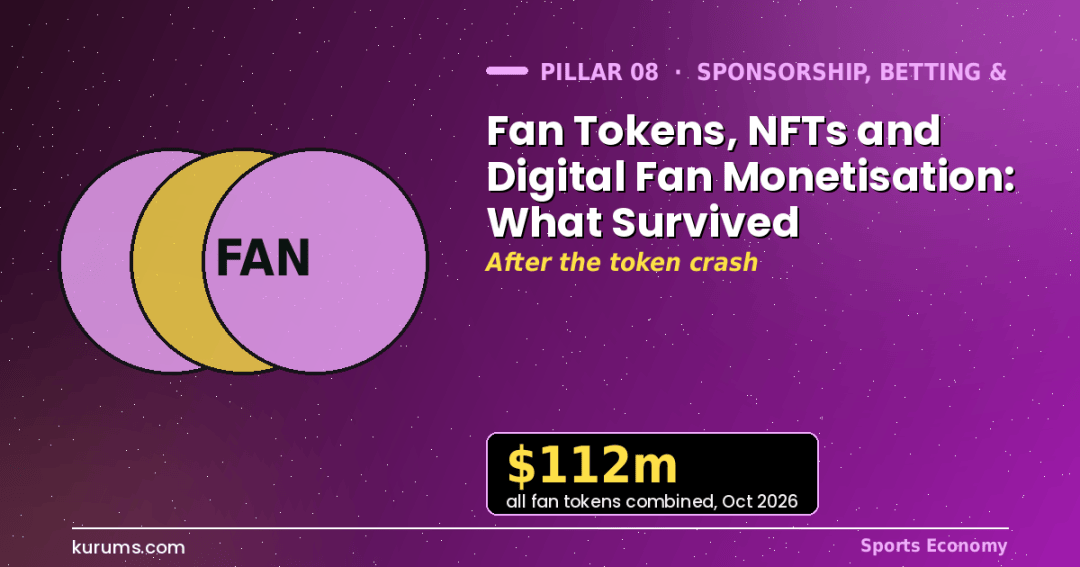
The entire fan-token category is worth about $112 million in October 2026 according to CoinMarketCap, down from several billion dollars at the 2021 peak, and the largest club token (Barcelona’s) has a market value under $8 million. NBA Top Shot has recorded more than $1.2 billion of lifetime sales but most of it came in 2021. What survived is the unglamorous part: memberships, premium streaming, fantasy games and loyalty programmes that give clubs a direct, recurring relationship with fans. Socios still lists 60-plus teams under an EU MiCA licence; Sorare pivoted to free-to-play; the lesson is that fans pay for access and utility, not speculation.
Digital fan monetisation was supposed to be transformed by fan tokens and NFTs between 2020 and 2022. Clubs launched tokens that raised millions in minutes, the NBA licensed video highlights that sold for six figures, and a fantasy platform raised $680 million at a $4.3 billion valuation. Four years on, most of that value has gone and regulators have moved in. Yet the underlying idea, that a club can earn directly from fans who never attend a match, has become central to commercial strategy. This article examines what worked, what failed and why, and what the second wave looks like in 2026. It is part of the Sports Economy hub and complements our analyses of merchandise and licensing and the global sponsorship market, where crypto brands briefly became the biggest spenders.
What happened to fan tokens?
Total fan-token market capitalisation is about $112 million in October 2026 (CoinMarketCap), with daily trading of roughly $44 million concentrated in a few tokens. Prices fell 90 to 99 percent from 2021 highs amid fan backlash and regulatory scrutiny.
What happened to sports NFTs?
NBA Top Shot reached $1.2 billion of lifetime sales and 1.6 million collectors (Dapper Labs), but monthly volume collapsed after early 2021. Sorare, valued at $4.3 billion in 2021, moved toward free-to-play. Several league NFT programmes closed.
What actually makes money?
Memberships (Barcelona’s socis, Bayern’s 400,000-plus members), premium streaming and club apps, fantasy games with tens of millions of players, loyalty points tied to ticketing and merchandise, and first-party data that raises sponsorship prices.
What were fan tokens and how much money did they raise?
Fan tokens are club-branded crypto assets, mostly issued through Socios.com on the Chiliz blockchain, giving holders votes on minor club decisions and access to rewards. Clubs received an upfront payment and a share of sales; Barcelona’s 2020 launch reportedly raised €1.3 million in under two hours.
The model spread fast. By 2022 Socios listed tokens for Barcelona, Paris Saint-Germain, Juventus, AC Milan, Inter, Manchester City, Arsenal, Atlético Madrid, Galatasaray, Fenerbahçe, Trabzonspor, the Argentine and Portuguese federations, Formula 1 teams and UFC. Clubs received a seven- or eight-figure fee plus revenue share, and Chiliz, Socios’ parent, also sponsored the clubs it listed. At the late-2021 peak, fan tokens were reported at well over $1 billion combined and CHZ’s market capitalisation exceeded $4 billion.
The economics were front-loaded. The club earned at issuance and from trading commissions; fans bought at launch and held an asset whose value depended on later demand. As crypto markets fell in 2022 and utility proved thin, prices fell with them. The UK Advertising Standards Authority censured Arsenal in 2021 for promoting its token without adequate risk warnings, and several clubs quietly stopped marketing theirs.
The October 2026 picture, from CoinMarketCap’s fan-token category, is a total market value of about $112 million. The largest is the OG esports token at $12.9 million; Atlético Madrid’s is $8.8 million, Barcelona’s $7.5 million, PSG’s $7.4 million, Galatasaray’s $7 million and Alpine F1’s $6.9 million. Daily volume of about $44 million is largely speculative trading. For a club with €800 million of revenue, a token worth €7 million is a rounding error, which is why most now treat it as a legacy programme.
Why did sports NFTs rise and fall so quickly?
NFTs attached scarcity to digital highlights and cards just as retail crypto investors had money and time. NBA Top Shot sold about $224 million in one month in early 2021 and has $1.2 billion of lifetime sales, but once speculative demand left, volume fell more than 95 percent.
Dapper Labs’ Top Shot, launched with the NBA and the players’ association in 2020, was the breakout product: licensed video “moments” sold in packs and resold on a marketplace where the league and Dapper took a cut of every trade. It reached 1.6 million collectors and $1.2 billion of sales by Dapper’s own figures, and in February 2021 a LeBron James moment sold for $208,000. NFL All Day, launched in 2022, reached about 132,000 collectors and $160 million of sales. The NBA earned licence fees, trading royalties and equity in Dapper.
The collapse had three causes. Supply: Dapper minted tens of millions of moments (its supply counter shows almost 53 million), so scarcity was nominal. The 2022 crypto crash removed the speculative buyers who set prices. And utility was absent: a moment conferred no access, discount or community benefit beyond ownership. Top Shot continues in 2026 with $10 packs and rookie-debut campaigns, a sustainable collectibles business closer to trading cards than to the asset class pitched in 2021.
Sorare, the Paris-based fantasy game built on licensed NFT player cards, raised $680 million from SoftBank and others in 2021 at a $4.3 billion valuation and signed the Premier League, Bundesliga, La Liga, MLB and NBA, then spent 2023 to 2025 adapting to a market in which few users wanted to pay hundreds of euros for cards. It added free-to-play modes, faced gambling-law reviews in France and the UK, and survives as a fantasy company that happens to use blockchain.
| Product | Model | Peak (2021–22) | Status, October 2026 | What survived |
|---|---|---|---|---|
| Socios fan tokens (Chiliz) | Club tokens with votes and rewards | Category >$1bn; CHZ >$4bn | Category c. $112m; 60+ teams listed; MiCA licence in Malta | Rewards app, federation tokens (Belgium 2026), small-club launches (Palermo) |
| NBA Top Shot (Dapper Labs) | Licensed video-highlight NFTs | c. $224m sales in one month (Feb 2021) | $1.2bn lifetime sales, 1.6m collectors; low volumes | $10 packs, rookie campaigns, WNBA sets: a collectibles business |
| NFL All Day (Dapper Labs) | Licensed highlight NFTs | Launched 2022 after the peak | $160m lifetime sales, 132k collectors | Niche collectibles |
| Sorare | Fantasy game on NFT cards | $4.3bn valuation (2021) | Operating; free-to-play tiers; licences retained | A fantasy company using blockchain, not a crypto asset |
| Club memberships | Annual fee for access and priority | n/a (pre-dates crypto) | Growing: Bayern 400k+, Benfica and Barcelona six figures | The model tokens tried to imitate |
| Fantasy sports (FPL, DraftKings, Dream11) | Free or paid entry, advertising, data | n/a | FPL more than 11 million managers; Dream11 200m+ users | Largest digital fan products by users |
What did fans actually want from digital products?
Access, recognition and utility: earlier ticket windows, cheaper merchandise, a say in something real, exclusive content and visible status among other fans. Products that delivered these at low cost retained users; products offering financial upside without utility lost them when prices fell.
The evidence from the survivors is consistent. Socios’ 2026 rewards menu is organised around premium experiences, tickets, merchandise and collectibles, and newer launches are built on tangible benefits: the Royal Belgian Football Association’s token, launched in June 2026 before the World Cup, was marketed on access to the national team rather than price. Top Shot’s 2026 campaigns sell $10 packs tied to rookie debuts and WNBA Finals access rather than six-figure moments.
The clubs that monetise fans best were already doing it before crypto. Bayern Munich’s membership exceeds 400,000, each paying an annual fee for voting rights, ticket priority and discounts, giving the club a direct relationship and a data record for every member. Barcelona’s socis, Benfica’s sócios and the congress-based membership structures of Galatasaray and Fenerbahçe perform the same role. A fan token tried to replicate this with a tradeable asset; a membership does it with a subscription, and subscriptions do not crash.
Fantasy games show the engagement available without any financial asset. The free Fantasy Premier League has grown past 11 million managers, India’s Dream11 reports more than 200 million registered users, and DraftKings and FanDuel built their betting businesses on daily fantasy. These monetise through advertising, sponsorship, premium tiers and, above all, data: a fantasy player reveals which teams, players and fixtures they care about every week.
How does digital fan monetisation work in 2026?
Through five recurring lines: paid memberships, club-owned streaming and content, loyalty programmes linked to ticketing and retail, fantasy and prediction games, and first-party data access sold to sponsors. The common feature is a direct relationship the club owns rather than a tradeable asset.
Streaming and content come first for the biggest clubs. Real Madrid, Barcelona, Manchester United, Bayern and PSG run subscription video services and apps selling behind-the-scenes content and, where rights allow, live youth and women’s matches; Real Madrid’s commercial revenue of €594 million in 2024/25, up 23 percent per Deloitte, includes a growing digital line. Leagues do the same with NFL+, NBA League Pass and MLB.TV, examined in our article on streaming’s entry into sport.
Loyalty programmes are the quiet success. Points earned on tickets, merchandise or content, redeemable for upgrades and priority, give the club behavioural data and the fan status without a volatile price. Premier League clubs, MLS franchises and NBA teams all run variants, many on platforms examined in our comparison of fan-engagement and OTT platforms, and some have folded their fan tokens into these programmes.
Data is the layer underneath. A club that knows which fans buy tickets, stream, play fantasy or live abroad can price sponsorship on verified audience rather than estimates, which is why first-party data access is now a line item in sponsorship contracts. It turns digital engagement into higher commercial revenue even when the digital product itself earns little.
What did regulators and fans say?
Regulators treated fan tokens and some NFT games as financial or gambling products. The UK’s advertising regulator censured Arsenal in 2021; the EU’s MiCA regime, in force from 2024, required Socios to obtain a licence, which it holds in Malta; and Sorare faced gambling-law reviews.
The Arsenal case set the tone in England. The Advertising Standards Authority ruled that the club’s promotion had trivialised the risks of crypto investment and failed to make clear the token was an unregulated asset that could fall in value. The ruling ended the uncritical promotion of 2021 launches.
Europe’s MiCA regulation changed the structure of the business. By classifying most fan tokens as crypto-assets requiring an authorised issuer or service provider, it forced Socios to reorganise: its European entity is authorised by the Malta Financial Services Authority, and launches such as the Belgian federation’s 2026 token run under that licence with mandatory risk disclosures. Compliance cost is one reason fewer tokens have launched since 2024, and why recent ones, such as Palermo’s in October 2026, are smaller clubs rather than giants.
Fan opposition was the most durable constraint. Supporters’ trusts in England and Germany’s membership-owned clubs pushed back on the idea that a club should earn from fans trading an asset against each other; Germany’s 50+1 culture, described in our piece on the Bundesliga’s member-club model, made tokens almost unmarketable there. Where tokens did launch, the backlash when prices fell damaged exactly the relationship they were meant to build.
Does blockchain still have a role in sport?
A limited one. Ticketing on blockchain rails can reduce fraud and give clubs a share of resale, licensed collectibles have a steady niche, and tokens can work as loyalty points. What has not survived is the claim that fans want to own tradeable financial assets in their clubs.
Ticketing is the most credible remaining use. Controlled-transfer digital tickets let a club cap resale prices, collect a royalty on every transfer and identify who is in the seat; the economics are closer to the ticketing platforms in our comparison of sports ticketing platforms than to crypto.
Collectibles will persist at the scale of physical trading cards. Top Shot’s 2026 calendar, with $10 packs, rookie-debut moments and WNBA sets, is a licensed collectibles line for active collectors rather than a speculative market. Fanatics, which bought Topps in 2022, has largely stayed with physical cards, suggesting the largest licensee in sport sees digital collectibles as an extension of the card business.
Fan tokens may find a role as loyalty points. Chiliz moved its tokens onto Solana in 2026 to improve liquidity, and Socios positions its wallet app around rewards. A token used to earn and redeem benefits is a loyalty programme with an unusual back end; whether fans will accept a loyalty point that also trades on an exchange is the open question.
What should rights-holders and investors take from the cycle?
Three lessons: fans pay for access and utility, not speculative upside; a direct, owned relationship (membership, subscription, loyalty) is worth more than a tradeable asset; and the value of digital engagement is realised mainly through higher sponsorship and ticketing income, not the digital product’s own revenue.
For club executives, the implication is to build the data and membership layer first and treat tokens and collectibles as optional products on top. The clubs that did best, Bayern, Real Madrid, Barcelona and the biggest NFL and NBA franchises, had membership or subscription relationships with hundreds of thousands of fans before 2020. Those that led with tokens earned a one-off fee and a lasting trust problem.
For investors, the cycle is a reminder that fandom is a durable asset and sports crypto was a liquidity event. The $680 million raised by Sorare and the venture money behind collectibles platforms mostly went to companies whose revenue depended on continued speculative demand. The case that endured is infrastructure: ticketing, data, streaming and fan-engagement platforms, which is where private capital, discussed in our article on sportstech funding and exits, has concentrated since 2023.
Frequently Asked Questions
Are fan tokens still worth anything?
Very little compared with 2021. CoinMarketCap put the entire fan-token category at about $112 million in October 2026, with the largest club tokens (Atlético Madrid, Barcelona, PSG, Galatasaray) each worth $7 million to $9 million. Most tokens have lost 90 to 99 percent of their peak value. They still function for rewards and votes on the Socios app, and Socios holds an EU MiCA licence, but their role as an investment has effectively ended.
Did NBA Top Shot fail?
Not entirely. Dapper Labs reports more than $1.2 billion of lifetime sales and 1.6 million collectors, but the vast majority came in 2021, when monthly sales peaked around $224 million. Volumes fell more than 95 percent afterwards. Top Shot still operates in 2026 as a licensed NBA and WNBA collectibles product with $10 packs and rookie campaigns, a sustainable niche but far from the asset class it was pitched as.
What digital fan products actually make money for clubs?
Paid memberships (Bayern Munich has more than 400,000 members), subscription streaming and club apps, loyalty programmes tied to ticketing and merchandise, fantasy games that sell advertising and data, and first-party fan data that lets clubs charge sponsors more. The common thread is a recurring relationship the club controls, rather than a tradeable asset whose value depends on other buyers.
How are fan tokens regulated?
In the European Union, the Markets in Crypto-Assets regulation (MiCA), applied from 2024, treats most fan tokens as crypto-assets that must be issued or serviced by an authorised firm with mandatory risk disclosures; Socios’ European entity is licensed by the Malta Financial Services Authority. In the UK, financial-promotion rules and the advertising regulator apply, as Arsenal’s 2021 censure showed.
Discover more from Kurums | Business Intelligence
Subscribe to get the latest posts sent to your email.