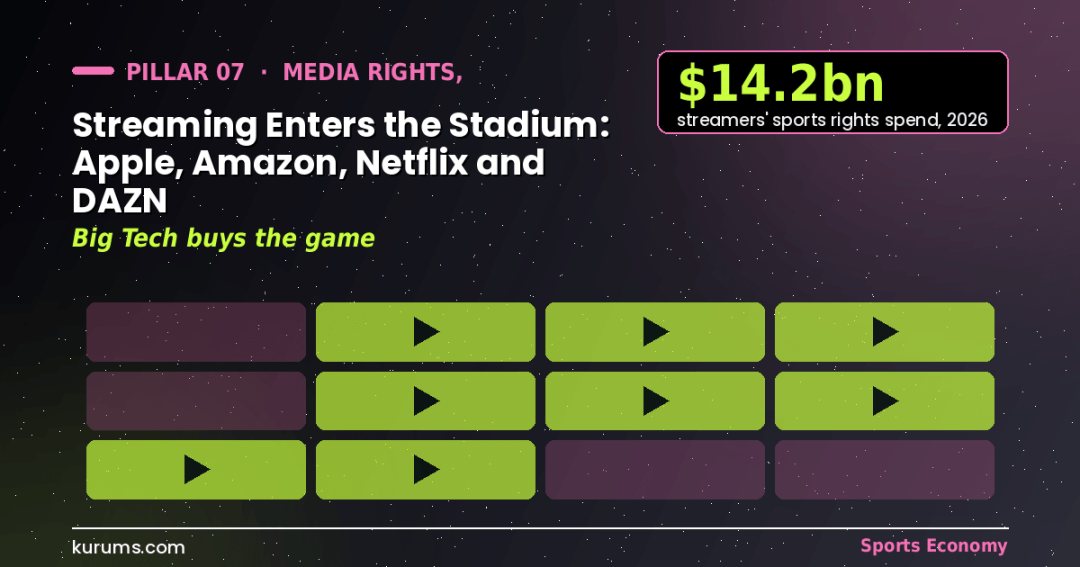
Streaming platforms will spend about $14.2 billion on sports rights in 2026 according to Ampere Analysis, roughly a fifth of the $65.8 billion global market, up from $13.2 billion in 2025. Amazon is the largest single streaming buyer at about $3.8 billion, paying $1.8 billion a year for the NBA and $1 billion for Thursday Night Football. Apple holds MLS for $250 million a year and Formula 1’s US rights from 2026; Netflix pays a reported $75 million per NFL Christmas game; DAZN spent roughly $1 billion on the 2025 Club World Cup but walked away from Ligue 1 after one season. Tech platforms pay record prices for the biggest properties and leave everything else to broadcasters.
Apple, Amazon, Netflix and DAZN have taken streaming in sport from experiment to establishment in less than five years. In 2021 no global tech company held an exclusive package from a major American league; by 2025/26 Amazon was the NBA’s third partner, Netflix broadcast the NFL on Christmas Day, Apple owned every MLS match worldwide and YouTube was the only place to buy NFL Sunday Ticket. This article explains what each platform has bought, why, where the model has failed and what it means for leagues, broadcasters and fans. It is part of the Sports Economy hub, sits alongside our guide to the NFL and NBA media deals and draws on our sizing of the global sports media rights market.
How much do streaming platforms spend on sport?
About $14.2 billion in 2026 according to Ampere Analysis, up from $13.2 billion in 2025. Amazon leads at roughly $3.8 billion, with YouTube, Paramount+ and Netflix next; generalist streamers now account for 44% of streaming sports spend, up from 31%.
Which platform has which rights?
Amazon: NBA, Thursday Night Football, Champions League in several markets. Apple: MLS worldwide, Formula 1 in the US from 2026. Netflix: NFL Christmas games, WWE Raw, the 2027 and 2031 Women’s World Cups. DAZN: Serie A, Bundesliga, Club World Cup, Japan’s J.League and Foxtel in Australia.
Does the streaming model work for leagues?
For premium properties yes: the NBA’s fee rose 2.6 times with Amazon in the mix. For mid-tier leagues the record is mixed; DAZN’s Ligue 1 deal collapsed after one season and the league’s own service earns about a third of what it was promised.
Why did Apple, Amazon, Netflix and DAZN enter sport at all?
Because live sport is the one kind of content that subscribers will not wait for, cannot easily be replaced by a competitor’s catalogue and drives the daily engagement that reduces churn. For platforms that have already signed up most of the households they can reach, sport is the most reliable tool left for keeping them.
Each platform’s motive differs. Amazon measures sport in Prime memberships and advertising: Thursday Night Football averaged 15.3 million viewers in 2025 according to Amazon Ads, and since Prime Video added advertising to its base tier in 2024, every game is an inventory of ad impressions sold to the brands that use Amazon’s retail platform. Apple treats sport as a feature of its subscription bundle: MLS Season Pass was folded into Apple TV at no extra charge in 2026, and Formula 1 follows the same model. Netflix spent years insisting it would not buy live sport, then discovered through the Paul-Tyson fight in November 2024 and the NFL’s Christmas games that live events deliver its largest simultaneous audiences and the advertising revenue it now needs. YouTube uses Sunday Ticket to anchor YouTube TV, its cable substitute.
DAZN is the exception: a sports streamer with no retail, hardware or entertainment business to subsidise its rights bills, which is why its successes and failures tell rights holders the most about whether a pure-play model can work.
What has Amazon bought, and why is it the biggest streaming buyer?
Amazon holds the NBA for $1.8 billion a season from 2025/26, Thursday Night Football for about $1 billion a season, Champions League packages in the UK, Germany and Italy, and a range of tennis, football and cricket rights in individual markets. Deadline estimates its 2026 sports spend at roughly $3.8 billion, about 27% of all streaming sports expenditure.
Amazon buys one marquee package per league rather than the whole league. In the NFL it took Thursday nights and the Black Friday game, which drew 16.3 million viewers in 2025. In the NBA it took Thursday to Saturday games plus the NBA Cup and a rotating conference final, enough to make Prime Video a weekly habit without paying Disney’s price for the Finals. In UEFA’s 2027-31 cycle it holds the Tuesday first pick in the UK and the Wednesday first pick in Germany and Italy, according to Inside World Football, giving it the best game each week in three of Europe’s five largest markets.
The economics work because Amazon counts revenue that broadcasters cannot: a Prime member who signs up for Thursday Night Football also pays for faster delivery and buys more on Amazon.com, and Prime Video advertising is one of the company’s fastest-growing revenue lines. The NBA’s rejection of Warner Bros. Discovery’s matching offer in 2024, because TNT could not replicate Amazon’s distribution, confirmed that leagues now see Prime’s reach as something no cable network can match.
What is Apple’s strategy with MLS and Formula 1?
Apple bought the global rights to every MLS match for ten years from 2023 at about $250 million a year, and in 2025 agreed a five-year deal for Formula 1 in the United States from 2026 at roughly $150 million a year, replacing ESPN’s $90 million. Both are worldwide or market-exclusive deals with no local blackouts.
The MLS deal was the first time a league had sold all of its rights, in every country, to a single streaming platform. It gave Apple a clean product with every match on the same app worldwide, and gave the league a guaranteed $2.5 billion over a decade, roughly triple its previous income. Lionel Messi’s arrival at Inter Miami in 2023, in a deal that reportedly included a share of Apple’s subscription revenue, turned the platform into a global showcase. In 2025 the two sides restructured the agreement so that from 2026 MLS is included in the standard Apple TV subscription rather than sold as a separate pass, an acknowledgement that a league-specific subscription had reached its ceiling.
Formula 1 is a different test. The sport’s US audience grew sharply after Netflix’s Drive to Survive, and Apple is paying about two-thirds more than ESPN for every race and session. If the bundle turns that audience into subscribers the model will be copied; if US viewing falls behind a paywall, Formula 1 will have traded reach for revenue in its most important growth market.
| Platform | Key sports rights (2026) | Reported annual cost | Business model behind the bid |
|---|---|---|---|
| Amazon Prime Video | NBA (2025-36), Thursday Night Football (2022-33), UEFA first picks UK/Germany/Italy (2027-31) | ~$3.8bn total; NBA $1.8bn, TNF ~$1bn | Prime membership retention, Prime Video advertising, retail cross-sell |
| Apple TV | MLS worldwide (2023-32), Formula 1 US (2026-30) | MLS ~$250m, F1 ~$150m | Apple TV subscriptions and services bundle; global single-app product |
| Netflix | NFL Christmas games (extended 2026), WWE Raw (2025-34), FIFA Women’s World Cup 2027 and 2031 (US), boxing events | NFL ~$75m per game; WWE ~$500m | Advertising tier growth, event-driven sign-ups, no season-long commitments |
| YouTube (Google) | NFL Sunday Ticket (2023-29), free global NFL game in Brazil (2025) | ~$2bn | YouTube TV subscriptions, creator ecosystem, advertising |
| DAZN | Serie A, Bundesliga (Germany), Club World Cup 2025, J.League, Foxtel/Kayo (Australia), UEL/UECL Germany from 2027 | Club World Cup ~$1bn one-off; multi-billion annual portfolio | Pure-play sports subscriptions, sublicensing, Saudi-backed investment |
| Paramount+ | Champions League UK and Germany (2027-31), UEFA in parts of Latin America, NFL on CBS simulcast | UK reportedly well above TNT’s current ~£1bn deal | Streaming subscriber growth in Europe after Skydance merger |
Sources: Ampere Analysis and Deadline via TheWrap (2026 spend); SportBusiness (NBA); Inside World Football (UEFA 2027-31 awards); The Current (MLS); ESPN (Formula 1); NBC Sports (Netflix NFL). Figures are reported values and contract averages.
How has Netflix approached live sport?
Netflix buys events rather than seasons. It pays a reported $75 million per game for NFL Christmas fixtures, about $5 billion over ten years for WWE’s weekly Raw programme from January 2025, and holds US rights to the 2027 and 2031 FIFA Women’s World Cups. It has avoided full-season league packages that would commit it to hundreds of hours a year.
The audience results have been strong. The Lions-Vikings game on Christmas Day 2025 drew 27.5 million US viewers according to Nielsen and 30.5 million worldwide by Netflix’s measure, the largest streaming audience for an NFL game to date. WWE Raw averages around 3.3 million weekly views. In 2026 Netflix extended its NFL arrangement with additional games, and Inside World Football names it among the likely bidders for UEFA’s global Champions League package from 2027.
Netflix’s model depends on the advertising tier it launched in 2022: live events are the only Netflix programming advertisers can buy against a known audience at a known time. The limit is schedule. A league season means fixed weekly dates, regional rights conflicts and production costs Netflix has so far left to broadcasters, which is why its purchases concentrate on holidays, finals and a weekly entertainment product rather than the NBA or Premier League.
What does DAZN’s record say about pure-play sports streaming?
DAZN shows both the ceiling and the floor of the model. It has built the largest sports-only streaming business in the world, spent roughly $1 billion to broadcast the 2025 Club World Cup free worldwide and bought Foxtel in Australia, but it also abandoned Ligue 1 after one season at a cost of €85 million and has reported losses in every year of its existence.
DAZN’s strongest markets are those where it holds the dominant football league: Serie A in Italy, the Bundesliga alongside Sky in Germany, LaLiga in Spain and the J.League in Japan. In 2025 it streamed the FIFA Club World Cup free in every country after a reported $1 billion investment from Saudi Arabia’s SURJ Sports Investment, and completed the acquisition of Foxtel, Australia’s largest pay-TV operator. In UEFA’s 2027-31 cycle it holds the Europa League and Conference League in Germany.
France is the counter-example. DAZN agreed in 2024 to pay roughly €400 million a season for eight of nine Ligue 1 matches per round, needed 1.5 million subscribers to break even and had about 400,000 by November 2024 according to figures reported by Soccerscene. It exited after one season. The league’s replacement, Ligue 1+, launched in August 2025 at €14.99 a month, half DAZN’s price, passed 600,000 subscribers after one matchweek and reached about 1.1 million by the end of the season; Le Monde expects it to generate roughly €150 million for clubs in 2025/26, a fraction of what DAZN had promised. DAZN now distributes Ligue 1+ as one of several partners. The French experience suggests that a sports streamer cannot charge pay-TV prices for a single domestic league in a market where piracy is widespread, a problem we quantify in what piracy costs sport.
How are traditional broadcasters responding to the streamers?
By becoming streamers themselves. ESPN launched its full direct-to-consumer service in August 2025 at $29.99 a month, NBC puts exclusive NFL and NBA games on Peacock, Paramount+ won the Champions League in the UK and Germany from 2027, and Sky, Canal+ and beIN now sell their sports channels as apps as much as through set-top boxes.
The economics are uncomfortable. US pay-TV penetration fell below 50% of households in 2025 according to MoffettNathanson, and Nielsen’s Gauge puts streaming at 47.5% of television viewing against 20.2% for cable. Broadcasters’ sports rights were underwritten by carriage fees from every cable subscriber, whether or not they watched sport; a direct-to-consumer service charges only the people who do. ESPN’s answer is to combine its app with the NFL Network and RedZone distribution it acquired in 2026, in a deal that gave the NFL a 10% stake in ESPN. Paramount’s is to use the Champions League, reportedly at a price well above TNT’s current £1 billion over four years, to establish Paramount+ in Europe.
In Europe the pattern is similar with different players. Sky Deutschland and DAZN share the Bundesliga; Sky Italia and Amazon split the Champions League; Canal+ bought all UEFA competitions in France from 2027 to defend its subscriber base; Telefónica committed €1.5 billion over four years for UEFA rights in Spain, about 14% more per season than before. In Türkiye, beIN’s Digiturk remains the Süper Lig’s sole broadcaster at just under $370 million a season, with subscribers increasingly watching through its streaming app rather than satellite.
What does streaming mean for fans, leagues and the price of sport?
For leagues, streaming has raised prices at the top and introduced new partners worldwide. For fans, it has fragmented sport across more subscriptions than ever. For the market as a whole, it has shifted roughly a fifth of global rights spending to companies that measure sport by retention and advertising rather than by ratings.
Fragmentation is now the industry’s central complaint. A US fan following the NFL needs broadcast or cable, Prime Video, Peacock, Netflix, YouTube and ESPN’s app; a German football fan needs Sky and DAZN for the Bundesliga and, from 2027, Paramount+ and Prime Video for the Champions League. PwC’s 2026 Global Sports Survey found that 58% of fans aged 18 to 24 consume sport mainly through highlights on TikTok and Instagram, and that executives expect media rights to grow only 5.4% a year, partly because of “fragmentation across viewing habits and distribution platforms”. The next phase is likely to be bundling: ESPN’s bundle with Fox One in 2025 and Apple’s folding of MLS into Apple TV both point toward fewer, larger subscriptions.
For rights holders the strategic question is simple: what is sport worth to a company that does not need it to make money directly? So far the answer has been record prices for the NFL, the NBA, the Champions League and the biggest one-off events, and flat or falling prices for almost everything else. That split, more than the identity of any single platform, is what has changed about the sports media rights market, and it is the context in which every league now decides how to sell its domestic and international rights.
Frequently Asked Questions
How much do streaming platforms spend on sports rights?
About $14.2 billion in 2026, according to Ampere Analysis figures reported by TheWrap, up from $13.2 billion in 2025 and equal to roughly a fifth of the $65.8 billion global sports rights market. Amazon is the largest streaming buyer at about $3.8 billion, followed by YouTube, Paramount+ and Netflix. Generalist streamers now account for 44% of streaming sports spend, up from 31% a year earlier.
What sports rights does Apple own?
Apple holds global rights to every Major League Soccer match from 2023 to 2032 under a deal worth about $2.5 billion, restructured in 2025 so that MLS is included in the standard Apple TV subscription from 2026. It also holds US rights to Formula 1 from 2026 to 2030 at roughly $150 million a year, replacing ESPN. Apple has so far avoided the NFL, NBA and European football.
Why did DAZN leave Ligue 1?
DAZN agreed in 2024 to pay roughly €400 million a season for most Ligue 1 matches but needed roughly 1.5 million subscribers to break even and had around 400,000 by late 2024, with piracy widely blamed. It negotiated an exit after one season, paying an €85 million termination fee. The league launched its own service, Ligue 1+, which reached about 1.1 million subscribers at €14.99 a month but earns clubs far less than the DAZN contract promised.
Will Netflix buy a full league season?
Not yet. Netflix has concentrated on events: NFL Christmas games at a reported $75 million each, WWE Raw for about $5 billion over ten years, boxing and the 2027 and 2031 Women’s World Cups in the US. It has been named as a likely bidder for UEFA’s global Champions League package from 2027, but it has avoided weekly league packages whose fixed schedules and production costs sit awkwardly with its on-demand model.