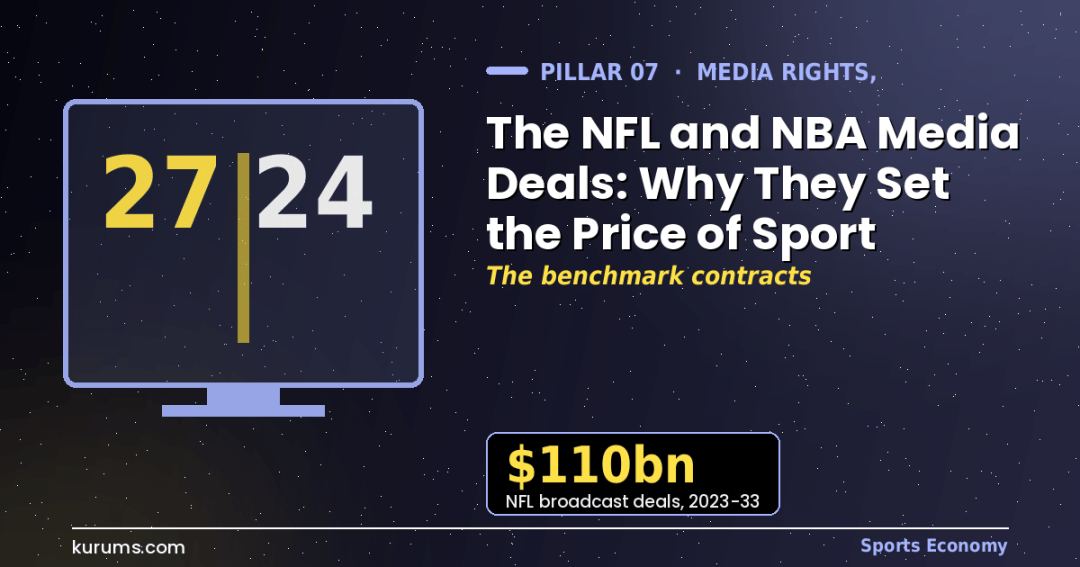
The NFL’s 2023-33 contracts with CBS, Fox, NBC and ESPN are worth about $110 billion, roughly $10 billion a season before Amazon’s $1 billion Thursday package, YouTube’s $2 billion Sunday Ticket and Netflix’s Christmas games are added. The NBA’s 2025-36 deal with Disney, NBC and Amazon is worth $76 billion, or $6.9 billion a season, up from $2.7 billion. Together they take about 30% of the $65.8 billion global rights market, and their renewals set the price of live sport everywhere.
NFL and NBA media deals are the reference prices for the entire sports industry. When the NBA nearly tripled its annual fee in 2024, every league negotiating afterwards cited it; when the NFL reopens its 2023-33 contracts, the number it extracts will reset expectations from London to Mumbai. This article explains what each league sold, who bought it, how the money flows to players and franchise values, and why deal structure matters more than headline totals. It is part of the Sports Economy hub and builds on our sizing of the global sports media rights market and our analysis of how Amazon, Apple, Netflix and DAZN entered sport.
How much do the NFL’s media deals pay?
About $110 billion over 2023-33 from the four broadcast partners, plus roughly $1 billion a year from Amazon, $2 billion a year from YouTube for Sunday Ticket and an undisclosed sum from Netflix: around $12-13 billion a season in total.
How much does the NBA’s new deal pay?
$76 billion over 11 seasons from 2025/26: Disney $2.6 billion, NBC $2.5 billion and Amazon $1.8 billion a year, against $2.7 billion a year under the previous Disney-Turner contract.
Why do these two deals set prices for everyone else?
They represent about 30% of global rights value, they are the largest line item for every US network and streamer, and the salary caps, franchise valuations and rival leagues’ tenders are all priced off them.
What did the NFL actually sell in its 2023-33 media deals?
The NFL sold its national television rights in five separate packages worth about $110 billion over eleven seasons to CBS, Fox, NBC and Disney’s ESPN/ABC, then added a Thursday night package for Amazon, Sunday Ticket for YouTube and holiday games for Netflix. The league has an opt-out after the 2029 season.
The core structure has barely changed in forty years. CBS carries the AFC Sunday afternoon package and Fox the NFC package, each paying roughly $2.1-2.2 billion a season. NBC pays about $2 billion for Sunday Night Football, consistently the most-watched programme on American television, and Disney about $2.7 billion for Monday Night Football on ESPN and ABC plus a Super Bowl rotation. The four-way split is deliberate: the league wants every major broadcaster dependent on football, so no bidder can afford to lose it at renewal.
The newer packages are where the growth is. Amazon’s Thursday Night Football, which began in 2022 at about $1 billion a season, averaged 15.3 million viewers in 2025 according to Amazon’s own figures. YouTube pays about $2 billion a season for NFL Sunday Ticket, the out-of-market subscription product, under a contract running from 2023 to 2029. Netflix signed a three-year deal in 2024 for two Christmas Day games at a reported $75 million per game, then extended it in 2026 after the Lions-Vikings Christmas 2025 game drew 27.5 million US viewers. In 2026 ESPN also took over NFL Network and RedZone distribution in exchange for the NFL receiving a 10% equity stake in ESPN, the first time a league has become a shareholder in its main broadcaster.
Add the pieces together and the NFL collects roughly $12-13 billion a season from media, against total revenue that SportsPro reports passed $23 billion in 2024, with $416 million distributed to each of the 32 clubs. Media is more than half of every club’s income before a ticket is sold.
What did the NBA sell in its 2025-36 deal, and who lost out?
The NBA sold three national packages for $76 billion over eleven seasons starting in 2025/26: Disney’s ESPN/ABC at about $2.6 billion a year, NBC and Peacock at $2.5 billion and Amazon Prime Video at $1.8 billion. Warner Bros. Discovery’s TNT, the league’s partner for 36 years, was left out.
The previous contract, signed in 2014, paid about $24 billion over nine seasons, or $2.7 billion a year, so the new deal is worth about 2.6 times as much per season. Disney kept the NBA Finals, which it insisted on as a condition of staying, plus one conference final a year and around 18 early-round playoff games. NBC returned to basketball for the first time since 2002 with Sunday nights after the NFL season, a Tuesday doubleheader, an exclusive Monday game on Peacock and the All-Star Game from 2026. Amazon took Thursday to Saturday, the NBA Cup and a conference final on rotation with NBC.
TNT’s exclusion mattered because of what it revealed about pricing. Warner Bros. Discovery tried to match Amazon’s $1.8 billion offer under its matching rights; the league rejected the match because WBD could not replicate Amazon’s streaming distribution, and WBD sued. The settlement gave WBD live rights in selected international territories and licensed Inside the NBA to ESPN and ABC. The lesson for every other league was that a streamer’s distribution can disqualify a broadcaster’s matching right.
Early audiences suggest the league got the exposure it paid for: regular-season viewing averaged about 1.78 million per game in 2025/26, up 16% according to NBA figures reported by Sports Media Watch, and the 2026 All-Star Game on NBC and Peacock drew 8.8 million.
| League / partner | Term | Annual value | What it buys |
|---|---|---|---|
| NFL – ESPN/ABC (Disney) | 2022-33 | ~$2.7bn | Monday Night Football, playoff games, Super Bowl rotation |
| NFL – Fox | 2023-33 | ~$2.2bn | NFC Sunday afternoons, Super Bowl rotation |
| NFL – CBS | 2023-33 | ~$2.1bn | AFC Sunday afternoons, Super Bowl rotation |
| NFL – NBC | 2023-33 | ~$2.0bn | Sunday Night Football, Peacock streaming |
| NFL – YouTube | 2023-29 | ~$2.0bn | Sunday Ticket out-of-market subscription |
| NFL – Amazon | 2022-33 | ~$1.0bn | Thursday Night Football, Black Friday game |
| NBA – ESPN/ABC (Disney) | 2025-36 | ~$2.6bn | NBA Finals, one conference final, ~18 playoff games |
| NBA – NBC/Peacock | 2025-36 | ~$2.5bn | Sunday and Tuesday nights, Monday on Peacock, All-Star Game |
| NBA – Amazon Prime Video | 2025-36 | ~$1.8bn | Thursday-Saturday games, NBA Cup, conference final rotation |
Sources: NFL partner values as compiled from league and network announcements; NBA values as reported by SportBusiness, July 2024. Annual values are contract averages.
Why do the NFL and NBA media deals set the price of sport?
Because they are the two largest line items in every major US media company’s budget and together account for about 30% of the $65.8 billion global rights market according to SportBusiness’s 2026 report. Every other property is priced relative to them.
The mechanism works through the buyers’ budgets. Disney, Comcast, Fox, Paramount, Amazon, Google and Netflix each decide how much to spend on sport, and the NFL and NBA absorb the largest slices; what remains funds college football, MLB, the NHL, golf, Formula 1 and European football. When the NBA took an extra $4.2 billion a year out of those budgets from 2025, the money had to come from somewhere, which is one reason ESPN let Formula 1 go to Apple for 2026-30 at about $150 million a year rather than compete.
The deals also set the benchmarks rights holders use. The WNBA’s new agreement, worth about $2.2 billion over 11 years according to Deloitte, was negotiated inside the NBA deal and inherited its partners. College conferences such as the Big Ten ($1.2 billion a year) and SEC (about $1 billion a year through 2034) price their Saturday audiences as the nearest substitute to the NFL. Even the Premier League’s US rights, held by NBC until 2028, are valued against what NBC pays for Sunday Night Football.
Finally, the two leagues define the market’s structure: the NFL invented the multi-partner model, the NBA proved a streamer can trump a broadcaster’s matching right, and both have made decade-long contracts with opt-outs and escalators the norm for premium properties.
How does the media money flow through to players and owners?
Both leagues share national media revenue equally among their clubs and then split it with players through a fixed percentage. The NFL distributes about $416 million per club a year, and players receive roughly 48% of league revenue; the NBA’s players get about 51% of basketball-related income, which drove the salary cap to $154.6 million in 2025/26 and $165 million in 2026/27.
The NFL model is the simplest in world sport. All national television money goes into a central pool divided 32 ways, so the Green Bay Packers, the only club that publishes accounts, received the same $416 million in 2024 as the Dallas Cowboys. Because the collective bargaining agreement sets the salary cap at a fixed share of revenue, the 2023 media deals flowed directly into player pay: the cap rose from $224.8 million in 2023 to $279.2 million in 2025 and around $300 million in 2026.
The NBA has the same principle but a smoothing rule. After the 2016 television deal jumped the cap 34% in one summer and distorted the market, the league and players agreed the cap could rise no more than 10% a year regardless of revenue. The 2025/26 cap therefore rose to $154.6 million, and it is projected to reach about $176 million by 2027/28 according to Hoops Rumors, with the escalator running for the full eleven years.
For owners, media deals show up as valuation. Sportico’s 2025 valuations put the average NFL franchise at roughly $7 billion and the average NBA franchise at roughly $4.5 billion, with the fastest increases following each new rights deal; our guide to franchise valuations explains the multiples. A guaranteed decade of rising media income is the closest thing in sport to a government bond.
What happens when the NFL reopens its deals?
The NFL can opt out of most contracts after the 2029 season, and commissioner Roger Goodell said in September 2026 that the league was evaluating a repackaging of its rights. Analysts widely expect negotiations to begin before 2028, with streamers bidding for packages that currently belong to broadcast networks.
The incentive is obvious. Since 2021, when the current deals were signed, Amazon has shown it will pay $1.8 billion a season for basketball, Netflix a reported $75 million per game for Christmas football and YouTube $2 billion a year for Sunday Ticket. The NFL’s broadcast partners pay about $2.2 billion each for packages delivering audiences four to five times larger than any NBA package; per viewer, the NFL is underpriced relative to the market it created.
The constraints are political and structural. The league’s antitrust exemption under the 1961 Sports Broadcasting Act comes with a long-standing commitment that every game is on free television in the teams’ home markets, so a wholesale move to streaming is not politically possible, and the Super Bowl’s record 127.7 million viewers in February 2025 according to Nielsen depend on near-universal reach. The likely outcome is therefore more packages rather than new partners: additional international games sold to streamers, more Netflix-style holiday windows, a separate package if an 18-game season is agreed, and a higher price for the existing Sunday windows.
Whatever the NFL extracts becomes the new ceiling. If annual media income rises from roughly $12.5 billion to the $15-18 billion some analysts have floated, the US share of global rights spending, already 53.9% in 2026, would rise again, and every other league would lift its asking price.
How do the NFL and NBA deals compare with the Premier League and UEFA?
The Premier League earns about £4.08 billion a season, roughly $5.2 billion, from all its rights combined, and UEFA’s club competitions pass €5 billion a year from 2027. Each is less than half the NFL’s media income and well below the NBA’s $6.9 billion, despite larger global audiences.
The gap is structural rather than a matter of popularity. The Premier League sells to a home market of 28 million television households; the NFL to 125 million. Sky and TNT’s £5 billion domestic live deal for 2025-29 is worth about $1.6 billion a season, less than NBC pays for one night a week of NFL. English football compensates with the most successful international sales operation in sport: overseas rights of £2.16 billion a year now exceed domestic rights. The NFL’s international income is a small fraction of its domestic deals, which is why it keeps adding games in London, Germany, Brazil, Spain and Australia.
UEFA’s €5 billion is an aggregate of dozens of country-by-country contracts rather than three or four national ones, and the 2027-31 cycle run through Relevent is the first to invite global streamers to bid on a pan-European basis. For a fuller comparison of these models see our article on domestic versus international rights strategy and the closed versus open league models in the Football & League Economics pillar.
What do the NFL and NBA deals mean for other leagues and investors?
For rights holders, the deals prove that long contracts, multiple partners and at least one streamer maximise fees. For investors, they show media income is the asset bought when a franchise changes hands. For fans, they mean the cost of watching keeps rising.
Leagues outside the top tier have drawn practical lessons. The Bundesliga, La Liga and Serie A have restructured their tenders into more packages with explicit streaming lots; cricket’s BCCI split the IPL’s television and digital rights in 2022 and raised $6.2 billion. Türkiye’s Süper Lig, whose domestic fee fell to about $370 million a season in 2026 because beIN was the only serious bidder, shows what happens when a league cannot attract the second and third bidders the American model depends on.
For fans, following a full NFL season now requires broadcast or cable plus Prime Video, Peacock, ESPN’s streaming service, Netflix and YouTube. That fragmentation is the direct consequence of selling to seven partners, and it is the main driver of the piracy problem we examine in what piracy costs sport. The NBA made the same trade: more money from more platforms in exchange for an audience that has to work harder to find the game.
Frequently Asked Questions
How much is the NFL’s media rights deal worth?
The 2023-33 contracts with CBS, Fox, NBC and Disney are worth about $110 billion, roughly $10 billion a season. Amazon adds about $1 billion a year for Thursday Night Football, YouTube about $2 billion for Sunday Ticket and Netflix a reported $75 million per Christmas game, taking total media income to roughly $12-13 billion a season. Most contracts can be reopened after 2029.
How much is the NBA’s new media deal worth per year?
About $6.9 billion a season, or $76 billion over eleven seasons from 2025/26 to 2035/36. Disney’s ESPN and ABC pay roughly $2.6 billion a year, NBC and Peacock about $2.5 billion and Amazon Prime Video about $1.8 billion. The previous nine-year contract with Disney and Turner was worth about $24 billion, or $2.7 billion a season, so the new deal is roughly 2.6 times larger.
Why was TNT dropped from the NBA deal?
Warner Bros. Discovery tried to match Amazon’s $1.8 billion-a-year offer under its matching rights, but the NBA ruled that TNT could not replicate Amazon’s streaming distribution. WBD sued and settled, receiving live rights in some international markets and licensing Inside the NBA to ESPN and ABC. The case established that a streamer’s reach can disqualify a broadcaster’s matching right.
How do media deals affect NFL and NBA salary caps?
Both leagues pay players a fixed share of revenue, roughly 48% in the NFL and 51% in the NBA, so new media money flows directly into the salary cap. The NFL cap rose from $224.8 million in 2023 to around $300 million in 2026. The NBA limits cap growth to 10% a year, so its cap rose to $154.6 million in 2025/26 and $165 million in 2026/27.
Discover more from Kurums | Business Intelligence
Subscribe to get the latest posts sent to your email.