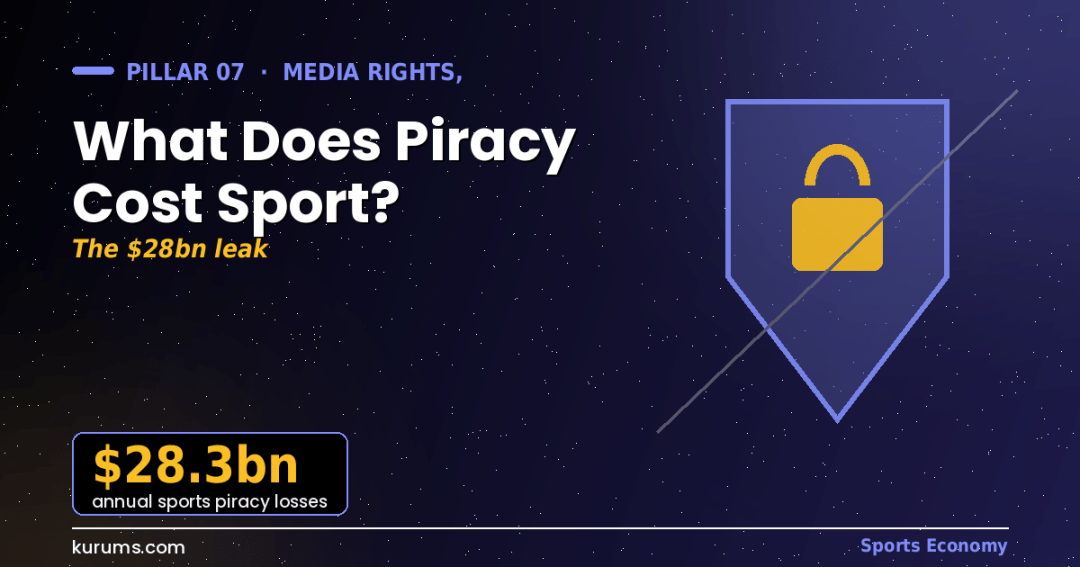
Live sports piracy costs rights holders an estimated $28.3 billion a year, a figure from Ampere Analysis research for Synamedia still used by the Alliance for Creativity and Entertainment in 2026, against a legal rights market of $65.8 billion. The largest pirate network, Streameast, logged more than 1.6 billion visits across 80 domains in the year before Egyptian authorities and ACE shut it down in September 2025; its operators were jailed in July 2026. During the 2026 World Cup, agencies seized more than 1,000 illegal sites that had drawn 156 million visits in July alone. Piracy has helped collapse two French rights deals and is the main reason mid-tier leagues struggle to sell subscriptions.
What does piracy cost sport? Enough, by 2026, to move rights prices. When DAZN walked away from Ligue 1 in 2025 after one season, it blamed piracy for its failure to reach 1.5 million French subscribers; when the Premier League, LaLiga and UEFA negotiate, every bidder discounts for the audience it expects to lose to illegal streams. This article explains how big the problem is, who bears the cost, how the pirate economy works, which enforcement tools work and what the trade-off between price, fragmentation and piracy means for the next generation of deals. It is part of the Sports Economy hub, follows our sizing of the global sports media rights market and connects to our analysis of why streaming platforms entered sport.
How much does sports piracy cost?
About $28.3 billion a year, according to Ampere Analysis research for Synamedia cited by ACE in 2026; LaLiga puts its own losses at €600-700 million a season and beIN sought $1 billion in damages over beoutQ.
Who pays for it?
Broadcasters first, through lost subscriptions; then leagues through lower bids at the next tender; then clubs and players through smaller distributions. France’s clubs have lost most of a €1 billion-a-year promise since 2020.
What works against it?
Criminal prosecution of operators (Streameast’s founders jailed in Egypt in 2026), dynamic blocking orders in nearly 60 countries, and above all legal products priced and packaged so fewer fans look elsewhere.
How much does piracy cost sport each year?
The most-cited estimate is $28.3 billion a year in lost revenue to live sports rights holders and broadcasters, from Ampere Analysis research for Synamedia still quoted by the Alliance for Creativity and Entertainment in July 2026. Individual leagues report losses from hundreds of millions to about €1 billion.
The $28.3 billion figure is an estimate of forgone revenue: the subscriptions and advertising that broadcasters would earn if pirate audiences paid for legal streams. Not every pirate viewer would buy at the current price, so the recoverable sum is lower; but the estimate also excludes second-order effects such as the discount broadcasters apply to rights bids. Against a legal rights market worth $65.8 billion in 2026 according to SportBusiness, piracy is equivalent to roughly 40% of all the money that changes hands for sports broadcasting.
League-level figures are more concrete. LaLiga has repeatedly said piracy costs Spanish football around €600-700 million a season and has fought public legal battles with Cloudflare to force faster blocking. Serie A puts its losses at roughly €300 million a year, a figure that drove Italy’s Piracy Shield system in 2024. beIN Media Group, the dominant sports broadcaster in the Middle East and Türkiye, filed a $1 billion arbitration claim against Saudi Arabia in 2018 over beoutQ, a pirate satellite service that rebroadcast its channels industrially from 2017 to 2019 and was condemned jointly by FIFA, UEFA, the Premier League, Bundesliga, LaLiga and Serie A. The Premier League told US trade officials in 2020 that illegal IPTV was still running on up to three million beoutQ boxes after the satellite feed went dark.
How does the pirate sports economy work?
Sports piracy has three layers: illegal IPTV services that resell broadcaster feeds for a few euros a month, free streaming websites funded by advertising and malware, and social-media restreams on Telegram and Discord. Each has different operators, revenue models and vulnerabilities.
Illegal IPTV is the largest by revenue. Operators buy or steal legitimate subscriptions, strip the encryption and resell thousands of channels for perhaps €10-15 a month through resellers on social media. The EU Intellectual Property Office estimated in 2019 that illegal IPTV already generated close to €1 billion a year in Europe. These services run as companies, with customer support and payment processing, and their operators are the usual targets of criminal prosecution: in the UK, Premier League investigations have led to sentences of up to eleven years for ringleaders.
Free websites are the largest by audience. Streameast, the biggest ever identified, ran 80 domains, recorded more than 1.6 billion visits in the twelve months before its September 2025 shutdown and drew traffic mainly from the United States, Canada, the UK, the Philippines and Germany, according to ACE. It carried every major European football league, UEFA’s competitions, the NFL, NBA, NHL, MLB and pay-per-view boxing. Italy’s most-visited pirate site, Calcio, ran 134 domains and 123 million visits a year before ACE and DAZN closed it the same month. These sites earn from advertising for gambling, cryptocurrency and adult services, and from malware.
The third layer, restreams on Telegram, Discord and mainstream platforms’ live-video features, is the hardest to measure. These are often run by individuals, are removed within minutes when reported, and re-emerge constantly.
| Case | Scale | Outcome | Lesson |
|---|---|---|---|
| Streameast (global, to 2025) | 80 domains; 1.6bn visits in final year; 136m visits a month | Shut down by Egyptian authorities and ACE, Sept 2025; two operators jailed for two years, July 2026 | Criminal action against operators, not just domain blocking, closes networks |
| beoutQ (Saudi Arabia, 2017-2019) | 10 satellite channels rebroadcasting beIN; up to 3m boxes | WTO ruling 2020; beIN $1bn arbitration claim; resolved with Saudi-Qatar rapprochement 2021 | State-tolerated piracy is a trade and diplomatic issue, not a legal one |
| Calcio (Italy, to 2025) | 134 domains; 123m visits a year; 80% Italian traffic | Moldova-based operator ceased after ACE and DAZN approach, Sept 2025 | Broadcaster-ACE partnerships can close sites without litigation |
| 2026 FIFA World Cup | Seized sites drew 156m visits in July 2026 alone | 1,000+ sites seized, ~2,000 domains blocked by ACE, US IPR Center and DoJ | Mega-events need pre-planned, multi-agency enforcement |
| Ligue 1 (France, 2024-25) | DAZN ~400k subscribers vs 1.5m needed; piracy cited | DAZN exited after one season (€85m fee); league launched Ligue 1+ at €14.99 | High prices in high-piracy markets fail; pricing is an anti-piracy tool |
Sources: Alliance for Creativity and Entertainment (Streameast, Calcio, World Cup 2026); WTO panel and beIN statements; Soccerscene and Inside World Football (Ligue 1).
Who actually bears the cost of sports piracy?
Broadcasters bear it first, as lost subscriptions and lower advertising yields. Leagues bear it next, because every bidder at the next tender discounts for the audience it cannot monetise. Clubs and players bear it last, through smaller central distributions, most severely in mid-sized markets where one broadcaster carries the whole league.
The French case shows the full chain. Mediapro’s €1 billion-a-year contract collapsed in 2020 partly because the company could not convert viewers into subscribers in a market where free pirate streams were ubiquitous. DAZN, paying roughly €400 million a season from 2024, reached about 400,000 subscribers against a break-even target of 1.5 million and exited after one season, with piracy cited by both the company and the league. The replacement service, Ligue 1+, halved the price to €14.99 a month and reached 1.1 million subscribers, but generates about €150 million for clubs, a fraction of what was promised five years earlier. France’s financial watchdog, the DNCG, projected combined club losses of about $2 billion for Ligue 1 and Ligue 2, driven largely by that shortfall.
In larger markets the effect is a ceiling rather than a collapse. The Premier League’s domestic live rights rose only about 4% per season in the 2025-29 cycle, after falling 8% in the previous one, and UK broadcasters argue that illegal IPTV caps what they can bid. In Türkiye, where beIN’s Süper Lig fee fell from about $500 million a season to roughly $370 million by 2025, illegal IPTV is widely cited alongside currency weakness and the limited bidder pool as a reason for the lower offers.
Finally, the cost falls on fans who pay: every subscription not sold raises the price of those that are, because broadcasters must recover fixed rights fees from a smaller base.
Which anti-piracy measures have worked?
Three things have measurably reduced piracy: criminal prosecution of operators, dynamic site-blocking orders that take down streams within minutes of kick-off, and coordinated enforcement through ACE. Watermarking helps trace leaks, but no tool works without a legal product fans are willing to buy.
Prosecution has the clearest deterrent effect. Streameast was not blocked out of existence; it was closed when Egyptian police arrested its operators in a raid coordinated with ACE in August 2025, and the July 2026 convictions, two years’ imprisonment and fines of about $110,000 each with confiscation of equipment and bank accounts, removed the people rather than the domains. In the UK, the Premier League’s private prosecutions produced sentences totalling more than 30 years for five defendants in a single 2023 case. ACE’s civil actions in the US added judgments of $9 million in June 2026 and $18.75 million in March 2026 against IPTV operators.
Blocking is the day-to-day tool. The Premier League has held dynamic blocking orders against UK internet providers since 2017, allowing it to block servers in real time during matches. Italy’s Piracy Shield, launched in February 2024, requires providers to block flagged addresses within 30 minutes, though it has been criticised for over-blocking. LaLiga has similar orders in Spain and in 2026 joined the StreamSafe alliance and signed an enforcement partnership with Canal+. ACE says judicial blocking operates in nearly 60 countries, and during the 2026 World Cup it worked with the US IPR Center and Department of Justice to seize more than 1,000 sites and block nearly 2,000 domains.
Technical defences help but are not decisive. Forensic watermarking lets broadcasters identify which subscriber’s feed is being restreamed and cut it within minutes, but it stops a leak only after it has started, and pirates rotate accounts faster than broadcasters can cut them.
Why does fragmentation make piracy worse?
Because every additional subscription needed to follow a sport raises the price and friction of watching legally. Surveys consistently find that most pirate viewers would pay for a single affordable service; what they refuse is five services at €20-30 each.
The arithmetic is unavoidable. A German football fan in 2027 will need Sky and DAZN for the Bundesliga and Paramount+ and Prime Video for the Champions League; a US fan needs cable or an antenna, Prime Video, Peacock, Netflix, YouTube TV and ESPN’s app to follow the NFL. Each platform prices as if it were the only one, so the combined cost of legal viewing can exceed €100 a month. Ampere’s research for Synamedia found that most pirate viewers also hold at least one legal subscription; they pirate the content that falls outside what they already pay for.
The leagues that take this seriously have changed their packaging. The Premier League keeps the BBC’s free highlights and sells to only two live broadcasters domestically; Ligue 1 consolidated eight of nine matches into one cheaper service; UEFA’s 2027-31 tender kept a co-exclusive free-to-air final in France, Spain and Germany and highlights on the BBC and ZDF; even the NFL insists every local-market game remains on free television. Our article on the NFL and NBA media deals explains that trade-off, and the comparison of sports OTT platforms in our Tools pillar covers the technology side of direct-to-consumer services.
How do governments and regulators treat sports piracy?
Unevenly. The UK, Italy, Spain and France have fast judicial or administrative blocking systems; the United States relies on civil litigation and criminal prosecution without a site-blocking law; and in parts of the Middle East, Asia and Latin America enforcement depends on diplomatic pressure as much as courts.
The European model is the most developed. The EU’s 2023 recommendation on live-event piracy urged member states to allow blocking injunctions that act within minutes, and Italy’s Piracy Shield is the first fully automated implementation. The UK’s dynamic orders are renewed each season; France’s regulator, Arcom, can order blocks within hours; Spain’s courts have given LaLiga broad powers it has used against Cloudflare-hosted mirrors, prompting a public dispute over proportionality.
The United States has no site-blocking statute. ACE, backed by the major studios, streamers and now sports leagues, pursues operators through civil suits, domain seizures with the Department of Justice and partnerships with foreign police, as in Egypt. The 2026 World Cup became a test case: the 1,000-plus seizures were achieved through the IPR Center’s criminal powers rather than injunctions. In the Gulf, beoutQ showed that state-tolerated piracy is resolved politically: the service ended with the 2021 Saudi-Qatar rapprochement and Saudi Arabia’s lifting of its beIN ban, reportedly linked to the Premier League’s approval of the PIF’s purchase of Newcastle United, a case we cover in the Gulf sports investment playbook.
What will piracy mean for the next generation of rights deals?
Piracy will be priced into rights fees as a measurable discount, will push leagues toward fewer and cheaper legal packages, and will make enforcement capability a condition of winning tenders. Leagues that reduce piracy will charge broadcasters more; those that ignore it will see fees fall.
Three trends are visible. First, rights holders are bundling enforcement into their sales: LaLiga’s partnership with Canal+ and the LFP’s work with DAZN treat anti-piracy as part of the product delivered to the broadcaster. Second, tenders are rewarding reach over exclusivity: the Bundesliga’s free YouTube package in the UK, DAZN’s free global Club World Cup and the co-exclusive free-to-air Champions League finals in Spain, France and Germany all reflect a judgement that a large legal free audience is worth more than a small paying one plus a large pirate one. Third, measurement is improving: analysts can now estimate pirate audiences by match, so a broadcaster can show a league exactly what it is losing and bid accordingly.
The long-term question is whether the industry will accept lower prices for broader access. PwC’s 2026 Global Sports Survey found executives expecting media rights to grow only 5.4% a year, the slowest of any major revenue stream, and named fragmentation as a cause. Piracy is the market telling rights holders that the legal product is too expensive or too scattered; the leagues that listen will keep their fees, and those that do not will follow France.
Frequently Asked Questions
How much money does sports piracy cost each year?
The most-cited estimate is $28.3 billion a year in lost revenue, from Ampere Analysis research for Synamedia that the Alliance for Creativity and Entertainment still quoted in July 2026. League-level estimates include LaLiga’s €600-700 million a season and Serie A’s roughly €300 million a year. These are forgone-revenue figures that assume pirate viewers would otherwise pay, so the recoverable amount is lower.
What was Streameast and what happened to it?
Streameast was the largest illegal live sports streaming network ever identified, running about 80 domains and attracting more than 1.6 billion visits in its final year, mostly from the US, Canada, the UK, the Philippines and Germany. Egyptian authorities, working with ACE, shut it down in September 2025, and in July 2026 an Egyptian court sentenced two operators to two years in prison with fines of about $110,000 each.
Did piracy cause DAZN to leave Ligue 1?
It was the main reason cited. DAZN paid roughly €400 million a season from 2024, needed about 1.5 million French subscribers to break even and had around 400,000 by late 2024, with both the company and the league blaming widespread illegal streaming. DAZN negotiated an exit after one season and paid an €85 million termination fee; the league’s replacement service, Ligue 1+, cut the price to €14.99 a month and reached about 1.1 million subscribers.
Does site blocking actually reduce sports piracy?
It reduces casual piracy during matches but does not close networks. The Premier League’s dynamic orders in the UK and Italy’s Piracy Shield cut access to known streams within minutes, and ACE says judicial blocking operates in nearly 60 countries. The networks that have disappeared, such as Streameast and Calcio, were closed by arrests or pressure on operators, so most rights holders now combine blocking, prosecution and cheaper legal products.