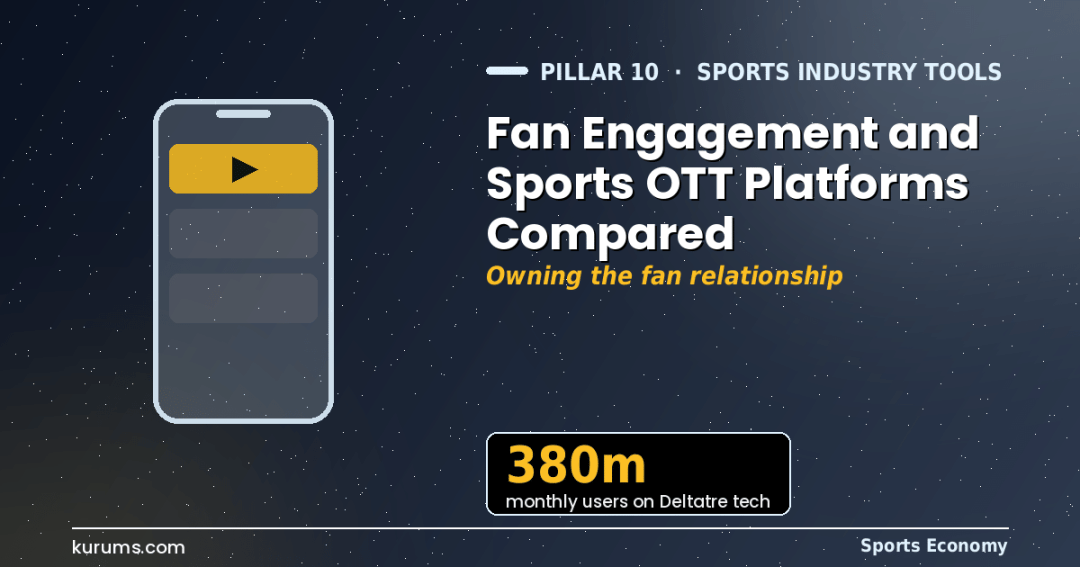
Fan engagement and OTT platforms let a rights holder sell video, membership and content directly to fans instead of through a broadcaster. Deltatre, which bought Endeavor Streaming in 2025, says its technology reaches 380 million users a month and runs 28,000 managed live events a year; Endeavor Streaming alone delivers 25,000-plus events and transacts over $200 million annually for UFC Fight Pass, WWE and WNBA League Pass. Vimeo OTT publishes the only rate card, $1 per subscriber a month plus 10 percent of one-off purchases; StreamAMG serves TennisTV, Arsenal and Inter; Greenfly distributes content to athletes for the NFL, Premier League and PSG; Socios lists 60-plus clubs on Chiliz’s fan-token chain. Everything above the entry tier is quote-priced.
Sports OTT platforms and fan engagement tools are the direct-to-consumer layer of the sports economy: the apps, streaming services and content systems through which a club or league reaches fans without a broadcaster in between. This independent comparison of seven platforms is part of the Sports Economy hub and complements our reviews of sports ticketing platforms and sponsorship measurement platforms, which cover the two revenue lines an engagement platform is meant to lift.
What is the difference between an OTT platform and a fan engagement platform?
An OTT platform streams and monetises video (Deltatre, Endeavor Streaming, StreamAMG, Vimeo OTT). A fan engagement platform drives interaction and data (Greenfly for athlete content, Socios for fan tokens). DAZN is a broadcaster that also sells its platform to rights holders.
What does it cost?
Vimeo OTT Starter is $1 per subscriber per month plus 10 percent of one-off purchases and card fees. Enterprise platforms charge a build fee, an annual licence and often a revenue share; a club service typically costs from the low hundreds of thousands of dollars a year, a league service millions.
What decides success?
Rights, not technology. A platform can only stream what the rights holder is allowed to show, so the biggest services, UFC Fight Pass, WWE, Ligue 1+ and NFL Game Pass, belong to owners who kept or reclaimed their rights.
What do sports OTT platforms and fan engagement tools actually do?
An OTT platform ingests live and recorded video, delivers it to web, mobile and connected-TV apps, handles subscriptions, pay-per-view and advertising, and reports who watched. A fan engagement platform distributes content, runs memberships and builds a first-party fan database.
The two categories are converging. A club that launches a streaming service wants the subscriber database to drive ticket, merchandise and sponsorship sales, and a club that runs a membership app wants video inside it. Vendors therefore sell suites: Deltatre offers OTT, digital, hybrid and data and graphics products under one roof; StreamAMG pairs its BLAZE OTT product with growth and affiliate marketing services; Greenfly measures earned media value and sponsorship proof-of-performance from the content it distributes.
The economic logic is control of the fan relationship. When a league sells rights to a broadcaster, the broadcaster owns the viewer data and the customer; when it streams directly, it keeps the data, the pricing and the upside, and carries the cost and the risk. The arithmetic works for intense, global or under-served audiences, which is why combat sports, tennis, rugby and women’s leagues were early adopters, and why DAZN’s October 2026 deals to stream Super League Basketball and Portuguese basketball free worldwide are as much about data as rights fees.
Türkiye shows the mixed model: the Süper Lig’s rights sit with beIN Sports, but Galatasaray and Fenerbahçe run their own membership apps and club channels carrying training footage, interviews and youth matches, exactly the content an engagement platform exists to monetise.
Who are the main vendors, and how did they get here?
Deltatre became the largest sports OTT vendor by acquiring Endeavor Streaming in 2025, adding UFC Fight Pass, WWE Network and WNBA League Pass to a client list that already included the NFL, NHL, MLS, Euroleague, Juventus and Ligue 1+. StreamAMG, Vimeo OTT and a group of specialists serve the tiers below.
Deltatre’s own figures describe the scale: 40 years of operation, 380 million end users a month and 28,000 fully managed live events a year. Endeavor Streaming, built inside the WME-IMG group before its sale, adds 25,000-plus live events, more than $200 million transacted annually and over 3,000 app-store submissions a year, with SPURSPlay, UEFA.tv and RugbyPass TV among its clients.
StreamAMG, based in London, Manchester and Malta, has spent 20 years serving clubs and federations that need a branded service without a league-scale budget. Its logo wall includes ATP Media’s TennisTV, the WTA, Matchroom, the Canadian Elite Basketball League, Inter Milan and Arsenal, and recent announcements cover a streaming service for Shrewsbury Town. Its product, BLAZE, is pitched as fast to market and cost-effective, the language of a vendor selling to commercial directors rather than technology chiefs.
Below that, Vimeo OTT is the self-serve option: a web-only Starter tier at $1 per subscriber a month plus 10 percent of one-time purchases, and an Enterprise tier with branded apps on iOS, Android, Apple TV, Roku, Fire TV and smart TVs, live events, advertising and DRM at a quoted price. Greenfly and Socios are not OTT vendors but occupy the engagement side: Greenfly distributes photos and clips to athletes and partners within seconds of the whistle for the NFL, NHL, MLB, Bundesliga, Premier League and PSG; Socios sells fan tokens for 60-plus clubs including Manchester City, PSG, Juventus and Arsenal on the Chiliz blockchain, which claims 70-plus official tokens and over 2 million token wallets.
How do the seven main platforms compare?
The table compares Deltatre, Endeavor Streaming, StreamAMG, Vimeo OTT, Greenfly, Socios and DAZN on fit, pricing model, standout feature and weakness. Pricing checked October 2026; only Vimeo publishes a rate card.
| Product | Best for | Pricing model | Standout feature | Weakness |
|---|---|---|---|---|
| Deltatre | Leagues, federations and broadcasters running flagship services at scale | Build fee plus annual licence and managed services, quoted; multi-year | 380m monthly users, 28,000 managed live events; NFL, NHL, MLS, Euroleague, Ligue 1+ | Cost and complexity beyond most clubs |
| Endeavor Streaming (Deltatre) | Pay-per-view and subscription services with heavy event volume | Licence plus transaction share, quoted | 25,000-plus events and $200m-plus transacted a year; UFC Fight Pass, WWE, WNBA League Pass | Integration with Deltatre’s stack still in progress after 2025 deal |
| StreamAMG | Clubs, tours and federations wanting a branded OTT service quickly | Setup plus annual licence; growth and affiliate services billed separately, quoted | BLAZE end-to-end OTT; TennisTV, WTA, Matchroom, Arsenal, Inter | No published scale figures; UK-centric footprint |
| Vimeo OTT | Small clubs, academies and niche sports starting a paid video service | Starter: $1 per subscriber/month plus 10% of one-off purchases, web only; Enterprise quoted | Self-serve launch in days; 100 currencies; apps and live on Enterprise | Starter is pre-recorded and web only; no sports-specific features |
| Greenfly | Leagues and clubs distributing content to athletes, partners and sponsors | Annual licence by organisation, quoted | Seconds from capture to athlete post; earned media value per asset; NFL, Premier League, PSG | Not a streaming or membership product |
| Socios (Chiliz) | Clubs wanting a paid global fan membership with voting and rewards | Club receives share of token sale proceeds and trading; free to register for fans | 60-plus clubs in one app; 2m-plus token wallets; MiCA-registered whitepaper | Token prices volatile; reputational and regulatory exposure |
| DAZN | Rights holders wanting global distribution without building a service | Rights fee or revenue share; free-to-view and subscription models | Global reach plus production; 2026 deals with Super League Basketball, EPCR, BASKET.TV acquisition | Rights holder gives up the direct customer relationship and much of the data |
What does a direct-to-consumer service really cost?
At entry level, Vimeo OTT’s $1 per subscriber a month plus 10 percent of purchases and card fees means a 5,000-subscriber club service costs about $60,000 a year in platform fees before content. Enterprise platforms charge a build fee, an annual licence and often a revenue share, so a club service runs from the low hundreds of thousands of dollars and a league service into the millions.
Platform fees are the smaller part; production is the larger. A club streaming reserve and youth matches needs cameras, commentary and an operator for each fixture, and a league service needs broadcast-grade production. Deltatre’s 28,000 managed live events a year is a production figure as much as a technology one, and StreamAMG’s development days and growth marketing are how the vendor charges for work beyond the software.
Revenue depends on rights and pricing. A service with exclusive live matches can charge a subscription comparable to a broadcaster; one with only behind-the-scenes content is a membership add-on priced in single digits a month. Endeavor Streaming’s $200 million-plus of annual transactions shows what exclusive live rights can produce; most club services are far smaller and justify themselves through fan data and sponsorship inventory. For the broadcaster side of the calculation, see our analysis of how Apple, Amazon, Netflix and DAZN entered the stadium.
Fan tokens follow a different economics. Socios sells tokens giving holders votes on minor club decisions and access to rewards; the club takes a share of the initial sale and trading, which for the largest clubs ran into eight figures during the 2021 boom. Chiliz’s September 2026 burn report records 7.4 million CHZ burned in the month, worth roughly $123,000, a measure of how far values have fallen since. The model survives as a global membership product for clubs with large overseas fan bases; our review of what survived of fan tokens and NFTs covers the lessons.
Which platform fits which organisation?
Leagues and federations with live rights use Deltatre or Endeavor Streaming; clubs and tours use StreamAMG; small clubs and niche sports start on Vimeo OTT; any rights holder with athletes to activate adds Greenfly; clubs with large overseas fan bases consider Socios; rights holders that would rather not build choose DAZN or another broadcaster.
The size of the live-rights portfolio is the first filter. A property streaming hundreds of live events a year with pay-per-view and multi-territory pricing needs the transaction and app-store machinery that Endeavor Streaming built for UFC Fight Pass, which runs 3,000-plus app submissions a year across platforms. A federation or tour with a focused schedule, such as TennisTV or Matchroom’s boxing, fits StreamAMG’s BLAZE. A club with mostly non-live content can begin on Vimeo OTT Enterprise with branded apps, or on Starter if a web player is enough.
The second filter is what the organisation wants from the data. Greenfly’s value is that athlete posts reach more fans than club accounts, and it tracks earned media value per asset for sponsorship reporting. Socios is bought by commercial teams seeking a membership product and revenue from international fans. DAZN is chosen when the rights holder values reach and a guaranteed fee over owning the relationship, the trade-off behind its free-to-view basketball and rugby deals in 2026 and its acquisition of BASKET.TV.
Women’s and emerging leagues are the clearest growth segment: WNBA League Pass runs on Endeavor Streaming, the NWSL and WSL are Deltatre clients, and DAZN’s free global streaming of Super League Basketball bets that audience data and advertising can replace rights fees for under-served properties.
Who owns the fan data and the app?
On a white-label platform the rights holder owns the subscriber data and the brand, and the vendor owns the technology; on a broadcaster deal the broadcaster owns both. Contracts should specify data export, app-store account ownership and what happens to subscribers if the vendor is acquired.
Vendor consolidation makes the last point concrete: Deltatre’s 2025 acquisition of Endeavor Streaming put two of the largest sports OTT stacks under one owner, and clients of either now depend on an integration roadmap they did not choose. The app-store account is an overlooked asset: if the vendor publishes the club’s app under its own developer account, the subscriber relationship with Apple and Google belongs to the vendor, and migration means asking every fan to re-subscribe.
Fan tokens add regulatory exposure. Chiliz notified the Malta Financial Services Authority of a revised whitepaper in October 2025 and lists its CHZ whitepaper in the European Securities and Markets Authority register under MiCA, so the asset is now a regulated crypto-asset in the European Union. A club selling tokens is marketing a regulated product to its supporters and should treat the compliance obligations as its own.
How is AI changing fan engagement?
AI is automating three things: clipping and tagging live video so highlights reach athletes and social accounts within seconds, personalising what each subscriber sees and recommending prices, and generating the commentary, subtitles and localised versions that make a service viable in more markets.
Greenfly’s pitch rests on the first: a median upload-to-delivery time it describes as ten times faster than the industry average, so a goal is on a player’s feed before the replay ends. The second is where OTT platforms compete with consumer streaming giants, and where subscriber analytics are becoming the main differentiator.
The third lowers the barrier for smaller properties. Automated subtitles and synthetic commentary let a federation stream to markets it could never afford to produce for, one reason DAZN can offer Portuguese basketball worldwide. The constraint, as throughout this category, is rights rather than technology.
How we compared
We weighted five criteria for a club, league or federation buyer: cost and pricing transparency (20 percent), live and transaction capability (20 percent), data and app ownership (25 percent), track record with comparable properties (20 percent) and fan-facing experience (15 percent). Evidence came from vendor product and pricing pages checked in October 2026, vendor scale claims reported as stated, DAZN Group’s 2026 announcements and Chiliz’s published regulatory filings. We did not test the software and accepted nothing from any vendor.
Frequently Asked Questions
Can a small club launch its own streaming service?
Yes, cheaply, if it starts with content it owns. Vimeo OTT’s Starter tier costs $1 per subscriber a month plus 10 percent of one-off purchases and card fees, with no setup charge, and supports subscriptions and pay-per-view for pre-recorded video on the web. Live streaming, branded apps and connected TV require the Enterprise tier or a sports specialist such as StreamAMG. The constraint is usually the league’s broadcast contract, which decides whether first-team matches can be shown.
What happened to Endeavor Streaming?
Deltatre acquired Endeavor Streaming in 2025, combining the technology behind UFC Fight Pass, WWE Network and WNBA League Pass with Deltatre’s own OTT, digital and data businesses, whose clients include the NFL, NHL, MLS, Euroleague and Ligue 1+. Endeavor Streaming still operates under its name and reports 25,000-plus live events and over $200 million transacted a year. Existing clients should ask about the integration roadmap and confirm their data and app-store ownership terms.
Are fan tokens still worth launching?
For a few clubs. Socios lists 60-plus teams and Chiliz claims over 2 million token wallets, but token values and trading volumes are far below the 2021 peak, and the EU’s MiCA regime now treats them as regulated crypto-assets. Clubs with large international fan bases, such as PSG, Barcelona or Manchester City, can still earn from token sales and use them as a global membership; a club with a mostly domestic audience will usually do better with a conventional paid membership inside its own app.
Is it better to sell to DAZN than to build a service?
It depends on what the rights holder values. Selling to DAZN or another broadcaster brings a fee or revenue share, global distribution and production without capital cost, at the price of the customer relationship and most of the data. Building on Deltatre, StreamAMG or Vimeo keeps the data and the upside but carries production cost and subscriber risk. Many properties do both: a broadcaster for live rights and an owned platform for archive, youth, women’s and behind-the-scenes content.
Discover more from Kurums | Business Intelligence
Subscribe to get the latest posts sent to your email.