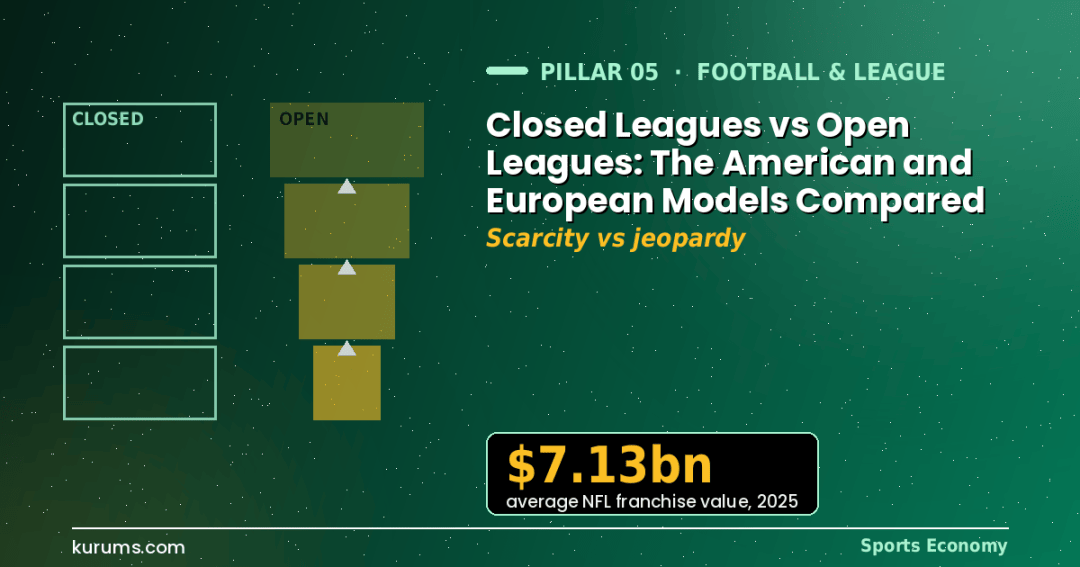
American closed leagues and European open leagues are two different businesses that happen to involve the same games. The NFL’s 32 franchises earn more than $23bn a year, share national media money equally, cap wages and are worth an average of $7.13bn each according to Sportico’s 2025 valuations. Europe’s “big five” football leagues earn €21.6bn between 98 clubs, distribute money by merit, impose no hard cap and expose every member to relegation: the 2026 Championship play-off final was worth roughly £200m to Hull City, and three Premier League clubs lost that income in the same month. Closed leagues sell scarcity, which is why San Diego FC paid $500m to join MLS in 2023; open leagues sell jeopardy, which is why 380 Premier League matches a season are worth £1.7bn to domestic broadcasters. The CJEU’s December 2023 Super League ruling and the USL’s 2025 vote to adopt promotion and relegation show that both sides are now borrowing from each other.
Closed leagues vs open leagues is the most consequential design choice in sports economics. It determines who may enter a competition, how revenue is shared, whether wages are capped, how much a team is worth and who bears the risk when it fails. The American model (fixed membership, drafts, salary caps, equal revenue sharing) and the European model (promotion and relegation, merit-based distribution, open labour markets) have evolved from different legal and cultural roots, and each has begun to copy the other. This article compares them on revenue, valuations, competitive balance, risk and law, with examples from the NFL, MLS, the Premier League, UEFA and the leagues in between. It belongs to the Sports Economy hub and extends our analysis of Premier League economics and revenue distribution, which is the open model’s most successful case.
What is the difference between a closed and an open league?
A closed league has fixed membership: teams join by paying an entry fee and cannot be relegated. An open league links tiers through promotion and relegation, so membership is earned and lost on the pitch each season.
Which model makes more money?
Per team, the closed model: the NFL’s 32 franchises share more than $23bn and average $7.13bn in value. In aggregate, open football: Europe’s top divisions generated more than €40bn in 2024/25 across more than 700 clubs, according to Deloitte and UEFA.
Which is more competitive?
Closed leagues produce more champions over time through drafts and caps; open leagues produce more meaningful matches because the bottom of the table matters. Neither delivers both.
How do closed leagues vs open leagues differ in structure?
A closed league is a joint venture among a fixed set of owners who admit new members by vote and entry fee and cannot be demoted. An open league is one tier of a pyramid in which the worst teams drop a division and the best teams of the division below replace them.
The closed model dates from 19th-century baseball, when the National League restricted membership and expelled clubs to protect territorial monopolies, and was cemented by the US Supreme Court’s 1922 ruling in Federal Baseball Club v. National League, which exempted baseball from antitrust law. The NFL, NBA and NHL followed the template: a single commissioner, a collective bargaining agreement with a players’ union, a draft that assigns the best new players to the worst teams, a salary cap and floor derived from league revenue, and equal sharing of national media money regardless of results. Australia, Canada, Singapore and the Philippines use variants of the same structure.
The open model dates from English football’s decision in 1898 to link the First and Second Divisions by automatic promotion and relegation, and it was exported with the game. Today the English pyramid runs through more than 20 tiers, with 92 professional clubs in the top four. Most of Europe, South America, Africa and Asia follows the same logic, and UEFA’s club competitions sit on top of it as a further tier that clubs qualify for by domestic position. There are hybrids: Belgium’s Pro League and rugby league’s Super League have used licensing and grading systems that mix sporting results with financial and stadium criteria, and Argentina’s “promedios” relegate on a three-season average rather than a single year.
The distinction matters because it determines what a club is. In a closed league, a franchise is a permanent share in a cartel’s future revenue; in an open league, a club is a going concern whose tier, and therefore most of its revenue, is reassessed every May.
How do the two models share revenue?
Closed leagues share national revenue equally and cap wages at a fixed share of it; open leagues share central revenue by formula weighted towards merit and leave wages uncapped. The NFL’s cap was $255.4m per team in 2024; the Premier League’s central payments in 2024/25 ranged from £109m to £175m with no cap at all.
In the NFL, roughly 48% of league revenue is allocated to players under the collective bargaining agreement, divided equally among 32 teams to set the cap, with a floor of 90% of the cap to prevent owners under-spending. Each team received about $255m from the national television contracts as early as 2019, and the current deals (ESPN/ABC around $2.7bn a year, CBS, Fox and NBC each above $2bn, Amazon around $1bn) run to 2033. Because every team has the same income and the same wage limit, the only ways to outspend a rival are stadium revenue and better management. MLS goes further: it is a single entity in which the league itself holds all player contracts and each club is an investor-operator holding shares in the league company, with a salary budget and limited “designated player” exceptions.
The Premier League, the most egalitarian of the open leagues, splits domestic broadcast money 50% equally, 25% by finishing position and 25% by live appearances, and allocates growth in international rights by merit; the resulting top-to-bottom ratio of about 1.6 to 1 is flat by European standards but still rewards success. LaLiga’s ratio is nearer 3.5 to 1, and UEFA’s Champions League distribution adds a further layer of merit money: each league-phase participant received €18.62m from 2024/25, plus €2.1m per win and ranking bonuses up to €9.9m, with the champion collecting a maximum single payment of €25m. The clubs that reach the Champions League every year therefore compound their advantage, which is why Europe’s open leagues have become less open at the top even as they remain open at the bottom.
| Feature | NFL (closed) | MLS (closed, single entity) | Premier League (open) | UEFA Champions League (open, qualified) |
|---|---|---|---|---|
| Members | 32 fixed | 30 in 2026, by expansion fee | 20; 3 relegated, 3 promoted each year | 36 in league phase, re-qualified annually |
| Entry cost | Buy a franchise: avg value $7.13bn (Sportico 2025) | $500m expansion fee (San Diego, 2023) | Win promotion: play-off final worth roughly £200m (2026) | Finish top 4–5 domestically |
| Revenue sharing | National media shared equally | Central Apple deal ($2.5bn / 10 years) shared | 50% equal, 25% merit, 25% facility; top:bottom 1.6:1 | €18.62m base + €2.1m per win + ranking and value pillars |
| Wage control | Hard cap ($255.4m, 2024) and 90% floor | Salary budget with designated-player exceptions | Squad cost ratio 85% of revenue from 2026/27 | Squad cost ratio 70% of revenue |
| Talent allocation | Draft, worst team picks first | Draft plus allocation money | Open transfer market, fees to selling club | Open transfer market |
| Downside for failure | Better draft pick | None structural | Relegation: central income falls by roughly half | Loss of €50m–€150m of UEFA income |
Sources: Sportico (2025 NFL valuations), MLS and USL public announcements, Premier League handbook and 2024/25 central payments, UEFA distribution figures from 2024/25, EFL play-off final estimates (2025, 2026).
Why are closed-league franchises worth so much more?
Because scarcity and predictability are what investors pay for. An NFL franchise has guaranteed membership, an equal share of a media contract running to 2033 and a wage bill fixed by formula; its cash flow can be modelled a decade ahead. A football club’s tier, European income and wage bill are all uncertain every year.
Sportico’s 2025 valuations put the average NFL team at $7.13bn and the 32 teams together at $228bn, with the Dallas Cowboys at $12.8bn. Forbes’ May 2026 football list put Real Madrid, the most valuable club in the world, at $9.5bn and the top 30 clubs at roughly $87bn combined, less than 40% of the NFL’s total despite football’s far larger global audience. The multiple tells the story: NFL franchises trade at 10–12 times revenue, elite football clubs at 6–8 times and ordinary European clubs at 1–2 times, as our article on club valuations and multi-club ownership explains.
MLS is the clearest demonstration that structure, not sporting quality, sets the price. Its clubs’ revenues would not reach the Deloitte Money League’s top 40, yet Forbes lists seven MLS clubs among the world’s 30 most valuable, led by Inter Miami at $1.35bn and LAFC at $1.32bn. Expansion fees have risen from $10m for Toronto in 2007 to $100m for New York City FC in 2015, $150m for Cincinnati and Nashville, a reported $325m for Charlotte and $500m for San Diego FC in 2023. Buyers are paying for a permanent seat at a 30-team table in the world’s largest consumer market, a central Apple TV contract worth $2.5bn over ten years and the knowledge that no bad season can remove them. A Championship owner who spends the same $500m has bought a lottery ticket.
Which model produces better competition?
Closed leagues produce more different champions and closer regular seasons, because the draft and cap pull talent towards weak teams. Open leagues produce more meaningful matches, because relegation makes the bottom of the table as consequential as the top. Evidence from the 2020s suggests relegation alone does not deliver parity.
The NFL has had at least 13 different Super Bowl winners this century; the Premier League has had seven champions in 34 seasons and Bayern Munich won eleven consecutive Bundesliga titles to 2023. The economics are not mysterious. A hard cap prevents the richest owner from converting money into wins beyond a point, while the reverse draft order gives the worst team the best new player. In open leagues, the Champions League’s merit payments and the open transfer market concentrate both money and talent. Deloitte’s 2026 Annual Review notes that Real Madrid and Barcelona take 52% of LaLiga’s club revenue and that Juventus, Inter and Milan take 45% of Serie A’s.
What open leagues do better is engagement across the whole table. Broadcasters value the Premier League’s 380-match season at roughly £1.7bn a year domestically partly because a match between 17th and 18th in April carries a £100m-plus swing. Wikipedia’s summary of the research notes that, in the 2020s, association football leagues brought in only about twice the NFL’s annual revenue despite roughly eight times the fans, and attributes part of that gap to predictable blowouts in uncapped leagues, which is one reason EuroLeague basketball adopted mandatory salary bands in September 2024. The honest answer is that each model optimises a different quantity: the closed league maximises the probability that any given team wins something eventually; the open league maximises the number of games that matter.
How does risk differ for owners, players and lenders?
In a closed league the owner’s downside is a bad season and a lower attendance; in an open league it is relegation, which removes most central income within weeks. Players in closed leagues trade free movement for guaranteed cap share; players in open leagues enjoy a global market but no collective share of revenue.
The Championship illustrates the owner’s problem. Deloitte’s 2026 review found its 24 clubs spent a record £903m on wages against £942m of revenue, a 96% ratio, lost £355m before tax and have accumulated £4.5bn of losses over 20 seasons. Owners spend because the prize is the Premier League: the 2025 play-off final, won by Sunderland, was described as worth at least £220m to the winner, and the 2026 final, won 1–0 by Hull City over Middlesbrough with a 95th-minute goal, roughly £200m. The gamble is rational for each owner and ruinous for the division as a whole, which is why England created an Independent Football Regulator in 2025 and why the Premier League and EFL are negotiating a new distribution deal under its supervision. No equivalent regulator exists in American sport because the cartel regulates itself.
Lenders price the difference. An NFL team can borrow against a fixed share of a $110bn media contract; a Premier League club borrows against receivables that may evaporate, which is why English club debt (£3.6bn net across the Premier League in 2024/25) is dominated by owner loans and stadium mortgages rather than corporate bonds. Our article on club debt, bonds and stadium loans explains who lends to sport and at what price. Players, meanwhile, get a fixed 48% of NFL revenue through collective bargaining, while European footballers get whatever the transfer and wage market pays; the two labour models are the subject of our explanation of how the transfer market works as an economy.
What did the Super League case decide about closed leagues in Europe?
On 21 December 2023 the Court of Justice of the EU ruled that FIFA’s and UEFA’s rules requiring prior approval of rival competitions, and the sanctions threatened against clubs that joined one, were arbitrary and conflicted with EU competition law. It did not endorse the Super League itself, and the project has since collapsed.
The original Super League, announced on 18 April 2021 by twelve clubs from England, Italy and Spain with JP Morgan financing of several billion euros, was a closed league in the American sense: founding members would have had permanent places and a guaranteed share of revenue. It fell apart within 72 hours under pressure from fans, players, governments and the remaining clubs. A22 Sports Management, its promoter, relaunched the idea as a multi-division “Unify League” with promotion and relegation in December 2024, precisely because the court had made clear that a closed structure would be hard to defend on sporting-merit grounds. Barcelona then withdrew, and in February 2026 Real Madrid, the last founding club still attached, also withdrew.
The legal lesson is that European law treats sporting merit, which is to say openness, as a legitimate objective that governing bodies may protect, provided they do so with transparent, non-discriminatory criteria. The same reasoning underpins the challenges to UEFA’s financial rules discussed in our guide to Financial Fair Play and squad cost control. In the United States, by contrast, antitrust exemptions and union agreements make closed leagues legally secure. The USL’s March 2025 vote to adopt promotion and relegation across its professional tiers, and its plan for a Division One league from 2027 or 2028 separate from MLS, is therefore a commercial experiment rather than a legal necessity, and one that MLS, with $500m entry fees to protect, has no reason to join.
Are the two league models converging?
Yes, from both directions. European leagues are adopting cost controls, centralised commercial deals and private-equity capital that resemble American practice, while American soccer is experimenting with promotion and relegation and American investors now own or co-own a majority of Premier League clubs.
The European move is towards cost control. UEFA’s squad cost ratio (70% from 2025/26) and the Premier League’s 85% rule from 2026/27 are percentage caps rather than hard caps, but they serve the same purpose, and the Premier League’s rejected “anchoring” proposal was an explicit attempt at an NFL-style ceiling tied to the bottom club’s income. Leagues are also centralising: LaLiga and Ligue 1 sold stakes in their commercial businesses to CVC Capital Partners, and the Bundesliga adopted its own squad cost rule in March 2026. American owners, from Fenway Sports Group and the Kroenkes to Clearlake and the Friedkins, bring franchise-style thinking on stadiums, pricing and cost discipline; PitchBook found that nearly 40% of big-five league clubs had US capital at ownership level by 2025.
The American move is towards openness, slowly. MLS has adopted European-style academies, a global transfer strategy and a central streaming deal, and the Leagues Cup links it to Mexico’s Liga MX. The USL’s promotion-and-relegation vote is the first time a US professional league has committed to the open model. Elsewhere, hybrids are spreading: rugby league’s Super League used IMG grading criteria to expand to 14 clubs in 2026, mixing sporting results with financial and stadium scores, and the Saudi Pro League, Türkiye’s Süper Lig and the Indian Super League each combine open structures with heavy state or conglomerate ownership. Galatasaray and Fenerbahçe, for instance, face relegation in theory but have never been relegated in practice, and their revenues depend on Champions League qualification in a way that resembles the American franchise’s dependence on playoff revenue more than it resembles a mid-table English club. The models are converging on a middle ground: open at the bottom, nearly closed at the top, and regulated by cost ratios in between.
Frequently Asked Questions
Why do American sports leagues not have promotion and relegation?
Because they were built as cartels of franchise owners rather than as tiers of a pyramid. Baseball’s National League restricted membership in the 1870s, the Supreme Court’s 1922 Federal Baseball ruling exempted the sport from antitrust law, and the NFL, NBA and NHL copied the model. Fixed membership protects the value of each franchise, allows equal revenue sharing and a salary cap, and gives new entrants a reason to pay fees such as San Diego FC’s $500m to join MLS in 2023.
How much is promotion to the Premier League worth?
Estimates for the Championship play-off final, often called the richest game in football, were at least £220m for Sunderland in 2025 and around £200m for Hull City in 2026, combining one season of Premier League central payments (£109m–£175m in 2024/25), higher matchday and commercial income, and parachute payments if the club is relegated again. The figure is revocable: three clubs lose that income every May.
Did the European Super League ruling allow closed leagues in Europe?
Not directly. The CJEU’s judgment of 21 December 2023 held that FIFA’s and UEFA’s rules for approving rival competitions, and the threatened sanctions, were arbitrary and breached EU competition law. It also recognised that governing bodies may protect sporting merit with transparent criteria. A22 responded by proposing an open, multi-division “Unify League” rather than a closed one, and by February 2026 every founding club, including Real Madrid, had withdrawn from the project.
Is the USL really introducing promotion and relegation?
In February 2025 the United Soccer League announced plans for a Division One league, separate from MLS and subject to US Soccer approval, to launch in 2027 or 2028 under the name USL Premier. In March 2025 its club owners voted to adopt promotion and relegation across all its professional tiers. No start date for relegation had been fixed by October 2026, and MLS, which charges $500m expansion fees, has no plan to join the system.