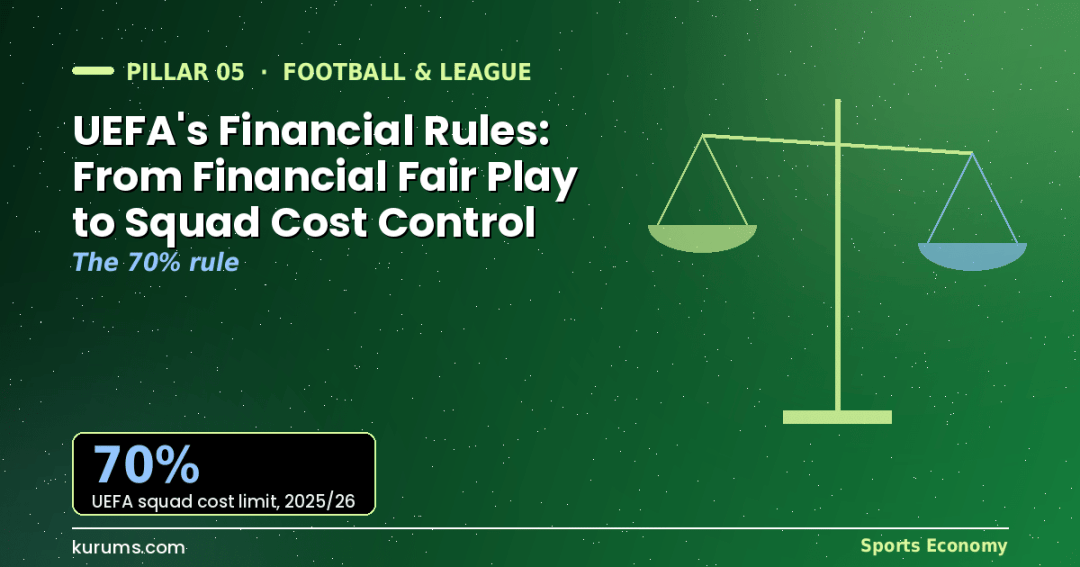
UEFA replaced Financial Fair Play in 2022 with Financial Sustainability Regulations built on three tests: solvency (no overdue payables), stability (football earnings losses capped at €60m over three years, or €90m for clubs in good financial health) and cost control (a squad cost ratio that fell from 90% in 2023/24 to 80% in 2024/25 and 70% from 2025/26). The rules bite: in July 2026 UEFA’s Club Financial Control Body fined 14 clubs, including Aston Villa (€22.5m, of which €15m conditional, plus a registration restriction), Newcastle (€13m across two rules with a three-year settlement), Chelsea (€3m) and Nottingham Forest (€2.5m). The Premier League’s own replacement for PSR, voted through in November 2025, uses a looser 85% ratio from 2026/27, and UEFA’s 2026 finance report says European clubs will reach operating break-even in 2025 for the first time in four years.
UEFA’s financial rules decide which of Europe’s 700-plus top-division clubs may spend what, and they have been rewritten twice in fifteen years. The first version, Financial Fair Play (FFP), asked whether a club lost more than it was allowed to; the current version asks that question and two more: whether it pays its bills on time, and whether its wages, transfer amortisation and agent fees exceed a fixed share of revenue. This article explains the three pillars, the sanctions ladder, the cases that have tested it, how national rules in England, Spain, Germany and France differ, and what the shift to cost control means for clubs and investors. It belongs to the Sports Economy hub and builds on our explanation of how the transfer market works as an economy, since amortisation is the mechanism most of these rules are designed to police.
What replaced Financial Fair Play?
UEFA’s Financial Sustainability Regulations, approved in April 2022 and phased in from 2022/23. Three pillars: solvency, stability (football earnings) and cost control (the squad cost ratio, now 70%).
What does the squad cost ratio limit?
Player and head-coach wages, transfer amortisation and agent fees must not exceed 70% of football revenue plus net profit on player sales, assessed each calendar year. Breaches are priced by how far and how much a club exceeds the line.
Who has been sanctioned recently?
In July 2026 the CFCB fined 14 clubs; the English group was Aston Villa (€22.5m), Newcastle (€13m), Chelsea (€3m) and Nottingham Forest (€2.5m). Villa also faces a List A registration restriction for 2026/27.
What were the original Financial Fair Play rules?
Financial Fair Play, agreed by UEFA in September 2009 and applied from the 2011/12 season, required clubs in European competition to break even over a rolling three-year period, allowing a €5m deficit, or up to €30m if the excess was covered by owner equity. Spending on stadiums, training facilities, youth and women’s football was excluded.
The rules were a response to a decade in which clubs across Europe ran persistent losses funded by owner loans and unpaid tax. UEFA’s benchmarking at the time showed aggregate top-division losses above €1.6bn in 2011; by 2017 they had become an aggregate profit. On that measure FFP worked. Its break-even model, however, had a design flaw: it measured profit, and profit can be manufactured. Clubs sold assets to related parties, inflated sponsorship from companies linked to their owners and used long contracts to spread transfer costs thinly. Enforcement depended on proving that a sponsor was related and its deal above market value, which took UEFA years of litigation.
The sanctions ladder, which survives in the current rules, runs from a warning and fines through withholding of prize money, restrictions on the number of players registered for UEFA competitions, a ban on registering new players, points deductions and, at the top, exclusion from competition. Manchester City and Paris Saint-Germain both agreed settlements in 2014 that included fines of around €60m (mostly suspended) and squad-size limits. AC Milan was excluded from the 2019/20 Europa League for repeated break-even breaches. In 2020 UEFA banned Manchester City for two seasons for allegedly disguising owner funding as sponsorship; the Court of Arbitration for Sport overturned the ban, finding most alleged breaches time-barred or unproven, and reduced a €30m fine to €10m. Juventus accepted a one-season exclusion in 2023 after the Italian capital-gains scandal.
Why did UEFA move to Financial Sustainability Regulations in 2022?
Because the pandemic exposed the limits of a profit test. European clubs lost more than €7bn across 2020 and 2021, UEFA suspended break-even assessment, and when it returned it wanted rules that constrained costs directly rather than relying on a loss figure that owners could plug. The Executive Committee approved the new regulations in April 2022.
The timing also reflected changes in ownership. By 2022 sovereign and private-equity owners could inject equity at a scale FFP had never contemplated, and the break-even test, which permitted unlimited losses if covered by equity within the allowance, had become weak protection against wage inflation. UEFA’s own 2024 European Club Finance and Investment Landscape report shows the problem the rules were chasing: wages as a share of revenue rose from 60% in 2019 to 71% in 2021 before falling back to 61% in 2023, and the 2026 edition records that top-division clubs still carried a combined pre-tax loss of around €1.1bn in 2025 even as operating results reached break-even.
The new regulations kept the break-even idea under a new name (football earnings), added the solvency test as an early-warning system, and introduced the squad cost ratio as the main constraint. Crucially, they also capped the amortisation period for transfer fees at five years for UEFA purposes, ending the practice of signing players to eight-year contracts to shrink annual charges, and required all related-party revenue to be restated to fair value. Our article on club valuations and multi-club ownership explains why the fair-value test matters more as groups trade players and sponsorships internally.
How do the three pillars of UEFA’s financial rules work?
Solvency requires no overdue payables to clubs, employees, tax authorities or UEFA at three checkpoints each year. Stability caps football earnings losses at €60m over three years (€90m for clubs in good financial health). Cost control limits squad costs to 70% of revenue plus net player-trading profit from 2025/26.
The solvency rule is the least discussed and the most frequently triggered. It catches clubs that pay transfer instalments late, which is why lower-ranked clubs from Greece, Türkiye, Serbia and Kazakhstan appear regularly in CFCB decisions; in July 2026 the list of 14 sanctioned clubs included AEK Athens, Fenerbahçe, Partizan, Astana and Santa Clara alongside the English and Italian names. A single late payment can bring a fine and a conditional registration ban.
The football earnings rule is FFP’s break-even test with a bigger allowance and tighter definitions. Revenue from related parties above fair value is stripped out, and the costs of infrastructure, youth, women’s football and community work remain deductible. Newcastle United’s July 2026 sanction (€10m, of which €7m conditional) was for breaching this rule, and the club agreed a three-year settlement requiring full compliance by the end of 2028/29 based on the financial years ending in 2026, 2027 and 2028, with penalties, registration limits or sporting measures if annual targets are missed.
The squad cost ratio is the rule that reshapes behaviour. Its numerator is player and head-coach wages, transfer amortisation and impairment, and agent fees; its denominator is operating revenue plus net profit on player sales (averaged to reduce volatility). It was set at 90% for 2023/24, 80% for 2024/25 and 70% from 2025/26, and it is assessed on calendar-year accounts. Fines are calculated from both the number of percentage points over the line and the absolute size of the excess, and a breach classed as “significant” brings restrictions on the List A squad the club may register, which is what Aston Villa faces for 2026/27.
| Rule | UEFA FSR (2025/26) | Premier League (to 2025/26 then from 2026/27) | LaLiga | Bundesliga / Ligue 1 |
|---|---|---|---|---|
| Loss limit | €60m per 3 years (€90m if in good health) | PSR: £105m per 3 years; replaced by SSR solvency tests from 2026/27 | No loss limit as such; spending limit set per club in advance | Licensing with liquidity tests; DNCG can relegate (Lyon provisional, 2025) |
| Cost control | Squad cost ratio 70% of revenue + net player-trading profit | SCR 85% from 2026/27, with a 30% multi-year allowance subject to levy | “Límite salarial”: squad cost limit calculated from budget before the season | DFL adopted a squad cost rule in March 2026; France has no fixed ratio |
| Amortisation cap | 5 years | 5 years (adopted 2023) | Follows UEFA for European entrants | Follows UEFA for European entrants |
| Typical sanction | Fines (part conditional), List A restrictions, exclusion | Points deductions (Everton 8, Forest 4 in 2023/24); fines | Refusal to register players (Barcelona, repeatedly) | Licence refusal, transfer embargo, relegation |
| Timing | Retrospective, calendar year; decisions each July | Retrospective to date; in-season monitoring from 2026/27 | Prospective: limit fixed before spending | Prospective licensing |
Sources: UEFA Club Licensing and Financial Sustainability Regulations; Premier League statement of 21 November 2025; fcbusiness reporting on the DFL rule (March 2026) and CFCB decisions (July 2026).
Which clubs have been sanctioned under the new rules?
The CFCB’s July 2026 decisions covered 14 clubs. Aston Villa was fined €22.5m (€15m conditional) for a significant squad cost breach and restricted on List A registrations for 2026/27; Newcastle €10m plus €3m across the earnings and squad cost rules; Chelsea €3m (€2m conditional); Nottingham Forest €2.5m. In 2025 Chelsea and Villa had already been sanctioned.
The design of the fines is instructive. Conditional portions become payable only if a club fails to improve its ratio in line with projections it has agreed with UEFA, so the headline figure is partly a performance bond. Chelsea’s and Villa’s improving ratios between 2024 and 2025 were credited when the 2026 conditional amounts were set. The 2025 round, which followed the first assessment at the 80% threshold, had been harsher on Chelsea, reflecting the club’s record £355m loss for 2024/25 reported in February 2026 and its reliance on intra-group asset sales (its hotels and its women’s team were sold to sister companies within BlueCo), which UEFA excludes from football earnings even though the Premier League’s PSR accepted them.
Domestic enforcement has been sharper still. The Premier League deducted ten points from Everton in November 2023 (reduced to six on appeal, with two more in 2024) for losses of £124.5m against a £105m limit, and four from Nottingham Forest. In March 2026 it fined Chelsea £10.75m with a suspended one-year transfer ban for undisclosed payments between 2011 and 2018. And on 29 September 2026 an independent commission found Manchester City guilty of serious breaches across nine seasons, concluding that commercial arrangements inflated revenue and cut reported costs by more than £900m and that the club had tried to frustrate the investigation; the sanction, which could include points deductions, was referred to a further hearing, with City appealing. UEFA’s own 2014 and 2020 cases against the same club, one settled and one overturned at CAS, show how much harder cross-border enforcement is than domestic enforcement.
How do the Premier League’s new rules differ from UEFA’s?
On 21 November 2025 Premier League clubs voted to replace the Profitability and Sustainability Rules from 2026/27 with a Squad Cost Ratio of 85%, a 30% multi-year allowance above it (used with a levy) and a Sustainability and Systemic Resilience test of working capital, liquidity and equity. A proposed “Top to Bottom Anchoring” cap was rejected.
The gap between 85% and 70% is deliberate. Only seven or eight English clubs play in Europe each season, and the Premier League wanted a rule its other twelve members, whose revenue is dominated by central broadcast distributions, could live with while still spending to compete. For clubs in UEFA competitions, the stricter 70% applies regardless, which creates a two-tier compliance regime and, as the July 2026 fines show, catches English clubs such as Villa and Forest whose spending was legal domestically. In-season monitoring is the Premier League’s main innovation: under PSR, breaches were assessed only after accounts were filed, which produced the mid-season points deductions of 2023/24 and the sense that the rules were applied retrospectively and unpredictably.
Anchoring, which would have limited any club’s squad spend to a multiple (five was discussed) of the bottom club’s central payment, was the rule smaller clubs wanted and bigger clubs resisted, with Manchester City’s legal challenges to associated-party transaction rules in the background. Its rejection means the Premier League’s cost control is proportional to each club’s own revenue, which preserves the hierarchy. The economics of that hierarchy, and how central payments range from £109m to £175m, are set out in our article on Premier League revenue distribution.
How do clubs adapt to the squad cost ratio?
By growing revenue, selling players for profit, shortening the amortisation tail and restructuring wages. The denominator includes net player-trading profit, so a club that sells an academy graduate for £40m improves its ratio twice: once through the profit and once by removing the wage.
Revenue growth is the preferred route and explains the stadium and commercial boom documented by UEFA, whose 2026 report records that 17 of the top 25 clubs reported record commercial revenue in 2025 and that stadium revenue rose in 18 of the top 20 leagues. Aston Villa’s revenue jumped 45% to €450m in 2024/25 according to Deloitte’s 2026 Money League, largely from Champions League participation, yet its squad costs grew faster, hence the 2026 fine. Player trading is the second route and the reason academies have become profit centres: a homegrown sale carries zero book value, so every euro is profit in the denominator. Chelsea, Manchester City and Brighton have all leaned on this.
Wage restructuring is the third. Clubs are moving fixed salaries into performance bonuses tied to qualification, which only count when revenue arrives, and are using loan deals with wage-sharing to keep surplus players off the ratio. Agents’ fees, now inside the numerator, are being negotiated down or spread across contract length. The least attractive route is the one FFP used to encourage: owner equity. Under the squad cost ratio, an owner’s injection does not change the ratio at all, which is the whole point of the rule and the reason state-backed and private-equity owners dislike it. The wider capital picture, including why owners keep investing despite these constraints, is covered in our pillar on private equity in sport.
How do UEFA’s rules compare with the American salary cap?
Both limit spending on players relative to revenue, but the NFL’s cap is a single league-wide number ($255.4m per team in 2024) negotiated with a players’ union, while UEFA’s ratio is proportional to each club’s own revenue and imposed without collective bargaining. One produces parity; the other preserves hierarchy.
The NFL’s cap is calculated from a fixed share of league revenue (around 48%) divided equally among 32 teams, with a floor of 90% to stop owners pocketing the difference. Every team can therefore afford the same squad, and revenue sharing of national media money ensures every team has roughly the same income. The European model has no union agreement, no equal revenue sharing beyond each domestic league’s formula and no closed membership; a cap set at one number would either bankrupt small clubs or be meaningless to large ones. The percentage ratio is the compromise, and its price is that it entrenches the clubs that already earn the most, which is exactly what critics said of FFP in 2011.
Whether football can ever adopt a hard cap depends on competition law. The CJEU’s Super League judgment of December 2023 held that UEFA’s rules requiring prior approval of rival competitions were arbitrary and conflicted with EU law, and the Diarra judgment did the same for parts of FIFA’s transfer system. A hard cap imposed without the players’ consent would face the same scrutiny, which is why FIFPro Europe and the European Leagues have begun discussing a collective agreement. Our comparison of closed and open league models explains why the two systems keep arriving at different answers to the same question. Türkiye’s Süper Lig illustrates the limit of national rules: the Turkish federation has run its own cost-control and licensing regime since 2019, but Galatasaray, Fenerbahçe and Beşiktaş still appear regularly on UEFA’s solvency list because currency depreciation turns euro-denominated transfer instalments into a moving target.
Frequently Asked Questions
Does Financial Fair Play still exist?
Not under that name. UEFA replaced Financial Fair Play with the Club Licensing and Financial Sustainability Regulations in 2022. The old break-even concept survives as the “football earnings” rule, which allows a deficit of €60m over three years (€90m for clubs in good financial health), but the main constraint is now the squad cost ratio, which caps wages, transfer amortisation and agent fees at 70% of revenue plus net player-trading profit from 2025/26. A solvency test on overdue payables completes the framework.
What is included in UEFA’s squad cost ratio?
The numerator is wages for players and the head coach, amortisation and impairment of transfer fees, and agent fees. The denominator is operating revenue plus net profit on player sales, with UEFA applying averaging to smooth volatile trading gains. Related-party income above fair value is excluded. The limit fell from 90% in 2023/24 to 80% in 2024/25 and 70% from 2025/26, and it is assessed on calendar-year accounts, with decisions published each July.
Which clubs were fined by UEFA in 2026?
The CFCB First Chamber sanctioned 14 clubs in July 2026. The English clubs were Aston Villa (€22.5m, of which €15m conditional, plus a List A registration restriction for 2026/27), Newcastle United (€10m under the football earnings rule with €7m conditional, plus €3m under the squad cost rule and a three-year settlement to 2028/29), Chelsea (€3m, €2m conditional) and Nottingham Forest (€2.5m). Strasbourg, Juventus, Nice, Fenerbahçe, Fiorentina, AEK Athens, Santa Clara, Astana and Partizan were also sanctioned.
How is the Premier League’s Squad Cost Ratio different from UEFA’s?
The Premier League’s rule, approved on 21 November 2025 and effective from 2026/27, sets the limit at 85% of football revenue plus net player-trading profit, compared with UEFA’s 70%, and gives clubs a 30% multi-year allowance above the line that can be used on payment of a levy before sporting sanctions apply. It also introduces in-season monitoring and a Sustainability and Systemic Resilience test. Clubs in European competition must satisfy both regimes, so the stricter UEFA figure governs their planning.
Discover more from Kurums | Business Intelligence
Subscribe to get the latest posts sent to your email.